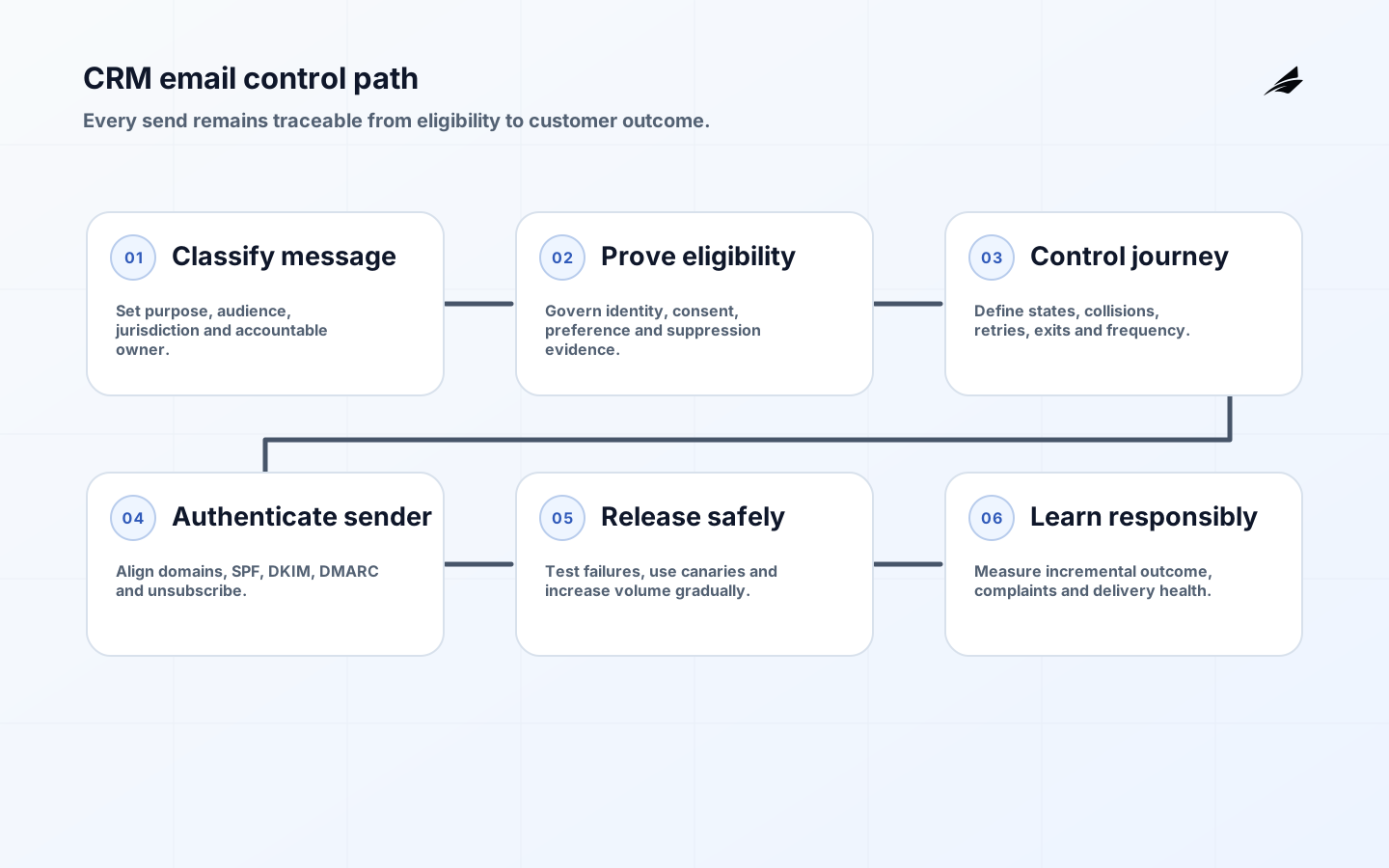
CRM email automation should send the right category of message to an eligible person, using current customer context, through authenticated infrastructure, with a reliable route to stop. A polished journey can still be harmful if consent is wrong, suppression arrives late, a lifecycle event is duplicated or commercial content is mixed into a transactional notice. This checklist treats legal rules, data, orchestration and deliverability as one operating system.
Use it with the CRM email automation delivery plan, readiness checklist and CRM email automation FAQ. Laws vary by recipient and purpose, so obtain legal advice for actual markets and keep jurisdiction rules configurable.
1. Classify message purpose and audience
List every message and classify its primary purpose: transactional, service, marketing or mixed. Name the initiating event, sender, recipient population, jurisdiction, frequency, data used and accountable owner. Do not assume a customer relationship makes all promotion transactional. The U.S. FTC CAN-SPAM guide explains requirements for commercial email, including accurate headers, non-deceptive subjects, identification, address, opt-out and prompt honoring of requests; it also notes that responsibility cannot simply be contracted away.
Map the lawful basis and consent rule per audience. The UK ICO’s current electronic mail marketing guidance distinguishes subscriber types, consent and soft opt-in conditions. Requirements differ internationally. Store the policy version used for eligibility and route uncertain records to exclusion. “Legitimate interest” or “B2B” should never be a global toggle without a reviewed jurisdiction and recipient analysis.
2. Establish customer data and consent authority
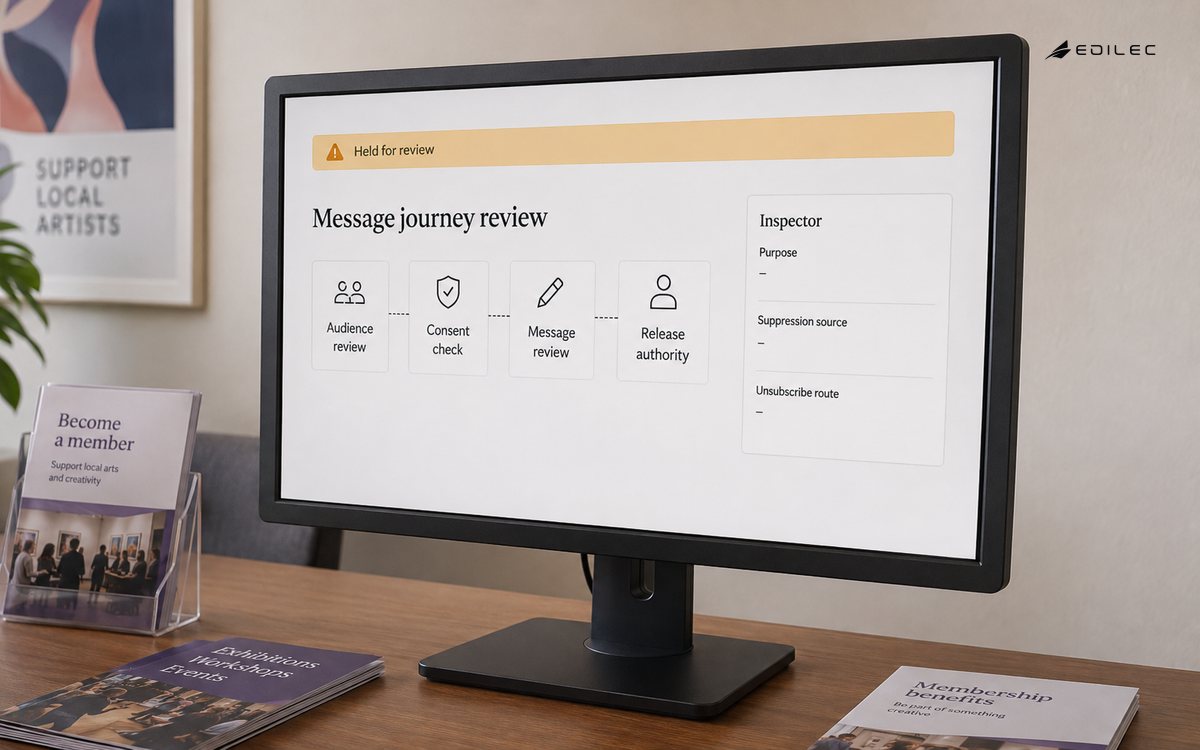
Define the customer, account, contact, address, consent, preference and suppression records. Choose the authoritative source for each field and the conflict rule. Consent evidence should include who, what they agreed to, channel, brand, purpose, time, collection method, notice version, source and withdrawal. Preferences are not interchangeable with legal eligibility: a person may choose topics within an eligible subscription, while a global suppression must override all optional marketing journeys.
Reconcile duplicates and shared addresses conservatively. Do not merge people solely on email address when households or role accounts are possible. Establish freshness and deletion rules, and limit access to sensitive attributes used for segmentation. The NIST Privacy Framework can help connect data processing to privacy risk. Maintain a trace from each send decision to source data and rule version so complaints can be investigated.
| Record | Required fields | Control question |
|---|---|---|
| Consent | Purpose, channel, brand, timestamp, source, notice version | Can eligibility be proved for this message? |
| Suppression | Scope, reason, effective time, source | Does it override every relevant journey quickly? |
| Customer event | Type, entity, event time, unique identifier | Can retries occur without duplicate sends? |
| Campaign | Owner, audience rule, content version, schedule | Can the exact send population be reproduced? |
| Delivery event | Provider response, bounce, complaint, unsubscribe | Does feedback update the authoritative record? |
3. Design journeys as controlled state machines
Draw each journey with entry criteria, states, waits, exits, frequency limits, priority and re-entry behavior. Business events need unique identifiers and idempotent processing. A purchase confirmation retry should not create two messages; a customer who buys during a nurture sequence should exit outdated promotion. Define collisions when onboarding, renewal, service and promotional journeys target the same person. Global pressure rules should consider all tools and brands, not one campaign workspace.
Set content and data fallbacks. If a personalization field is missing, use a reviewed neutral version or suppress the block; never expose template syntax. Links should reveal their destination and retain required tracking without leaking sensitive values. Separate transactional infrastructure and templates from marketing where possible so promotional reputation or suppression logic does not disrupt critical receipts, security notices or service communication.
4. Configure domains, authentication and unsubscribe
Inventory every platform authorized to send for each domain. Configure SPF, DKIM and DMARC with aligned identities; validate DNS, return paths, TLS and tracking domains. Use a consistent visible sender and monitored reply route. Google’s email sender guidelines require authentication and infrastructure hygiene for all senders to personal Gmail accounts, with additional requirements for senders above its stated daily threshold, including SPF, DKIM, DMARC alignment and one-click unsubscribe for marketing or subscribed messages.
Implement List-Unsubscribe and one-click behavior correctly where required, plus a visible body link. Process withdrawal at the authoritative suppression service and propagate it to every sender. The Google sender FAQ states that enforcement on non-compliant traffic increased beginning in November 2025, making current compliance monitoring operationally important. Test unsubscribe from receipt through attempted resubmission and verify no optional message is sent after the applicable deadline.
5. Test content, rules and failure paths
Build fixtures for eligible, suppressed, unknown, duplicate and boundary-time recipients in each relevant jurisdiction. Test journey entry, cancellation, re-entry, time zones, quiet periods, frequency caps, localization, dynamic blocks and link destinations. Verify plain-text and accessible HTML, meaningful subjects, visible sender identity and accurate address details. Use seed accounts across mailbox providers, but do not infer population-wide inbox placement from a few seeds.
Test provider timeout, delayed event, duplicate event, partial audience build and CRM outage. Decide whether to delay, cancel or use a minimal message. Campaign approval should show audience count and change from prior run, sampled eligibility evidence, content version, links, sender, schedule and suppression freshness. Establish a second review for large or sensitive sends and a kill switch that stops remaining batches without corrupting state.
6. Warm up and release in controlled stages
Start with engaged, clearly eligible recipients and increase volume gradually. Sudden changes in domain, IP, message format or volume can harm delivery. Separate promotional from transactional streams and avoid purchased lists. Monitor SMTP responses, authentication, complaints, unsubscribes and domain reputation. Google recommends keeping Postmaster Tools spam rates below 0.10 percent and avoiding 0.30 percent or higher; treat those figures as Gmail-specific operational guidance, not a universal legal threshold.
Use canary batches for large campaigns and stop on unexpected bounce, complaint, link or rendering signals. Reconcile requested, accepted, delivered, bounced and suppressed counts; these states are not interchangeable. A provider’s “delivered” event generally means acceptance by the receiving system, not inbox placement or reading. Do not use open rate as the primary success metric because privacy features and image behavior reduce its reliability.
7. Measure customer and operating outcomes
Choose a business outcome appropriate to the journey: completed activation, renewal, attended appointment or reduced support demand. Use holdouts where feasible and account for natural conversion. Pair outcome with guardrails such as complaints, unsubscribe, bounce, duplicate sends and support contacts. Attribute at the person and journey level without claiming that the last email caused every subsequent action. Review segment differences to detect broken content or eligibility rules.
Operational reporting should show consent evidence coverage, suppression propagation time, audience-build failures, provider deferrals, authentication status, complaint rate and journey backlog. Give every alert an owner and runbook. A lower send count may reflect healthier suppression or a broken event feed; pair metrics with source freshness. Retain campaign and decision evidence for the required period while applying data-minimization and access controls.
| Metric | Definition | Action trigger |
|---|---|---|
| Eligibility proof | Sent optional messages with reproducible consent or rule evidence | Stop if evidence coverage falls below policy |
| Suppression latency | Withdrawal receipt to enforcement across all senders | Investigate any breach of target |
| Hard bounce | Permanent delivery failure divided by attempted sends | Suppress address and review acquisition source |
| Complaint rate | Mailbox complaints divided by delivered or provider-defined denominator | Reduce volume and inspect audience/content |
| Incremental completion | Outcome difference against valid comparison | Scale only with positive value and guardrails |
8. Govern change, incidents and vendors
Version audience rules, templates, journeys and integration contracts. Require review for changes to eligibility, suppression or transactional classification. Monitor vendor sub-processors, data use, breach notification, retention and export. Keep customer-controlled domain and data ownership. Rehearse response to an erroneous mass send, exposed tracking data, compromised sending credential and unavailable suppression service. Communications should be approved and evidence preserved.
Maintain portability for contacts, consent, suppression, templates, journey state and delivery history. Test exports before contract renewal. On exit, rotate credentials, update DNS, remove vendor access and retain suppression continuity; changing platforms must not resurrect withdrawn recipients. Periodically delete obsolete segments and experiments. Good automation reduces unnecessary communication as deliberately as it sends useful messages.
Key takeaways
Practical journey acceptance example
For an abandoned-cart journey, create test customers who purchase before the wait expires, withdraw marketing consent, share an address, live in different rule jurisdictions and receive another campaign during the same period. Confirm that purchase exits the journey, suppression propagates before send, identity resolution does not merge the wrong people, jurisdiction selects the correct eligibility rule and global frequency limits arbitrate the collision. Then replay the initiating event to prove idempotency.
Review the evidence as a complaint investigator would: source event, customer identity, consent or eligibility rule, audience snapshot, content version, sender authentication and withdrawal state. If the team cannot reproduce why one recipient was selected, the journey is not ready for scale even when aggregate conversion looks strong.
- Classify message purpose and jurisdiction before designing a journey.
- Keep consent, preference and suppression distinct, authoritative and traceable.
- Model journeys with explicit states, collision rules, retries and exits.
- Authenticate every sender and test one-click withdrawal end to end.
- Scale by incremental customer outcome while guarding complaints, delivery and privacy.
CRM email automation FAQ
Can one opt-in cover every brand and message?
Often not. Valid scope depends on wording, organization, purpose, channel and jurisdiction. Store the exact evidence and apply the narrowest defensible interpretation. Obtain legal review for the actual audience.
Conclusion
CRM email automation earns trust when every send can be explained from eligibility through outcome. Govern the customer record, journey state, sender identity and withdrawal path as one service. That discipline improves compliance and deliverability while reducing the volume of irrelevant communication customers must manage.