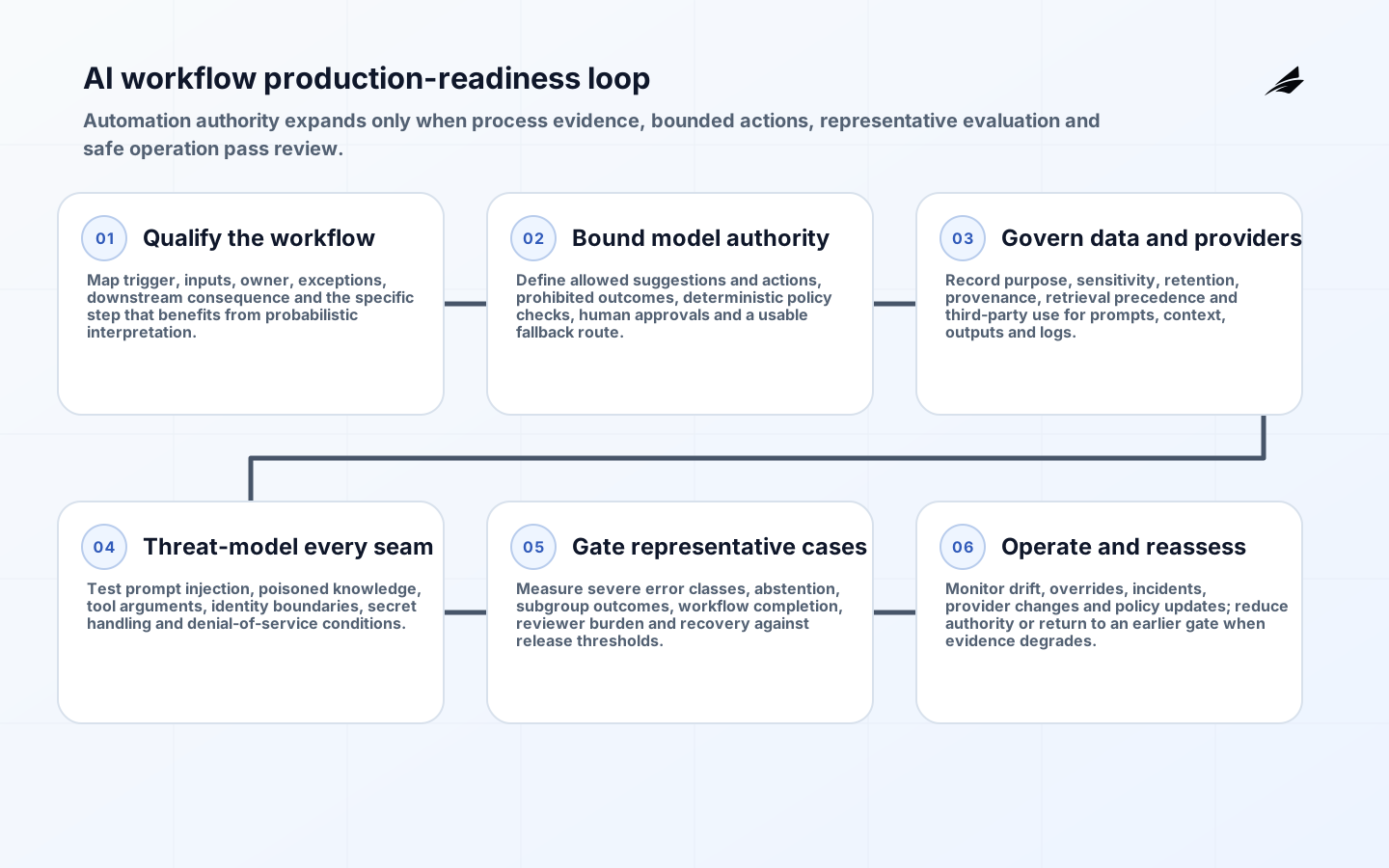
AI workflow automation implementation is ready to proceed only when the organization can describe the workflow, constrain the model’s authority, evaluate representative cases and operate a safe fallback. A successful demonstration proves that a model can produce an output. Readiness proves that the surrounding service can handle ordinary variation, adversarial input, dependency failure, policy change and correction.
Use this checklist as an evidence gate before committing a workflow to production. The AI automation scope, cost and risk plan helps define the initiative, while the implementation FAQ addresses common design choices. Apply requirements in proportion to consequence, data sensitivity and autonomy.
1. Qualify the AI workflow automation implementation use case
Document trigger, inputs, current steps, decision owner, exceptions, output and downstream consequence. Quantify volume, waiting, rework and error cost. Remove unnecessary process variation before automating it. Identify which step actually needs probabilistic interpretation; keep calculations, eligibility, permissions and state transitions deterministic wherever possible. A workflow with no stable policy or accountable owner is not ready for AI.
Write prohibited outcomes and an unsupported-case path. Decide whether the model may suggest, draft, classify, retrieve or act. Every tool action needs explicit scope, argument validation, idempotency and audit. High-impact changes should require deterministic policy and human approval. Establish a manual or simpler automated route that remains usable during model or provider failure.
| Readiness area | Evidence to approve | Stop condition |
|---|---|---|
| Process | Mapped flow, owner, baseline and exceptions | Unknown responsibility or unstable policy |
| Authority | Allowed actions, approvals and prohibited outcomes | Model can expand its own permissions |
| Fallback | Tested manual or deterministic route | Failure strands active work |
| Value | Outcome measure and total-cost model | Only activity or novelty is measured |
2. Assign governance, risk tolerance and accountability
Name a business owner, system owner, data owner, security contact and operational responder. Record affected people and provide a path to contest or correct material outcomes. Define release authority, incident authority and who may disable the workflow. NIST’s AI RMF is voluntary and lifecycle-oriented; its Core organizes outcomes under Govern, Map, Measure and Manage.
Create a use-case risk register covering validity, safety, security, privacy, transparency, bias, resilience and third-party dependency as applicable. Specify likelihood, severity, control, residual risk and review trigger. The NIST Generative AI Profile offers actions for risks distinctive to or intensified by generative systems. Select relevant actions and record rationale instead of treating the profile as a universal checkbox list.
3. Establish data, knowledge and provider controls
Inventory prompt inputs, retrieved sources, training or tuning data, evaluation sets, outputs, logs and feedback. Record ownership, purpose, sensitivity, quality, retention and permitted provider use. Minimize personal and confidential data before model access. Keep evaluation holdouts protected from prompt iteration, and document labels and adjudication so quality comparisons remain meaningful.
For retrieval, define authoritative sources, version, audience, freshness and conflict precedence. Apply access filters before material reaches the model. For providers, review data handling, regions, subprocessors, model-change policy, availability, quotas, incident notification and exit. Do not place secrets in prompts or assume logs are harmless. Rehearse export or replacement of prompts, evaluation evidence and workflow configuration.
| Evaluation layer | Measure | Retained evidence |
|---|---|---|
| Input handling | Parsing and policy classification | Input class, validation and decision |
| Model output | Task correctness by error type | Versioned case and expected result |
| Grounding | Support for material claims | Claim-to-source assessment |
| Workflow outcome | Completion, correction and harm | Final action, reviewer and downstream state |
4. Threat-model and secure the complete workflow
Treat user messages, documents, webpages and tool output as untrusted. Instructions inside them must not override system policy. The OWASP LLM project provides a useful threat lens for prompt injection, sensitive disclosure, supply chain and excessive agency. Test direct and indirect injection, encoded content, poisoned retrieval, malicious files, tool-argument manipulation and attempts to reveal hidden context.

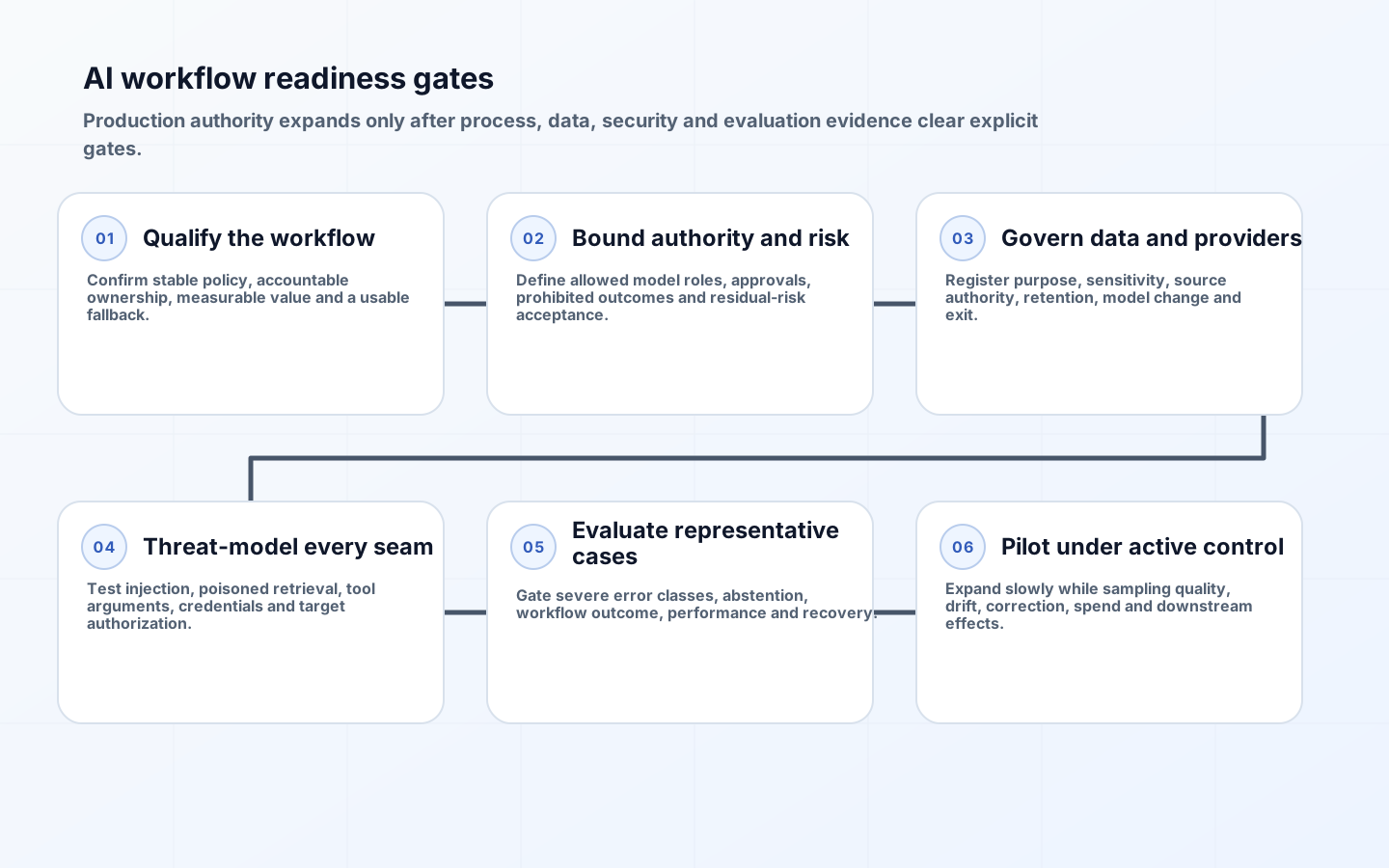
Authenticate users and services, enforce authorization at each target, scope credentials, allowlist tools and destinations, and cap transactions. Separate development, evaluation and production data. NIST’s SSDF applies to the application surrounding the model: protect repositories and builds, inventory dependencies, review changes, verify releases and prepare vulnerability response. Record model, prompt, retrieval, policy and tool versions for material runs.
5. Set evaluation thresholds and deployment gates
Build a representative set from real workflow distributions, with de-identification where appropriate. Include normal, rare, ambiguous, missing, conflicting, multilingual and adversarial cases plus requests that should abstain. Score components separately: retrieval, classification, grounding, policy compliance, tool selection and final outcome. Aggregate accuracy can hide a severe error class; set specific zero-tolerance or review requirements where warranted.
Compare against current practice and a deterministic baseline. Measure reviewer agreement and correction burden. Define acceptance thresholds, sign-off and known limitations before the final run. Re-evaluate after model, prompt, tool, source or policy changes. Performance, load, quota and recovery testing belong in the gate because a correct workflow that times out or duplicates actions is not production-ready.
6. Pilot, monitor and maintain control in production
Begin in shadow or suggestion mode, then expand authority only after evidence. Use a bounded cohort and watch cases actively. Provide reviewers with sources, uncertainty and correction tools. Publish limitations to users in language appropriate to the task. Confirm stop controls, rollback, fallback queues, incident communication and reconciliation of partially completed actions before the pilot handles live consequences.
Monitor input drift, source freshness, abstention, corrections, policy violations, access denials, injection attempts, tool failures, latency, cost and downstream outcomes. Sample outputs even when no complaint occurs. Define thresholds that trigger investigation or disablement. Feed incidents and user corrections into a controlled evaluation set, while preventing unreviewed feedback from becoming automatic training data.
7. Maintain lifecycle records and third-party assurance
Keep a system record describing purpose, affected users, architecture, models, prompts, knowledge sources, tools, data classes, evaluation, limitations and owners. Link it to change and incident records. The document should be concise enough to stay current but detailed enough for reviewers to understand where deterministic policy ends and model behavior begins. Record retired versions and production dates when decisions may later need explanation.
Supplier assurance should cover more than a questionnaire. Verify contractual data use, retention, model-change notice, regions, subprocessors, availability, security notification and deletion. Identify what evidence the provider supplies and what the organization must produce. Test quota, outage and degraded response. Do not rely on provider claims for controls in your application, such as authorization, approval, retrieval filters and transaction limits.
Create an exit and continuity plan before dependency becomes critical. Retain portable prompts, policy, evaluation cases and workflow code; document provider-specific behavior; and maintain a manual or alternate route. Replacing a model can change output distributions even when interfaces match, so require fresh evaluation rather than assuming interchangeability. Budget for periodic revalidation and ownership, not only initial integration.
Define communication for affected users and decision subjects. Explain the automation's purpose, material limitations and path to correction in language suited to the context. Incidents may require targeted notification even when infrastructure remains available. Retain enough run evidence to find affected cases without creating an excessive surveillance dataset. Test the communication and escalation process during the pilot.
Evaluate interactions between controls. A stricter confidence threshold can increase manual backlog; aggressive filtering may remove evidence; extra retrieval can raise disclosure risk and latency. Run end-to-end tests with realistic staffing and volume rather than validating components alone. Record trade-offs and decide which service objective prevails when safety, speed, cost and completion cannot all be maximized.
Include accessibility and language variation. People must understand when automation assists, what information it used and how to correct it. Test assistive technologies and plain-language content, and evaluate languages separately because aggregates conceal uneven quality. If a population is unsupported, route it safely rather than applying a model validated on different language or context.
Prepare investigation without excessive logging. Use a run identifier connecting authorized user, input class, source versions, model and policy versions, tool calls and final state. Redact secrets, minimize sensitive content, protect evidence from tampering and limit access. Retention should match incident, audit and privacy needs so observability does not become an uncontrolled secondary dataset.
Decide how independent review will work for higher-risk workflows. Internal audit, risk, legal, domain experts or an external assessor may examine different questions. Give reviewers access to the system record, representative tests and unresolved limitations while protecting sensitive data. Track findings to closure and preserve management responses. Independence adds value when it challenges evidence and authority; it should not become a ceremonial approval detached from how the workflow actually operates.
Key takeaways
- Qualify process stability and authority before selecting a model.
- Map risk and affected people across the complete lifecycle.
- Evaluate material error classes separately from average accuracy.
- Enforce tool permissions outside the model and test hostile content.
- Launch with fallback, stop authority and continuous sampled review.
Frequently asked questions
Is a high benchmark score enough for readiness?
No. A benchmark may not represent the workflow, data or consequences. Readiness requires use-case evaluation, security and privacy controls, operational recovery, accountable ownership and evidence that the overall workflow—not only the model—meets thresholds.
Does human review eliminate AI risk?
No. Review can reduce risk when reviewers have time, evidence, competence and authority. Automation bias, workload and unclear accountability can make nominal oversight ineffective. Measure corrections and test whether reviewers detect seeded errors.
When should readiness be reassessed?
Reassess after material changes to the process, population, policy, data, knowledge source, model, prompt, tools or provider, and after incidents or drift. Schedule periodic review even when no planned change occurs.
Conclusion
Readiness is a property of the governed workflow, not the model endpoint. Clear authority, representative evaluation, hostile testing and operational fallback create a defensible path to production. They also give the organization the evidence needed to expand automation without expanding uncertainty blindly.