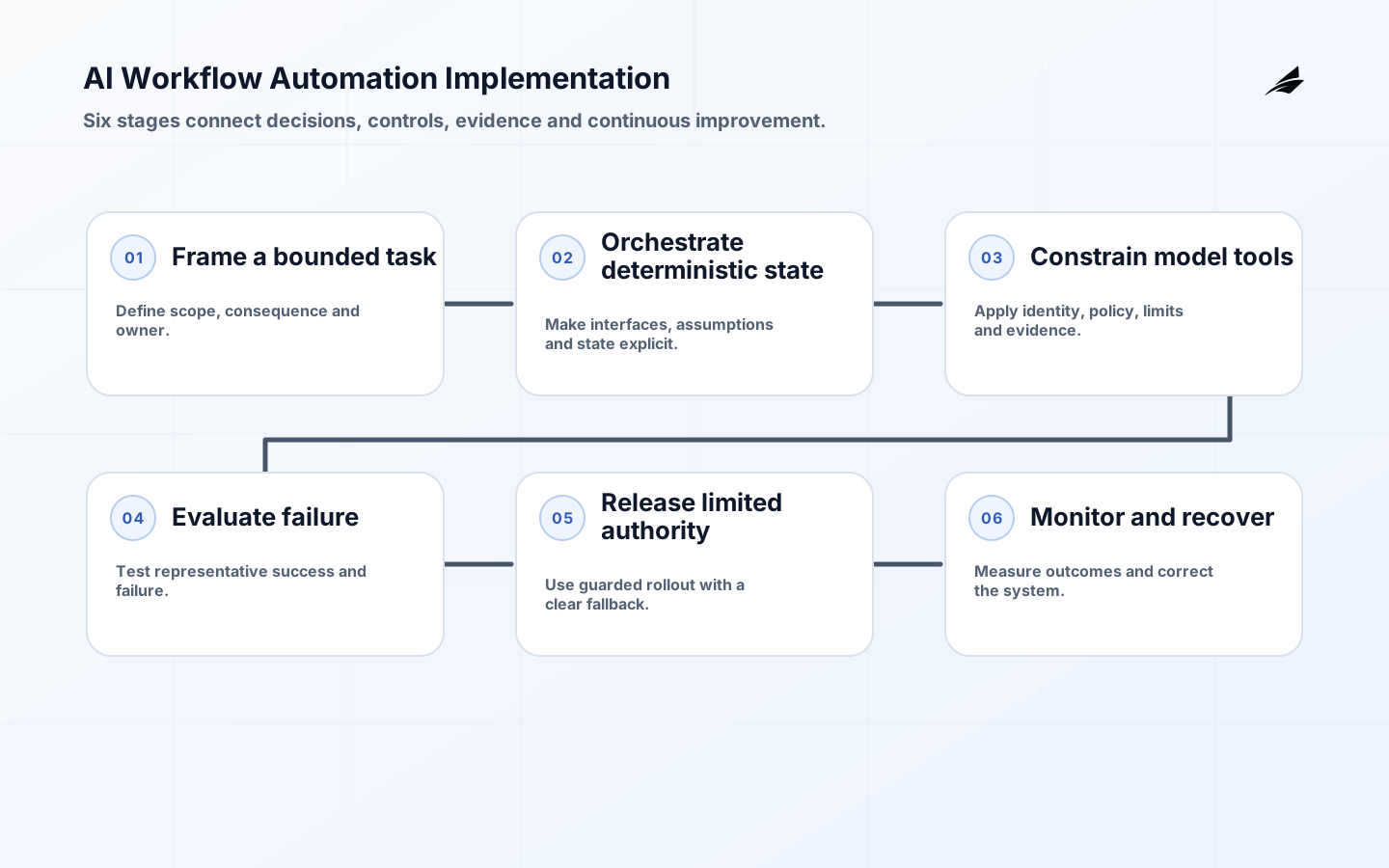
AI workflow automation implementation combines probabilistic capabilities such as extraction, classification or generation with deterministic workflow, business rules and system actions. The key design question is not whether a model can complete a demo. It is which inputs it may see, which tools it may call, how authority is bounded, when a person decides and how the organization detects and recovers from error.
Use this FAQ with the AI workflow automation delivery plan, readiness checklist, enterprise team checklist and enterprise team FAQ. Keep the workflow engine authoritative for state and policy.
Choose a bounded, measurable workflow
Select work with clear inputs, outputs, exception paths and an accountable owner. Good early candidates include document classification, draft preparation, field extraction and routing. Avoid autonomous authority over irreversible financial, legal, safety or access decisions until strong evidence and controls exist. Define baseline time, quality, rework and cost.
Model the deterministic process using a shared notation such as BPMN 2.0.2. Mark where AI interprets, recommends or generates and where rules or people decide. This separation makes fallback possible and prevents model behavior from becoming hidden process logic.
Separate interpretation, policy and action
Use an orchestrator to manage state, retries, timeouts, idempotency and compensation. Put policy checks at the system boundary, not inside prompts. Give each tool a narrow schema and least-privilege identity. Validate arguments and current business state before execution. Store authoritative records outside model memory.
Design for model and provider substitution. Version prompts, models, retrieval collections, tools and policies. Treat external documents and tool output as untrusted data. Avoid long autonomous loops; set step, time, cost and action limits. Require explicit approval tokens for consequential actions and expire them after use.
| Authority level | Example | Minimum control |
|---|---|---|
| Interpret | Extract fields from an invoice | Schema validation and confidence route |
| Recommend | Propose an approval category | Evidence, explanation and human decision |
| Draft | Prepare a customer response | Grounding, review and disclosure policy |
| Act | Create payment or change access | Deterministic policy, explicit authority and audit |
Govern AI risk across the lifecycle
The NIST AI RMF provides Govern, Map, Measure and Manage functions. Apply them to affected people, purpose, data, provider, error consequence and monitoring. The NIST Generative AI Profile adds cross-sector considerations for generative systems.
Maintain an inventory with owner, authority, model, tools, data and lifecycle state. Conduct impact, privacy, security and legal review proportionate to consequence. Document limitations and residual risk. Reassess after model, data, prompt, tool, authority or policy changes. Human review needs competence, context, time and an easy rejection path.
Threat-model tools, context and identities
MITRE ATLAS is a living knowledge base of adversary tactics and techniques against AI-enabled systems, now covering predictive, generative and agentic contexts. Model prompt injection, context or tool poisoning, credential theft, data exfiltration, insecure output handling, privilege abuse and supply-chain compromise alongside ordinary application threats.
OWASP’s Securing Agentic Applications Guide offers technical recommendations for agentic systems. Isolate tools, minimize credentials, filter sensitive context, enforce allowlists and validate output. Do not let model text directly form shell, database or workflow commands. Log material decisions without exposing secrets.
Evaluate task, control and failure behavior
Build representative cases including rare and adversarial inputs. Measure extraction or classification quality, unsupported content, policy compliance, abstention, tool selection, argument validity and end outcome. Evaluate deterministic controls separately so a correct model result does not hide an unsafe execution path.
Run offline tests, simulation, shadow mode and bounded pilot. Define stopping rules and fallback. Include provider outage, timeout, repeated action, stale retrieval, corrupted attachment and approval denial. Preserve traces sufficient to reconstruct a case: input reference, versions, output, policy checks, tools, human decisions and final state.
| Failure | Detection | Recovery |
|---|---|---|
| Repeated tool action | Idempotency key and action ledger | Suppress duplicate and reconcile state |
| Prompt injection | Adversarial tests and policy denial telemetry | Quarantine input and review affected runs |
| Provider outage | Timeout, error rate and health signal | Deterministic queue and manual fallback |
| Wrong high-impact output | Outcome audit and user report | Stop authority, correct records and notify |
Roll out with progressive authority
Begin with read-only assistance and drafts. Expand to recommendations, then low-risk reversible actions after evidence. Use feature controls by team, workflow and action. Limit throughput and spend. Maintain a kill switch that disables tool execution while allowing safe manual work. Train operators on limitations and incident reporting.
Pilot with users who understand the work and include exception-heavy cases. Compare quality, cycle time, reviewer effort and rework with baseline. Review overrides and near misses weekly. Do not scale because adoption is high; people may overtrust convenient output. Scale when outcome and controls remain sound.
Operate, monitor and improve
Monitor model and tool latency, errors, cost, fallback, approvals, overrides, policy denials, repeated actions and outcome quality. Correlate workflow, model and system identifiers. Alert on changed behavior after provider updates and on data-source freshness. Sample outputs according to risk and preserve an appeal or correction route.
Incident plans should cover harmful action, data exposure, compromised tool, poisoned knowledge and provider outage. Revoke identities, stop execution, preserve evidence, reconcile affected records and communicate corrections. Feed recurring failures into process simplification, source quality, policy or focused tests. Retire automations whose benefit no longer exceeds risk and operating cost.
Example: automate invoice intake without autonomous payment
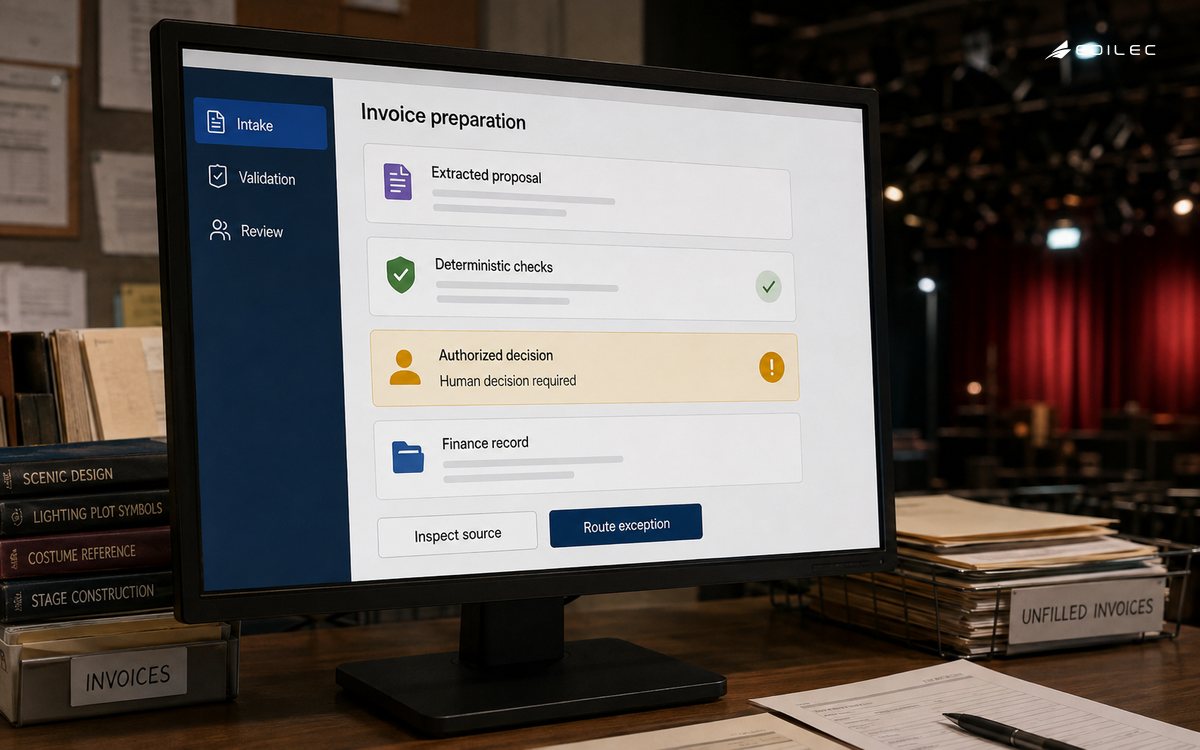
An AI service extracts supplier, invoice, tax and line data; the workflow validates schema, supplier identity, duplicate status and purchase-order match. The model cannot approve or pay. Low-confidence fields create a review task, policy exceptions route to finance and every action uses a stable invoice ID.
- Use a quarantined document intake path and malware checks.
- Version extraction model, prompt, schema and validation rules.
- Require supplier and bank data from authoritative systems.
- Test duplicate, altered bank details and prompt-injected documents.
- Record reviewer corrections as evaluation evidence.
- Reconcile approved invoices with the finance system daily.
Pilot one supplier group and measure extraction accuracy by field, straight-through eligibility, reviewer time, duplicate prevention and downstream correction. Expand only when controls, recovery and workload remain sound. If a model change increases corrections, roll back the interpretation component without losing workflow state.
Review evidence before expanding scope
Before expanding AI workflow automation implementation, the accountable owner should review representative outcomes, exceptions, access, changes, operating cost, user feedback and recovery evidence. Confirm that metrics still reflect the intended business result, that known limitations are visible to users and that suppliers have not changed material behavior without evaluation. Exercise one realistic failure and reconcile the resulting records. Record the decision to scale, narrow, correct or retire the capability, including assumptions and a review date. This review keeps implementation evidence connected to authority and prevents a successful pilot from becoming an unmanaged dependency.
Data governance must follow the workflow boundary. Inventory every source, retrieved document, transient prompt field, model output, tool response and log. For each, record purpose, sensitivity, owner, location, retention, permitted provider use and deletion behavior. Minimize context before a model call and tokenize or redact identifiers when the task permits it. Prevent prompts, traces and evaluation sets from becoming shadow records with broader access than the system of record. Test deletion and subject or records requests across caches, vector indexes, logs and vendor systems. When a workflow learns from reviewer corrections, define whether those corrections may become training or evaluation data and obtain the required authority rather than assuming operational use permits reuse.
Supplier and model economics also affect safe operation. Model cost per completed business outcome, including retries, retrieval, reviewer time, exceptions, monitoring and incident response. Set per-run and aggregate limits, and decide what happens when a quota or budget is reached. Contract for service changes, data use, security evidence, incident notice, export and termination. Preserve a provider-independent test harness and representative cases so replacement can be evaluated. A technically portable API does not make prompts, safety behavior, latency, pricing or tool semantics portable. Exercise one provider outage and one model substitution before expanding critical dependence. The exit result should leave workflow state intact, revoke credentials, reconcile pending actions and preserve required decision evidence. Include operations, security, privacy, legal, finance and the process owner in the scale decision. Review denied actions and near misses, not only completed runs, because the control path can reveal unsafe demand before harm occurs. Require evidence that manual fallback can handle peak volume for the expected outage duration, with later reconciliation that detects duplicate or omitted work.
Key takeaways
- Keep deterministic workflow and policy authoritative around probabilistic AI.
- Grant narrow tool identities and expand authority only through evidence.
- Evaluate representative, adversarial and failure cases with reconstructable traces.
- Provide real human control, fallback and incident recovery.
- Measure end outcome, reviewer effort, rework, cost and control behavior together.
Frequently asked questions
Is an AI agent required for workflow automation?
No. Many workflows need one bounded model call inside conventional orchestration. Use an agent only when dynamic planning adds value that justifies additional evaluation and control. Deterministic rules and ordinary code remain preferable for known decisions and calculations.
Where should human approval occur?
Place approval immediately before the consequential action, with the evidence, proposed change and alternatives visible. Bind approval to exact parameters and expire it. Early generic approval is weak because the final action may differ from what the person reviewed.
How should model updates be handled?
Treat them as production changes. Run regression and adversarial evaluation, compare outcome and control metrics, release progressively and preserve rollback. Reassess when provider behavior changes even if the model name stays the same.
Conclusion
AI workflow automation implementation works when AI is a bounded capability inside an accountable operating process. Separate interpretation from authority, constrain tools, evaluate failure and preserve fallback. Expand from assistance to action only when representative evidence and operational monitoring justify the consequence.