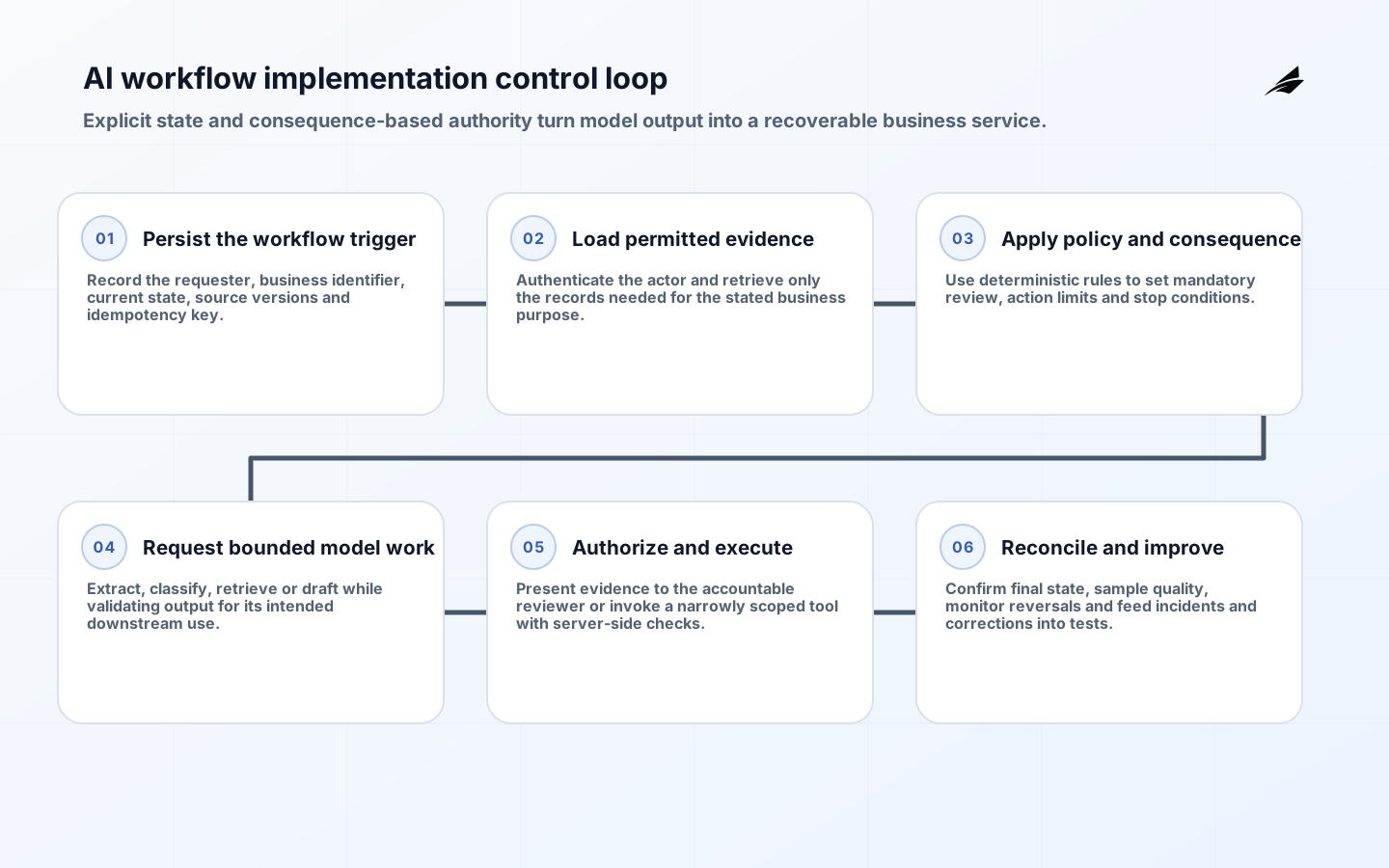
AI workflow automation combines conventional process orchestration with models that can interpret language, images, documents, or ambiguous context. It can classify work, extract fields, retrieve evidence, draft content, recommend a decision, or prepare an action. Production success depends less on a clever prompt than on workflow state, authoritative data, policy, identity, integration, evaluation, and operations.
This guide shows how to scope and deliver AI automation without handing a probabilistic component undefined authority. It is suitable for support, finance, sales operations, procurement, compliance, and internal service workflows. Teams needing implementation support can use Edilec's AI automation, API integration, and enterprise systems capabilities.
1. Select a workflow with measurable boundaries
Document the trigger, requester, inputs, source systems, decisions, actions, exceptions, end state, owner, volume, cycle time, error cost, and current manual effort. A good first workflow is frequent enough to measure, bounded enough to understand, and reversible enough to pilot safely. Avoid processes whose policies and ownership are unresolved.
| Candidate characteristic | Favorable first use | Warning sign | Discovery evidence |
|---|---|---|---|
| Inputs | Repeated documents or messages with known formats | Unbounded sources with unclear rights or ownership | Sample set and data classification |
| Decision | Classification or recommendation with written policy | Judgment depends on undocumented negotiation | Decision table and exception history |
| Action | Draft, route or reversible update | Irreversible financial, safety or access change | Authority and consequence matrix |
| Feedback | Outcome and correction are observable | No one records whether the result was right | Baseline measures and review owner |
| Integration | Stable API or controlled export exists | Only brittle screen automation reaches the system | Interface inventory and failure behavior |
Define success as a completed business outcome: correctly routed cases, reconciled invoices, approved content, resolved exceptions, or reduced handling time without more corrections. Automation percentage is an implementation measure, not the objective.
2. Specify the workflow contract and state machine
Represent the workflow as explicit states and transitions. Store the current version, source identifiers, policy result, model output, human decision, action status, and final outcome. Long-running work must survive retries, timeouts, and service restarts. Use idempotency keys so repeated events cannot create duplicate payments, messages, or records.
Define what happens when evidence is missing, services disagree, policy changes mid-case, or the user cancels. The workflow engine should own state; the model should not infer it from conversation history. This separation allows models and prompts to change while business invariants remain stable.
| State concern | Control | Evidence |
|---|---|---|
| Duplicate trigger | Business idempotency key and stored prior result | Trigger identifier and deduplication decision |
| Stale evidence | Version check before decision and action | Source version and revalidation timestamp |
| Partial action | Compensation or repair path | Step results and recovery outcome |
| Timeout | Bounded retry and explicit pending state | Attempt count, backoff and escalation |
| Policy change | Versioned policy with re-evaluation rule | Policy version and transition reason |
| Manual intervention | Authorized pause, edit, approve or reject | Actor, reason and before-after state |
3. Separate orchestration, policy, model and tools
A controlled architecture receives the trigger, authenticates the actor, loads current evidence, evaluates deterministic policy, calls the model for a bounded task, validates output, and requests review or invokes a narrow tool. The tool independently checks authorization and parameters. The model never becomes the sole enforcement point for access, limits, or business rules.
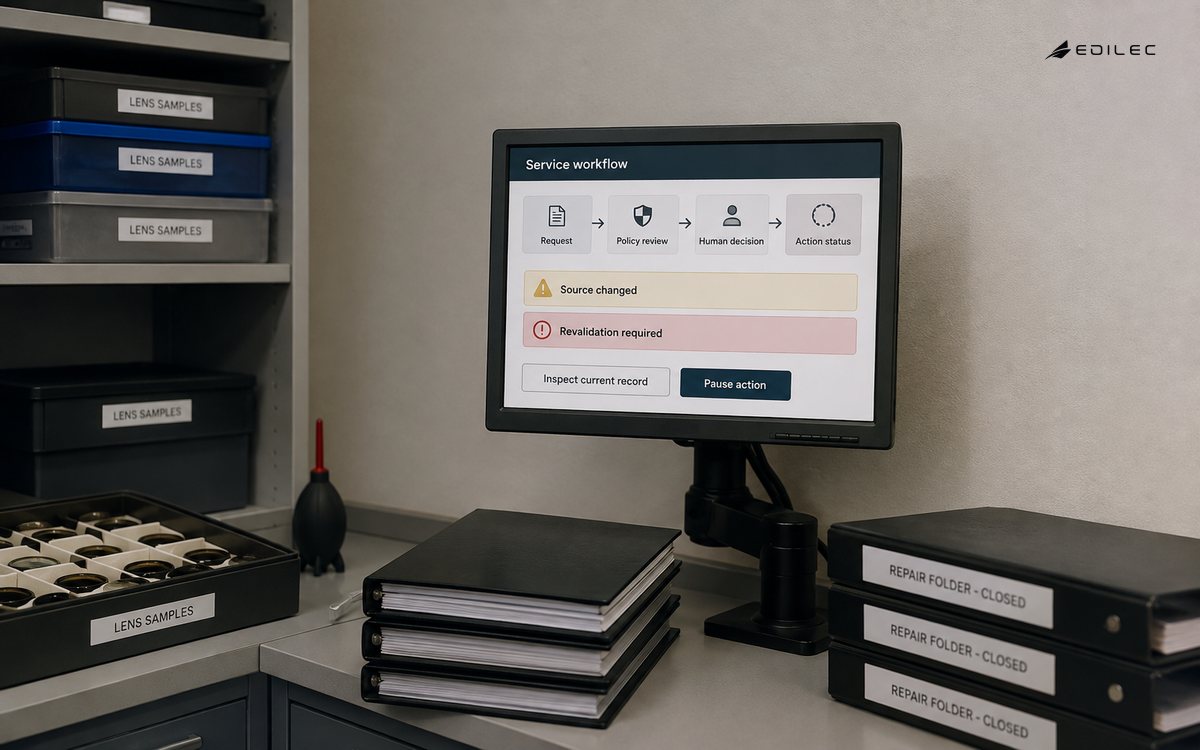
Apply least privilege to service identities. NIST Zero Trust Architecture is useful for treating every resource access as a policy decision. Give each workflow only the operations and records it needs. Separate read, draft, approve, and execute permissions. Rotate credentials and keep secrets out of prompts and logs.
Treat emails, documents, retrieved passages, web pages, and tool responses as untrusted. OWASP's LLM Top 10 addresses prompt injection, sensitive-information disclosure, improper output handling, excessive agency, and other application risks. Validate model output before it becomes SQL, HTML, a message, or a tool parameter.
4. Define human authority by consequence
Create levels such as advise only, prepare a draft, execute after approval, execute within a deterministic limit, and never automate. Assign each workflow and action to a level. Consider financial loss, legal effect, safety, access, privacy, customer harm, reversibility, and detectability. Model confidence is not a substitute for this analysis.
A useful review screen shows the proposed action, source evidence, policy, uncertainty, and consequences. Reviewers must be able to correct, reject, request more information, or escalate. Track rubber-stamping and review time; a nominal human step that cannot realistically inspect the evidence is not a strong control.
5. Evaluate the whole workflow before granting action
Build a representative test set from real, de-identified cases. Include common, rare, ambiguous, adversarial, restricted, and should-refuse examples. Score extraction or classification, evidence retrieval, grounding, policy selection, action parameters, privacy, and final state. Compare performance by category instead of hiding failures in one average.
| Evaluation gate | Release question | Example threshold evidence |
|---|---|---|
| Data and access | Are sources approved and permission filters correct? | Positive and negative access tests |
| Task quality | Does the model perform the bounded task on representative cases? | Per-class precision, recall or reviewed rubric |
| Grounding | Are material claims supported by current evidence? | Claim review and citation result |
| Workflow safety | Do retries, conflicts and tool failures preserve invariants? | Failure-injection and recovery tests |
| Human operation | Can reviewers understand and correct proposals? | Usability test and override analysis |
| Production readiness | Can owners monitor, disable and roll back each component? | Runbook, alert, rollback and exercise |
Use the NIST AI RMF functions—govern, map, measure, and manage—across design and operation. Re-evaluate when the model, prompt, retrieval source, policy, tool, or user population changes. Production sampling is necessary because real inputs drift.
6. Deliver through controlled evidence gates
- Discover the current workflow, owners, baseline, risks and exceptions.
- Build identity, source, event, policy, tool and observability foundations.
- Evaluate offline against representative and adversarial cases.
- Run shadow mode without changing queues, records or customers.
- Release assistive recommendations to a trained cohort and capture corrections.
- Enable bounded actions by consequence, with reconciliation and rollback.
Each phase should end with evidence and a stop decision, not simply a calendar date. Keep a manual path during rollout. Train operators on limitations, incident reporting, and how to challenge an output. Publish change notes when behavior or action scope changes.
7. Model implementation and operating cost honestly
Cost includes discovery, data preparation, integrations, model and retrieval services, identity and security, evaluation, product interface, human review, monitoring, support, and change management. Runtime usage depends on volume, context length, number of model calls, caching, latency, and model choice. Integration and review commonly outweigh raw inference cost in consequential workflows.
| Cost area | Primary driver | Planning control |
|---|---|---|
| Discovery | Workflow variation and undocumented policy | Time-boxed observation and decision mapping |
| Integration | System count, interface quality and failure handling | Prioritize stable APIs and one source path |
| AI services | Context size, model class, calls per case and volume | Route by complexity and measure unit economics |
| Evaluation | Consequence, categories, languages and change frequency | Reusable test set and automated regression |
| Human review | Initial quality and action risk | Narrow scope and improve evidence presentation |
| Operations | Service level, monitoring, incidents and source updates | Named owner and run-cost budget |
A responsible estimate is a range tied to assumptions. Calculate cost per completed, quality-approved outcome and compare it with the existing process. Include correction and incident cost. Do not claim savings before shadow or assisted data establishes the likely review and exception rate.
8. Operate models, policies and workflows together
Monitor queue age, task quality, citations, refusals, policy outcomes, tool errors, retries, human overrides, action reversals, complaints, latency, and unit cost. Retain enough traceability to reconstruct material decisions without storing unnecessary sensitive content. Define incident severity and who can disable a model, source, policy, or action.
The CISA and NCSC secure AI system development guidance covers secure design through operation. Apply ordinary production disciplines: change review, dependency updates, access recertification, backup, disaster recovery, vulnerability handling, and post-incident learning.
Key takeaways
- Choose a bounded workflow with observable outcomes and exceptions.
- Store workflow state outside the model and make retries idempotent.
- Separate model assistance from deterministic policy and tool authorization.
- Assign action authority by consequence and reversibility.
- Evaluate access, task quality, grounding, failure recovery and human operation.
- Estimate total cost per completed outcome and operate every component with rollback.
Frequently asked questions
How long does AI workflow automation implementation take?
A narrow assistive pilot can take weeks; multi-system action automation commonly takes months. The range depends on workflow clarity, data, integrations, controls, evaluation, service levels, and rollout cohorts. Discovery should refine the estimate.
Should the workflow use rules or generative AI?
Use deterministic rules for explicit policy and stable structured decisions. Use generative models for language and ambiguous interpretation where evaluation shows value. Most robust systems combine both rather than asking a model to imitate policy.
How should ROI be calculated?
Compare completed outcomes, cycle time, quality, error recovery, customer or employee impact, and full run cost against a baseline. Include review and exception work. Report assumptions and segment by workflow class.
Procurement and vendor review should cover model and subprocessor locations, data use, retention, deletion, incident notification, availability, change notices, intellectual property, evaluation support, and exit. Preserve an abstraction around model calls where the business needs portability, but do not assume models are behaviorally interchangeable. A provider or model change requires regression and production comparison, particularly when outputs influence customers, money, access, or regulated records.
Do not leave ownership with an innovation team after launch. Assign a service owner, workflow owner, data owners, security contact, and model or evaluation steward. Establish review cadences for quality, incidents, access, cost, and change. The operating team needs budget and authority to pause actions, correct sources, change policy, and retire a workflow that no longer produces acceptable value.
Conclusion
AI workflow automation becomes dependable when ordinary software controls surround model capability. Explicit state, current evidence, deterministic policy, narrow tools, accountable review, measurable gates, and production ownership turn a promising demonstration into a service that can act without losing control of the business process.