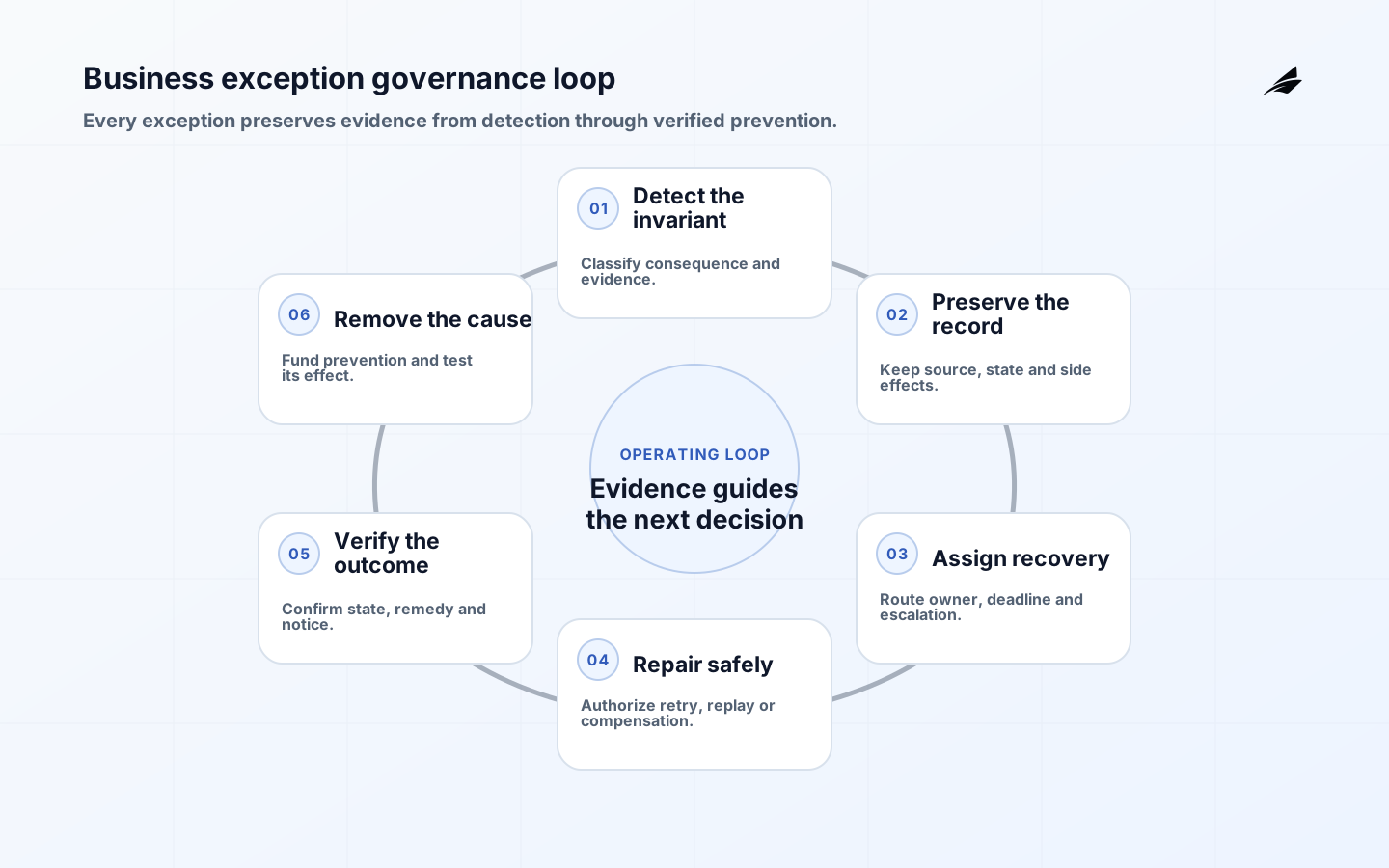
Business process exception handling is the controlled path for work that cannot continue as designed. It detects the exception, preserves the business context, stops unsafe side effects, assigns a qualified owner, supports correction and records the outcome. Reporting and governance make that recovery visible without turning every unusual case into an executive dashboard or every technical error into a manual ticket.
This checklist builds on Edilec's practical exception handling guide, exception-first planning guide and ERP, CRM and workflow integration guide. Use those resources to connect workflow design, record authority and cross-system recovery.
Key takeaways
- Define exceptions by failed business invariant and required response, not one generic error state.
- Preserve correlation, input, decision, state and side-effect evidence before repair.
- Route ownership by consequence, skill and deadline with clear escalation.
- Treat overrides as controlled transactions with reason, scope, approval and review.
- Govern recurring causes and exception debt, not just queue volume.
Define business exceptions and invariants
Start with the process outcome and invariants that must remain true: an invoice balances, a shipment refers to an approved order, a benefit decision has required evidence, or an employee change has valid authority. An exception occurs when the process cannot prove an invariant or reach the next valid state within its promise. Separate business exceptions, data defects, technical faults, policy holds and suspected abuse because they need different owners and disclosure.
Model exception paths alongside the happy path. BPMN provides constructs for events and alternative flow in the Business Process Model and Notation specification. Use diagrams to clarify where work stops, waits, retries or compensates, then add fields for evidence, priority, access and retention. Validate the model with operators who actually resolve cases.
| Exception class | Example | Immediate control | Recovery owner |
|---|---|---|---|
| Business rule | Credit limit exceeded | Hold commitment | Authorized approver |
| Data quality | Customer identity unresolved | Stop downstream posting | Data steward |
| Technical transient | Supplier timeout | Bounded retry | Integration service |
| Partial transaction | Payment captured, order missing | Prevent duplicate charge | Transaction owner |
| Suspected abuse | Unusual refund pattern | Restrict action and preserve evidence | Fraud or security team |
Create an exception record that supports recovery
Store a stable exception identifier, process and entity identifiers, invariant, class, severity, occurred and detected times, current state, source versions, attempted actions, side effects, owner, deadline and permitted repairs. Link protected evidence rather than copying sensitive payloads into a broad queue. Preserve the original failure separately from annotations and repairs so an investigation can reconstruct what happened.
Logs can support detection and investigation when they are planned and protected. NIST's log management guide addresses infrastructure, processes, roles and retention. Application exceptions also need business context that infrastructure logs do not know. Define which events and attributes are required, who may access them, and how clocks and correlation are managed across systems.
Route ownership, deadlines and escalation
Route by exception class, business impact, required skill, customer promise and jurisdiction. Name primary and backup queues, operating hours, service objectives and escalation. Show operators why the case was routed and what actions they may take. Avoid individual email as the only ownership system. Reassignment should preserve history and never reset the original age.
Prioritize from consequence and time sensitivity rather than a manually selected label alone. A low-value record blocking payroll may be more urgent than a large order awaiting information. Pause deadlines only for defined external waits and show the reason. Notify customers or partners when their next step or promised time changes, using language that does not expose security-sensitive detail.
| Queue measure | Decision it supports | Useful slice | Misleading interpretation |
|---|---|---|---|
| Open exceptions | Capacity and exposure | Class and age | All cases are equal |
| Time to containment | How quickly harm stops | Consequence | Same as full resolution |
| Time to resolution | Recovery performance | Owner and dependency | Fast closure means correct |
| Recurrence rate | Root-cause priority | Invariant and source | Operator is at fault |
| Override rate | Policy or workflow pressure | Reason and approver | Overrides are productivity |
Design safe repair, replay and compensation
Provide typed repair actions such as correct reference, obtain approval, retry dependency, replay event, reverse transaction or close as accepted risk. Validate authorization and current state at execution time. Use idempotency to prevent repeated payment, shipment or notification. Display expected side effects and require confirmation for consequential changes. Preserve before-and-after values and the rule version used.
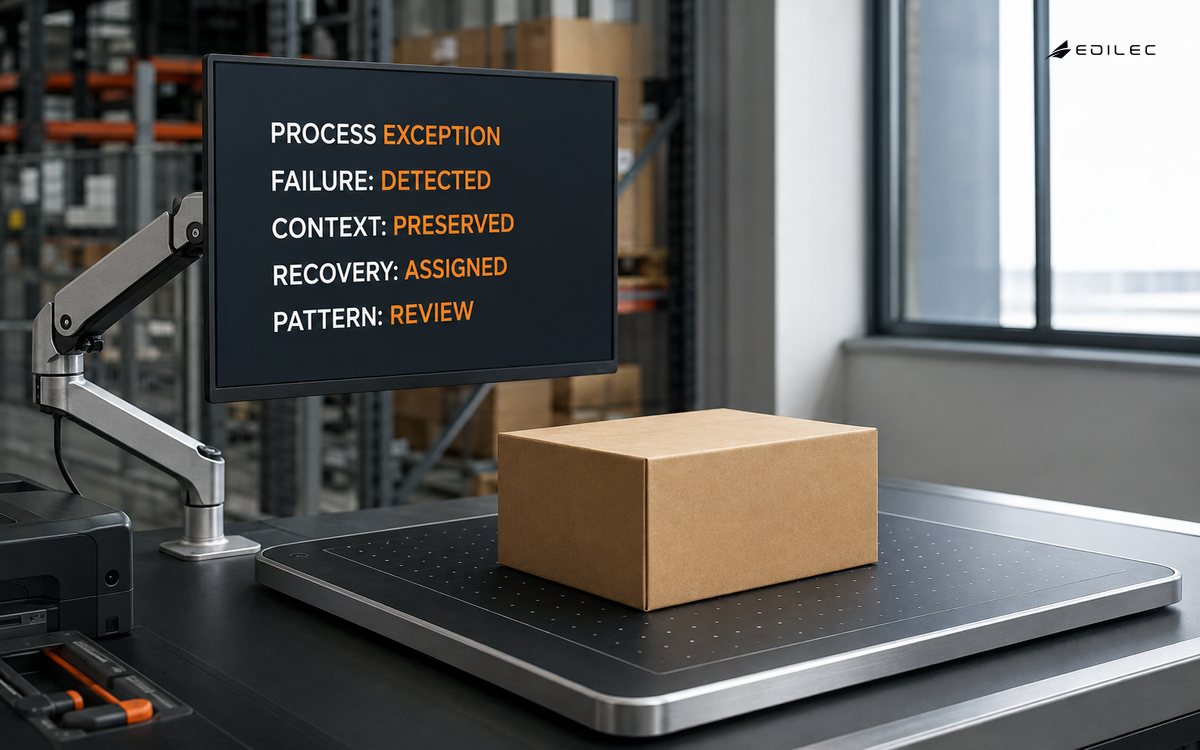
Replay only after confirming the underlying cause is resolved and the message is still valid. Old events can conflict with newer state. Compensation should reflect business reality: a refund is not deletion of a charge, and a correcting journal entry is not alteration of an original posting. Where automated repair is unsafe, create a coordinated case with explicit completion evidence.
Govern overrides and accepted exceptions
An override is a new controlled decision. Capture requester, approver, reason category, free-text rationale, scope, evidence, duration and compensating controls. Separate the person requesting from the approver where consequence warrants it. Time-limit standing exceptions and alert before expiry. Do not implement an “admin complete” button that changes state without the business transaction needed to make it true.
COSO describes internal control as supporting operations, reporting and compliance objectives and provides internal control guidance. Apply those principles proportionately: reliable information, appropriate authorization, monitoring and correction. Review override patterns as evidence that a policy, data source or workflow may no longer fit the work.
Instrument exceptions consistently
Use common service, operation, error type and correlation attributes so teams can connect an exception to traces, logs and metrics. OpenTelemetry's exception conventions and error recording guidance offer technical semantics. Add domain-specific invariant and process state without placing confidential values in broadly accessible telemetry.
Alert on actionable conditions: a critical invariant failure, age approaching a customer deadline, abnormal recurrence, repair failure or evidence loss. Do not page on every expected business exception. Give responders links to the owned record, runbook and recent change. Test dashboards and queues during dependency outage and high volume so visibility does not fail with the process.
Review root causes and exception debt
Hold a regular review with process, data, product, engineering and risk owners. Examine severe cases, recurring invariants, old queues, overrides, customer harm and manual effort. Assign root causes to policy ambiguity, missing state, data ownership, integration contract, capacity, user interface or control design. Fund prevention based on consequence and recurrence, and verify that the change reduced the intended exception class.
Publish a concise governance report: material exposure, overdue cases, recurring causes, override trends, control failures and improvement decisions. Avoid ranking teams by raw exception count because teams may serve different processes and better detection can increase reported volume. Preserve detailed evidence for authorized investigation while limiting broad reporting to necessary information.
Verify closure quality and customer remedy
Define closure criteria by exception class. A payment case may require ledger reconciliation and customer confirmation; an identity mismatch may require corrected linkage and review of downstream access; a reporting defect may require republication and notification to prior recipients. Require evidence that the invariant is restored, consequential side effects are resolved and any promised communication occurred. Keep resolution code, root-cause hypothesis and remedy distinct. An operator selecting “fixed” should not silently supply all three.
Sample closed cases for quality, especially high-consequence, rapidly closed and repeatedly reopened work. Review whether the repair was authorized, evidence was sufficient, sensitive data was handled correctly and the customer received an appropriate remedy. Track reopen rate and downstream recurrence, but interpret them with case complexity. Use findings to improve forms, guidance and permissions rather than adding another approval to every case.
Customer remedy should match actual impact. Correct the record, restore service, reverse or compensate a transaction and explain next steps where appropriate. Coordinate legal, privacy or security notification through the relevant incident process instead of improvising in an operational queue. Preserve proof of delivery for required notices without copying confidential content into broad reports.
Closure also starts the prevention clock. For material or recurring cases, assign a preventive action, owner, target date and verification measure. A new validation rule should reduce the intended exception without blocking valid work; a data cleanup should remain reconciled after the next cycle. Governance is complete only when the organization can show both recovered outcomes and whether the chosen prevention worked. Retire temporary monitoring and elevated access after verification, and retain the case according to its evidence and records obligations rather than leaving it indefinitely in the operational queue.
Periodically test the exception process itself with a seeded case. Confirm detection, routing, restricted evidence access, escalation, repair, communication and reporting. Include an absent primary owner and a failed repair action. The exercise should reveal whether the process can operate under pressure, not merely whether a dashboard contains the expected fields.
Exception handling governance checklist
- Material process invariants and exception classes are documented.
- Exception records preserve source, state, side effects and repair history.
- Queues have skilled owners, deadlines, backups and escalation.
- Repair and replay are typed, authorized, idempotent and auditable.
- Overrides include reason, approval, scope, expiry and review.
- Governance tracks recurrence, harm, debt and verified prevention.
Frequently asked questions
Is a dead-letter queue an exception management system?
No. It stores failed messages. Effective management adds business context, ownership, safe repair, deadlines, communication and outcome verification.
When should an exception retry automatically?
When the failure is transient, the action is idempotent, attempts are bounded and delay remains acceptable. Validation, authorization and suspected abuse should not be retried blindly.
Who should close an exception?
The owner responsible for verifying the business invariant or an authorized delegate. Technical completion alone should not close a case when financial, customer or compliance evidence remains unresolved.
Conclusion
Business process exception handling protects operations when normal automation cannot continue. Define invariants, preserve evidence, assign recovery, constrain repairs and govern overrides. Reporting should reveal consequence and recurring causes, enabling the organization to fix the process rather than normalize a growing queue of unexplained work.