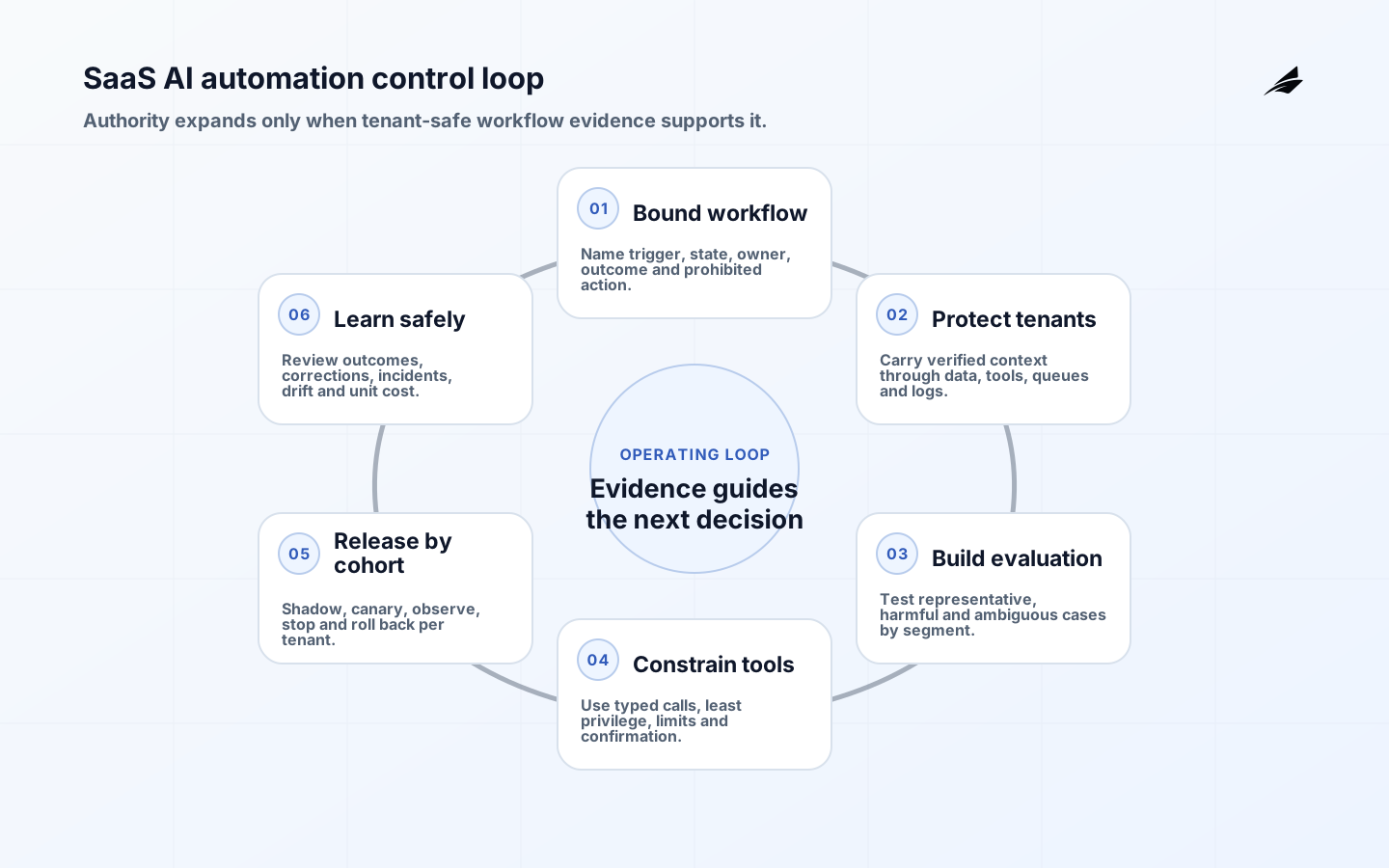
These AI workflow automation services for SaaS companies are designed for teams moving from research to an accountable delivery decision. Use the SaaS AI workflow delivery plan to define scope, cost, risk, and ownership, the SaaS AI workflow FAQ to resolve operating questions, and the startup AI automation checklist to plan a controlled implementation. Require named owners, explicit boundaries, representative tests, and a way to stop or correct the system when assumptions fail.
AI workflow automation services for SaaS companies should improve a bounded customer or operating workflow, not add an unconstrained agent to production. The NIST AI RMF organizes lifecycle risk through govern, map, measure and manage, and its generative AI profile addresses risks that generative systems can intensify. OWASP’s current LLM guidance highlights prompt injection and excessive agency, which makes tool permissions, untrusted content and downstream validation central architectural concerns.
Choose a workflow with measurable boundaries
Map the current trigger, records, roles, decisions, systems, exceptions, approvals and outcome. Select repetitive work where inputs and acceptable outputs can be evaluated, such as classifying support intake, drafting a response for review or extracting renewal terms. Avoid beginning with irreversible financial, access, safety or legal decisions. Establish baseline cycle time, touch time, error, backlog, abandonment and cost, then define the intended change and stop conditions. Separate assist, recommend, approve and execute modes. Write what the automation must never do, which cases require abstention and who owns the outcome. Include representative tenants, languages, document formats and ambiguous cases in discovery. A broad claim that the system will “handle support” cannot become a testable product contract; a defined stage with stable inputs and an accountable reviewer can.
Preserve tenant context and data boundaries
Carry a verified tenant identifier from authenticated request through retrieval, model context, tools, queues, storage, telemetry and support operations. Enforce authorization server-side at every data and action boundary; never rely on a prompt instruction to prevent cross-tenant access. Classify inputs and outputs, minimize retained prompts, define provider data-use terms, encrypt appropriately and apply tenant-specific deletion and residency where promised. Indexes, caches, vector stores, evaluation datasets and traces can all leak tenant information if treated as generic infrastructure. Use the NIST Privacy Framework to identify processing-related effects on people and connect them to enterprise risk. Test with deliberately conflicting tenant identifiers, stale memberships and malicious retrieved documents. Support staff need controlled impersonation or delegated access with reason, time limit and audit, not shared administrative visibility.
| Automation mode | System role | Required control | Good first use |
|---|---|---|---|
| Assist | Retrieve or summarize | Sources visible; no action | Case preparation |
| Recommend | Propose a route or value | Evaluation and reviewer | Ticket classification |
| Approve | Apply a bounded policy | Deterministic eligibility and audit | Low-risk standard request |
| Execute | Call a production tool | Typed tool, limits and confirmation | Reversible status update |
| Autonomous loop | Plan repeated actions | Rare; strict sandbox and stop rules | Controlled internal experiment |
Build an evaluation contract before integration
Define task-specific correctness, unacceptable outputs, abstention, evidence, latency and cost. Build a versioned evaluation set from representative, permissioned examples and difficult edge cases; hold out a test set from prompt and workflow tuning. Measure field accuracy, routing errors, unsupported claims, unsafe actions, fairness where relevant, reviewer agreement and downstream outcome. Compare with the current process and a simple deterministic baseline. The NIST generative AI profile emphasizes pre-deployment testing and ongoing management; apply that by recording model, prompt, retrieval, tool and policy versions for every release. Do not collapse different harms into one average score. A rare cross-tenant disclosure or unauthorized cancellation must be a release blocker even if aggregate text quality is high. Define who can accept each residual error and how production corrections return to evaluation.
Bound models, tools and generated output
Treat user content, emails, web pages, files and retrieved records as untrusted data that may contain instructions. Separate system policy from content, label provenance and limit what enters context. OWASP’s LLM application guidance explains that retrieval and fine-tuning do not fully remove prompt-injection risk. Give the model a narrow allowlist of typed tools with least-privilege credentials, server-side authorization, strict parameters, rate and spend limits, idempotency and audit. Validate generated values against schemas and business rules before they cross an application boundary. Use previews and explicit confirmation for material actions. OWASP’s excessive-agency guidance links damage to excessive functionality, permissions and autonomy; reducing all three is more reliable than asking a model to be careful.

Design human review and exception states
Place review where consequence and uncertainty require judgment. Show source evidence, material uncertainty, proposed action and policy reason without exposing hidden reasoning as if it were proof. Reviewers need authority to correct, reject, request information and escalate, plus enough time and training to do so. Prevent automation bias by sampling accepted outputs and monitoring rubber-stamp behavior. Model the workflow as explicit states such as received, validated, proposed, awaiting approval, executed, failed, reversed and closed. Every transition needs actor, timestamp, input version and retry behavior. Route low-confidence, conflicting, unsupported or policy-sensitive cases to a queue with service objectives. Preserve a manual path during outages. Inform affected users appropriately and provide a correction or appeal route when automation materially influences them. Human review is a control only when the surrounding workflow makes it effective.
| Release gate | Evidence | Blocking example | Owner |
|---|---|---|---|
| Task quality | Held-out results by segment | Unsafe error above tolerance | Product |
| Tenant isolation | Adversarial authorization tests | Cross-tenant retrieval | Security |
| Tool safety | Denied action and idempotency tests | Unauthorized irreversible call | Engineering |
| Human control | Review and escalation exercise | Reviewer lacks evidence | Operations |
| Production | Canary, rollback and kill switch | No tenant-scoped stop | Reliability |
Release progressively and observe outcomes
Use versioned software practices consistent with the NIST SSDF: protect source and artifacts, review dependencies, test changes and address root causes. Run shadow mode first, comparing proposed outputs with actual decisions without taking action. Move to internal users, selected tenants and limited action scopes with feature flags, canaries, tenant-level kill switches and rollback. Monitor workflow completion, corrections, abstentions, tool denials, injection indicators, cross-tenant access attempts, latency, token and tool cost, queue age and customer outcomes. Correlate each decision to model, prompt, retrieval, policy and tool versions while minimizing sensitive log content. Define incident severity and notification paths before launch. Stop or degrade safely when evaluation drift, provider failure, cost runaway or suspicious input crosses a threshold.
Operate the service and its commercial promises
Assign product, workflow, model, data, security, privacy, reliability and support owners. Publish supported use, limitations, status, change notices and tenant controls. Review vendor models for retention, training use, regions, subprocessors, security evidence, service levels, deprecation and export. Make customer commitments no broader than tested behavior. Price from observable units such as completed cases, reviewer minutes, model and tool usage, storage and support; set per-tenant budgets and abuse controls. Maintain model and provider substitution options at architectural boundaries, but test them because outputs and context limits differ. At exit, return customer data and configured workflow artifacts in usable forms, delete retained content under policy, revoke integrations and preserve required decision records. Continuous evaluation and customer feedback should determine expansion, not enthusiasm for a new model release.
Set service acceptance and customer assurance
Require an evidence pack containing the state machine, tenant and data flows, versions, evaluation design, severe-case results, tool permissions, human-review behavior, latency, unit cost, fallback, incident route and open risks. Demonstrate authorization denial, prompt injection, malformed output, duplicate request, provider timeout, tenant kill switch, rollback and deletion. Verify logs support investigation without excessive customer content. Product, security, privacy, reliability, support and workflow owners approve their evidence. Match claims to the tested task and population. For rollout, check each tenant’s permission, region, integrations, mappings, administrator consent, quotas and support contacts. Provide controls to enable features, choose approval mode, inspect history and stop automation. Monitor correlated dependency failure. Use cohorts for model or prompt changes and retain rollback versions. Treat customer corrections and complaints as safety evidence. New tools or irreversible actions require a fresh threat model and evaluation. This discipline lets customers govern the capability instead of merely trusting the provider.
Review the automation at workflow, tenant and portfolio levels. Workflow owners examine corrections, abstentions, queue delay and outcome; tenant reviews examine configuration, isolation events, cost and support; portfolio governance examines providers, repeated failure patterns and unauthorized expansion of authority. Trigger reassessment when the target population, policy, model, retrieval source, tool or customer promise changes. Expire experiments and credentials that lack an owner. Sample apparently successful actions because silent automation bias may not create support tickets. Publish material changes and known limitations to affected customers. Regular review should be able to narrow or disable capability, not merely approve the next expansion.
Key takeaways
- Automate a bounded workflow stage with an accountable outcome owner.
- Enforce tenant isolation in code, data and tools, never in prompts alone.
- Evaluate harmful edge cases separately from average quality.
- Reduce tool functionality, permissions and autonomy.
- Release progressively with human exceptions, tenant stops and continuous evaluation.
Frequently asked questions
Should a SaaS company start with an autonomous agent?
Usually no. Start with assist or recommend mode in a narrow workflow. Expand authority only after task quality, tenant isolation, tool safety, human control and rollback are proven.
Can retrieval prevent hallucination and prompt injection?
Retrieval can improve relevance and provide evidence, but it can return stale, unauthorized or malicious content. Validate access, provenance and outputs; retrieval and fine-tuning do not eliminate prompt injection.
What is the most useful production metric?
No single metric is sufficient. Pair workflow outcome and correction rate with severe safety events, abstention, tenant isolation, latency, human effort and unit cost. Segment results by tenant and case type.
Conclusion
AI workflow automation services for SaaS companies create value when authority grows only with evidence. Bound the workflow, preserve tenant context, evaluate representative and harmful cases, constrain tools, design effective human review and release progressively. The production system should make every action attributable, reversible where possible and visible to the customer and owner.