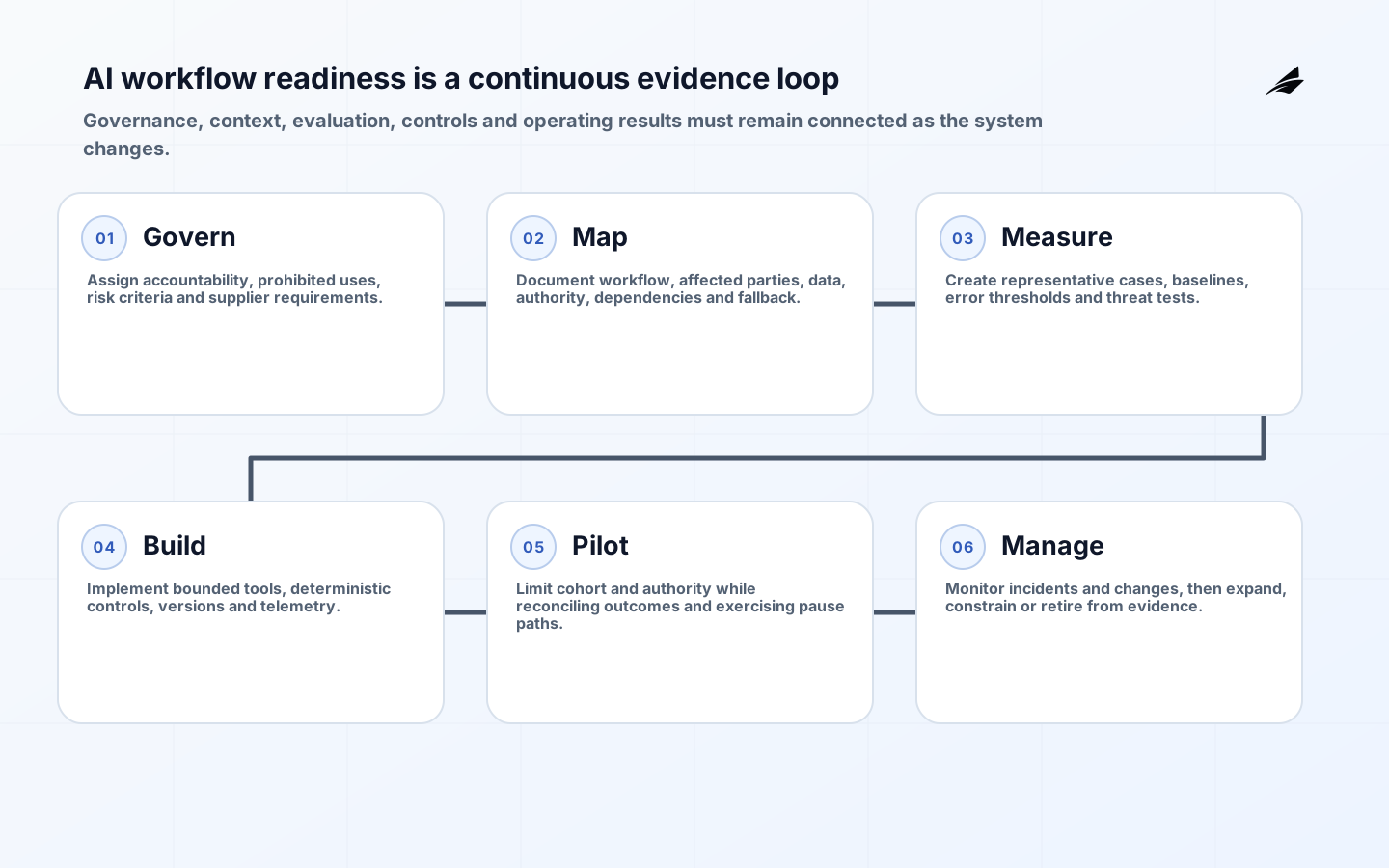
An enterprise AI workflow is ready only when the whole system can be governed: model, prompt, retrieved knowledge, deterministic rules, tools, records, human review and supplier dependencies. This checklist turns that system into a sequence of evidence gates. It draws on NIST's voluntary AI RMF functions of Govern, Map, Measure and Manage, while retaining ordinary privacy, cybersecurity and software-engineering controls.
AI workflow readiness gates
| Gate | Decision | Evidence |
|---|---|---|
| Govern | May this use proceed to discovery? | Owner, policy fit, prohibited uses and risk criteria |
| Map | Is the context and consequence understood? | Workflow, authority, affected parties, data and fallback |
| Measure | Can quality and harm be tested? | Evaluation set, baselines, error taxonomy and thresholds |
| Build | Are actions bounded and observable? | Architecture, permissions, validation, versions and telemetry |
| Pilot | Does controlled use support expansion? | Cohort outcomes, red-team results, incidents and reconciliation |
| Manage | Can change and operation remain controlled? | Monitoring, review cadence, response, change gates and retirement |

1. Govern the initiative before selecting a model
- Name the business, product, model, data, security, privacy, legal and operations owners.
- Define permitted and prohibited uses, affected populations and escalation authority.
- Classify consequence, reversibility and detectability for errors and misuse.
- Identify applicable laws, regulations, contracts, records duties and internal policies.
- Set risk appetite, exception authority and conditions that require pause or termination.
- Create an inventory entry for the workflow, suppliers, models and material versions.
- Plan user and affected-party communication, challenge and remedy where appropriate.
Governance should include people who understand the current operation, not only an AI committee. Record why AI is needed and compare deterministic automation, search, rules and process redesign. Confirm procurement rights to assess security, receive change notice, export necessary artifacts and respond to incidents. Supplier claims do not transfer accountability for the enterprise's context of use.
2. Map the workflow, authority and data
- Trace current and proposed workflows from trigger through final authoritative record.
- Mark every model task as classification, extraction, retrieval, generation or recommendation.
- Define who may approve, override, abstain, appeal and correct each consequential outcome.
- Inventory prompt, context, retrieval, output, feedback, logs and downstream data.
- Document purpose, provenance, quality, classification, access, retention, location and deletion.
- Map model, vector store, APIs, tools, identity, monitoring and human dependencies.
- Design a practical non-AI fallback and continuity path.
Minimize data before model access and verify current provider handling and configuration. Separate the model from authority: a workflow service should hold state and policy; narrow tools should validate and authorize actions; systems of record should hold final business truth. Untrusted documents and messages remain untrusted even when retrieved into a prompt.
| Boundary | Required decision | Evidence |
|---|---|---|
| Model input | Allowed fields and purpose | Data map and minimization test |
| Knowledge retrieval | Approved sources, permission and freshness | Access tests and versioned corpus |
| Model output | Permitted use and required validation | Schema, citation or reviewer rule |
| Tool action | Narrow permission, limits and confirmation | Allowed and denied action tests |
| Business record | Authoritative state and correction path | Transaction and reconciliation evidence |
| Human review | Information, workload and decision authority | Usability study and override record |
3. Define evaluation before building the pilot
- Create an error taxonomy weighted by consequence, not a single average accuracy target.
- Assemble representative approved cases with common, rare, ambiguous and boundary examples.
- Include languages, formats and population segments relevant to the intended context.
- Reserve a holdout set and control contamination between development and evaluation.
- Measure the current human or deterministic process as a comparison baseline.
- Specify thresholds for automation, review, abstention, escalation and stopping.
- Define latency, reliability, privacy, security, accessibility and unit-cost acceptance.
Evaluate retrieval separately from generation: whether the correct authorized material was found, whether evidence supports the output and whether the final workflow decision was correct. Test reviewer behavior and workload. A human approval button is weak protection when reviewers lack evidence, see automation-biased framing or cannot keep up with volume. Calibrate any confidence threshold on representative cases and revisit it after changes.
4. Threat-model the complete AI application
- Test direct and indirect prompt injection from user input, documents and retrieved sources.
- Attempt unauthorized retrieval, cross-tenant disclosure and sensitive output extraction.
- Test malformed, oversized and adversarial inputs plus denial-of-service and cost amplification.
- Verify output handling prevents unsafe execution, rendering or downstream interpretation.
- Constrain tool choice, parameters, sequence, rate, spend and irreversible action.
- Examine model and dependency supply chain, secrets, build systems and administrative access.
- Create incident scenarios using relevant OWASP guidance and MITRE ATLAS techniques.
Assume model-level instructions can be bypassed. Enforce identity, authorization, validation and transaction policy in deterministic code outside the model. Apply conventional secure development to the application through practices such as NIST SSDF. Record residual risks and expiry dates for temporary controls, and retest after model, prompt, knowledge, tool or policy changes.
5. Build a bounded, versioned and observable workflow
- Pin or record model, prompt, system instruction, retrieval corpus, policy and tool versions.
- Use typed inputs and outputs where feasible; reject invalid structure before downstream action.
- Give each tool the least privilege needed for one bounded operation.
- Use durable workflow state, idempotency, timeouts, retries and explicit partial-failure states.
- Log decisions, evidence and actions without retaining unnecessary sensitive content.
- Add cost, rate, loop and token limits plus a controlled stop mechanism.
- Expose abstention, escalation and manual-continuity paths in the user experience.
Make uncertainty visible in language users can act on. Do not present generated text as an authoritative record or conceal when a response lacks evidence. Administrative interfaces should show the deployed configuration, health, recent changes and evaluation status. Restrict who can alter prompts, models, knowledge and tools, and make material changes reviewable and attributable.
6. Pilot with limited authority and consequence
- Begin with offline evaluation, then shadow or advisory mode where practical.
- Select a defined cohort and restrict records, tools, rate, spend and action authority.
- Train users on capability, limitations, review duties, escalation and prohibited inputs.
- Sample outputs and compare them with authoritative outcomes and the baseline process.
- Monitor consequence-weighted errors, overrides, abstentions, escalations and tool failures.
- Set immediate pause triggers for harmful output, data exposure or control bypass.
- Run incident, supplier-outage and fallback exercises before broader exposure.
Consider a hypothetical accounts-payable intake workflow. The model extracts candidate invoice fields and flags possible purchase-order references, but deterministic checks validate supplier identity and totals. A clerk approves any posting. The pilot covers one invoice type, cannot create suppliers or alter bank details, and sends uncertain documents to the existing queue. The team measures extraction errors, review correction, duplicate detection, turnaround, data exposure tests and fallback performance.
| Pilot signal | Expand when | Pause when |
|---|---|---|
| High-consequence error | Below approved boundary with effective detection | A prohibited or harmful action occurs |
| Human review | Review is informed and sustainable | Rubber-stamping or backlog appears |
| Data protection | Access and minimization tests pass | Unexpected disclosure or retention occurs |
| Tool behavior | Actions reconcile and denial paths work | Duplicate, unauthorized or untraceable action |
| Operations | Fallback, incident and supplier paths work | No owner can contain or restore service |
| Value | Outcome improves without shifting unacceptable risk | Activity rises but outcome does not |
7. Manage operation, change and retirement
- Monitor workflow outcomes and errors, not only model availability and latency.
- Segment performance where appropriate to identify materially uneven behavior.
- Review overrides, complaints, appeals, security events, privacy events and near misses.
- Re-evaluate after material model, prompt, corpus, policy, tool, population or supplier change.
- Track variable usage cost, review labor, support and fallback workload together.
- Exercise incident containment, credential revocation, provider substitution and manual continuity.
- Retire workflows that no longer meet value, risk or maintainability criteria and close data access.
Use a change classification that distinguishes routine operational updates from changes requiring full evaluation and approval. A provider's silent model update may be material even if the API name stays the same, so contracts and monitoring should address notice and regression evidence. Maintain a rollback target and the artifacts needed to reproduce the prior approved configuration where technically and contractually possible.
Keep these risks visible throughout implementation
| Risk | Control | Owner question |
|---|---|---|
| Automation bias | Evidence-rich review, sampling and override analysis | Can reviewers disagree effectively? |
| Prompt injection | Untrusted-data boundary and external action controls | What happens when model instructions fail? |
| Sensitive disclosure | Minimization, access tests and output controls | Where can data persist or escape? |
| Evaluation blind spot | Representative, adversarial and holdout cases | Which consequence is hidden by the average? |
| Model or data drift | Version monitoring and recurring evaluation | Which change triggers reassessment? |
| Excessive agency | Narrow tools, limits, approvals and stop mechanism | What is the maximum harm from one run? |
A six-stage rollout checklist
- Approve the use case and accountability boundary.
- Map workflow, data, affected parties, authority and fallback.
- Set evaluation cases, baselines, thresholds and red-team plan.
- Build bounded actions, deterministic controls, versions and telemetry.
- Pilot in shadow or limited-authority mode with explicit pause gates.
- Expand only from evidence, then monitor change and preserve retirement capability.
Key takeaways
- Govern the business context and consequences before choosing a model.
- Keep authoritative state and permissions in deterministic enterprise controls.
- Evaluate the end-to-end workflow with representative and adversarial cases.
- Pilot with constrained tools, limited cohorts, real fallback and stop conditions.
- Treat every model, prompt, corpus, policy and tool change as a governed release input.
Frequently asked questions
What is the minimum evidence for an AI pilot?
At minimum: a named owner, mapped workflow and data, risk classification, representative evaluation set, baseline, acceptance and pause thresholds, threat model, bounded permissions, monitoring, fallback and an approved pilot cohort. Higher-consequence uses require deeper evidence.
When is a prototype production-ready?
When the complete workflow meets approved outcome and risk gates, actions are authorized and recoverable, data handling is governed, operations and incident paths are exercised, and responsible owners accept residual risk. A persuasive demonstration alone is not readiness.
How often should the workflow be reviewed?
Set a risk-based routine cadence and event-driven reviews after material changes, incidents, drift, complaints, new populations, changed law or supplier updates. Continuously monitor the signals needed to know when an event review is necessary.
Should the checklist include a decision not to automate?
Yes. If value is weak, errors cannot be detected, authority is unclear, data use is unacceptable or fallback is impractical, retain or redesign the process. A well-run pilot can succeed by preventing an unsafe expansion.
Conclusion
A trustworthy AI workflow is a governed operating system around a bounded model task. The implementation checklist should make data, authority, evidence, failure and change visible at every gate. When teams can detect errors, stop actions, recover the process and explain who remains accountable, automation can expand on evidence rather than enthusiasm.