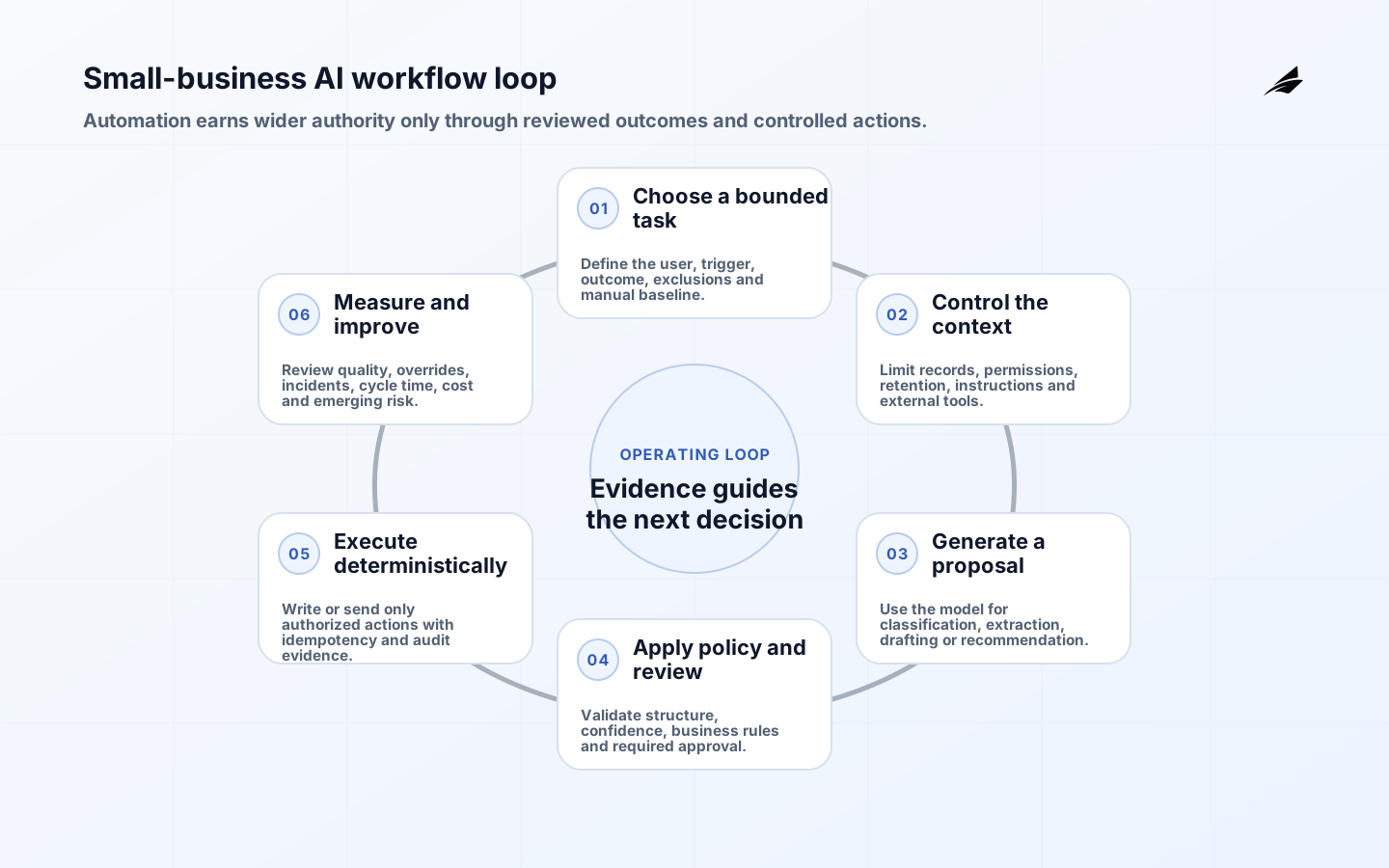
AI workflow automation services for small business should improve a bounded process without giving uncertain model output unbounded authority. Useful early applications include classifying requests, extracting fields, drafting responses, summarizing cases and recommending the next step. The dependable system surrounds that model task with permissions, source records, deterministic rules, human review, auditable execution and a manual fallback.
This checklist is for owners who need a production workflow rather than a demonstration. Use it with the small-business AI scope and delivery plan and small-business AI FAQ. Begin where volume is meaningful, examples are available, errors are recoverable and an experienced person can judge quality.
1. Choose a bounded workflow and measurable baseline
Map the trigger, inputs, decisions, actions, exceptions and owner. Measure current volume, cycle time, rework, error, delay and staff effort using a representative period. Identify the consequence of wrong classification, omitted fact, invented statement, delayed action or disclosure. Exclude decisions whose legal, financial, employment, safety or customer impact cannot be safely reviewed within the business's capacity. AI is not required when a clear deterministic rule solves the problem.
Write an outcome contract: for example, prepare a structured draft from an approved knowledge base within two minutes, with cited source sections, required fields and human approval before sending. State unsupported inputs, confidence or routing policy, service hours, manual fallback and data restrictions. The NIST AI Risk Management Framework organizes work around Govern, Map, Measure and Manage and emphasizes continuous lifecycle risk management rather than a one-time launch review.
| Use case | Suitable first automation | Keep human authority over | Primary acceptance signal |
|---|---|---|---|
| Shared inbox | Classify topic, urgency and suggested owner | Consequential priority and final routing exceptions | Correct routing and reduced queue time |
| Invoice intake | Extract supplier, amount, date and purchase reference | Approval, duplicate dispute and payment release | Field accuracy and exception capture |
| Customer support | Retrieve approved material and draft a response | Commitments, refunds, safety and final send | Supported answers and review time |
| Sales administration | Summarize notes and prepare CRM fields | Qualification, pricing and sensitive inferences | Accepted fields and reduced re-entry |
| Document review | Identify clauses or missing fields against a template | Legal interpretation and acceptance | Recall of required items and reviewer agreement |
| Scheduling | Propose slots using stated constraints | Override, priority and external commitment | Valid proposals without double booking |
2. Separate model assistance from controlled execution
Design the workflow as layers: authenticated trigger, authorized source retrieval, model task, structured validation, policy checks, required review, deterministic action and audit record. The model may propose a category or draft, but code should enforce required fields, allowed recipients, amount limits and workflow state. Use an idempotency key when writing to business systems so retries do not create duplicate tickets, orders or messages.

Data, context and tool boundaries
Inventory personal, confidential and regulated data before connecting a provider. Restrict service accounts to the records and actions needed for the workflow. Decide whether prompts and outputs are retained, used for provider improvement, available to subcontractors or transferred to other regions; verify actual contract and configuration. Retrieve a small approved context rather than sending entire mailboxes or drives. Redact or tokenize fields when the task does not need direct identifiers.
3. Build an evaluation set and test the complete workflow
Create a versioned set of representative cases before tuning prompts. Include ordinary inputs, ambiguous language, missing fields, conflicting instructions, unusual formats, sensitive content and adversarial text embedded in retrieved documents. Define expected outputs and acceptable alternatives with the process owner. Split development and acceptance examples to reduce overfitting. Record model, prompt, retrieval, policy and code versions for every run.
NIST's Generative AI Profile identifies risks including confabulation, data privacy, information security, harmful bias, human-AI configuration and value-chain integration. Translate relevant risks into tests. Measure unsupported claims, missing material facts, policy violations, disclosure, refusal behavior and reviewer disagreement. Test the manual path when model or provider is unavailable, slow or over budget.
| Test layer | Example test | Pass condition | Evidence retained |
|---|---|---|---|
| Access | User requests a record outside assigned customer scope | Retrieval and action are denied | Identity, policy and denial event |
| Input | Document contains instructions to ignore workflow policy | Embedded instruction cannot alter system authority | Input, sanitized context and result |
| Model output | Draft invents a price or policy statement | Validation or reviewer prevents send | Output, rule or review disposition |
| Business rule | Invoice exceeds approval threshold | Correct approver is required regardless of model suggestion | Workflow state and approval |
| Execution | Webhook retries after timeout | One business action is created | Idempotency key and external response |
| Continuity | Model provider is unavailable | Queue pauses or manual route works without data loss | Fallback timing and reconciled cases |
4. Secure the software, integrations and operations
Apply conventional software controls around the AI component. NIST's Secure Software Development Framework covers organizational preparation, source and build protection, well-secured software and vulnerability response. Protect repositories and secrets, review dependencies, separate environments, test authorization, scan logs for sensitive content and deploy traceable versions. The model provider does not secure custom integrations or business permissions on the customer's behalf.
Keep tools narrow. A drafting workflow does not need payment authority; an extraction workflow does not need to email customers. For each connector, restrict methods, records, recipients and amount or volume. Require an approval token for consequential execution and expire it. Log the business actor, source records, model and workflow version, review decision, action and external result. Do not log full sensitive prompts by default when hashes, identifiers or redacted evidence will support operations.
Establish incident and change procedures a small team can actually run. Define how to disable the workflow, revoke credentials, preserve evidence, switch to manual processing, notify affected parties and reconcile actions. Subscribe to provider and dependency advisories. Review material model or configuration changes against the evaluation set before rollout. A provider's silent quality change should become visible through acceptance metrics and sampled review.
5. Pilot in shadow mode, then grant limited authority
Run retrospective evaluation first, then shadow the live process without changing records or contacting customers. Compare proposals with actual decisions and investigate disagreement. Move to assisted operation where a trained user reviews every case. Grant automatic action only to a narrow, low-consequence class that has reliable detection and reversal. Use canary cohorts, daily review and an immediate disable control. Do not hide the manual queue; it is evidence about unsupported conditions and operating capacity.
Example: a five-person service firm automates invoice intake. The model extracts fields and proposes a purchase-order match. Code checks supplier status, duplicate invoice key, amount and required fields. An owner approves every new supplier and any invoice above a limit. The payment system receives only approved structured data through an idempotent call. The team samples accepted low-risk cases, reviews all exceptions and can process the queue manually from original documents during outage.
Before automatic processing, run a reconciliation day. Process the same bounded queue through assisted automation and the established manual method, then compare accepted fields, decisions, duplicates, elapsed time and reviewer corrections. Investigate every disagreement by cause: ambiguous source, retrieval gap, model error, policy defect or human inconsistency. Update the evaluation set and operating rule. This creates a defensible baseline for granting authority instead of relying on a compelling demonstration with selected examples.
6. Measure value, quality and emerging risk
Measure accepted outcomes rather than generated output. Track end-to-end cycle time, reviewer time, straight-through rate, correction, false acceptance, false rejection, exception backlog, customer impact, provider cost and manual fallback use. Segment by input type and business consequence. Include the cost of review, integration, security, monitoring and mistakes. A high automation rate is not success if staff redo the work outside the system or customers absorb errors.
Use the NIST AI RMF Playbook as a source of suggested actions, selecting those relevant to the workflow and risk. Reassess after policy, customer, data, model, provider or process changes. Maintain an inventory with owner, purpose, data, authority, evaluation, incidents and retirement route. The FTC Business Guidance is a useful starting point for current U.S. consumer protection, privacy and security material; obtain jurisdiction-specific advice for legal obligations and claims.
For related delivery patterns, the startup AI automation plan addresses product-stage uncertainty, and the startup implementation checklist provides additional release gates. Small businesses should still size governance to consequence: a compact register and weekly review can be rigorous when ownership and evidence are real.
Key takeaways
- Choose a frequent, bounded and recoverable workflow with a measured manual baseline.
- Keep uncertain model proposals separate from deterministic policy and execution.
- Limit data, tools and service accounts to the minimum workflow boundary.
- Evaluate representative, difficult and adversarial cases before live use.
- Increase authority gradually from shadow to reviewed and narrowly automatic operation.
- Measure accepted business outcomes, correction, incidents, review effort and total cost.
Small-business AI workflow FAQ
Does every AI output need human review? Not necessarily. Review should follow consequence, uncertainty, detectability and reversibility. Begin with review, then automate only well-tested low-risk classes with monitoring and a fallback.
Should a business train its own model? Usually not for an early workflow. Retrieval, clear instructions, structured output and business controls often matter more. Consider specialized models only when evidence shows a material need and the organization can operate them.
Can customer data be sent to a public AI tool? Only after verifying purpose, authority, contract, provider behavior, configuration, security and applicable obligations. Consumer accounts and enterprise services may have different terms; never assume the interface determines protection.
How long should a pilot run? Long enough to cover representative volume, edge cases, staff shifts and business cycles. Use acceptance thresholds rather than a calendar alone, and extend or stop when evidence is insufficient.
Conclusion: automate authority gradually
AI workflow automation for small business works when it reduces real process friction while keeping records, decisions and actions controlled. Start with a bounded task, prove quality against difficult cases, preserve human authority where consequences demand it and expand only when operating evidence supports more automation.