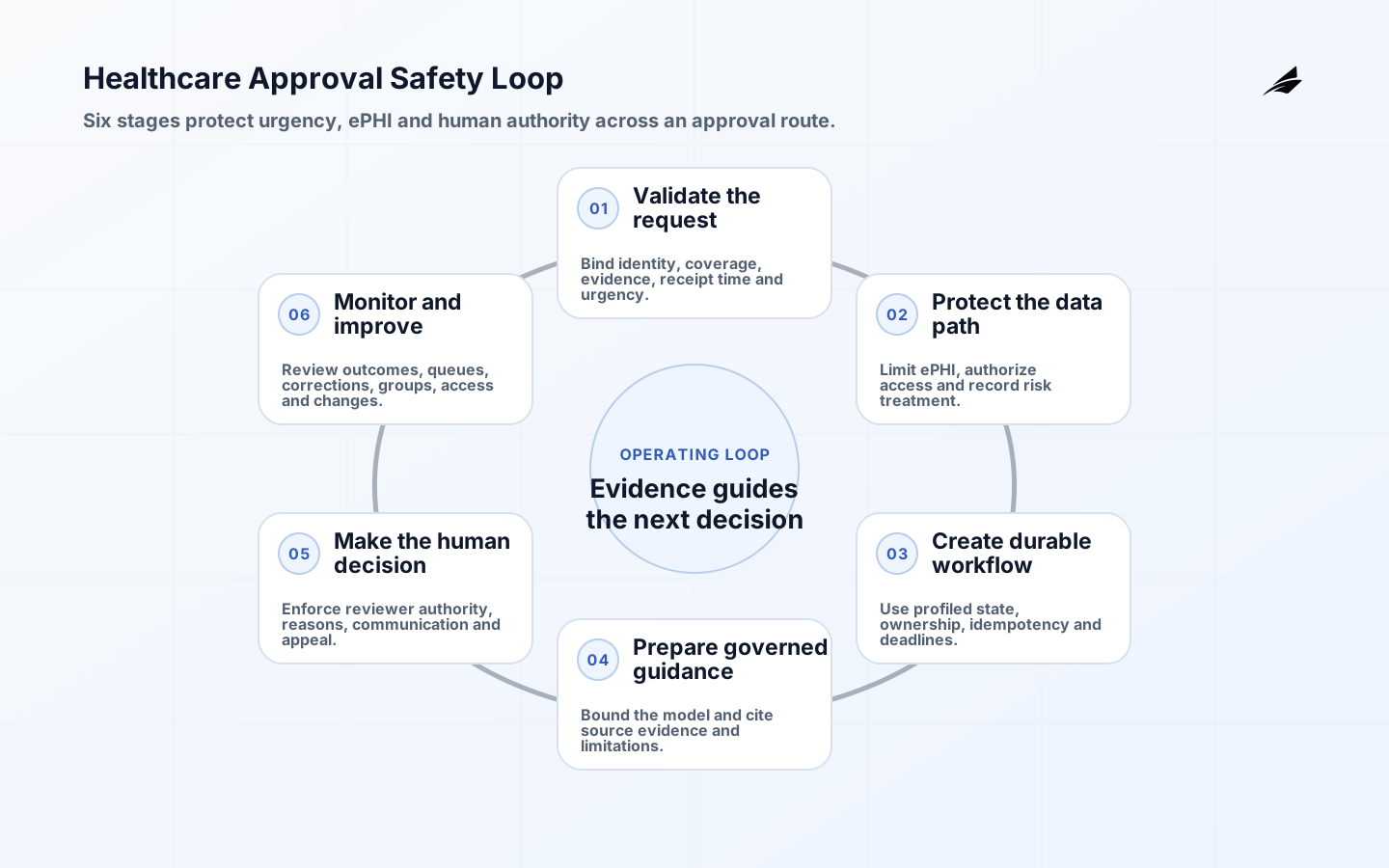
AI approval routing in healthcare should move a complete request to the right authorized reviewer and surface relevant evidence without making an ungoverned clinical or coverage decision. The implementation must protect electronic protected health information, preserve urgency and appeals, and continue safely when the AI or an external service is unavailable. This checklist turns those needs into testable delivery gates.
Use it with Edilec's healthcare approval routing guide, healthcare routing FAQ, manufacturing approval guide and manufacturing routing checklist. Have privacy, security, clinical, compliance and payer-policy owners tailor the controls.
1. Define scope, urgency and authority
Choose one request class and document trigger, required data, urgency rules, routing destination, reviewer credentials, decision authority, service target, escalation, communication and appeal. Separate routing from recommendation and final decision. Write prohibited behaviors: the model must not invent missing clinical facts, downgrade statutory or clinical urgency, approve beyond delegated authority, or suppress a request because confidence is low.
Create a role and responsibility map covering requesting provider, intake operations, utilization or clinical reviewer, medical director, privacy, security, compliance, model owner, integration owner and patient support. Configure deterministic rules for deadlines, licensed-review requirements, monetary or clinical thresholds and conflicts of interest. AI may prioritize or summarize within those boundaries; policy remains the authority.
| Workflow element | Owner | Required evidence |
|---|---|---|
| Request completeness | Intake operations | Field and document validation |
| Urgency | Clinical and policy owner | Rule version and reason |
| Routing | Operations owner | Queue, reviewer role and timestamp |
| Decision | Authorized reviewer | Source evidence and signed outcome |
| Communication and appeal | Member or patient operations | Delivery, reason and appeal path |
2. Complete privacy and security analysis
Map every place ePHI is created, received, maintained or transmitted, including prompts, embeddings, caches, logs, evaluation stores and support tools. The current HHS HIPAA Security Rule page states that appropriate administrative, physical and technical safeguards protect ePHI confidentiality, integrity and availability. Determine covered-entity and business-associate roles, agreements, permitted uses, minimum necessary access and retention with qualified counsel.
Perform and document risk analysis. HHS risk-analysis guidance says all ePHI created, received, maintained or transmitted is subject to the rule and identifies risk analysis as foundational. Inventory assets and data flows, assess threats and vulnerabilities, evaluate existing controls, assign treatment and residual-risk owners, and revisit analysis after material model, integration or workflow change.
3. Build an interoperable workflow contract
Define identifiers for request, patient, encounter, coverage, service, requester, organization and reviewer; specify status, intent, priority, authored time, owner, reason and referenced evidence. The HL7 FHIR R4 Task resource models a trackable activity with status, intent, owner, inputs and outputs. Use applicable implementation guides and profiles rather than treating base FHIR alone as complete interoperability.
Make updates idempotent and preserve source-system identifiers. Reject or quarantine incompatible profiles visibly. Synchronize status transitions so cancellation, additional-information requests, reassignment and appeal are not stranded between systems. The CMS Interoperability and Prior Authorization Final Rule page notes operational provisions beginning in 2026 and API requirements primarily beginning in 2027 for impacted payers; validate exact applicability and dates.
4. Bound and evaluate the AI component
Document purpose, users, affected parties, model and prompt versions, retrieval sources, training or tuning data where applicable, known limitations, uncertainty behavior and fallback. Apply the NIST AI Risk Management Framework functions to govern, map, measure and manage risk throughout the lifecycle. Keep an inventory and require approval for model, prompt, threshold, source or provider changes.
Build a representative evaluation set across request types, urgency, missing information, contradictory documents, rare diagnoses or services, age and language needs, and relevant protected or clinically meaningful groups. Measure routing accuracy, deadline risk, unsupported summary claims, evidence citation accuracy, reviewer correction, false escalation and subgroup differences. The ONC HTI-1 decision-support material is useful context for predictive intervention transparency and risk-management expectations in certified health IT.
| Test | Pass condition | Safe failure |
|---|---|---|
| Missing evidence | Workflow requests the exact missing item | Route to intake review |
| Urgent request | Deterministic urgency and deadline preserved | Immediate priority queue |
| Unsupported model statement | Detected in evaluation or reviewer view | Suppress summary and show source |
| Integration outage | Request remains durable and visible | Manual queue with reconciliation |
| Unauthorized reviewer | Assignment or decision rejected | Escalate access incident |
5. Design effective human review
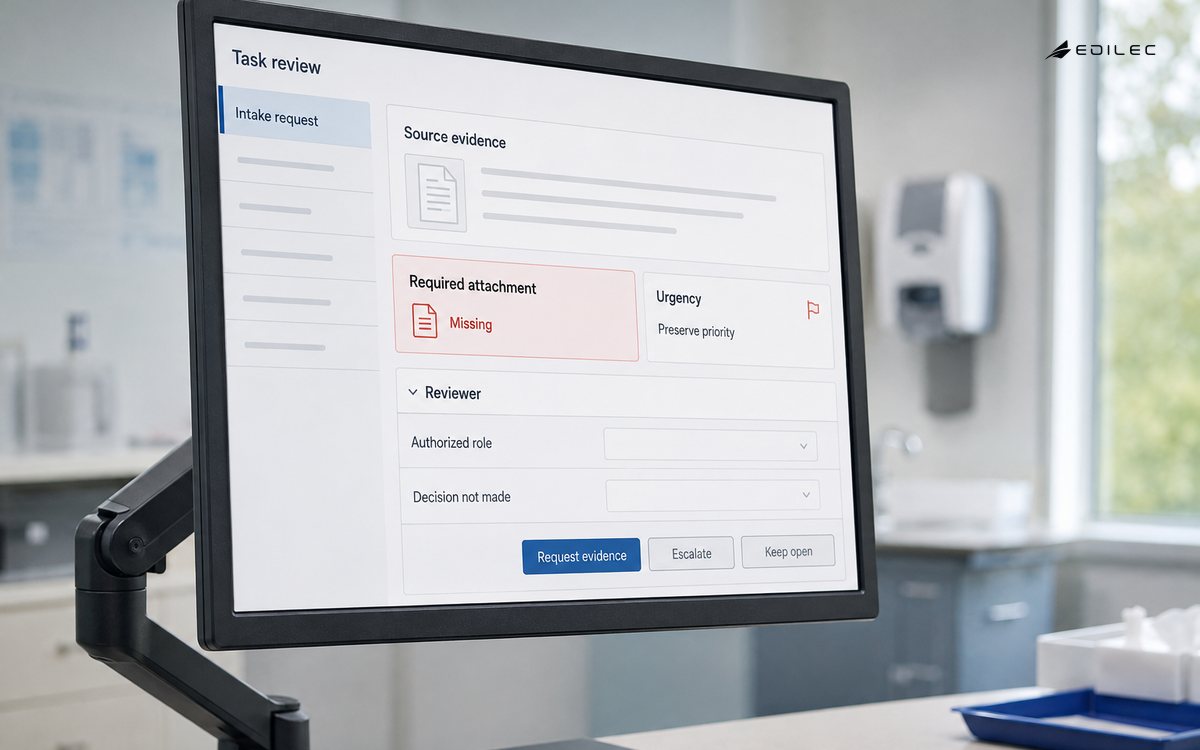
Show the original request, relevant source excerpts, policy or guideline version, missing information, model suggestion and uncertainty without forcing the reviewer to accept a preselected outcome. Require a reason for overrides and sample accepted suggestions too. Reviewers need enough time and training to challenge automation. Measure agreement carefully; high agreement can reflect automation bias rather than correctness.
Enforce licensure, specialty, organizational and delegation rules in deterministic authorization. Prevent self-approval where policy requires separation. Make reassignment and escalation simple, and keep a visible deadline clock. Final notices and clinical or coverage reasons must derive from the actual decision and applicable requirements, not a generic model-generated explanation. Preserve appeal and reconsideration routes.
6. Prove resilience before controlled release
Test duplicate submissions, wrong patient binding, stale coverage, clock skew, model timeout, provider outage, queue saturation, lost callback, identity-provider outage and rollback. Reconcile counts and statuses across requester, workflow and decision systems. A request should never disappear because an acknowledgment was lost. Define recovery time, maximum queue age and manual activation criteria, and rehearse the fallback with actual operators.
Run shadow mode, then suggestion-only mode, then a limited request cohort. Hold expansion when deadline misses, corrections, unsupported statements, queue age, subgroup performance or privacy events breach thresholds. Keep a control group or baseline where feasible. Obtain named clinical, operations, privacy, security and compliance acceptance before each increase in authority or scope.
Monitor outcomes, access and change
Monitor request volume, completeness, urgency, queue age, assignment churn, reviewer corrections, overrides, decisions, turnaround, appeals, integration rejects, model version, access events and patient or provider complaints. Segment by request and relevant population characteristics. Alert on service risk and unusual access, not only infrastructure availability. Review samples where AI and reviewer agreed to detect shared blind spots.
Maintain change control for policy, code, terminology, FHIR profile, model, prompt, retrieval corpus and threshold. Rerun relevant regression and equity tests, update risk analysis, communicate material changes and preserve prior versions. Review business-associate access and deletion evidence. A decommission plan should export records, revoke interfaces, reconcile open requests and continue legally required access.
Worked example: routing a prior-authorization request
An impacted payer selects one non-drug imaging request type for a bounded pilot. The intake API validates patient, coverage, requesting provider, service code and required documents. Deterministic policy assigns statutory and clinical urgency and the deadline. The AI extracts document topics, identifies likely missing evidence and proposes the appropriate reviewer specialty. It cannot deny, approve, lower urgency or write the final reason. Requests with low confidence or conflicting identity go directly to intake review.
A durable task record carries request status, priority, owner, evidence references and timestamps across the API, work queue and decision system. Tests lose callbacks, duplicate submissions and take the model service offline. In each case, one request remains visible with one authoritative state. Reviewer authorization is checked at assignment and decision. The interface displays source excerpts and the applicable policy version, and it requires a signed outcome and specific reason before communication.
Shadow evaluation compares proposed routing with actual specialist assignment and samples every urgent request. The suggestion-only pilot measures correction, queue age, deadline risk, unsupported summary statements and relevant subgroup outcomes. A manual queue drill confirms operators can continue when the AI is disabled and reconcile completed work after restoration. Expansion requires joint acceptance by clinical operations, privacy, security and compliance, plus evidence that appeals and additional-information requests retain their links and deadlines.
Evidence required at the rollout gate
- Approved authority matrix with deterministic urgency, licensure, delegation and escalation rules.
- ePHI inventory and risk analysis covering prompts, retrieval, logs, evaluation and support.
- Profiled API contract with duplicate, cancellation, reassignment and reconciliation tests.
- Model documentation, evaluation set, subgroup analysis, limitations and approved fallback.
- Reviewer interface test showing source evidence, policy version, uncertainty and override capture.
- Deadline and queue monitoring with an owner for every urgent breach condition.
- Outage drill proving durable requests, manual work, restoration and status reconciliation.
- Appeal, additional-information and communication records linked to the original request.
- Business-associate access, retention, deletion and incident obligations confirmed.
- Joint clinical, privacy, security, compliance and operations acceptance for the exact cohort.
Key takeaways
- Keep urgency, authority and deadlines in deterministic policy.
- Map ePHI through model, prompt, retrieval, logs and support paths.
- Use profiled interoperable resources with durable, idempotent status transitions.
- Evaluate corrections, unsupported claims, subgroup outcomes and workflow failures.
- Preserve timely human review, appeal and a rehearsed manual route.
Frequently asked questions
Should AI make the final healthcare approval decision?
That requires use-case-specific clinical, legal, regulatory and policy analysis. A safer starting point is completeness checking, routing and evidence preparation, with deterministic authority rules and an authorized reviewer retaining the decision.
Can ePHI be sent to an external model provider?
Only after confirming roles, agreements, permitted use, safeguards, access, retention, deletion, incident terms and risk treatment. Minimize data and prefer architectures that keep unnecessary identifiers out of the model path. Obtain privacy, security and legal approval.
What defines a successful rollout?
Success means timely and accurate routing, preserved patient and provider rights, lower avoidable handling effort, no unacceptable subgroup or privacy harm, explainable final decisions, reliable interoperability and operators who can manage exceptions without the AI.
Conclusion
Healthcare approval routing can reduce administrative delay when it strengthens the path to an authorized human decision. Protect ePHI, formalize workflow state, bound AI authority and test urgency and failure behavior. Production readiness is demonstrated by safe exceptions and timely outcomes, not by model accuracy alone.