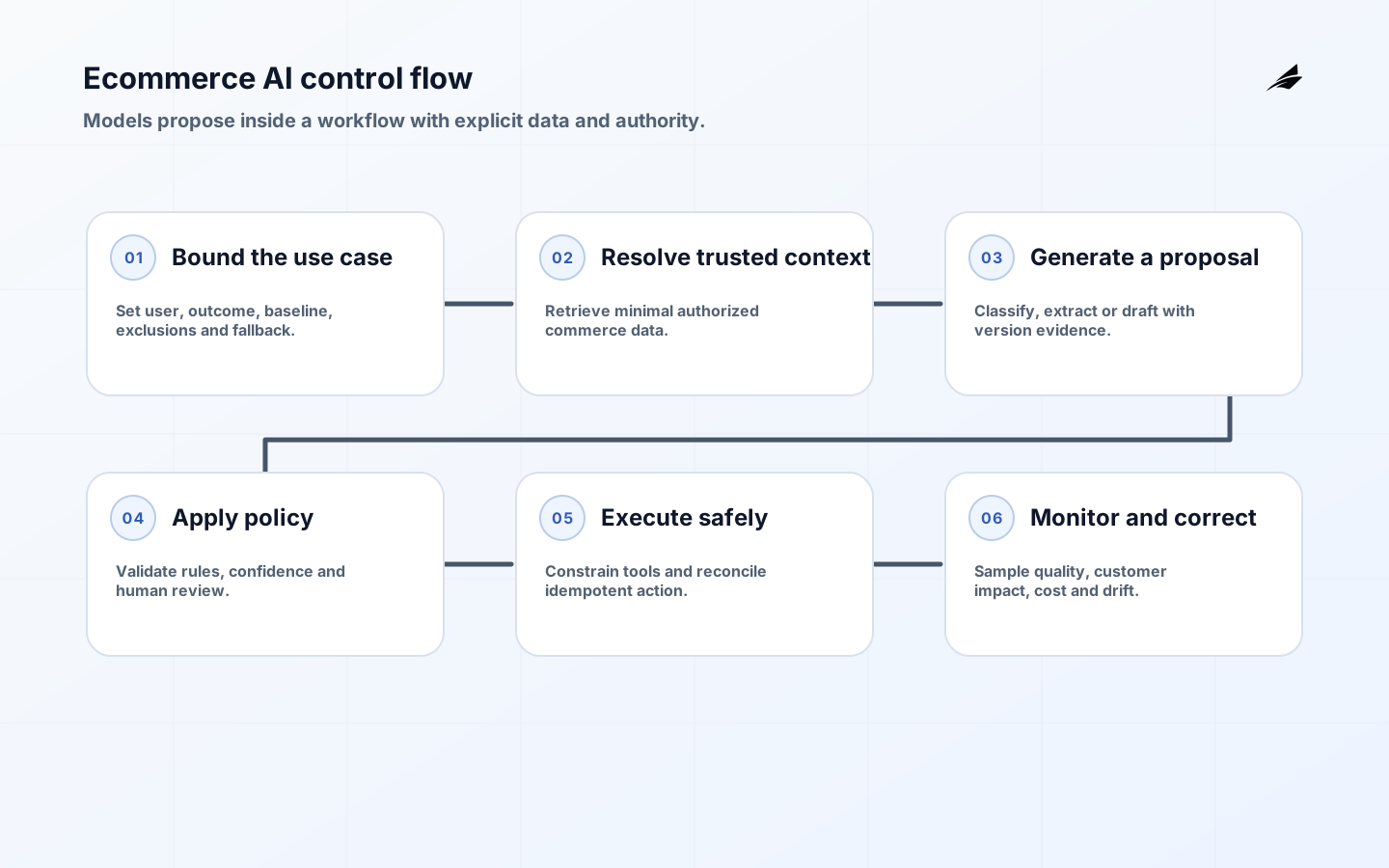
AI workflow automation for ecommerce combines deterministic commerce systems with models that classify, extract, rank or generate. Useful applications include product-content assistance, ticket triage, order-exception summaries, return routing and agent support. The model should not become the unrecorded authority for price, payment, refund, entitlement or customer promises. A production design keeps business rules, transaction state and approval outside the model, then measures whether automation improves the complete customer and operator journey.
Use this FAQ with Edilec's ecommerce AI delivery plan, ecommerce automation implementation checklist and startup AI workflow guide. They help translate the operating principles here into a bounded backlog.
Which ecommerce workflow should be automated first?
Choose a frequent, bounded task with accessible evidence, reversible action and a named owner. Baseline volume, handling time, queue age, error, rework, escalation, customer outcome and cost. Product-attribute extraction may be suitable when a merchandiser reviews changes; autonomous refunding is higher consequence because it changes money and can attract abuse. Decompose a broad ambition such as automate support into intent classification, retrieval, draft generation, policy check, approval, posting and feedback.
Define success and stop conditions before selecting a model. Include false acceptance and false rejection by meaningful cohort, not only average accuracy. State what happens when confidence is low, a tool is unavailable, input is malicious or the customer contests an outcome. The NIST AI RMF 1.0 organizes risk work through Govern, Map, Measure and Manage. NIST says the framework is under revision in 2026, so record the version used and watch for changes.
| Candidate workflow | Model contribution | Authority kept outside AI | Safe fallback |
|---|---|---|---|
| Product enrichment | Extract and suggest attributes | Catalog schema and publish approval | Manual merchandising queue |
| Support triage | Classify intent and urgency | Priority policy and case ownership | General support queue |
| Agent reply | Retrieve and draft response | Order facts, policy and send decision | Human-authored response |
| Return review | Summarize evidence and flag anomaly | Eligibility, refund and fraud decision | Specialist review |
| Demand planning | Forecast by product and horizon | Purchase approval and budget | Existing planning method |
What should the architecture separate?
Separate channel input, identity, authoritative commerce data, retrieval, model inference, deterministic policy, tool execution, human review and audit. Give every request a traceable identifier. Validate structured inputs and outputs, constrain tool parameters and make side effects idempotent. A model can propose a return reason; a policy service should determine eligibility from order state, jurisdiction, product class and timing. Record model, prompt or workflow version, sources, decision and final action without retaining unnecessary personal data.
Treat product descriptions, customer messages, uploaded files and retrieved pages as untrusted content. They can contain misleading instructions that should never redefine system policy or tool authority. Limit retrieval by tenant, locale and purpose; filter secrets and payment data; and allow only explicitly registered actions. Rate-limit costly or sensitive operations, require confirmation for high-impact steps and keep a kill switch that disables model action while ordinary commerce continues.
How are customers, privacy and payment data protected?
Tell customers when automation materially shapes an interaction, and provide an effective route to a person for consequential or disputed cases. Do not use urgency, hidden fees, confusing choices or obstructive cancellation to inflate an automation metric. The FTC's dark-patterns report describes designs that subvert choice in ecommerce, privacy and subscriptions. Review the whole journey, including generated copy, recommendations and recovery paths, for misleading behavior.

Collect the minimum data required for the stated purpose, define retention and deletion, restrict secondary use and inspect provider terms. The FTC's guidance on AI privacy and confidentiality commitments stresses that companies remain accountable for promises about data use. Avoid sending full order histories when a redacted field set is sufficient, and verify deletion across logs, evaluation stores, caches and vendor systems.
Keep payment account data out of model context. If an automated component stores, processes, transmits or can affect the cardholder-data environment, review scope against the current PCI DSS resources. Tokenize where possible, isolate payment interfaces, restrict scripts and monitor changes. AI does not change the need for deterministic amount, authorization, capture, refund and reconciliation controls.
How should quality and safety be evaluated?
Build an evaluation set from representative real cases with privacy controls, plus difficult and adversarial examples. Cover languages, channels, customer segments, product classes, incomplete records, policy exceptions, prompt injection and tool failures. Establish expert reference decisions and disagreement handling. Evaluate task correctness, groundedness, prohibited content, policy compliance, escalation and end-to-end outcome. A fluent answer can still be factually wrong or operationally unsafe.
For generative systems, the NIST Generative AI Profile identifies risks and actions that extend AI RMF use. Apply relevant actions to content provenance, human-AI configuration, information integrity, privacy, security and measurement. Test the complete configured system rather than assuming a base-model benchmark transfers to the retailer's catalog, policies, integrations and users.
| Measure | Why it matters | Segment | Action threshold |
|---|---|---|---|
| Task acceptance | Shows usable output | Intent, language and product class | Route weak cohort to review |
| Policy violation | Captures unsafe or disallowed action | Rule and consequence | Disable action path |
| Escalation quality | Tests recognition of uncertainty | Reason and queue | Adjust threshold or guidance |
| Customer correction | Reveals errors after delivery | Workflow and channel | Investigate repeated cause |
| Cost per resolved case | Tests economic value | Automation and fallback path | Redesign if total cost rises |
What drives cost and rollout time?
Cost includes discovery, data preparation, workflow integration, model usage, retrieval, evaluation, security, observability, human review, support and correction. Token price is rarely the whole business case. Estimate per completed journey, including failed attempts and review. Volume, context size, latency, multilingual coverage, catalog churn, vendor limits and peak-season capacity drive ongoing spend. Set budgets, caching rules and graceful degradation without hiding quality loss.
Roll out in shadow mode, internal assistance, limited cohort and controlled production. Shadow results reveal disagreement without customer impact; agent-assist exposes workflow friction while a human retains authority. Define health, pause and rollback thresholds before each step. Freeze major changes near peak commerce events unless the risk of delay is greater. Remove temporary access and experiments after acceptance, and retain a known non-AI path for service continuity.
How is the service operated after launch?
Monitor input drift, retrieval freshness, output quality samples, policy denials, tool failures, latency, cost, escalation, customer corrections and business outcome. Link incidents to workflow, model and policy versions. Sample apparently successful cases because silent mistakes may never create an alert. Review supplier model changes before broad exposure and rerun regression, safety and load evaluations. Give support teams a way to identify automation, inspect evidence and correct state without editing opaque model history.
Use a cross-functional review with product, commerce operations, customer support, security, privacy, legal, data and engineering. Compare outcomes with baseline and examine cohorts, not only averages. Decide whether to expand, constrain, redesign or stop. Close stale prompts, duplicated integrations and temporary manual work. The objective is not maximum automated volume; it is reliable customer and operator outcomes at an acceptable total cost.
How should model and automation providers be governed?
Due diligence should cover service architecture, model and data locations, retention, training use, subprocessors, security testing, incident notice, availability, rate limits, change policy, intellectual property, evaluation support and exit. Ask how the provider distinguishes tenant data and whether administrators can inspect customer content. Test export and deletion before launch. A general assurance report helps, but the retailer must still validate its own configuration, workflow and complementary controls.
Contract for notice of material model, safety, pricing, interface and region changes. Pin versions where the provider supports it and maintain regression tests even when versions are stable, because retrieval data and policies also change. Define what happens when a model is retired or a capability moves tiers. Avoid architecture that cannot route to another approved model or deterministic fallback without rebuilding every commerce integration.
Keep the retailer's prompts, policies, evaluation cases, tool schemas, incident records and business metrics in customer-controlled systems. Provider dashboards should supplement, not replace, local evidence. Assign an internal service owner who can pause automation, review costs, approve version changes and coordinate customer correction. Outsourcing inference does not outsource responsibility for the resulting offer, message or transaction.
Plan exit while the service is healthy. Maintain an inventory of endpoints, credentials, indexes, retained content, evaluation data and downstream dependencies. Rehearse switching to the deterministic fallback and exporting required records. On termination, revoke access, delete data under the agreed process, preserve required transaction evidence and verify that scheduled jobs no longer call the provider. Exit testing also reveals hidden coupling before it becomes an emergency.
Key takeaways
- Start with a bounded, reversible workflow and a measured baseline.
- Keep money, entitlement, policy and tool authority outside the model.
- Minimize personal data and isolate payment systems.
- Evaluate complete journeys across cohorts and adversarial cases.
- Roll out through shadow and assisted stages with stop conditions.
- Measure correction, customer outcome and total cost, not automation rate alone.
Frequently asked questions
Can AI issue refunds autonomously?
Only within a narrowly defined, tested and monitored policy boundary, and many retailers should keep approval deterministic or human. Start with summarization and recommendation before granting financial authority.
Should an ecommerce company train its own model?
Usually start by testing hosted or existing models with retrieval and controls. Train or fine-tune only when measured gaps, data rights, operating skill and economics justify the added lifecycle.
How is ROI measured?
Compare total cost and customer outcomes with the baseline: resolution, conversion or cycle time; corrections; escalations; loss; quality; and support effort. Count human review and incident correction, not only inference.
Conclusion
AI workflow automation for ecommerce earns trust through bounded authority and recoverable operations. Let models contribute where uncertainty is useful, keep commercial truth and policy deterministic, protect customer choice and data, and expand only when production evidence supports the next step.