Healthcare AI Automation ROI: Implementation and Measurement Checklist requires more than a feature backlog. It needs a named outcome, evidence about current work, explicit trust boundaries, and controls that remain effective after launch. This guide turns healthcare AI automation ROI into a staged review for product, engineering, security, operations, compliance, finance, and business owners. The aim is a useful, supportable system whose scope, cost, risk, and value can be challenged before production rather than explained after an incident.
Use the checklist as a working review, not a certification shortcut. Adapt legal, contractual, regulatory, and technical analysis to the organization and jurisdiction. Related planning appears in AI Automation ROI Planning for Healthcare: Practical Guide for Business Teams, AI Automation ROI Planning for Healthcare FAQ, AI Automation ROI Planning for Manufacturing: Practical Guide for Business Teams, AI Automation ROI Planning for Manufacturing Implementation Checklist. This article concentrates on implementation evidence: what should be observed, documented, tested, approved, monitored, and reconsidered when operating conditions change.
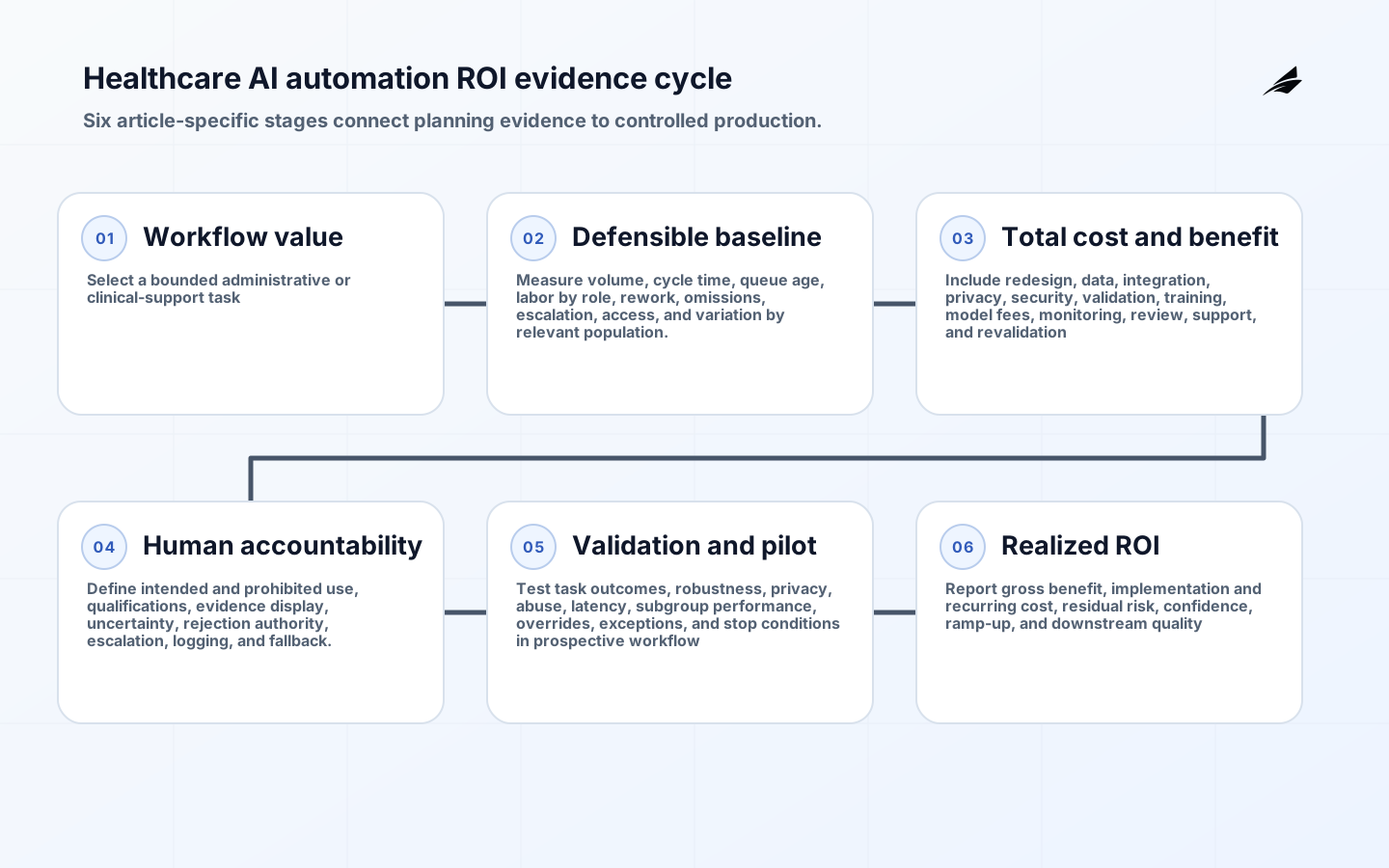
Workflow value
At this stage, select a bounded administrative or clinical-support task; define user, trigger, input, decision, output, reviewer, exception, and downstream consequence. For this workflow step, name the accountable owner, supporting evidence, exception route, and next measurable check.
Controls should account for this constraint: Starting with a model obscures accountability and can mix low-risk assistance with consequential clinical reliance. Within this workflow step, name the accountable owner, supporting evidence, exception route, and next measurable check.
Defensible baseline
At this stage, measure volume, cycle time, queue age, labor by role, rework, omissions, escalation, access, and variation by relevant population. When implementing this part of the system, name the accountable owner, supporting evidence, exception route, and next measurable check.

Controls should account for this constraint: Seasonality, backlog clearance, or shifted correction work can look like an automation benefit. Before releasing this part of the system, name the accountable owner, supporting evidence, exception route, and next measurable check.
| Stage | Decision | Evidence |
|---|---|---|
| Workflow value | Select a bounded administrative or clinical-support task; define user, trigger, input, decision, output, reviewer, exception, and downstream consequence. | Starting with a model obscures accountability and can mix low-risk assistance with consequential clinical reliance. |
| Defensible baseline | Measure volume, cycle time, queue age, labor by role, rework, omissions, escalation, access, and variation by relevant population. | Seasonality, backlog clearance, or shifted correction work can look like automation benefit. |
| Total cost and benefit | Include redesign, data, integration, privacy, security, validation, training, model fees, monitoring, review, support, and revalidation; classify benefit honestly. | Saved minutes are capacity, not cash, unless redeployment, avoided hiring, or purchased services change. |
Total cost and benefit
At this stage, include redesign, data, integration, privacy, security, validation, training, model fees, monitoring, review, support, and revalidation; classify benefit honestly. While operating this cost decision, name the accountable owner, supporting evidence, exception route, and next measurable check.
Controls should account for this constraint: Saved minutes are capacity, not cash, unless the organization redeploys staff, avoids hiring, or reduces purchased services. When changing this cost decision, name the accountable owner, supporting evidence, exception route, and next measurable check.
Human accountability
At this stage, define intended and prohibited use, qualifications, evidence display, uncertainty, rejection authority, escalation, logging, and fallback. During support for this part of the system, name the accountable owner, supporting evidence, exception route, and next measurable check.
Controls should account for this constraint: Human review is ceremonial when reviewers lack context, time, authority, or an appeal route. To validate this part of the system, name the accountable owner, supporting evidence, exception route, and next measurable check.
| Stage | Primary risk | Production control |
|---|---|---|
| Human accountability | Human review is ceremonial when reviewers lack context, time, authority, or an appeal route. | |
| Validation and pilot | Generic model accuracy can conceal clinically or operationally material errors. | |
| Realized ROI | Value is not defensible when it relies on skipped review, hidden labor, or averages that conceal harm. |
Validation and pilot
At this stage, test task outcomes, robustness, privacy, abuse, latency, subgroup performance, overrides, exceptions, and stop conditions in a prospective workflow. To govern this part of the system, name the accountable owner, supporting evidence, exception route, and next measurable check.
Controls should account for this constraint: Generic model accuracy can conceal clinically or operationally material errors. When explaining this part of the system, name the accountable owner, supporting evidence, exception route, and next measurable check.
Realized ROI
At this stage, report gross benefit, implementation and recurring cost, residual risk, confidence, ramp-up, and downstream quality; reforecast during scale. For this part of the system, test one expected case, one ambiguous case, and one failure with a documented recovery action.
Controls should account for this constraint: Value is not defensible when it relies on skipped review, hidden labor, or averages that conceal harm. Within this part of the system, test one expected case, one ambiguous case, and one failure with a documented recovery action.
Build an approval evidence package
The healthcare AI investment file should pair a measured workflow baseline with intended-use boundaries, population and site coverage, data provenance, task-specific validation, privacy and security review, human-oversight design, prospective pilot results, and a full cost model. Clinical or operational leadership should own the outcome; privacy and security should approve data handling; qualified domain reviewers should accept error thresholds; and finance should distinguish cash savings from released capacity, avoided cost, access improvement, and risk reduction.
Review the business case with the staff who perform the workflow, the people who review AI output, health-information management, clinical safety or quality, privacy, security, integration, finance, and support. Demonstrate representative cases, missing or contradictory records, subgroup performance, an unsafe suggestion, reviewer rejection, model or API outage, delayed EHR data, and manual fallback. Stop conditions and incident ownership must be understood before users are exposed to recommendations in live care or administrative operations.
Validate healthcare AI automation ROI through a complete operating case
Use this implementation checklist to validate healthcare AI automation ROI with one complete operating case before widening the scope. Delivery teams should trace one business case across intake, validation, approval, system updates, downstream handoffs, and an operator-visible completion state. Begin with the initiating business record, accountable role, approval state, integration handoff, exception reason, and reconciled outcome, cross each policy and dependency boundary, and finish in a durable state that a customer or operator can recognize. Record the expected state at every handoff, who may change it, and which evidence proves that the next step was justified. This walkthrough gives product, engineering, security, and support a shared acceptance case instead of allowing each team to assume that another layer owns the transition. Use representative roles, realistic timing, and the constraints that exist during an ordinary operating day.
The implementation checklist should also test a second healthcare AI automation ROI case that deliberately challenges the design. Include a disputed record, unavailable approver, duplicate handoff, policy exception, or mismatch between systems of record. The purpose is not to demonstrate that every dependency always succeeds; it is to prove that the service can stop safely, preserve useful evidence, and expose the next responsible action. Review record version, approval evidence, queue age, exception owner, reconciliation result, and service outcome together so the team can distinguish a policy refusal from bad input, a software defect, a delayed dependency, or an operator decision. A useful result is specific enough for a support or incident owner to act without reconstructing the entire journey from unrelated logs and messages.
Turn both cases into release evidence for healthcare AI automation ROI. Keep the input conditions, expected states, observed result, decision owner, and unresolved exceptions in one reviewable record. Define the recovery action in advance: protect the authoritative record, isolate the disagreement, assign the exception, reconcile affected systems, and document the resolution. Re-run the same cases after a material policy, interface, data, model, infrastructure, or entitlement change so that improvements do not silently weaken an earlier control. For this implementation checklist, readiness means that the normal path is usable, the failure path is understandable, and ownership remains visible after launch rather than ending when implementation work is declared complete.
- Choose one representative healthcare AI automation ROI journey and state the customer or operator result in plain language.
- Capture the initiating business record, accountable role, approval state, integration handoff, exception reason, and reconciled outcome as evidence, with a named owner for each consequential handoff.
- Exercise a disputed record, unavailable approver, duplicate handoff, policy exception, or mismatch between systems of record before broader exposure and verify that the safe state is visible.
- Review record version, approval evidence, queue age, exception owner, reconciliation result, and service outcome after release and assign every unresolved exception to a person and date.
Implementation takeaways
- Define the business and operating outcome before selecting technology.
- Assign owners for data, controls, service operation, incidents, changes, and value.
- Test representative exceptions, failure, rollback, and recovery before expanding scope.
- Keep architecture, security, privacy, cost, support, and retirement in one delivery plan.
- Measure downstream outcomes and residual risk, not only technical activity.
Frequently asked questions
| Question | Answer |
|---|---|
| Is time saved ROI? | No; it becomes return only through valued redeployment or changed spend. |
| Pilot size? | Enough representative cases to evaluate outcomes and important groups. |
| Same approval for all AI? | Governance may align, but clinical impact needs stronger evidence and analysis. |
| When stop? | When safety, privacy, quality, fairness, queue, cost, or value thresholds fail. |
Conclusion
Healthcare AI Automation ROI: Implementation and Measurement Checklist is strongest when each design choice traces to a user outcome, authoritative source, owned control, or tested constraint. That traceability makes scope and cost easier to challenge before release and incidents easier to diagnose afterward. It also distinguishes readiness from a demonstration that works only with curated inputs and expert supervision.
Pilot one bounded workflow at a representative site, initially in silent or advisory mode, and compare it with the predeclared baseline. Scale only when cycle time, correction effort, access, downstream quality, subgroup outcomes, exception queues, and total operating cost remain acceptable after normal adoption. A saved-minute estimate should be revised when capacity is not redeployed or when review and correction move work to another role. Clinical impact requires a separate evidence and regulatory assessment.
Before approving healthcare AI automation, test the deployed model, prompt or rules, retrieval sources, EHR interfaces, user roles, review screen, audit trail, and escalation route with production-like permissions and data. Rehearse stale clinical context, patient mismatch, privacy leakage, harmful output, reviewer overload, provider timeout, version rollback, and post-event reconstruction. Monitoring must identify affected workflow and population, model and knowledge versions, user disposition, downstream correction, and whether a safety or privacy threshold has been crossed.