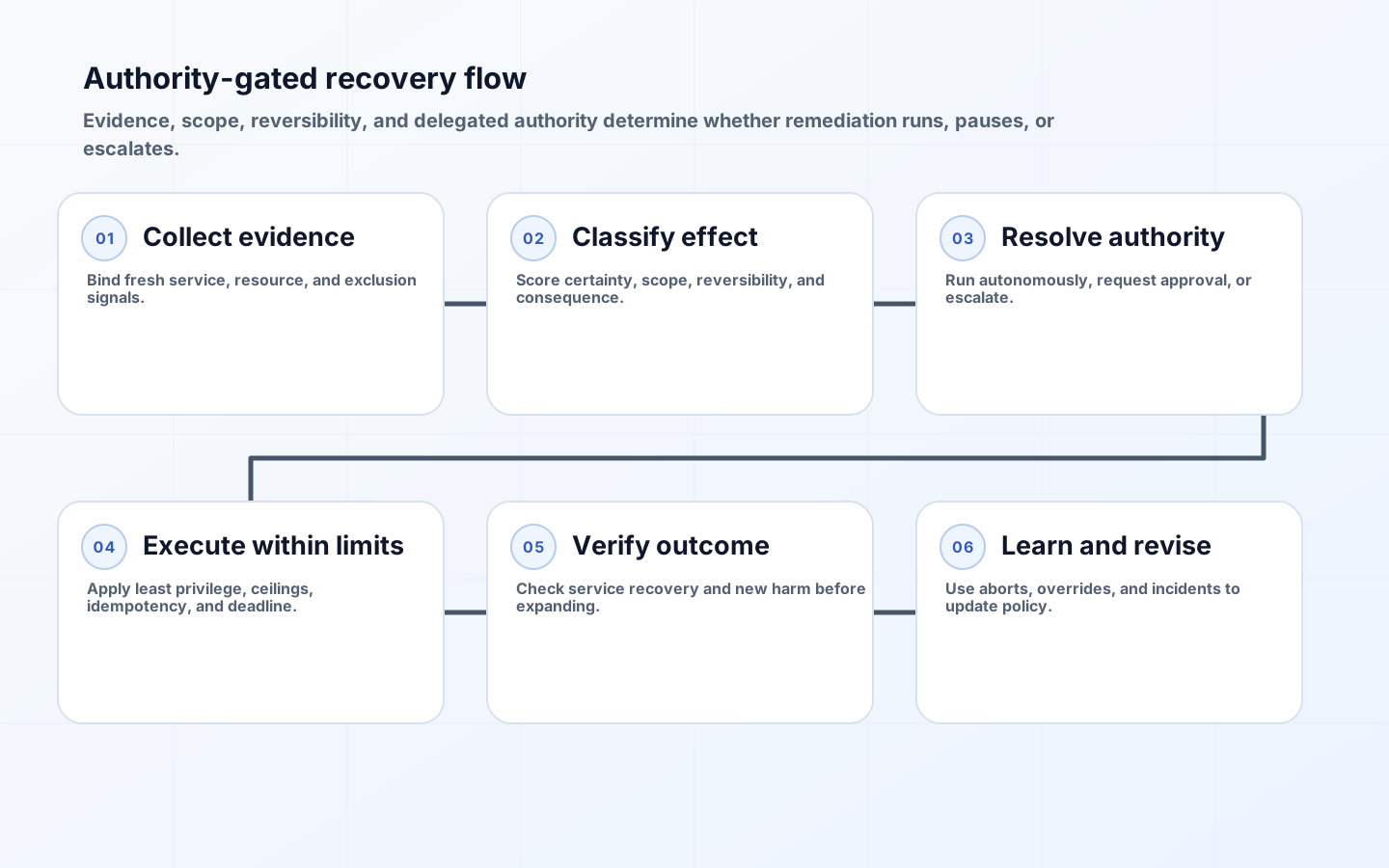
Runbook automation is safest when it automates a bounded decision, not merely a sequence of commands. A recovery step can be technically scriptable and still be unsuitable for autonomous execution because the diagnosis is uncertain, the target set is broad, the change is difficult to reverse, or the required authority belongs to another team. The operating question is therefore not whether a script can perform the action. It is whether the system has enough evidence and delegated authority to perform it now.
A useful design separates observation, recommendation, approval, execution, verification, and rollback. That separation lets teams automate repetitive diagnosis and low-risk restoration without granting a recovery engine unlimited production power. It also creates evidence for incident review: which signal triggered the workflow, what policy version applied, which resources were touched, and why the workflow proceeded or stopped.
Choose automation candidates by outcome and recurrence
Start with a named operational outcome such as restoring healthy replicas, clearing a bounded cache, or rotating traffic away from an unhealthy endpoint. AWS Well-Architected guidance describes a runbook as a documented process for a specific outcome and recommends including permissions, error handling, exceptions, and escalation. Those elements must survive translation into code. A loose collection of shell commands is not a production runbook because it lacks a success contract and a controlled failure path.
Prioritize procedures that are frequent, deterministic, and costly to perform manually. Measure current execution volume, median handling time, error modes, and recovery success before automating. Rare disaster procedures can still merit automation, but their infrequency makes drift and untested assumptions more likely. For those, invest first in simulation, dry runs, and scheduled exercises. Google SRE cautions that automation multiplies force without guaranteeing that the force is correctly directed; scope and evidence are the counterweights.
Classify each step by evidence, effect, and authority
Decompose the runbook into individual decisions and effects. For every step, record its required inputs, confidence threshold, write target, maximum scope, reversibility, expected duration, side effects, permissions, and owner. A read-only query may run autonomously, yet the conclusion drawn from it may still need corroboration. A reversible write can be low risk at one resource and high risk across a region. Treat these dimensions independently instead of assigning one risk label to the whole runbook.
| Step class | Typical example | Default authority | Required control |
|---|---|---|---|
| Observe | Read health, lag, saturation, or configuration | Autonomous | Authenticated source and freshness check |
| Prepare | Calculate targets or stage a replacement | Autonomous within quota | No production traffic or business effect |
| Bounded reversible write | Restart one unhealthy stateless instance | Autonomous when evidence passes | Scope cap, cooldown, and verification |
| Broad or lossy write | Fail over a data tier or purge durable state | Explicit approval | Named approver and tested recovery plan |
| Irreversible business action | Cancel orders or disclose customer data | Human decision | Business authority and case evidence |
Build evidence gates before write gates
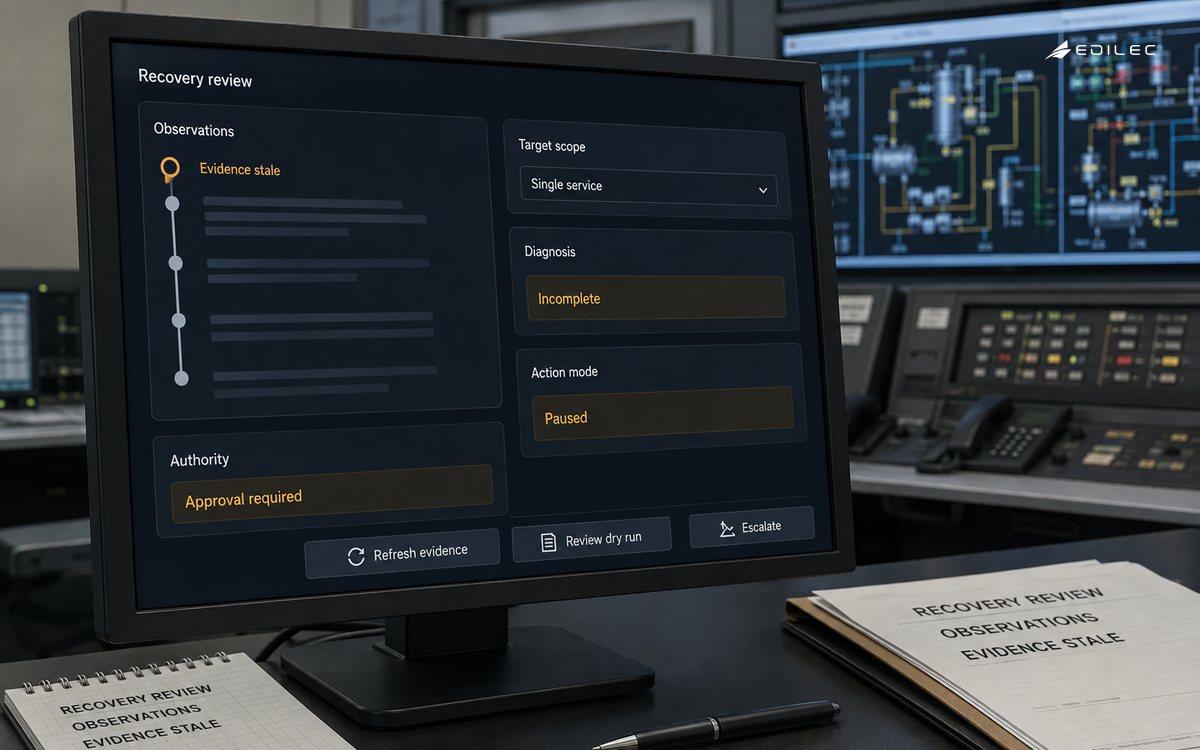
An autonomous recovery should require positive evidence, not merely the absence of an alarm. Define a diagnosis predicate from independent signals where practical: an availability symptom, a resource condition, and an exclusion check for known maintenance or upstream failure. Bind signals to the same service, environment, and time window. Stale metrics, conflicting inventories, or an unknown deployment state should produce an indeterminate result and stop the workflow rather than being treated as permission to act.
Record the exact evidence snapshot and policy evaluation with the execution. Confidence is not a universal percentage; it is a contract for a particular fault mode. For example, restarting one stateless worker may require repeated health-check failure, replacement capacity, and no active drain operation. A database failover may require replication health, a fencing guarantee, and confirmation that the primary is unavailable. Tests should include false-positive signals and partial telemetry, not only the happy path.
Place approvals at consequential decision boundaries
Do not ask an approver to authorize a vague runbook before diagnosis and then allow any later action. Pause immediately before the consequential effect and present the resolved target set, current evidence, predicted impact, rollback plan, and expiry time. AWS Systems Manager, for example, supports a dedicated approval action that pauses automation until designated principals approve or deny. The architectural lesson is the explicit state transition, not the particular service.
Approval should expire when its facts expire. If topology, scope, health, or code version changes while waiting, re-evaluate policy and request a new decision. Separate the person who changes the runbook from the identity that approves a high-risk execution where segregation is required. Emergency authority may use a faster path, but it should narrow scope, capture reason, notify accountable owners, and trigger retrospective review rather than silently bypassing control.
Execute with hard limits and a recovery envelope
The executor needs a smaller permission set than the author or platform administrator. Use short-lived workload identity, resource tags or explicit allowlists, and policy-enforced maximum concurrency. Validate preconditions again immediately before the write. Attach a stable execution ID to every command so retries do not repeat non-idempotent effects. A kill switch, global rate limit, per-service cooldown, and maximum elapsed time keep a local recovery from becoming a fleet-wide incident.
| Control | Question it answers | Failure behavior |
|---|---|---|
| Scope ceiling | How many resources may change? | Reject targets beyond the evaluated set |
| Concurrency limit | How quickly may effects accumulate? | Queue or stop additional actions |
| Idempotency key | Can an uncertain retry repeat the effect? | Return the recorded operation result |
| Cooldown | May the same remedy oscillate? | Escalate repeated triggers |
| Deadline | Is this recovery still timely? | Stop and require fresh diagnosis |
| Kill switch | Can operators halt the class of automation? | Prevent new writes and preserve state |
Verify the service outcome and make rollback conditional
Command success is not recovery. After each effect, verify the intended service-level outcome and check for new harm. A restart that exits successfully but leaves error rate unchanged should not be repeated across more instances. Define a short observation window, success indicators, abort indicators, and escalation owner. Verification should use the same customer-facing signals that justified intervention where possible, while also checking resource health and data integrity.
Rollback is another production change, so it needs its own preconditions and bounds. Some actions are compensable rather than reversible: traffic can be restored, but messages processed during the interval cannot be unprocessed. Describe the recovery envelope honestly. If automated rollback would amplify load or reintroduce a confirmed fault, stop in a stable state and hand over. Preserve the before state, effects performed, verification results, and any residual obligation for the incident team.
Treat automated runbooks as production software
Keep definitions in version control, require review from service owners, and test policy and execution separately. Unit-test target selection and safety predicates; integration-test against disposable environments; and run fault-injection exercises for timeouts, duplicate callbacks, partial writes, stale inventory, denied permissions, and failed rollback. Pin each execution to an immutable runbook version and dependency set. Azure Automation distinguishes graphical, PowerShell, PowerShell Workflow, and Python runbooks, but any representation needs the same lifecycle discipline.
Assign an owner, review date, supported service versions, and retirement condition. Track autonomous success, approval frequency, false triggers, aborts, rollback outcomes, manual takeovers, and incidents caused or worsened by automation. A high approval rate may mean the risk boundary is too conservative or that the candidate was poorly chosen. A low intervention rate is not automatically good if the workflow quietly acts on weak evidence. Review decisions alongside operational outcomes.
Implement autonomy in controlled increments
- Instrument the existing manual procedure and define one measurable recovery outcome.
- Automate evidence collection and generate a recommendation without production writes.
- Add operator-triggered execution with target preview, immutable logging, and verification.
- Introduce an approval gate for bounded writes and exercise denial, expiry, and cancellation paths.
- Delegate low-risk cases to autonomous execution with strict scope, rate, and cooldown limits.
- Expand only after false-positive, rollback, and incident evidence supports a wider boundary.
Key takeaways
- Automate a defined recovery outcome and retain permissions, exceptions, and escalation from the human procedure.
- Classify each step independently by diagnostic certainty, reversibility, scope, and decision authority.
- Put approval immediately before a consequential effect and expire it when the supporting facts change.
- Limit autonomous execution with least privilege, target ceilings, idempotency, cooldowns, deadlines, and a kill switch.
- Judge success by restored service and contained harm, not by a command returning zero.
Frequently asked questions
Which recovery steps should be automated first? Choose frequent, well-understood procedures with objective preconditions, narrow targets, reversible effects, and a measurable service outcome. Automating evidence collection before execution is often the safest first release.
Does reversible mean no approval is needed? No. Reversibility is only one dimension. A reversible action across hundreds of resources can have a large blast radius, and rollback may be slow or incomplete. Evidence quality, scope, customer impact, and authority still matter.
Can an incident commander override an automation stop? A documented emergency path can permit a broader action, but it should require explicit identity, reason, bounded targets, notification, and post-incident review. It should not mutate the safety policy invisibly.
Conclusion
Reliable runbook automation is delegated operational authority expressed as code. Teams gain speed when evidence is strong and the recovery envelope is narrow; they preserve judgment when diagnosis is ambiguous or consequences are broad. By making those boundaries executable, observable, and reviewable, an organization can remove repetitive toil without turning every incident into an unchecked machine-speed change.