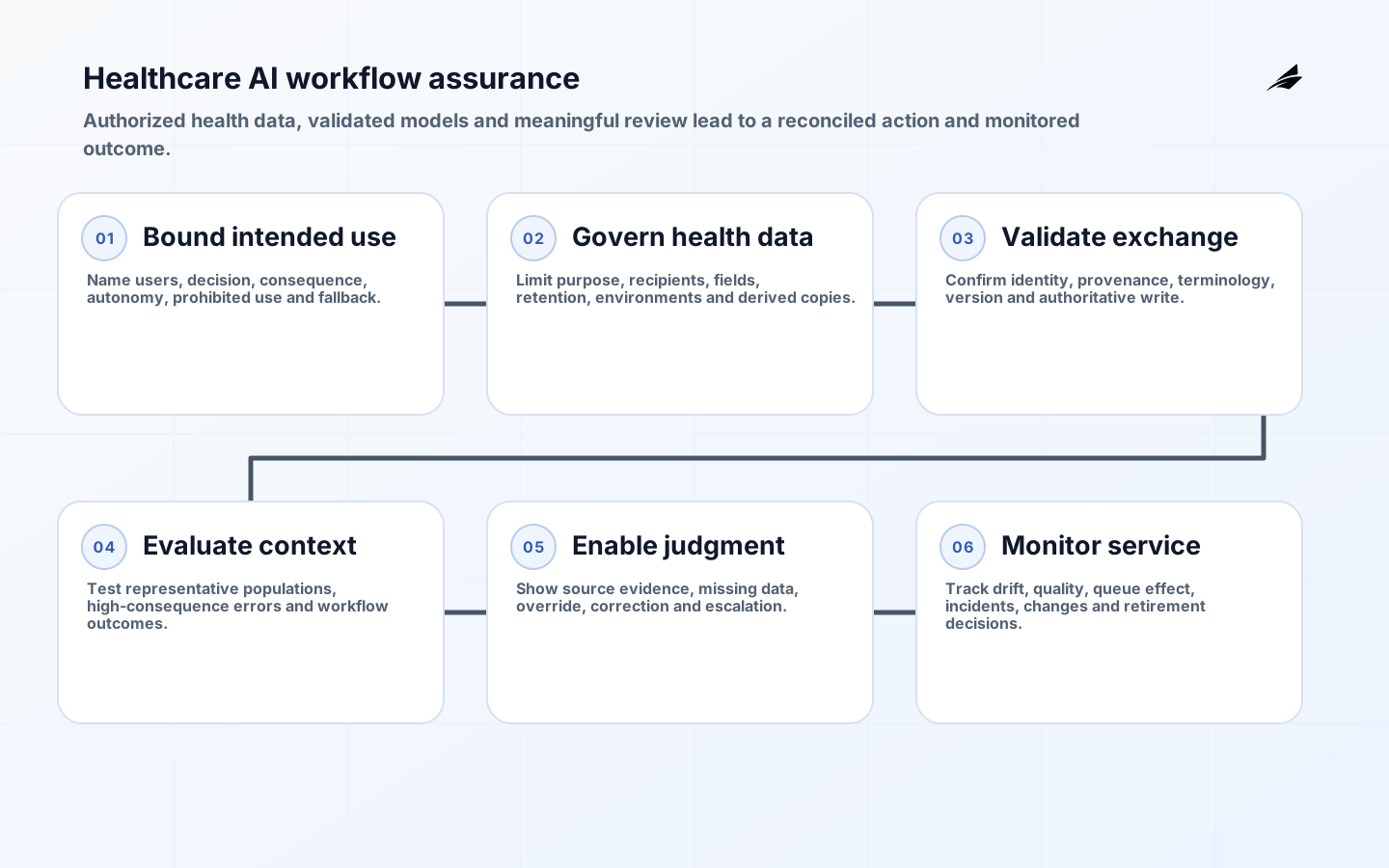
AI workflow automation services for healthcare should improve a defined care, administrative or operational process without hiding who remains responsible for the result. The term covers very different systems: extracting fields from referrals, summarizing records, predicting a risk, drafting a message, assigning work or initiating an action. Each has a different evidence and authority requirement. A model that suggests a queue priority is not equivalent to one that changes medication, denies a claim or sends patient instructions. The workflow—not the model brand—determines the risk.
This FAQ helps providers, health plans, digital-health teams and software buyers turn an automation idea into a controlled service. It is not legal or clinical advice. Applicability of HIPAA, FDA requirements, ONC certification rules, state law and the FTC Health Breach Notification Rule depends on the organization, data and intended use. The delivery team should involve privacy, security, clinical safety, compliance and affected workforce owners early. A generic statement that a vendor is “HIPAA compliant” does not establish the customer’s permitted use, configuration, integration or operating controls.
Which healthcare workflow should be automated first?
Choose a bounded process with a named owner, visible inputs and a reversible output. Good starting candidates often reduce clerical routing, duplicate entry or document classification while leaving consequential decisions with qualified people. Map the current trigger, records consulted, decision points, handoffs, exceptions and completion evidence. Baseline elapsed time, queue age, rework, abandonment, safety events and staff burden. Do not select a use case only because data are available; confirm that the result supports a real decision and that users can act on it.
Classify intended use before architecture. Is the system administrative, operational, patient-facing, clinical decision support or part of a medical device? Does it merely present information, recommend an action or execute one? Which people can be harmed by a false positive, false negative, omission, delay or confusing explanation? Can the result be corrected? Document prohibited uses and escalation thresholds. If the proposed boundary changes during delivery, repeat the review rather than assuming the original approval still applies.
| Workflow pattern | Primary risk | Appropriate first authority |
|---|---|---|
| Document classification | Wrong record or destination | Suggest class; user confirms exceptions |
| Queue prioritization | Delayed care or unfair ranking | Recommend with visible factors and override |
| Clinical summarization | Omission or unsupported statement | Draft with source links; clinician verifies |
| Patient communication | Misleading instruction or disclosure | Approved templates and human review for consequential content |
| Order or treatment action | Direct patient harm | No autonomous execution without applicable clinical and regulatory evidence |
How should health-data boundaries be defined?
Create a data-flow record from each source through processing, model provider, storage, logs, review interface, downstream system and deletion. Identify protected health information, other sensitive health data, purpose, legal basis, minimum necessary fields, residency, retention and recipients. Determine whether each supplier is a business associate or falls under another role; execute appropriate agreements before production data move. Health apps outside HIPAA may still fall within the FTC Health Breach Notification Rule. Avoid copying complete records when the workflow needs only a few attributes.
Separate production health data from development and evaluation sets. De-identification is a defined privacy process, not the removal of names alone. Protect keys and re-identification mappings separately, restrict exports and prevent sensitive content from entering unapproved prompts, analytics or support tools. Logs need enough context for investigation without reproducing entire clinical notes. Establish patient-access, correction, legal-hold and deletion behavior across primary and derived data. Test that a terminated user, expired integration and deleted tenant lose access everywhere, including caches and search indexes.
What does safe interoperability require?
Use the organization’s supported health-information standards and implementation guides. FHIR defines resource structures and REST interactions, but its core API does not by itself provide authentication, authorization or audit collection. Record the FHIR version, profiles, terminology bindings, search behavior and extension policy. Validate patient and encounter context, provenance, timestamps and units. A technically valid resource can still represent the wrong person or clinical meaning. Reconcile writes in the authoritative system and make retries idempotent so a timeout cannot create duplicate work.
Define downtime and partial-data behavior. If the electronic health record, identity service, terminology server or model endpoint is unavailable, should the process queue, fall back or stop? Show users when information may be stale or incomplete. Preserve the source references used for a summary or recommendation so a reviewer can inspect them. Use scoped service identities for integrations and separate read from write authority. Changes to schemas, mappings or code systems require contract tests and clinical review where meaning could change.
How should an AI component be evaluated?
Create an evaluation plan before tuning. Define the task, reference process, populations, settings, time period, edge cases and unacceptable failures. Measure task-specific quality and end-to-end workflow outcomes. For extraction, examine each consequential field and abstention behavior; for prioritization, examine sensitivity, false-negative consequences and subgroup performance; for generation, assess factual support, omissions, unsafe instructions and source attribution. Report uncertainty and sample sizes. One aggregate accuracy value can conceal poor performance for a smaller site, language or patient group.
NIST’s AI Risk Management Framework organizes work around governing, mapping, measuring and managing risk. In healthcare, those activities need clinical and operational evidence. Run retrospective evaluation, then shadow operation without affecting work, then a limited prospective release. Compare automation with the actual baseline, not an idealized human score. Track reviewer disagreement and reasons. HTI-1 establishes transparency expectations for predictive decision support in certified health IT; even where a specific certification criterion does not apply, documenting purpose, inputs, validation and limitations helps users judge appropriateness.
| Gate | Evidence | Stop condition |
|---|---|---|
| Data readiness | Representative, governed data with provenance | Unknown population or material missingness |
| Offline evaluation | Task metrics, subgroup results and error review | Unacceptable high-consequence failure |
| Shadow operation | Real workflow comparison without action | Unexplained drift or integration mismatch |
| Limited release | Named users, monitoring and rapid fallback | Safety signal, privacy event or uncontrolled queue effect |
| Scale | Stable outcomes and trained support | Review burden or exception rate exceeds capacity |
What makes human review meaningful?
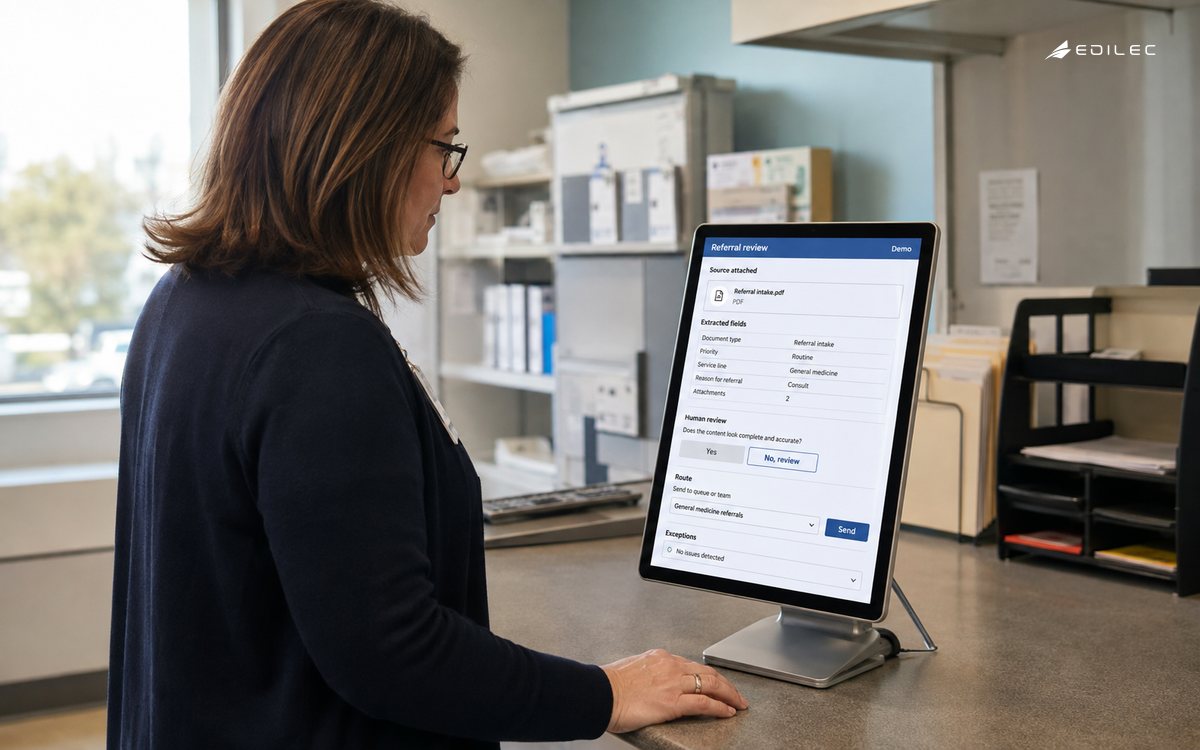
A person in the loop is not a control if the interface encourages automatic acceptance. Show the proposed result, relevant source evidence, important missing data, uncertainty and the actions available. Give reviewers time, competence and authority to correct, defer or reject. Avoid requiring them to reread an entire record to discover whether a summary is accurate; highlight source passages without replacing clinical context. Record the reviewer’s decision and material edit, but do not turn speed into a target that discourages scrutiny.
Define escalation for disagreement, repeated abstention and suspected harm. Patient-facing workflows need clear ways to reach a person and challenge an outcome. Clinical accountability remains with qualified professionals and organizational governance; a supplier should not imply otherwise. Train users on intended use, known limitations, privacy, downtime and incident reporting. Monitor automation bias by sampling accepted outputs and comparing edits across teams. If reviewers routinely rewrite the result, the system may be increasing work despite high acceptance counts.
Which security controls are essential?
HHS states that the HIPAA Security Rule requires administrative, physical and technical safeguards for electronic protected health information. Apply unique identities, strong authentication, least privilege, environment separation, encryption, secret management, secure configuration, vulnerability handling, audit controls, backup and tested recovery. Threat-model paths specific to the model: prompt injection through untrusted clinical content, cross-tenant retrieval, sensitive output leakage, excessive tool permissions and malicious files. Enforce authorization in trusted application code; do not rely on a model instruction to protect data or actions.
Establish incident procedures that join security, privacy, patient safety, clinical operations and vendor response. Preserve prompts or inputs, retrieved evidence, model and configuration version, output, reviewer action and downstream effect where lawful and necessary. Define who can disable the feature, stop writes, notify users and assess breach obligations. If the product is or supports a regulated medical device, align secure development, vulnerability management and update evidence with applicable FDA guidance. Test an outage and a suspected data exposure before broad release.
How should the service be operated after launch?
Monitor data freshness, integration failures, abstentions, output quality samples, override patterns, subgroup outcomes, queue effects, latency, cost and user-reported concerns. Tie alerts to owners and runbooks. Version prompts, models, retrieval content, mappings and policy separately so a change can be traced. Re-evaluate after material changes in population, workflow, vendor model or clinical policy. A supplier’s silent model update can alter behavior even when application code is unchanged; contracts and architecture should provide notice, testing and rollback options.
Govern at operational and clinical-risk cadences. Review incidents, near misses, workarounds, privacy requests and unresolved limitations, then decide whether to improve, constrain or retire the automation. Measure completed workflow outcomes, not generated outputs. Useful measures include turnaround time, backlog, rework, escalation, safety events, staff burden and patient experience. Savings claims should include review, integration, monitoring and exception-handling effort. An automation that shifts hidden work to clinicians or patients has not improved the system.
Key takeaways
- Classify the healthcare workflow, consequence and intended authority before choosing a model.
- Map health-data purpose, recipients, retention and derived data across every supplier and log.
- Validate clinical meaning and identity around FHIR or other technical exchanges.
- Evaluate representative populations and end-to-end workflow outcomes in staged release gates.
- Give human reviewers evidence, time, authority and a genuine escalation path.
Frequently asked questions
Is a signed business associate agreement enough?
No. Agreements allocate obligations, but the customer still needs a lawful purpose, risk analysis, appropriate configuration, access control, secure integrations, monitoring and incident procedures. The exact obligations depend on the parties and use case.
Should AI make clinical decisions autonomously?
Autonomy should follow intended use, evidence, consequence and applicable regulation. High-consequence clinical actions require far stronger evidence and controls than administrative assistance. Many appropriate deployments keep qualified review and explicit authorization.
Does using FHIR make an integration safe?
FHIR improves structural interoperability, but implementers must still manage profiles, identity, terminology, authorization, audit, retries, versioning and clinical validation. A valid resource can contain incomplete, stale or misidentified information.
Conclusion
Healthcare AI workflow automation succeeds when the organization can trace an outcome from authorized data and validated logic through meaningful human judgment to a reconciled system of record. That requires more than a model demo. It requires clinical scope, privacy and security boundaries, interoperability tests, representative evaluation, safe fallback and lifecycle ownership. When those parts are visible, automation can remove avoidable work while preserving the accountability on which health services depend.