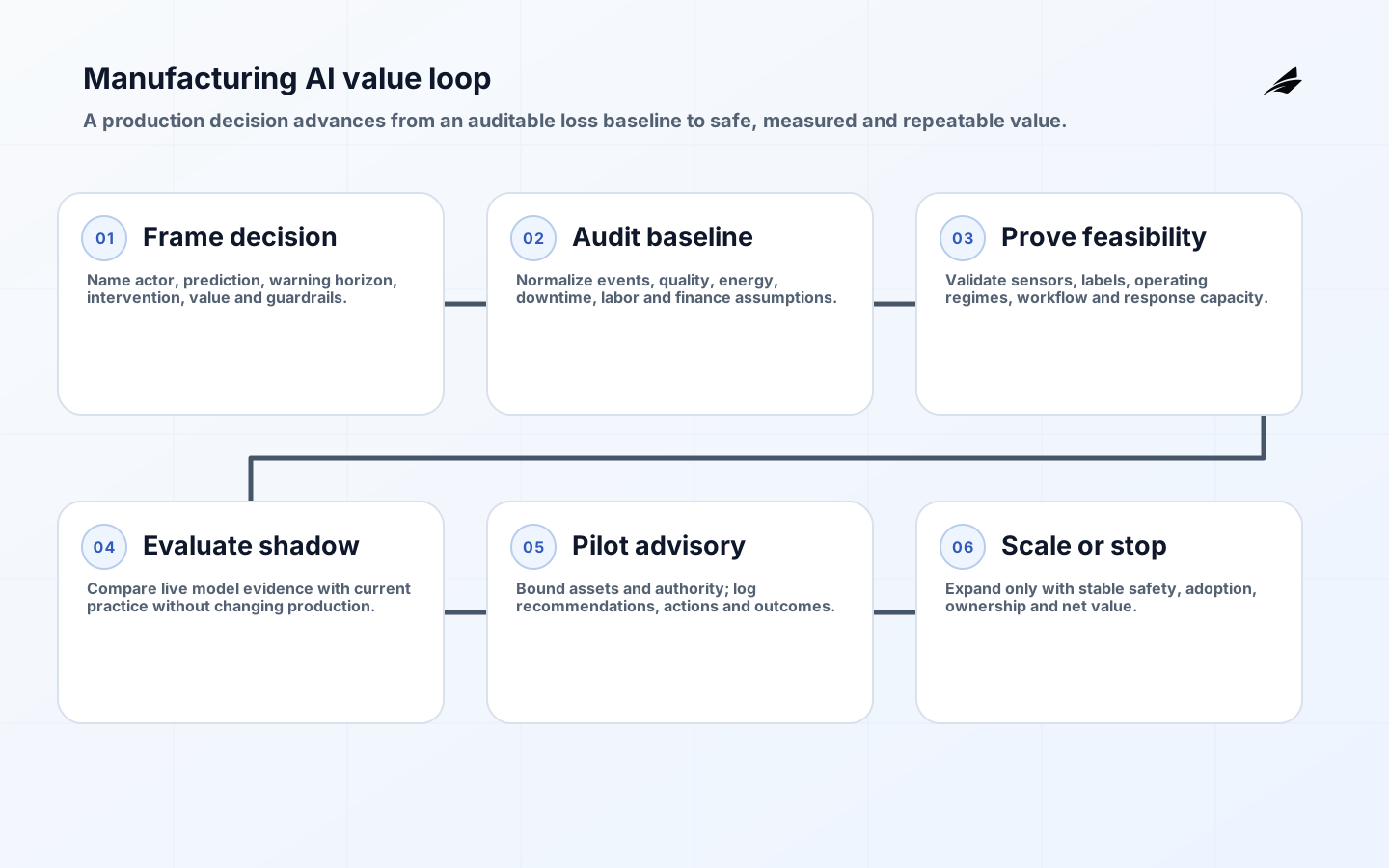
AI automation ROI planning for manufacturing should begin with a constrained production decision, not a promise that artificial intelligence will optimize the plant. Value appears only when a prediction or recommendation changes maintenance, quality, energy, scheduling or operator action and the resulting outcome can be measured against a credible baseline. The business case must include integration, verification, safety, workforce, downtime and ongoing model operation.
This guide helps plant leaders, operations, finance and engineering decide whether to pilot and scale. It complements the manufacturing AI implementation checklist, the manufacturing ROI FAQ and the general AI services delivery plan. Safety, employment and regulatory obligations depend on use and jurisdiction; involve qualified owners before deployment.
Choose a decision with measurable production value
Frame the use case as actor, decision, horizon, intervention and outcome. “Predictive maintenance” becomes “give the maintenance planner sufficient warning to inspect a named spindle before quality or availability is harmed.” List the current signal, response, delay and consequence. Strong candidates have recurring decisions, observable outcomes, enough representative data and an intervention the plant can execute. A high-accuracy model creates no value when parts, staff or authority are unavailable.
Prioritize by expected value, feasibility and consequence. Quality inspection, anomaly triage, energy optimization and maintenance may be candidates, but each has different labels and feedback. NIST's manufacturing work notes that many machine tools lack practical production measurements and generic pretrained models may not fit a specific machine. Treat data availability and transferability as hypotheses. Avoid placing an unproven model directly in a safety-critical control loop.
| Use case | Decision changed | Value signal | Critical guardrail |
|---|---|---|---|
| Maintenance triage | Which asset to inspect and when | Avoided disruption and planned work | Missed dangerous condition |
| Quality support | Which unit needs review | Scrap, rework and escape rate | False acceptance |
| Energy optimization | Which setpoint or schedule to change | Normalized energy and demand cost | Process or safety constraint |
| Production scheduling | How to sequence constrained work | Throughput, lateness and changeover | Priority customer or material rule |
| Operator knowledge | Which procedure or evidence to surface | Resolution time and first-pass completion | Incorrect instruction followed |
Build a baseline finance can audit
Define a comparable period and normalize for product mix, volume, shift, equipment state, season, energy tariff and planned maintenance. Use source records finance and operations trust: work orders, downtime codes, quality disposition, meters, production counts and labor. Audit definitions with frontline staff because a downtime label may reflect reporting habit rather than physical cause. Record missing data and changes to collection during the study.
Estimate opportunity from addressable events, not total plant loss. If a model can influence only failures with detectable precursors and enough response time, exclude the rest. For energy, compare normalized consumption or demand under equivalent production, not raw monthly bills. DOE's MEASUR tools illustrate engineering analysis for industrial systems; AI should not replace physical constraints and measurement. Use ranges for uncertain frequency, effectiveness and adoption.
Model benefits, costs and uncertainty explicitly
Annual expected benefit can be expressed as addressable events multiplied by avoided loss per event, model-assisted capture rate and operational adoption, plus measurable quality, energy or throughput gains, minus displacement effects. Keep assumptions separate. A high technical detection rate cannot compensate for low intervention adoption. Avoid double counting the same recovered hour as both throughput revenue and downtime savings unless the plant can sell and fulfill the additional output.
Total cost includes sensors, connectivity, historian or data platform work, labels, integration with MES or CMMS, model development, validation, cybersecurity, safety review, training, planned downtime, cloud or edge compute, monitoring, support, retraining and retirement. Include internal subject-matter time and parallel operation. Calculate net present value or payback using the organization's finance rules, with downside, expected and upside scenarios. Do not publish a false-precision ROI from guessed inputs.
| Assumption | Downside case | Expected case | Evidence to improve confidence |
|---|---|---|---|
| Addressable event frequency | Lower observed rate | Validated historical rate | Longer coded history |
| Detection usefulness | Late or noisy warning | Actionable warning window | Shadow-mode event review |
| Operator adoption | Recommendations often bypassed | Workflow integrated and trusted | Pilot action logs and interviews |
| Avoided loss | Only direct variable cost | Approved contribution estimate | Finance-reviewed event costing |
| Run cost | High support and labeling | Stable managed operation | Measured pilot labor and compute |
Prove data and intervention feasibility before modeling
Map sensor source, calibration, sampling, clock, unit, asset identity, maintenance state and network path. Check whether labels represent the event the model should predict and whether repairs changed the process. Prevent leakage: post-failure codes, future measurements or operator decisions cannot be training features for an earlier prediction. Split evaluation by time, asset or line to match expected deployment. Preserve raw evidence and transformations for reproducibility.
Map the intervention with equal care. Define who receives the output, explanation and uncertainty; what they can do; how quickly; and what evidence closes the loop. Integrate into existing work management rather than adding a dashboard nobody owns. Include abstention, unavailable sensors, communication loss and model-service failure. In advisory use, preserve operator authority and collect reasons for accepting, changing or rejecting recommendations without turning feedback into punitive surveillance.
Govern safety, cybersecurity and workforce impact
Use the NIST AI RMF functions Govern, Map, Measure and Manage to organize accountability, context, evaluation and ongoing response. Classify consequence if the model is wrong, late, manipulated or unavailable. Keep deterministic safety systems and validated control limits independent unless a formal engineering process approves integration. Threat-model sensors, gateways, remote access, model artifacts and update channels. An AI pilot must not create an unmanaged path into operational technology.
Involve operators, maintenance, quality, safety, labor relations and cybersecurity during design. Define training, changed workload and escalation. Measure whether alerts create fatigue or shift hidden work to one team. The EU AI Act uses intended purpose for risk classification and includes obligations for some high-risk systems, including documentation, logging, human oversight, robustness and cybersecurity. Obtain legal classification for applicable deployments instead of inferring it from a generic AI label.
Run a pilot that can answer a scale decision
Use historical backtesting to eliminate weak ideas, then shadow mode to evaluate live data without changing production. Predefine technical, operational, financial and safety thresholds. Compare against current practice, not against no decision. Record every eligible event, model output, operator action and outcome. Avoid choosing only favorable machines or periods. A pilot should cover enough operating conditions to expose maintenance changes, product shifts and sensor failure, while remaining bounded enough to contain harm.
Move from shadow to advisory operation under a change plan. Limit assets, shifts or users; keep rollback and manual procedure ready. Review false positives, false negatives and warning time with consequences attached. Technical metrics such as precision and recall matter only in relation to event cost and action. Stop when data cannot support the use case, intervention is impractical, guardrails fail or expected net value no longer clears the investment threshold.
Use six gates from hypothesis to scaled value
- Frame one production decision, addressable loss, owner and guardrails.
- Audit baseline, data, labels, intervention capacity and regulatory context.
- Model downside, expected and upside economics with full lifecycle cost.
- Evaluate offline and in shadow mode against current practice.
- Pilot advisory use with bounded authority, safety controls and action logging.
- Scale only after stable net value, ownership and monitoring are demonstrated.
Scale by operating pattern, not model file
Before replication, identify what is invariant and what changes by machine, line, plant, product and workforce. Validate sensor equivalence, calibration, labels, network, process windows and intervention. Use versioned deployment packages and site acceptance tests. A model trained on one asset family may need recalibration or replacement elsewhere. Budget local engineering and change work. Central governance should provide standards and evidence while plant owners retain operational authority.
Monitor input quality, drift, output distribution, action, realized outcome, latency, availability and cost. Set review and retraining triggers from observed degradation, not an arbitrary calendar alone. Keep a champion baseline and rollback. Review unresolved alerts and human overrides. Recalculate economics after changes in volume, energy price, maintenance policy or model cost. Retire the system when benefit disappears or a simpler control becomes superior.
Key takeaways
- Choose a specific decision and count only loss the intervention can influence.
- Normalize a finance-auditable baseline and expose uncertainty in scenarios.
- Prove data, warning time and operational action before investing in model complexity.
- Keep safety systems, human authority and OT cybersecurity explicit.
- Scale the full operating pattern and continue measuring realized net value.
Frequently asked questions
What is a good payback period for manufacturing AI?
There is no universal period. Use the organization's capital threshold and compare with safer alternatives, uncertainty and lifecycle risk. A short calculated payback based on unverified avoided downtime is weaker than a longer case supported by controlled operational evidence.
How much historical data is enough?
Enough representative events and normal operation to evaluate the required decision across relevant conditions. Rare failures may need engineering models, transfer learning or a different use case. More rows do not fix biased labels or missing operating regimes.
Should inference run at the edge or in cloud?
Choose from latency, connectivity, data sensitivity, hardware, update and support needs. Edge can preserve local operation; cloud can simplify centralized management. Many plants use a hybrid design with local safe behavior and centralized training and governance.
Conclusion
Manufacturing AI produces returns when evidence connects a trustworthy signal to a feasible intervention and a measured plant outcome. Build the baseline, count only addressable value, include full operating cost and pilot under real constraints. Scale after safety, adoption and net value remain credible, not after a model wins an offline benchmark.