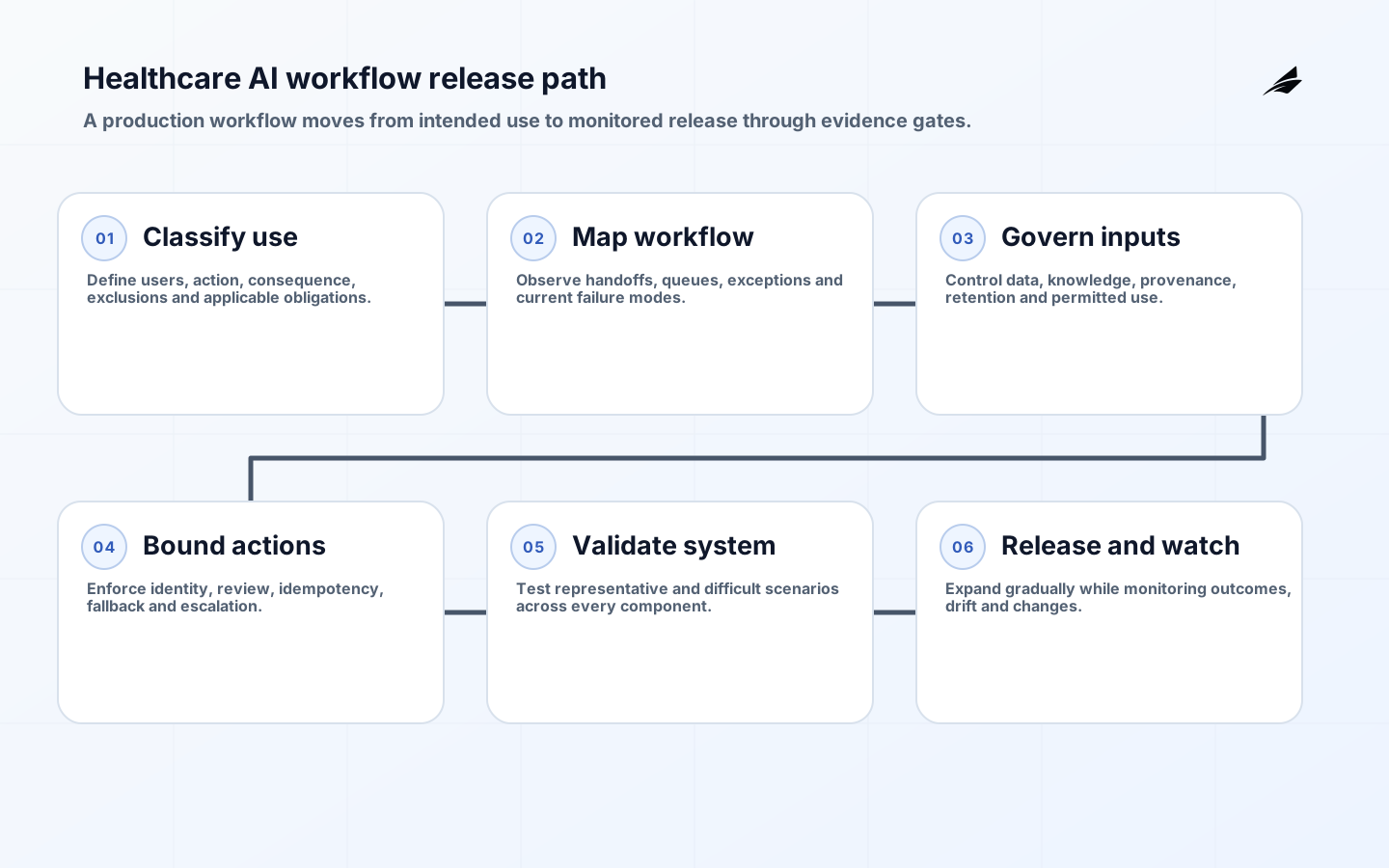
AI workflow automation services for healthcare should be implemented as a controlled change to a care or administrative process, not as a model connected directly to production. The implementation must define what initiates the workflow, which data is permitted, what the system may propose or execute, when a person must intervene, how exceptions are recovered, and which evidence proves acceptable operation. These requirements apply whether the system extracts referral data, drafts documentation, supports coding, prioritizes messages or presents decision support.
Use this checklist after the organization has selected a bounded outcome and accountable service owner. It complements the healthcare AI scope and delivery plan and healthcare AI FAQ. The sequence moves from classification and workflow evidence through architecture, validation and release. It should be adapted to local law, clinical governance and technology; it is not a substitute for qualified privacy, security, clinical or regulatory assessment.
1. Classify the workflow and intended use
Write an intended-use statement that names users, affected people, input data, output, action, environment and exclusions. Separate administrative assistance from software that supports prevention, diagnosis or treatment. For clinical decision support, assess FDA’s current CDS criteria, including intended user, time criticality, whether the output is a recommendation or directive, and whether the healthcare professional can independently review the basis. If certified health IT is involved, determine how ONC decision-support and algorithm-transparency requirements apply. Record the determination and the qualified owners who approved it.
Map consequence before automation level. A draft that is reviewed before use differs from a recommendation shown during an urgent decision, and both differ from an action executed without confirmation. Identify foreseeable misuse, automation bias, missed escalation, inappropriate population use and workflow workarounds. Set prohibited actions and hard boundaries in system design rather than relying only on training. Reassess classification when intended use, users, data, model, interface, clinical context or degree of automation changes. A procurement label such as “copilot” does not determine regulatory or operational risk.
| Decision | Required record | Owner | Release evidence |
|---|---|---|---|
| Intended use | Users, inputs, output, action and exclusions | Clinical and product owner | Approved use statement |
| Regulatory position | Applicable pathways and rationale | Regulatory counsel | Dated classification |
| Automation authority | Propose, draft, route or execute | Workflow owner | Enforced permissions |
| Human oversight | Reviewer, timing and escalation | Clinical operations | Usability and scenario test |
2. Map the current workflow and failure modes
Observe representative work from trigger to completion. Record queues, handoffs, data lookups, duplicate entry, informal communication, exceptions and downstream corrections. Interview the people who perform, supervise and receive the work. Baseline volume, touch time, elapsed time, rework, abandonment, escalation and relevant quality outcomes. Include nights, weekends, high-demand periods and uncommon but consequential cases. An automation that optimizes the visible middle step may worsen the overall service if it increases intake defects or sends more ambiguous work to a downstream team.
Create a failure-mode register with cause, consequence, detectability, existing control and proposed response. Include missing or delayed source data, duplicate patients, stale policies, ambiguous text, conflicting records, model unavailability, low-confidence output, unauthorized access and integration retries. For each failure, decide whether the system should stop, fall back, ask for clarification, route to a person or continue with a visible warning. Assign an owner and test case. Recovery behavior is part of the feature, not post-launch support documentation.
3. Govern data and knowledge sources
Inventory every data source and field. Record system of record, purpose, lawful authority, sensitivity, data owner, quality rule, update timing, retention and permitted destinations. Use the minimum data necessary for the approved workflow. Confirm business-associate and subcontractor arrangements where required, and understand whether vendors retain inputs, outputs or telemetry for product improvement. Keep production health information out of unapproved development and evaluation services. Use de-identified or synthetic data only when it preserves the characteristics needed for the test.
Treat guidelines, policies and reference material as governed dependencies. Record publisher, effective date, version, approval owner and replacement process. Retrieval should preserve source identity and allow reviewers to inspect the basis for a consequential suggestion. Define behavior when sources conflict or expire. Test the complete information path, including document parsing and ranking, rather than evaluating only the final model. ONC’s decision-support criterion illustrates the importance of source attributes and feedback data; local implementations should make provenance useful to actual users, not merely present in a hidden log.
4. Design integration, identity and action controls
Use stable patient, encounter, order, message and task identifiers across interfaces. Specify event ordering, retries, idempotency, reconciliation and late-arriving data. Do not let a timeout create a duplicate order or close a task that was never completed. Separate read, propose and execute permissions. Service identities should be workload-specific, least privileged, rotated and monitored. Human approval must record who reviewed which version of the information, what action was taken and when. Emergency access needs an explicit trigger and retrospective review.

Design the interface around the decision moment. Show uncertainty and material source information where users need it. Make edit, reject, defer and escalate actions efficient, and capture reasons without imposing excessive burden. Do not visually privilege acceptance over correction. Confirm accessibility, language, device and interruption behavior in the real environment. Measure additional clicks and review time. A technically accurate system can fail when it arrives too late, obscures existing information or creates an alert that competes with higher-priority clinical signals.
| Control area | Implementation check | Test | Evidence |
|---|---|---|---|
| Identity | Individual and workload roles are least privileged | Attempt unauthorized read and action | Access decision and audit event |
| Integration | Messages are idempotent and reconcilable | Retry, reorder and duplicate events | Reconciliation report |
| Human review | Material actions require the assigned role | Approve, reject and unavailable-reviewer paths | Decision history |
| Fallback | Work continues safely during outage | Disconnect model and source systems | Recovery timing and queue integrity |
5. Validate the complete system
Build an evaluation set that represents intended use, important subgroups, common exceptions and high-consequence boundary cases. Keep a protected holdout for release decisions. Select measures according to the harm: sensitivity may matter for urgent-message escalation, while positive predictive value and reviewer burden may matter for a coding suggestion. Report uncertainty and sample size. Test source retrieval, interface behavior, permissions, integrations and human response as well as model output. Document known limitations in language users can act upon.
Run scenario-based acceptance with real roles. Include missing data, conflicting information, low confidence, policy change, outage, access loss, abnormal volume and attempted use outside scope. Test security controls, audit completeness, backup, recovery and incident communication. Independent reviewers should examine consequential cases and disagreement patterns. Define release and stop thresholds before reviewing final results. When a metric fails, investigate and repeat a versioned evaluation; do not quietly remove difficult cases or redefine the denominator to make the release appear acceptable.
6. Pilot, release and train in controlled stages
Begin with a limited site, role, population and volume that can be supported closely. Use shadow or draft-only operation before enabling actions. Maintain a control or comparable baseline where feasible. Brief users on purpose, boundaries, source visibility, expected review, reporting and fallback. Training should include realistic failure cases rather than only successful demonstrations. Staff must know that they can question the system and how to obtain timely human support. Monitor operational load so a new review queue does not become an invisible bottleneck.
Use an explicit release checklist: approved intended use, versioned components, passed evaluation, secure configuration, privacy review, support roster, incident runbook, rollback or disable control, user communication and dashboard ownership. Expand one dimension at a time, such as site or case type, and recheck results before the next step. Preserve the prior safe configuration where rollback is technically possible. If the system affects a time-critical workflow, test disablement and manual continuity during live operating conditions.
7. Monitor outcomes, drift and changes
Monitor eligible volume, use, latency, unavailable dependencies, output distribution, edits, overrides, escalations, downstream corrections and relevant service outcomes. Segment where lawful and meaningful so aggregate results do not conceal unequal performance. Link each event to the deployed model, prompt, knowledge and workflow versions. Define alert thresholds, investigation ownership and maximum response times. User feedback should enter a managed queue with severity and closure evidence; a feedback button that nobody reviews is not a safety control.
Maintain change control for models, prompts, integrations, reference sources, user interface and operating policy. Classify changes by potential consequence and map each class to required regression tests, approvals and rollout method. Review vendor release notices against the intended use rather than accepting silent upgrades. Periodically confirm access, data flows, retention, fallback and business value. Retire the automation when it cannot meet thresholds, the workflow disappears or a safer process replaces it. Archive required evidence and remove credentials and data access.
Key takeaways
- Classify intended use and consequence before choosing an automation level.
- Validate integration, interface and human response together with model output.
- Govern clinical and operational knowledge as versioned dependencies.
- Design failure, fallback and reconciliation paths before production.
- Expand only through evidence gates with observable outcomes and stop rules.
Frequently asked questions
Should every AI output receive human approval?
Oversight should match consequence, uncertainty and regulation. Some low-risk classification or drafting tasks may use sampling after validation; consequential recommendations or actions may require review before use. The decision and rationale must be explicit.
Can a vendor validation report replace local testing?
No. Vendor evidence is an input. Local data, workflow, population, integrations, interface and oversight determine actual performance. Test the configured system in its intended environment and maintain evidence for the deployed version.
What is the minimum safe pilot?
It is large and representative enough to test predefined outcomes and important failures, but narrow enough for close support and rapid disablement. Size follows the measures and consequence; it is not a fixed number of users.
Conclusion
Healthcare AI workflow automation succeeds when the organization can explain the intended use, trace every material input and action, demonstrate performance in context, and recover safely when assumptions fail. The checklist therefore covers more than model quality: it makes data, integration, people, authority and change part of one controlled service.
Before go-live, run one end-to-end exercise that includes a difficult case, a missing dependency, a rejected output, an unavailable reviewer and a rollback. If owners can preserve the work, protect the patient, reconstruct the decision and resume safely, the implementation has meaningful evidence. If not, keep the scope bounded and close the operating gaps first.