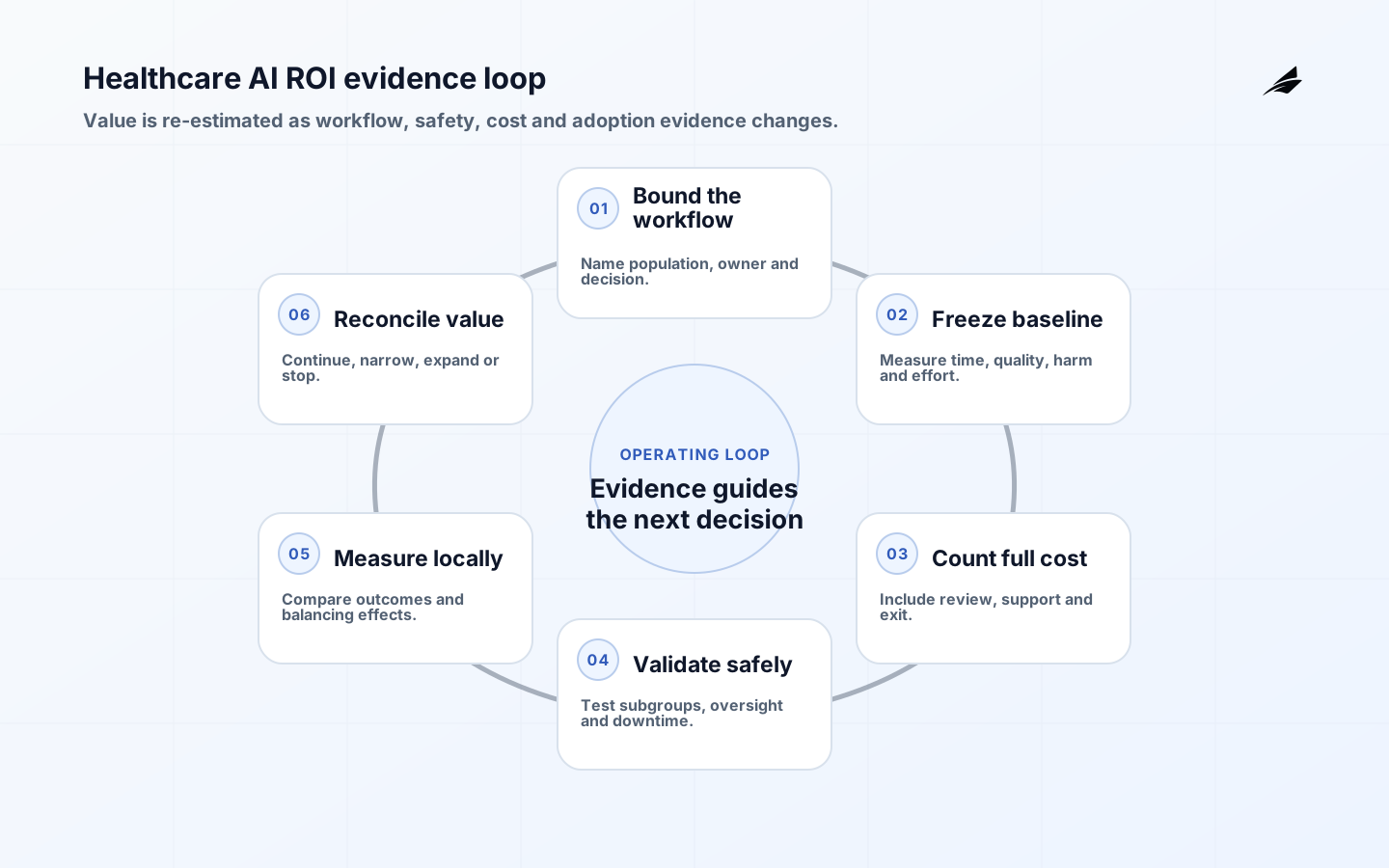
Healthcare AI automation ROI planning asks whether a defined workflow produces better outcomes after implementation cost, new work, safety risk and uncertainty are counted. It is not a forecast built by multiplying minutes saved by every transaction. This FAQ explains how to construct an auditable case for administrative, operational and clinical-support uses. Continue with Edilec's healthcare AI business guide, implementation checklist and AI capabilities checklist.
What counts as healthcare AI automation ROI?
Use a net-value view: realized financial and operational benefit, plus valued quality or access improvement, minus full lifecycle cost and expected harm. Keep monetary, clinical, workforce and equity outcomes visible rather than forcing every result into one currency. A scheduling assistant may reduce avoidable contacts while increasing portal messages; a documentation tool may reduce after-hours work but add review. Measure the complete workflow and affected groups.
Define the decision horizon and attribution method. Compare with a credible baseline, preferably through phased rollout, matched units or time-series analysis that accounts for volume and case mix. State which savings are cash-releasing, capacity-releasing or avoided future cost. Time released is not cash unless staffing, overtime, throughput or another budget line changes.
| Value category | Example measure | Evidence source | Common mistake |
|---|---|---|---|
| Patient outcome | Timely follow-up or harm avoided | Clinical record and review | Claiming causality from adoption |
| Access | Wait time and completed appointments | Scheduling system | Ignoring shifted demand |
| Workforce | After-hours work and rework | Workflow events and survey | Valuing every minute as payroll |
| Finance | Collected revenue or avoided expense | Finance ledger | Using vendor estimates |
| Quality | Error and exception rate | Audited case sample | Measuring only speed |
How should the baseline be built?
Map the current journey from trigger to final record, including queues, interruptions, corrections, denials, handoffs and patient effort. Sample normal, complex and failed cases. Record volume by population and site, labor by role, elapsed time, quality defects, downstream contacts and safety events. Use several periods where seasonality matters. Averages can hide a small group of cases that consumes most effort or carries most harm.

Pre-register pilot measures, exclusions, review windows and stop conditions. Decide how missing data, staff learning and simultaneous process changes will be handled. Preserve baseline definitions after launch. Changing a denominator or excluding difficult cases can manufacture apparent improvement. Finance, clinical, privacy, security and operations owners should sign off on the measurement design before procurement becomes a sunk cost.
Which costs belong in the model?
Include licenses and model use, integration, interface maintenance, data preparation, validation, clinical safety review, security and privacy work, user training, workflow redesign, monitoring, human review, support, incident response, vendor oversight, change control and exit. Add temporary productivity loss during adoption and the cost of parallel operation. Model price and workload sensitivity because token, imaging, message or transaction volume may rise differently from patient volume.
| Cost layer | One-time examples | Recurring examples | Sensitivity driver |
|---|---|---|---|
| Technology | Integration and environment | Licenses, compute and storage | Volume and model choice |
| Assurance | Validation and risk review | Monitoring and revalidation | Change frequency |
| People | Training and workflow design | Review, support and governance | Exception rate |
| Operations | Deployment and parallel run | Incidents and reconciliation | Reliability |
| Exit | Export and replacement design | Archive and transition support | Vendor dependency |
How do HIPAA and FDA scope affect ROI?
For US regulated entities, the HHS Security Rule summary describes administrative, physical and technical safeguards for electronic protected health information, and HHS risk-analysis guidance requires an accurate and thorough assessment across all ePHI the organization creates, receives, maintains or transmits. Privacy and security work is part of implementation cost, not optional overhead.
Determine whether functionality is a medical device or otherwise regulated based on intended use and applicable law, with qualified counsel and regulatory experts. The FDA AI-enabled medical-device list identifies authorized devices but says it is not comprehensive. FDA's digital health guidance index distinguishes final and draft guidance. Marketing authorization for a product does not prove local effectiveness, workflow fit or ROI.
How should safety and human oversight be valued?
Describe the human decision, time available, information shown, authority to disagree and escalation when the system is uncertain. Measure automation bias, alert burden, review time, overridden recommendations, missed cases and subgroup performance. Human review is not a control unless reviewers have competence, context, time and a usable way to correct the record. Include downtime and a manual path in both safety and cost models.
The ONC HTI-1 decision-support resource summarizes transparency requirements for relevant certified health IT. Applicability depends on product and role, but the principle is useful: users need enough information about purpose, development and performance to assess a predictive intervention. The NIST AI RMF adds continuous Govern, Map, Measure and Manage practices.
What makes a credible pilot?
- Select one workflow, accountable clinical or operational owner and bounded patient population.
- Freeze baseline, outcome, balancing, safety and cost definitions before configuration.
- Validate normal, complex, subgroup, adversarial and downtime cases before live use.
- Release in phases with stop authority, visible human oversight and rapid incident review.
- Compare realized workflow, quality, access and financial effects with the baseline.
- Scale only after unresolved harms, hidden labor and cost sensitivity are accepted.
Should a positive vendor study justify purchase?
No single study establishes local value. Examine population, setting, comparator, endpoints, missing data, conflicts and whether the evaluated version matches the product offered. Reproduce critical measures with local workflow and case mix. Vendor evidence can inform assumptions; the provider organization remains responsible for its use, integration, workforce and patient outcomes.
How long before ROI should be declared?
Use milestones rather than a universal period. Technical readiness, safe adoption, workflow stabilization and sustained outcomes mature at different rates. Report provisional results with confidence ranges and unresolved costs, then reassess after enough representative cases and change cycles. Do not annualize the best pilot month without accounting for seasonality, support and drift.
Reconcile the business case after go-live
At thirty, ninety and one hundred eighty days, reconcile the approved case with actual use. Compare eligible encounters, attempted use, completed use, overrides, exceptions and downtime. Explain differences between purchased capacity and realized volume. Separate adoption delay from poor task fit. A favorable per-case estimate cannot offset a service that reaches only a small, unrepresentative share of the intended population.
Audit labor on both sides of automation. Measure preparation, review, correction, escalation, support, data cleanup and governance, including work shifted to nurses, patients, front-desk staff or vendors. Interview users and sample event logs because hidden work rarely appears in the license report. Update the cost model when a new queue or manual reconciliation becomes permanent. Capacity released in one role can be consumed by another.
Review clinical and operational outcomes by relevant subgroup and site. Investigate differences rather than assuming small samples prove equivalence. Examine false reassurance, delayed escalation, abandonment and patient communication. Include balancing measures such as wait time elsewhere, message volume, alert burden and staff fatigue. The goal is to understand the net system change, not to defend the original sponsor forecast.
Confirm that the deployed version matches validated evidence. Record model, prompt, workflow, interface, data source and vendor changes. Determine whether changes require revalidation, regulatory review, user notice or updated training. Check that incidents and near misses reach safety, privacy and security governance. A product that improves continuously can also drift continuously away from the approved business case.
Finance should then classify realized results as cash, capacity, quality, access or risk avoidance and state confidence. Reforecast ongoing support, volume and exit. Continue, narrow, expand or stop by explicit criteria. Publishing negative or mixed findings internally improves future selection and prevents teams from treating every automation opportunity as a repeatable percentage saving.
Bring patient and workforce feedback into the reconciliation with a defined method. Ask whether explanations, consent or notice were understandable; whether patients could reach a person; and whether staff felt able to disagree without penalty. Connect themes to operational evidence while protecting confidentiality. Feedback is not a substitute for safety or outcome measurement, but it can reveal burden and trust failures before they appear in aggregate metrics. Assign resulting actions and report back to the groups who contributed where appropriate.
- Reconcile eligible, attempted and completed use.
- Count shifted and hidden labor.
- Review outcomes and balancing measures by group.
- Match production versions to validation.
- Reforecast and make an explicit continue decision.
Key takeaways
- Measure a complete healthcare workflow against a frozen baseline.
- Separate cash, capacity, quality, access and patient outcomes.
- Count assurance, human review, monitoring, downtime and exit in lifecycle cost.
- Determine regulatory scope from intended use and the actual product.
- Scale only from sustained local evidence with subgroup and balancing measures.
Frequently asked questions
Can time saved be counted as ROI?
Yes, but label it correctly. Measure whether time is actually released and what people do with it. Convert it to money only when overtime, staffing, throughput or another defensible financial line changes.
Is model accuracy enough?
No. Accuracy may not reflect calibration, subgroup performance, workflow use, delayed action, safety, patient effort or operational cost. Evaluate the complete human-AI system under representative conditions.
What if the pilot has negative ROI?
Use the evidence. Stop, narrow or redesign if the value hypothesis fails. A pilot that prevents an expensive or unsafe scale-up has produced useful information even when the deployed business case is rejected.
Conclusion
Healthcare AI automation ROI planning is an evidence discipline. Bound the workflow, establish a credible comparator, count full cost, protect patients and data, and measure what changes after adoption. The strongest business case is not the largest forecast; it is the one whose assumptions, risks and realized outcomes remain traceable enough for accountable leaders to act.