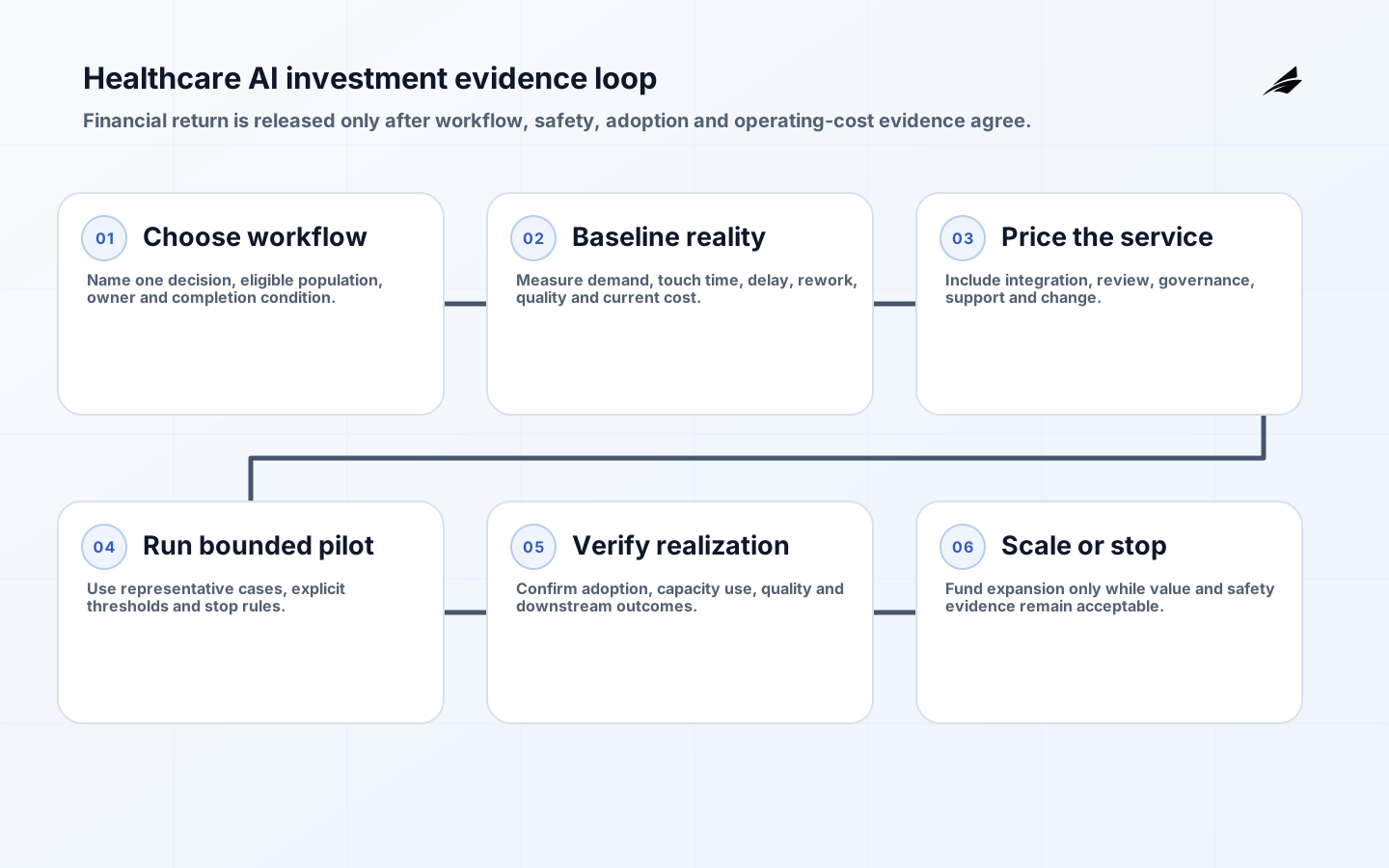
AI automation ROI planning for healthcare begins with a workflow decision, not a model demonstration. A promising assistant can summarize a chart quickly and still create negative value if clinicians must verify every detail, integration work increases queue time, or safety review blocks routine use. A credible business case names the people affected, the exact work interval, the current cost and failure pattern, the expected intervention, and the evidence required before expansion. It also separates financial return from patient, workforce, privacy and regulatory outcomes that cannot be reduced to a single currency figure.
This guide is for service-line leaders, operations teams, clinical informaticists, finance partners and technology owners evaluating automation in scheduling, documentation, revenue cycle, prior authorization, contact centers or decision support. It complements the healthcare AI implementation checklist and healthcare AI FAQ. The method is deliberately evidence-led: establish a baseline, classify risk, model total cost, run a bounded trial, measure adoption and exceptions, and release investment only when value survives those tests.
Choose a healthcare workflow with an observable decision
Start with a narrow work unit that has a clear beginning and end. Examples include converting an inbound referral into a complete scheduling request, preparing a draft discharge summary, identifying missing claim documentation, or routing a portal message to the appropriate queue. Record the triggering event, systems touched, handoffs, decision rights and completion condition. Avoid proposals such as “use AI across patient access”; they combine too many queues and make attribution impossible. A useful candidate has repeated demand, measurable delay or rework, sufficient data, and an owner who can change the surrounding process.
Distinguish administrative assistance from functions that influence diagnosis, prevention or treatment. FDA’s current clinical decision support guidance explains how intended user, time criticality, output and the clinician’s ability to independently review the basis affect whether a software function may be treated as non-device CDS. ONC’s HTI-1 requirements add transparency expectations for predictive decision support in certified health IT. Classification is not a procurement formality; it determines validation depth, change controls, documentation and post-release monitoring. Obtain qualified regulatory and clinical review before assigning a return target to consequential use.
| Candidate workflow | Primary value signal | Important guardrail | Early stop condition |
|---|---|---|---|
| Referral intake | Complete referrals per staffed hour | Correct specialty and urgency routing | Urgent cases are delayed or misrouted |
| Documentation assistance | Clinician after-hours documentation time | Material correction rate | Unsupported clinical statements appear |
| Prior authorization | Median submission cycle time | Required evidence completeness | Denials rise after automation |
| Patient messaging | Resolved messages and response time | Escalation sensitivity | High-risk messages miss human review |
Build a baseline that finance and operations can reproduce
Measure the present workflow for a representative period before introducing automation. Capture demand volume, touch time, elapsed time, queue age, first-pass completion, rework, escalation, abandonment and downstream correction. Segment by channel, service line, location and complexity so averages do not hide the cases that consume most effort. Time studies should sample real work rather than rely only on self-reported estimates. Reconcile operational records with payroll, vendor, denial, overtime and infrastructure data. Document seasonal events and policy changes that would otherwise be mistaken for automation impact.

Use a denominator that matches the decision. Cost per processed case is better than total team cost when volume changes; minutes returned to clinicians is better than generated summaries when the objective is workforce relief. Include current technology fees and the cost of unresolved defects, but do not monetize every clinical outcome without defensible evidence. Some outcomes belong in a separate safety or quality scorecard. Name the baseline owner, extraction query, date range and exclusions. A reviewer should be able to rerun the calculation and explain why it differs from a financial statement.
Model total cost, not just model or license fees
The cost model should cover discovery, data preparation, integration, identity, workflow design, clinical review, privacy and security assessment, testing, training, support and retirement. Recurring costs include software subscriptions, inference or transaction charges, storage, observability, evaluation datasets, human review, incident handling, retraining and vendor governance. Add contingency for interface changes and policy updates. Allocate shared platform costs consistently rather than making the first use case appear uneconomic or later use cases appear free. State whether benefits are cash-releasing, capacity-releasing, cost-avoiding or quality-improving.
Capacity released is not automatically a saving. Ten minutes removed from a fragmented shift may improve experience without reducing scheduled labor; that can still be valuable, but it should not be presented as payroll reduction. Translate released time into a planned action such as shorter backlog, additional appointments, fewer agency hours or protected patient-facing work. Apply a range rather than one optimistic estimate for adoption, accuracy, review time and volume. Present break-even under conservative, expected and favorable scenarios, and identify the variables that change the result most.
| Value component | Calculation | Evidence owner | Treatment |
|---|---|---|---|
| Labor capacity | Eligible cases × minutes saved × adoption | Operations | Capacity unless staffing plan changes |
| Avoided rework | Reduction in corrected cases × handling cost | Quality and finance | Cost avoidance |
| Faster throughput | Additional completed cases within capacity | Service-line leader | Revenue only when collectible |
| Operating cost | Platform, integration, review, support and governance | Technology and finance | Recurring and one-time cost |
| Safety and quality | Defined rates, thresholds and adverse events | Clinical governance | Separate release gate |
Design a bounded pilot with a counterfactual
A useful pilot tests the entire operating change, not only output quality. Include representative users, real integrations, exception paths, audit logging and support. Define eligibility and exclusions before starting. Where practical, compare against a concurrent group or use a staged rollout that controls for time trends. Measure baseline and post-change behavior using the same definitions. Keep the model, prompt, knowledge source and workflow version identifiable. If the intervention changes during the trial, mark the period rather than blending unlike configurations into one result.
Predefine acceptance and stop rules. A scheduling assistant might require a minimum completeness improvement while holding urgent-routing error below a threshold. A documentation tool might require lower after-hours time without increasing clinically material corrections. Record overrides and reasons, not just final approvals. NIST’s AI RMF organizes work through Govern, Map, Measure and Manage; for a pilot, that means named authority, understood context, valid measurement and an explicit response to evidence. It does not mean completing a generic checklist and declaring the system trustworthy.
Measure adoption, distribution and exceptions
Average performance can hide a workflow that fails for a particular clinic, language, payer or patient group. Segment outcome and error measures according to the context and lawful data available. Compare automation-assisted and unassisted cases, and inspect where users abandon, edit or bypass the tool. Low use may reflect training, poor interface placement, slow response, missing trust information or a mismatch between the product and actual work. Treat adoption as diagnostic evidence rather than pressuring staff to reach a target that was assumed in the business case.
Track leading and lagging indicators together. Leading indicators include response latency, unavailable source data, review burden and override patterns. Lagging indicators include corrected records, denial outcomes, patient complaints, safety events and realized capacity. A benefit dashboard should display the deployed version and eligible population beside each result. Establish an investigation threshold for drift, unusual subgroup differences and abrupt workflow changes. Preserve enough records to reconstruct material decisions while applying retention, access and privacy requirements appropriate to the data.
Govern investment as a series of evidence gates
Release funding in stages: discovery, instrumented prototype, bounded production pilot, controlled expansion and steady operation. Each gate should require a named evidence package covering value, safety, privacy, security, usability, interoperability and support. Finance confirms the calculation; workflow owners confirm that capacity is usable; clinical and regulatory owners confirm that the use remains within approved boundaries; technology owners confirm operability. A steering group should be able to pause or narrow deployment without renegotiating the entire program.
Review realized value at least quarterly and after material changes. Recalculate cost when volume, pricing, integration or human-review requirements change. Retire automation that no longer clears its value and safety thresholds; sunk cost is not a reason to continue. Contract terms should preserve access to usage data, model and workflow version records, incident information, exportable configurations and transition support. If a vendor supplies only a headline accuracy figure, the organization still lacks the operational evidence needed for an investment decision.
Key takeaways
- Define a bounded workflow and completion condition before selecting automation.
- Separate clinical decision support from administrative assistance and classify obligations early.
- Model integration, review, governance and support as recurring costs.
- Treat released time as capacity until an operating plan converts it into a financial result.
- Scale only when value, safety and adoption evidence remain acceptable across relevant groups.
Frequently asked questions
What payback period should healthcare AI target?
There is no universal period. Use the organization’s investment policy, the useful life of the workflow and the cost of validation and change. A short payback estimate is not persuasive when it excludes integration, human review or ongoing assurance.
Can accuracy be used as the main ROI measure?
No. Accuracy may be one technical measure, but ROI depends on workflow completion, review effort, adoption, exception handling, downstream quality and total cost. The relevant technical measures also vary by use and harm.
When should a pilot stop?
Stop or narrow it when a safety threshold is crossed, data or logging is insufficient, staff cannot exercise required oversight, the intervention leaves its approved scope, or expected value cannot be measured credibly.
Conclusion
A strong healthcare AI business case connects money to an observable operating change while keeping clinical, privacy and regulatory duties visible. It does not begin with a model and search for savings afterward. Baseline the work, classify the use, price the complete operating system, and test under real conditions with explicit stop rules.
The final investment question is practical: can the organization reproduce the claimed benefit, explain who receives it, show that quality and safety remain acceptable, and continue operating the workflow when data, vendors or models change? If the evidence answers yes, expansion can be deliberate. If it does not, the correct return decision may be redesign, a narrower use, or no deployment.