Manufacturing IoT software development begins with a physical process, not a device count. A useful system identifies an asset, preserves the meaning and timing of its signals, moves only required data across operational-technology boundaries, and gives operators an action they can safely take. This implementation checklist treats sensors, gateways, networks, cloud services and applications as one production capability. It is intended for teams selecting an IoT software development company for manufacturing or preparing an internal delivery plan.
A pilot that displays live values can still fail in production when tags are ambiguous, clocks drift, a gateway loses power, certificates expire, a line changes product, or the application cannot distinguish planned downtime from a fault. Manufacturing IoT software development therefore needs engineering evidence at the equipment, network, data, software and operating levels. The objective is not maximum connectivity. It is dependable information that improves maintenance, quality, energy, throughput or traceability without weakening plant safety or availability.
Use this checklist alongside the manufacturing IoT scope and delivery plan, the manufacturing IoT architecture FAQ, and the industrial dashboards delivery guide. Together they separate procurement questions from implementation controls and operator-facing design.
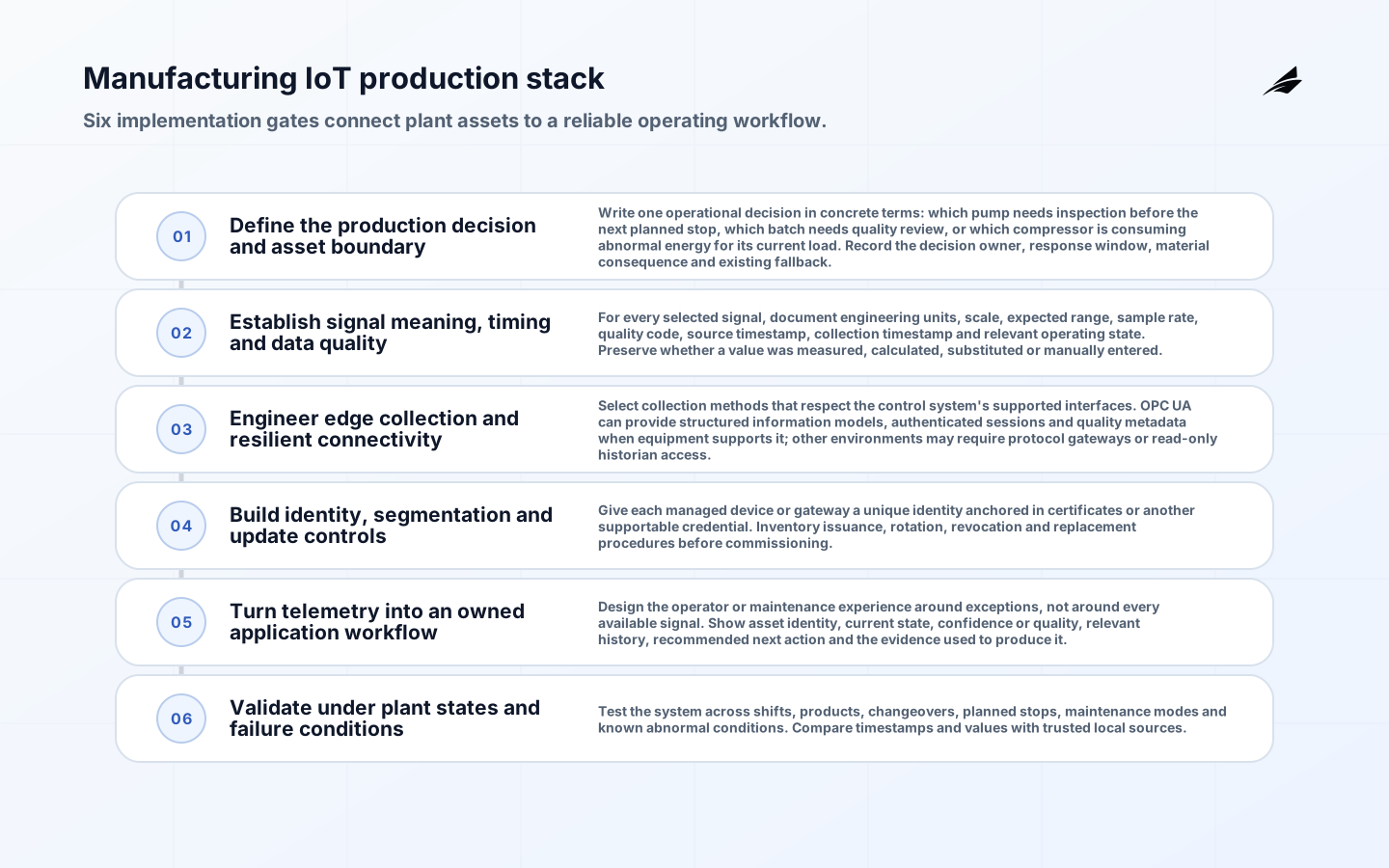
Define the production decision and asset boundary
Write one operational decision in concrete terms: which pump needs inspection before the next planned stop, which batch needs quality review, or which compressor is consuming abnormal energy for its current load. Record the decision owner, response window, material consequence and existing fallback. A dashboard with no named action merely relocates observation work. The first release should improve a bounded decision whose outcome can be measured without connecting every asset in the plant.
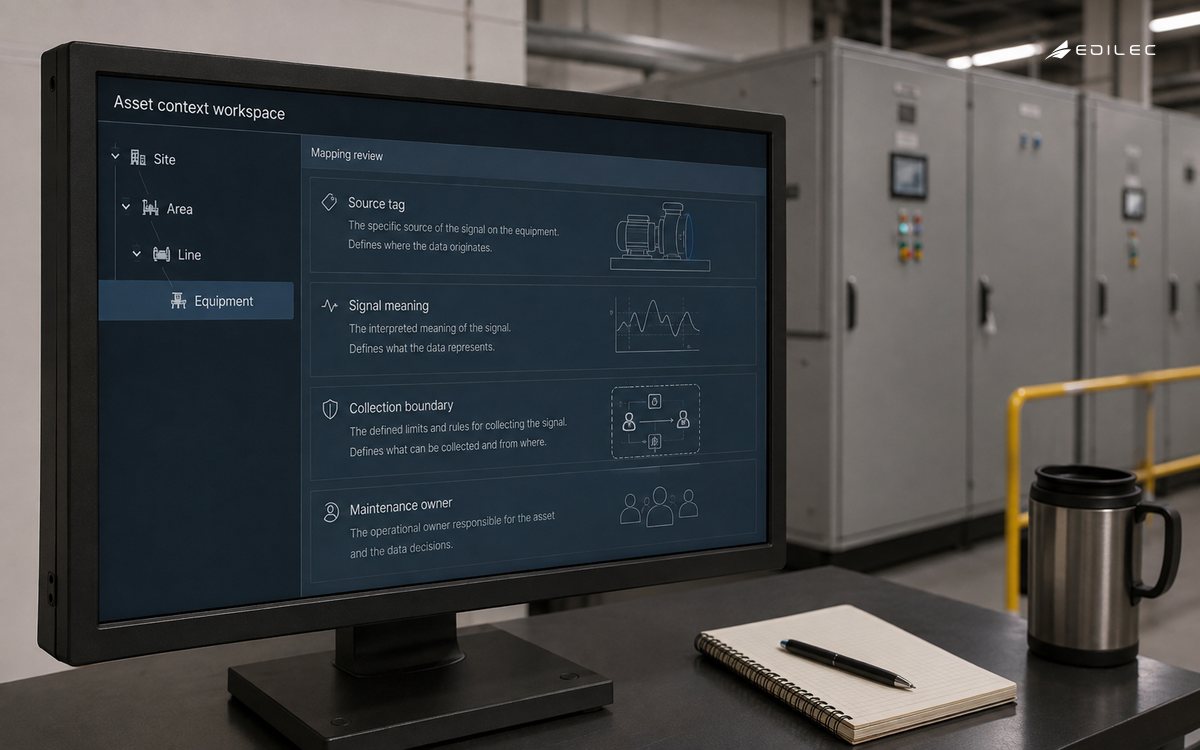
Create an asset inventory that maps enterprise, site, area, line, cell and equipment identifiers to the source control system. Include equipment class, firmware, network zone, criticality, maintenance owner and safe collection method. ISA-95 is useful as a common vocabulary for the boundary between business planning and manufacturing operations. It does not replace the plant's engineering hierarchy, but it prevents an ERP asset code, historian tag and maintenance record from being treated as the same identifier.
| Decision element | Implementation evidence | Failure to avoid |
|---|---|---|
| Operational trigger | Named signal, state and threshold with units | Alert generated during an irrelevant operating mode |
| Accountable role | Shift or maintenance role that accepts the task | Notification sent to an unattended shared inbox |
| Response window | Maximum useful latency and escalation time | Cloud pipeline reports after the decision has passed |
| Fallback | Documented manual observation or local control path | Connectivity loss stops an established production procedure |
Establish signal meaning, timing and data quality
For every selected signal, document engineering units, scale, expected range, sample rate, quality code, source timestamp, collection timestamp and relevant operating state. Preserve whether a value was measured, calculated, substituted or manually entered. Historians often contain years of tags, but a tag name alone does not prove meaning. A motor-current value without load, recipe and run-state context can produce confident but useless anomaly scores.
Design data-quality rules before analytics. Detect frozen values, impossible jumps, stale timestamps, duplicate events, out-of-order delivery and clock offset. Store raw evidence long enough to investigate transformations, while publishing curated records for applications. Assign ownership for each correction path: controls engineering may own scaling, maintenance may own asset relationships, and a data team may own derived features. A quality flag should travel with the value instead of disappearing at the first broker or API.
Engineer edge collection and resilient connectivity
Select collection methods that respect the control system's supported interfaces. OPC UA can provide structured information models, authenticated sessions and quality metadata when equipment supports it; other environments may require protocol gateways or read-only historian access. Avoid adding polling load to a controller without vendor and controls review. Edge software should buffer during upstream outages, cap disk use, resume without duplicating records and expose its own health independently of the business application.
Treat intermittent connectivity as normal design input. Define store-and-forward limits, acceptable data loss, retry behavior, back-pressure and the order in which telemetry is discarded when storage is exhausted. Test gateway replacement, certificate rotation, DNS failure, broker unavailability and time synchronization. A resilient design keeps local safety and control independent from cloud services. NIST's OT guidance emphasizes that security measures must coexist with performance, reliability and safety requirements, which is especially important during recovery.
| Layer | Required control | Acceptance test |
|---|---|---|
| Device or controller | Supported read path and bounded load | Collection does not change scan time or alarms |
| Gateway | Local queue, health signal and signed configuration | Upstream outage drains without gaps or duplicates |
| Broker or ingestion | Authenticated topic or endpoint with quotas | Unauthorized publisher and replay are rejected |
| Application | Freshness indicator and degraded-state behavior | Users can distinguish current, delayed and unavailable data |
Build identity, segmentation and update controls
Give each managed device or gateway a unique identity anchored in certificates or another supportable credential. Inventory issuance, rotation, revocation and replacement procedures before commissioning. Shared passwords embedded in images create an estate-wide failure mode. Apply least privilege to data paths, separate administration from telemetry, and place brokers and management services in zones consistent with the site's network architecture rather than opening direct device-to-cloud routes.
Security continues after installation. Define signed update packages, approved maintenance windows, rollback, vulnerability intake, component inventory and end-of-support handling. The NIST IoT baseline is useful for capabilities such as identification, configuration, data protection, interface restriction, update and cybersecurity-state awareness. For legacy equipment that cannot meet those capabilities, document compensating controls at the gateway and network layers, including monitored allowlists and physical replacement constraints.
Turn telemetry into an owned application workflow
Design the operator or maintenance experience around exceptions, not around every available signal. Show asset identity, current state, confidence or quality, relevant history, recommended next action and the evidence used to produce it. Allow users to acknowledge, defer, reassign and close work with a reason. If the output creates a maintenance order, define which system owns status and how duplicate creation is prevented. The IoT application should not become a shadow CMMS or MES by accident.
Connect notifications to real rosters and escalation rules. A severity label must correspond to a response expectation, not a color selected by a developer. Preserve the link from a notification to source measurements, transformation version and resulting work record. Collect operator feedback in structured categories so recurring false alarms can be traced to a threshold, sensor, context model or process change. Free-text comments alone are difficult to use for systematic improvement.
Validate under plant states and failure conditions
Test the system across shifts, products, changeovers, planned stops, maintenance modes and known abnormal conditions. Compare timestamps and values with trusted local sources. Measure completeness, freshness and false alerts by asset class rather than reporting one fleet-wide percentage. Exercise network isolation, gateway restart, credential expiry, malformed payloads and high event rates. Performance tests should include the plant's constrained links and the number of concurrent devices expected after expansion.
Acceptance evidence should be reviewable by operations, controls, cybersecurity and application owners. Record test data provenance, software and configuration versions, unresolved deviations and the exact scope approved for use. Do not silently generalize a successful compressor pilot to ovens, robots or packaging lines. Different assets have different dynamics, failure consequences and service procedures, so each new class needs its own mappings and acceptance thresholds.
Commission, operate and scale by site
Commission with a named site owner, trained support path and rollback window. Baseline gateway CPU, storage, queue depth, message rates, certificate expiry, data freshness and application latency. Route infrastructure alarms separately from process alerts so a failed collector is not mistaken for healthy equipment. Run a short period in observation mode, reconcile system events with shift logs, and close mapping defects before the application influences maintenance or production priorities.
Scale by repeatable site packages rather than cloning an opaque pilot. A package should include asset templates, network flows, certificates, configuration, dashboards, alert rules, training, support contacts and validation scripts. Track cost per connected asset and cost per useful decision, not only data volume. Retire unused tags and integrations. A smaller, governed signal set usually produces a more supportable manufacturing IoT capability than a data lake filled without clear ownership.
Key takeaways
- Start with one measurable plant decision and a defined fallback.
- Preserve asset identity, units, timestamps, quality and operating state end to end.
- Keep safety and deterministic control independent from remote analytics.
- Design device identity, updates and certificate rotation before commissioning.
- Validate outages and abnormal plant states, then scale by asset class and site package.
Frequently asked questions
Should manufacturing IoT software connect directly to PLCs?
Only through an interface and load pattern approved for that controller and process. Read-only OPC UA, a historian or an industrial gateway is often safer than ad hoc polling. Safety and deterministic control must remain independent from the IoT application.
Does industrial IoT require a public cloud?
No. Edge, on-premises and cloud components can be combined according to latency, availability, data residency, support and security constraints. The important design question is what must continue when each upstream service is unavailable.
How many assets should a first pilot include?
Use enough assets to represent meaningful operating variation, but keep the asset class and workflow bounded. A dozen well-understood machines with reliable labels can teach more than hundreds of poorly mapped tags.
Which metrics show that the implementation works?
Measure signal completeness and freshness, alert precision, response time, avoided downtime or waste, user adoption, support burden and cost per useful decision. Report them by site and asset class.
Conclusion
Manufacturing IoT software development succeeds when a production decision remains traceable from physical asset to source signal, edge path, application action and operating outcome. The implementation should tolerate outages, preserve local authority and give each plant a supportable commissioning package. That discipline turns connected devices into a dependable manufacturing capability instead of a fragile demonstration.