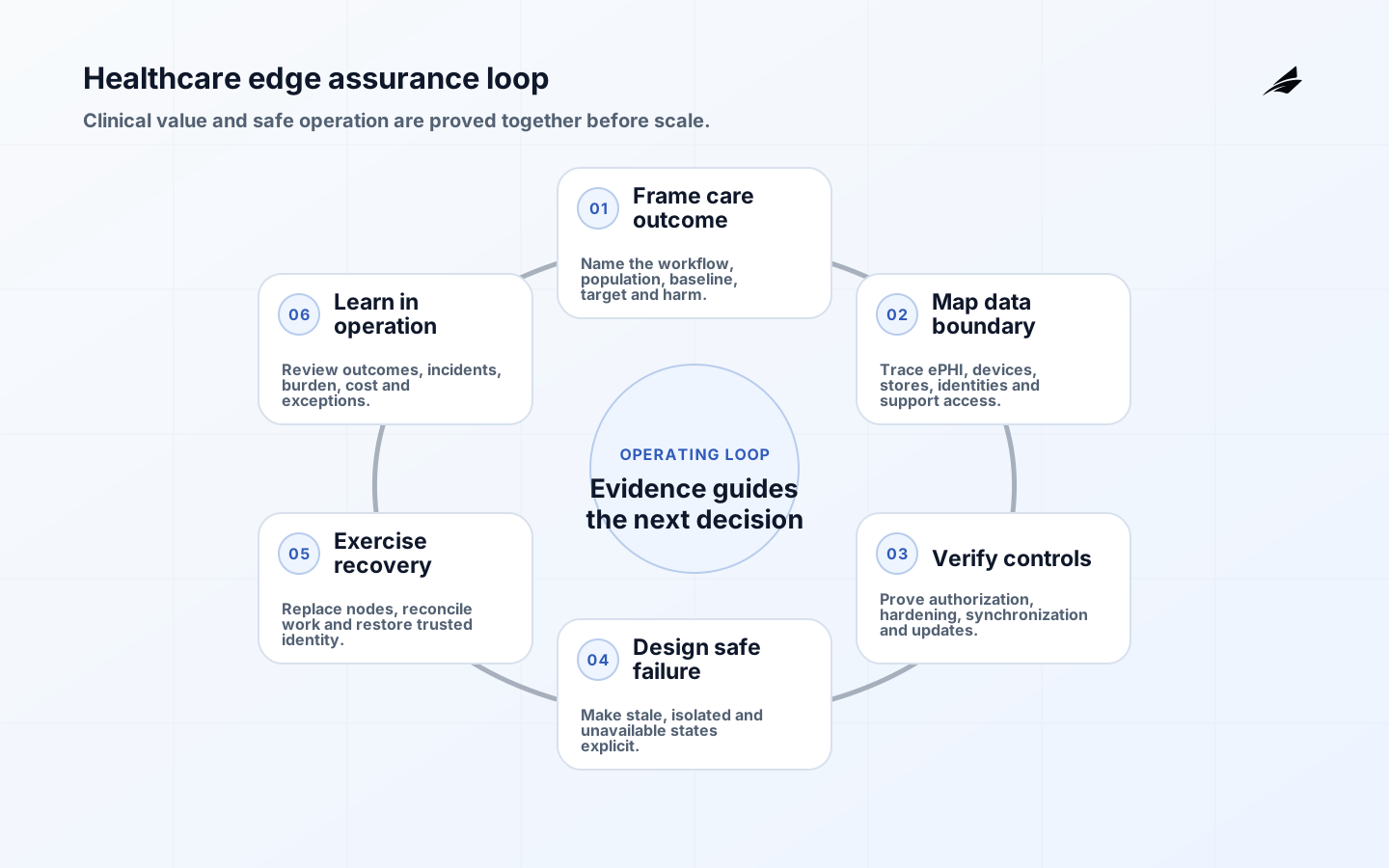
Edge providers in healthcare place selected compute, storage or network functions close to a clinic, imaging device, bedside system or patient-facing endpoint. The implementation case is strongest when local processing materially improves latency, continuity, bandwidth use or privacy control. It is weak when “edge” is merely a new hosting label. This checklist turns the topic into an evidence-based deployment: one clinical or operational outcome, a defined data boundary, explicit failure behavior and an accountable service owner.
Use this implementation checklist after the healthcare edge practical guide and alongside the healthcare edge FAQ. Teams automating care administration should also compare the controls in the healthcare workflow implementation checklist. The goal is not to force every workload to the edge; it is to put each decision and dataset where the service can meet its safety, security and recovery obligations.
1. Qualify the healthcare edge use case
Write a one-page use-case statement before evaluating providers. Name the user, care setting, event, required response time, source systems, data sensitivity and consequence of delay or error. A radiology pre-processing service may need local throughput during a wide-area outage; a waiting-room dashboard may tolerate cloud latency. Record a measured baseline rather than an adjective such as “slow.” Include the current median and tail latency, outage frequency, data-transfer volume, manual fallback time and number of affected encounters.
Separate patient-care claims from infrastructure assumptions. Local inference does not automatically make a model clinically appropriate, and a private appliance does not automatically satisfy privacy requirements. Define which output informs care, who may act on it and what evidence supports that authority. If the edge node only filters telemetry or caches content, state that clearly. This distinction determines validation depth, monitoring, incident escalation and whether medical-device obligations may apply.
| Candidate workload | Edge value to prove | Failure behavior to specify | Acceptance evidence |
|---|---|---|---|
| Imaging pre-processing | Lower transfer time and local throughput | Queue studies without losing image identity | Timed studies reconcile with source and destination |
| Bedside monitoring | Low-latency event evaluation | Alarm path remains available or degrades safely | Representative alarm and outage scenarios pass |
| Remote clinic synchronization | Continuity during weak connectivity | Local work is versioned and later reconciled | Conflict and replay tests preserve clinical meaning |
| Facility operations | Fast response for environmental or asset signals | Manual controls remain usable | Operational drill verifies local and central response |
2. Draw the service, trust and data boundaries
Inventory every component from device to destination: sensors, gateways, local runtimes, identity services, management planes, clinical systems, cloud regions and support connections. Mark where electronic protected health information is created, buffered, transformed, logged, backed up and deleted. Name the legal and operational entity responsible at each boundary. The current HIPAA Security Rule requires appropriate administrative, physical and technical safeguards for ePHI; applicability and contractual duties should be confirmed by the organization’s privacy and legal owners.
Treat the management plane as part of the clinical service, not a hidden vendor utility. Document who can enroll a node, change policy, retrieve logs, rotate keys, install software and remotely erase data. Identify outbound dependencies such as certificate authorities, time sources, package repositories and vendor support portals. A topology diagram should show normal traffic, maintenance traffic, emergency access and the route used during isolation. If the team cannot explain a connection, the provider should not receive production data through it.
3. Govern data, interoperability and synchronization
Define a minimum data contract for every flow: patient and encounter identifiers, event time, observation time, units, terminology, schema version, provenance and correction semantics. Use established healthcare standards where they fit, but test the exact profiles used by participating systems. The official USCDI reference is a useful baseline for standardized health data classes; it does not by itself settle every local interface or device payload.
Design synchronization as a business process. Specify ordering, duplicate detection, retry limits, idempotency and conflict ownership. A local medication update and a central correction can arrive in either order after connectivity returns. The system must preserve both events, apply approved precedence and expose unresolved conflicts to a qualified role. Store source identifiers and transformation versions so a result can be reconstructed. Avoid placing sensitive payloads in generic logs; log the event and evidence needed for operations without creating an uncontrolled secondary record.
4. Implement identity, access and device controls
Authenticate people, services and devices independently. Issue unique workload identities, restrict each identity to required resources and rotate credentials without rebuilding the node. The NIST zero trust architecture emphasizes protecting resources and evaluating subjects and devices rather than granting trust from network location. For an edge fleet, that translates into per-request authorization, device posture, segmented administration, short-lived credentials and explicit policy for disconnected operation.
Harden the physical and software platform. Use verified boot where supported, encrypted storage with separately governed keys, signed updates, tamper evidence, restricted ports and an asset record tied to location and custodian. Disable shared vendor accounts. Preserve an emergency access path with strong authentication, time-bounded elevation and review. The implementation team should demonstrate enrollment, key rotation, failed authentication, node replacement, remote revocation and secure disposal, not merely show configuration screenshots.
5. Validate clinical safety and degraded modes
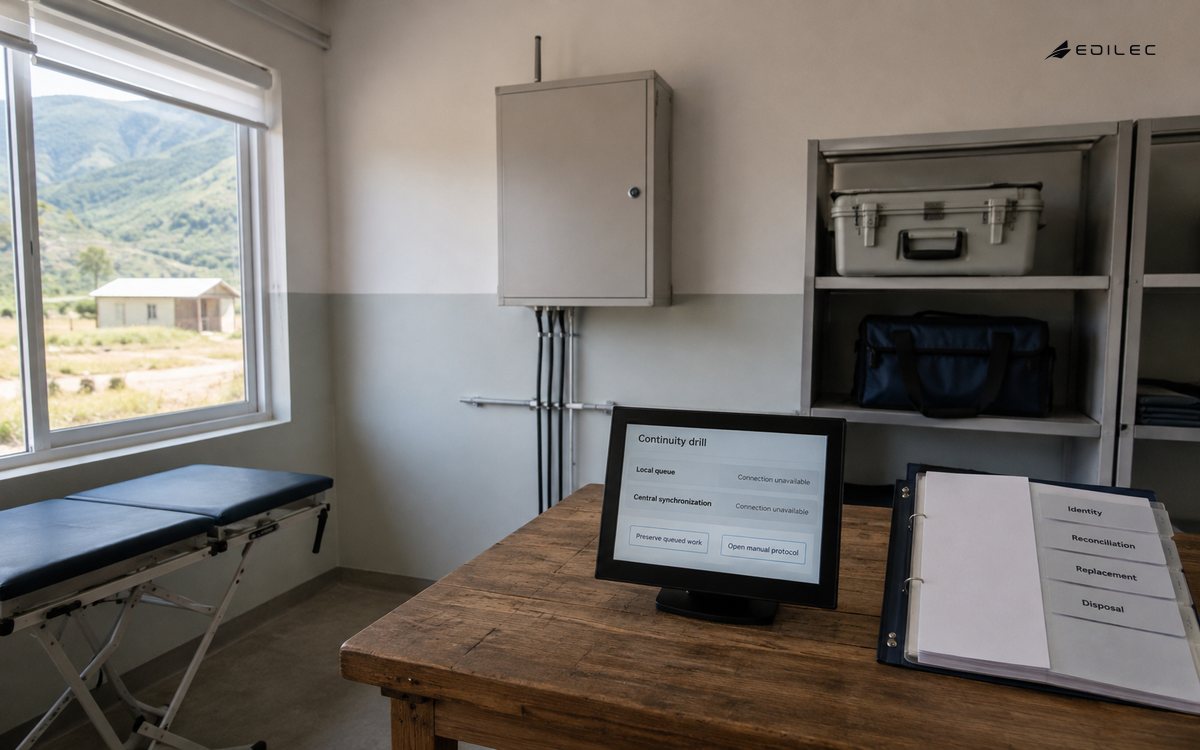
Create scenario tests with clinicians, biomedical engineering, security and operations. Include stale inputs, missing identifiers, clock drift, duplicate messages, partial connectivity, full storage, overheated hardware, delayed central responses and a corrupted update. For every scenario, define the expected user-visible state and who is notified. A safe degraded mode may be local read-only access, queued processing, a clear unavailable state or a return to a manual protocol. Silent use of stale data is rarely an acceptable fallback.
If the implementation connects to or changes the behavior of a medical device, involve regulatory and quality specialists early. The FDA’s medical-device cybersecurity resources describe current guidance and emphasize that connected devices introduce cybersecurity risks that manufacturers and healthcare facilities must manage together. Do not infer device status from a marketing description. Record intended use, responsible manufacturer, update authority, safety impact and the evidence required before a change reaches care.
6. Contract for operability and exit
Evaluate the provider on the complete operating model. Require support boundaries, vulnerability handling, update cadence, component inventory, end-of-support notice, incident cooperation, subprocessor disclosure, data-location controls and evidence access. Service levels should distinguish node, control-plane, connectivity and support failures. Ask how policy is enforced when the control plane is unavailable and how a replacement node receives only the correct site and workload configuration.
Price installation, network changes, clinical validation, security review, observability, spares, field service, data transfer, software updates and retirement. A low appliance price can conceal high fleet-management cost. Contract for export of configuration, audit evidence and operational data in usable formats. Define deletion verification and key destruction at exit. The NIST Privacy Framework can help connect data processing choices to privacy risk, especially when telemetry or support data could reveal patient, workforce or facility activity.
| Gate | Required artifact | Owner | Pass condition |
|---|---|---|---|
| Scope | Use-case statement and baseline | Clinical product owner | Benefit and harm are measurable for a named population |
| Architecture | Data-flow and trust-boundary model | Enterprise architect | Every store, connection and authority has an owner |
| Assurance | Threat model and safety scenarios | Security and clinical safety leads | Controls and degraded states pass representative tests |
| Operations | Runbooks, dashboards and recovery record | Service owner | On-call staff restore service within approved objectives |
| Scale | Pilot outcome and exception report | Executive sponsor | Outcome improves without breaching guardrails |
| Exit | Portable exports and disposal evidence | Vendor manager | Organization can transition without losing required records |
7. Pilot, recover and scale by evidence
Run a limited pilot with representative sites, users, device types and connectivity conditions. Instrument end-to-end latency, queue age, synchronization lag, correction rate, node health, storage pressure, unauthorized attempts and manual fallback. Review performance by workflow, not as a fleet-wide average. A pilot can appear healthy while one clinic repeatedly operates on stale data. Keep a decision log for every exception accepted during the pilot and assign an expiry date to temporary controls.
Exercise recovery before expanding. Replace a failed node from inventory, restore approved configuration, re-establish identity, reconcile queued work and prove deletion from the retired device. Simulate control-plane and network outages separately. Scale only when local teams can recognize degraded states and central teams can diagnose them. The decision should compare improved clinical or operational outcomes with safety events, privacy exceptions, support effort and total unit cost.
Key takeaways
- Use edge computing only where locality produces a measured healthcare benefit.
- Map ePHI, management access and synchronization behavior across every boundary.
- Give devices and workloads unique identities and test disconnected authorization explicitly.
- Define visible, clinically approved degraded modes before production.
- Contract for updates, evidence, recovery, portability and secure retirement.
- Scale from representative pilot evidence rather than a successful demonstration.
Healthcare edge implementation FAQ
Does edge computing replace the healthcare cloud?
Usually not. Edge and cloud components often share one service. The edge handles locality-sensitive work, temporary continuity or filtering; central platforms provide longitudinal records, fleet control, analytics and cross-site workflows. Allocate each function according to latency, data, safety, availability and operating requirements.
How long should a healthcare edge node work offline?
There is no universal duration. Derive it from the care workflow, likely outage, storage capacity, credential policy and reconciliation risk. Specify which functions remain available at each interval and test beyond the approved threshold so users see a controlled stop rather than ambiguous behavior.
Does using an edge provider make a deployment HIPAA compliant?
No provider label establishes compliance. The regulated organization must determine applicability, execute suitable agreements, perform risk analysis and implement required safeguards across people, processes and technology. Counsel and privacy leaders should assess the exact arrangement and applicable law.
Conclusion
A healthcare edge deployment is ready when the team can explain why processing is local, which records cross each boundary, how the service fails safely and how it is recovered. The most credible provider is the one that helps produce that evidence across the full lifecycle. Start with one bounded workflow, prove its controls under realistic failure, and expand only when the outcome and operating burden are both understood.