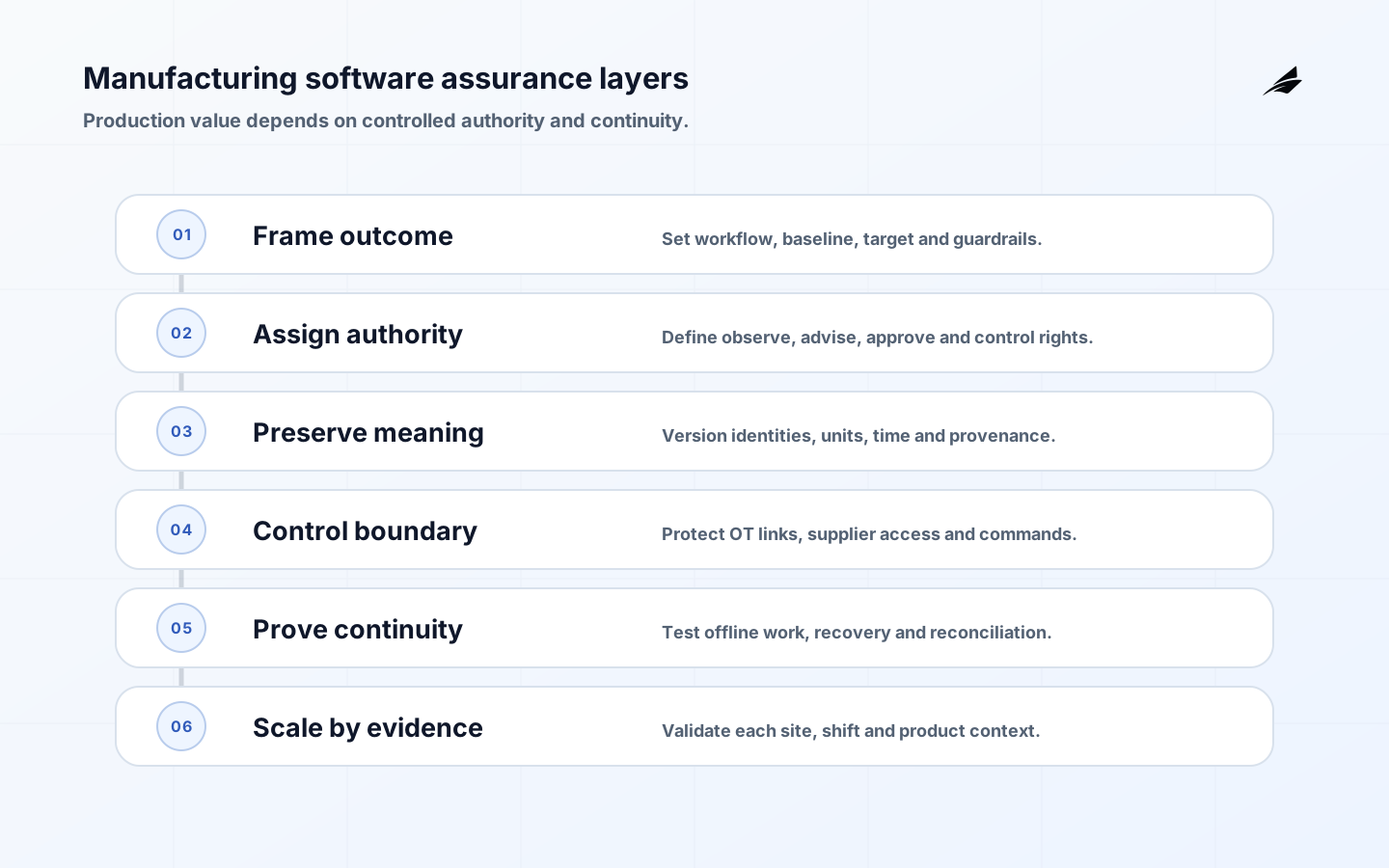
Custom software development services for manufacturing should improve a bounded production decision without weakening safety, quality, traceability or plant continuity. Typical work connects operators, work orders, equipment state, recipes, inspection, maintenance, inventory and enterprise systems. The difficult part is rarely the screen alone; it is preserving authoritative meaning and safe behavior across IT, operational technology and human procedures.
Manufacturing leaders need a proposal that makes scope, cost, risk, and delivery evidence visible. After the scope is approved, use the manufacturing software implementation checklist and the manufacturing development FAQ for execution and procurement detail.
Frame one production outcome and authority boundary
Start with a measurable workflow: reduce schedule-to-start delay, prevent wrong-material use, improve first-pass yield, shorten deviation review, expose work-in-progress or coordinate maintenance. Map the operator, supervisor, quality, engineering, maintenance, planning and supplier decisions. Establish the current baseline and guardrails for safety, product quality, throughput, labor and traceability. Avoid a broad goal to digitize the plant; it cannot define acceptance.
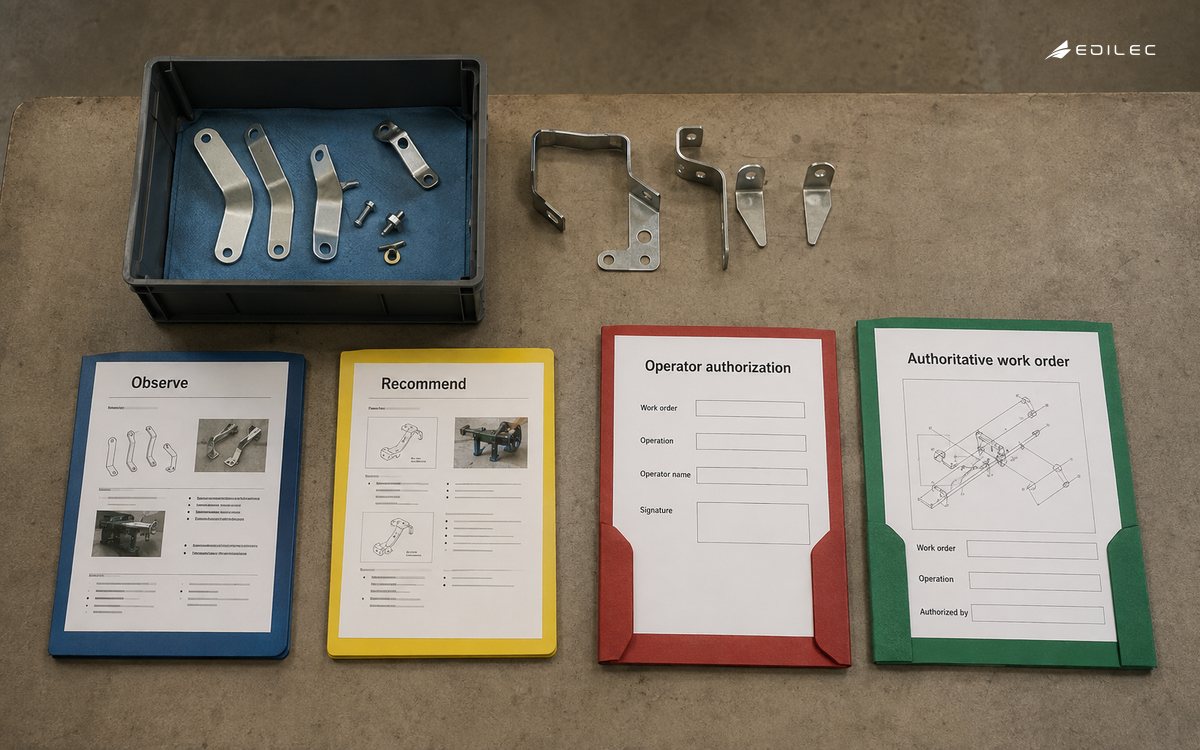
State what the software may observe, recommend and control. A planning application can propose a sequence while an authorized operator confirms it. A direct command to equipment changes the hazard and validation boundary. Identify the authoritative source for product definition, recipe, work order, machine state, inspection and genealogy. When sources disagree, define which record wins and who resolves the exception rather than synchronizing conflict silently.
| Scope record | Required decisions | Primary owner | Acceptance evidence |
|---|---|---|---|
| Production journey | Start, end, roles, baseline and target | Operations owner | Observed workflow completes with target evidence |
| Authority model | Advisory, approval and control boundaries | Plant and safety leadership | Unauthorized action is prevented |
| Data ownership | System of record, identifiers and change rules | Engineering and data owners | Conflicting records route to resolution |
| Integration estate | ERP, MES, QMS, historian, PLC and devices | Enterprise and OT architects | Versioned interface inventory and tests |
| Continuity | Offline, degraded and manual fallback | Plant manager | Shift operates safely during dependency loss |
| Support | Hours, escalation, suppliers and spares | Service owner | Incident and recovery exercise succeeds |
Conduct discovery on the plant floor
Observe representative shifts, products, changeovers and exceptions. Capture gloves, lighting, noise, shared terminals, scanner reach, language, accessibility, contamination controls and network dead zones. Interview the people who recover from failure, not only process owners. Compare documented procedure with actual work and understand why deviations exist. Software that adds duplicate entry or hides a useful local adaptation will be bypassed, regardless of interface polish.
Inventory hardware and software versions, protocols, support status, maintenance windows, time synchronization and vendor access. Identify legacy components that cannot tolerate scanning, agents or frequent connections. NIST SP 800-82 Rev. 3 stresses OT's unique performance, reliability and safety requirements. Discovery must therefore include engineering, controls, security and operations before a developer commits to an integration technique.
Design a bounded manufacturing architecture
Separate enterprise applications, manufacturing operations, edge integration and control. Use read-only observation before introducing commands. Gate writes through an authorized service with validation, rate limits and audit. Buffer work locally when central connectivity is unavailable, then reconcile explicitly. Keep safety functions independent unless the project is deliberately engineered and validated for that role. Define latency and availability per decision; not every dashboard needs control-loop speed.
Prefer supported standards and vendor interfaces where they preserve needed semantics. The OPC Foundation's OPC UA security model describes authentication, integrity, confidentiality and application trust concepts, but an operator must still select and configure security for the installation. Do not expose industrial protocols directly to broad enterprise networks. Use managed boundaries, distinct identities and monitored conduits.
Preserve manufacturing meaning and traceability
Define identifiers for product, lot, material, equipment, tooling, order, operation, person and software version. Record units, tolerances, event time, observation time, source and quality. Version mappings and master data. A temperature value without sensor, calibration, location, unit and production context cannot support a defensible quality decision. Reconcile clocks and preserve late or corrected events rather than overwriting history without provenance.
NIST's ongoing Digital Thread for Manufacturing work emphasizes standards, conformance testing and trusted product-definition data across design, manufacturing and quality. A custom application need not implement an entire digital thread, but it should preserve authoritative links and versions needed for its claim. Test genealogy by tracing a finished unit back to the exact approved inputs and process evidence.
Engineer cybersecurity and supplier access
Use distinct identities for applications, devices, operators and vendor support. Enforce least privilege, approved remote-access windows, multifactor authentication where supported, recorded administration and rapid revocation. Segment according to consequence and required communication, not a generic diagram. Inventory dependencies and protect builds and update packages. NIST's Manufacturing Profile provides a risk-based roadmap aligned to manufacturing goals.
Apply the NIST SSDF to custom code and its supply chain. Protect source, isolate builds, verify components, test security requirements and define vulnerability response. Stage updates in a representative environment and preserve rollback or roll-forward. Contract for supplier notification, support periods, remote-access controls and export of configuration and evidence. A plant should not depend on an individual developer's account for emergency recovery.
| Risk | Design control | Test before rollout | Operating signal |
|---|---|---|---|
| Unsafe command | Authority boundary and validated state transition | Attempt command in wrong mode and role | Denied and exceptional commands |
| Wrong master data | Versioned source and conflict workflow | Introduce conflicting recipe revision | Unresolved authority conflicts |
| Network loss | Local queue and bounded manual fallback | Run representative shift disconnected | Backlog age and reconciliation delta |
| Legacy overload | Rate-limited gateway and staged polling | Test production-shaped traffic | Device response and timeout rate |
| Remote-access abuse | Time-bound identity and recorded session | Revoke supplier during exercise | Standing vendor access |
| Bad release | Representative simulation and cohort rollout | Recover application and interface versions | Failed deployment recovery time |
Estimate delivery and lifetime cost
Cost drivers include plants, lines, product variation, shifts, interface age, vendor cooperation, data quality, hardware, validation, languages, cybersecurity, availability, support and rollout travel. Price discovery before assuming every site is identical. Separate reusable product capability from site configuration and genuine custom work. Include plant subject-matter experts and planned downtime; their availability often controls schedule more than coding capacity.
Model licenses, edge hardware, network changes, test environments, observability, backups, support, upgrades, training and legacy coexistence. Quantify benefits from observed cycle time, scrap, downtime, manual entry or inventory effects and protect against double counting. A custom system also creates an asset that must be maintained. Require source, build and deployment automation, dependency inventory, runbooks, data export and a funded product roadmap.
Pilot, cut over and scale by evidence
Build a thin end-to-end slice for one product family, line or cell that includes the hardest representative integration and exception. Test in simulation or a safe environment, then shadow real work before making the new record authoritative. Compare old and new outcomes, reconcile production and quality totals and train every affected shift. Define cutover, rollback and manual fallback with operations leadership, including who can stop deployment.
Scale through site cohorts only after the client team can support the pilot. Revalidate network, equipment, master data and local procedure at each site; copying configuration is not site acceptance. The manufacturing IoT scope guide covers device-heavy extensions, while the manufacturing AI implementation checklist addresses model-specific controls.
Maintain a site-readiness ledger covering equipment versions, interface credentials, network paths, master-data quality, local validation, training, spares and support contacts. Do not let a global completion percentage hide one plant's missing recovery path. After cutover, compare output, scrap, downtime, manual overrides and support demand with the baseline for several representative cycles. Give the plant authority to pause expansion when safe work or quality evidence deteriorates, even if the software project remains on schedule.
Plan product lifecycle changes that cross plant and software boundaries. A new product revision, line reconfiguration, machine replacement or ERP upgrade may invalidate mappings and tests. Define who assesses those changes, which simulation and site checks rerun and how configuration versions remain traceable to produced units. This turns acceptance from a launch event into a maintainable control and prevents local spreadsheet fixes from becoming the unrecorded source of manufacturing truth. Review emergency local changes after the shift and either incorporate or retire them through the governed baseline. Preserve who authorized each temporary deviation and when it expires.
Key takeaways
- Define one production outcome and the software's observe, advise or control authority.
- Discover real work, exceptions, equipment and network constraints on representative shifts.
- Preserve authoritative identifiers, versions, time, units and provenance.
- Protect OT boundaries and supplier access without compromising safe plant operation.
- Test disconnected work, reconciliation and recovery before making a new system authoritative.
- Fund the software as an operated product, including support, upgrades and site variation.
Custom manufacturing software FAQ
Should custom software replace the MES? Only after a capability and lifecycle comparison. A focused application may integrate with an existing MES more safely than replacing planning, execution and genealogy at once.
Can cloud software connect directly to PLCs? A direct path is rarely a sound default. Use architecture appropriate to safety, latency, protocol, vendor support and security, with controlled industrial boundaries and local fallback.
How should ROI be measured? Baseline the specific workflow and measure throughput, quality, downtime, labor, inventory or lead-time effects alongside support and transition cost. Validate causality with representative operation.
What belongs in acceptance testing? Normal work, authorization, incorrect data, equipment and network failure, shift handover, recovery, reconciliation and client-operated support should all be demonstrated.
Conclusion: make production evidence the release gate
Custom software development services for manufacturing succeed when the application improves a real production decision and the plant can trust its data, authority and degraded behavior. Scope one workflow, respect OT constraints, preserve traceability, secure every integration, prove continuity and transfer operation. Production evidence, not feature completion, should determine when the system scales.