Manufacturing IoT software development should improve a plant decision without weakening safety, availability or operator control. The useful starting point is not “connect every machine.” It is a bounded outcome such as detecting a process deviation earlier, tracing material through one line, reducing an inspection delay or giving maintenance a reliable condition signal.
This guide helps operations, engineering, IT and procurement define a production program and evaluate a delivery partner. It complements the manufacturing IoT implementation checklist, manufacturing IoT FAQ and manufacturing SaaS product plan. Safety, regulatory and equipment decisions require qualified plant and domain specialists.
Scope a plant outcome and operating boundary
Write the outcome with asset, user, decision, latency and baseline. “Predictive maintenance” is too broad; “provide a reviewed bearing-health signal to the maintenance planner at least one shift before the current inspection process” can be tested. Identify whether the software observes, recommends or controls. A first release should generally keep safety and control authority in existing validated systems unless a formal engineering case approves otherwise.
Map the physical process, shifts, environmental constraints, network zones, equipment ownership and current work order or quality flow. Include planned and unplanned downtime, manual override, calibration and disconnected operation. Select one representative line or asset family. A convenient lab device that avoids legacy protocols, noisy signals and real operator practice produces weak scale evidence.
| Scope decision | Evidence required | Acceptance measure | Common trap |
|---|---|---|---|
| Business outcome | Baseline loss, delay or quality signal | Observed decision or workflow improvement | Counting connected devices |
| Control boundary | Observe, advise or actuate classification | Safe behavior for every operating mode | Cloud path inside safety loop |
| Pilot asset | Representative machine, shift and environment | Works across defined conditions | Selecting only newest equipment |
| Data authority | Tag, timestamp, unit and source ownership | Values reconcile to trusted source | Treating every sensor as truth |
| Operator workflow | Role, alert, acknowledgment and escalation | Action is timely and understandable | Dashboard without decision path |
| Scale unit | Reusable asset model and site prerequisites | Second deployment requires bounded change | Assuming identical plants |
Design edge, network and cloud responsibilities
Place time-critical acquisition, protocol adaptation, buffering and safe local behavior near the process. Use the cloud or data center for fleet management, cross-site analysis, model training and long-horizon storage where latency and connectivity permit. Define behavior during network loss, clock drift, duplicate messages, full disk, device restart and cloud unavailability. Store-and-forward needs bounded queues and explicit data-loss policy.
Segment OT from enterprise and external services through controlled conduits. NIST SP 800-82 Rev. 3 emphasizes that OT security must account for performance, reliability and safety. Remote access should use individual identity, approved paths, time limits, least privilege, monitoring and rapid revocation. Do not expose controllers or engineering workstations directly for implementation convenience.
Create an industrial data contract
Define each signal with asset identity, semantic name, unit, range, sampling method, source timestamp, observed timestamp, quality, calibration state and transformation version. A temperature value without unit, location and quality is not analyzable evidence. Preserve raw data only when purpose, volume, security and retention justify it; derived features should link to their source and algorithm version.
Use established interoperability standards where the installed estate supports them. The OPC UA security model covers application and communication security concepts for client-server and publish-subscribe use. MQTT 5.0 standardizes brokered messaging features. A protocol choice does not complete authorization, certificate operations, topic design, semantics or failure handling.
| Data layer | Required contract | Quality control | Failure response |
|---|---|---|---|
| Device | Identity, firmware, signal and calibration | Known range and self-state | Quarantine implausible or untrusted source |
| Gateway | Mapping, unit conversion and clock policy | Compare raw and normalized samples | Buffer with visible capacity and age |
| Transport | Topic or endpoint, QoS and identity | Duplicate, loss and ordering tests | Retry without repeated business effects |
| Platform | Schema, tenancy, retention and lineage | Reject incompatible versions | Quarantine and alert owner |
| Analytics | Feature, model and confidence definition | Backtest by asset and operating mode | Suppress unsafe or stale recommendation |
| Business integration | Work-order or quality action contract | Reconcile status and identifier | Route exception to owned queue |
Engineer device and gateway lifecycle management
Maintain an inventory of hardware, firmware, software components, owner, location, identity, support date, configuration and known vulnerabilities. NIST IR 8259A identifies baseline capabilities including device identification, configuration, data protection, logical access, software update and cybersecurity-state awareness. Adapt these to plant risk rather than treating them as a universal certification.
Provide signed updates, staged deployment, compatibility checks and recovery from interrupted or failed update. Test old hardware and bandwidth-constrained sites. Protect device credentials in hardware-backed storage where appropriate, use unique identities, rotate through an operational process and remove access at retirement. Document support and vulnerability disclosure expectations with suppliers, consistent with the manufacturer activities in NIST’s current IR 8259 Rev. 1.
Integrate cybersecurity with safety and change control
Threat-model physical consequence, production loss, quality escape, intellectual-property exposure and lateral movement. Review spoofed telemetry, unauthorized commands, compromised supplier access, malicious firmware, unavailable broker, clock manipulation and poisoned analytics. Define independent safety controls and manual fallbacks. An anomaly detector or cloud model should not become an unreviewed interlock.
Align project risk work to the NIST Cybersecurity Framework 2.0 functions and plant procedures. Changes to collectors, gateways, tags, models and network rules need versioning, approval, test and rollback. Security monitoring must distinguish expected maintenance from suspicious activity and avoid overwhelming operators with alerts they cannot interpret.
Connect maintenance, quality and enterprise workflows
An IoT alert creates value only when it reaches a decision. Contract integration with CMMS, MES, historian, ERP, quality and identity systems around authority and state. Decide whether software creates a suggestion, notification or work order; who acknowledges it; how duplicates are prevented; and how completion returns. Preserve operator annotations as separate observations rather than overwriting sensor history.
Reconcile counts and states between systems. If a work order fails to create, show the failure and retain the originating condition. Keep integration queues visible by age and consequence. Avoid embedding plant-specific field mappings in application code; use versioned asset and semantic mappings with site ownership.
Estimate cost from lifecycle and scale drivers
Budget discovery, plant access, sensors, rugged gateways, enclosure and power, network changes, certificates, platform services, storage, integration, cybersecurity review, validation, training, support and travel. Include replacements, data egress, observability, model maintenance and site rollout. Hardware lead time and outage windows can shape schedule more than software construction.
Model unit economics per asset, line and site at expected sampling and retention. Separate fixed platform cost from variable device, message and storage cost. Put thresholds and owners around consumption. A high-frequency signal that does not improve a decision is an operating liability, not an asset.
Deliver a production-shaped pilot
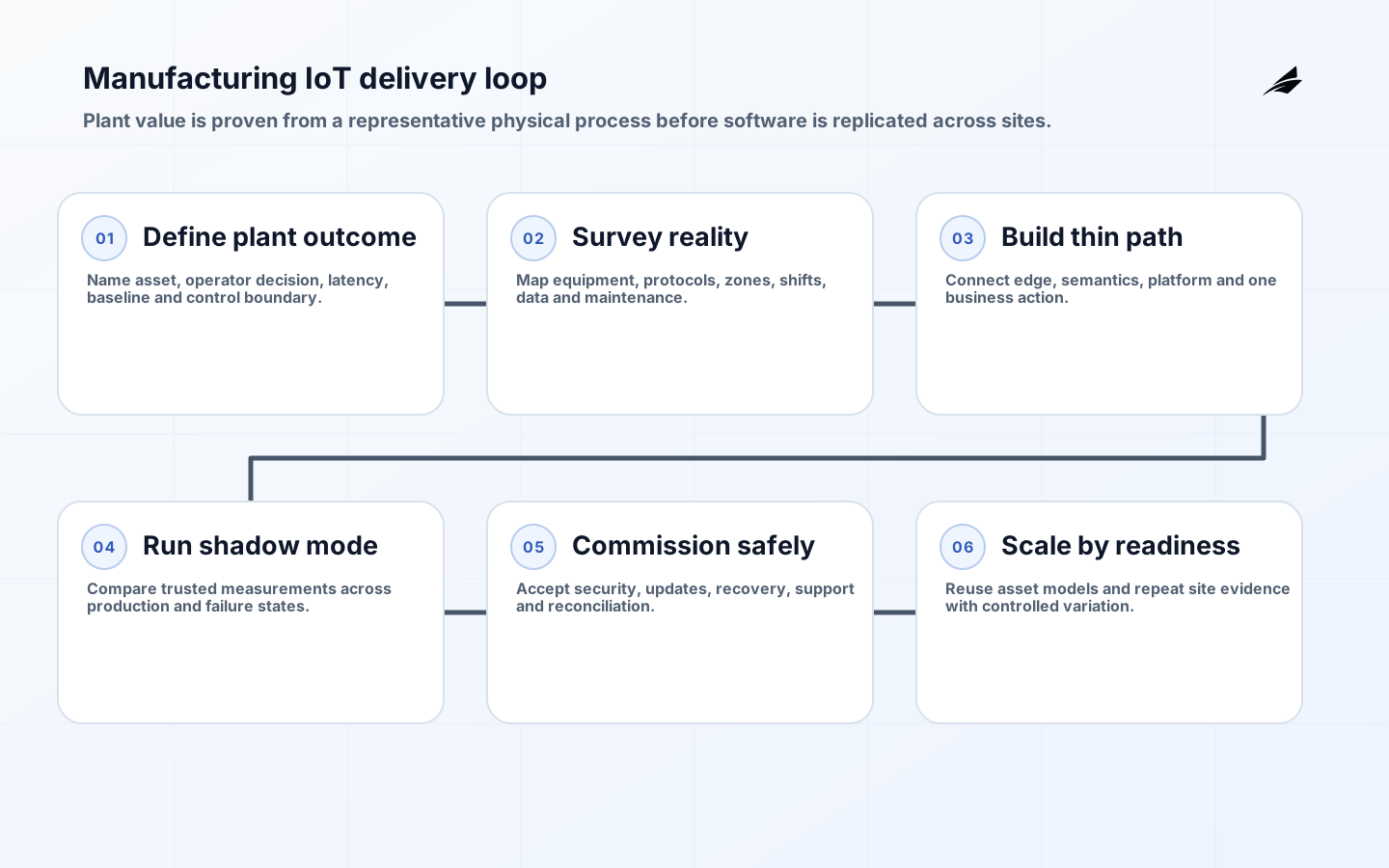
Begin with plant walkdown and a connectivity and data-quality spike. Build a thin path from representative equipment through edge, platform and one business action. Run shadow mode before influencing work. Compare signals with trusted measurements, test maintenance and failure periods, and collect operator feedback across shifts. Define stop conditions for unsafe, stale or unreliable recommendations.

Accept the pilot only after cybersecurity, performance, disconnected behavior, update, restore, support and data reconciliation are proven. Scale by an explicit site-readiness checklist and reusable asset model. The second installation is the architecture test: record which changes are configuration, physical work or new code.
Commission with both technical and plant ownership. Record calibrated baseline signals, gateway and certificate inventory, approved network routes, alarm thresholds, model or rule version, maintenance procedure and safe shutdown or isolation. Hand operations a tested runbook for stale data, storage pressure, failed updates, replacement hardware and supplier escalation. Schedule a post-commission review after representative production and maintenance conditions have occurred; a quiet shift alone cannot establish reliability.
- Define the plant decision, baseline, control boundary and representative asset.
- Survey equipment, protocols, network zones, workflows and support ownership.
- Approve edge-cloud behavior, industrial data contracts and device lifecycle controls.
- Build one complete signal-to-action path and operate it in shadow mode.
- Rehearse disconnection, stale data, updates, cyber incidents and recovery.
- Accept measured outcomes, then scale through site and asset readiness gates.
Key takeaways
- Start with one plant decision and define whether software observes, advises or controls.
- Design for disconnected, degraded and maintenance states at the edge.
- Treat industrial semantics, timestamps and quality as part of the data contract.
- Own every device from provisioning through updates, incidents and retirement.
- Scale only after a representative production pilot proves outcomes and operations.
Frequently asked questions
Should manufacturers buy an IoT platform or build one?
Use managed capabilities when they meet protocol, security, residency, scale, export, operations and cost needs. Build differentiating workflow and domain logic, not commodity fleet or messaging features without cause. Prove exit and data portability before commitment.
Does the first release need predictive AI?
Often no. Reliable condition thresholds, traceability or workflow visibility may deliver earlier value and create labeled evidence for later modeling. Use AI when a validated prediction improves a defined decision beyond simpler methods and can be monitored by operating mode.
How should ROI be measured?
Compare avoided downtime, scrap, inspection delay, energy or maintenance effort with full lifecycle cost. Attribute conservatively, use a baseline and include false alerts and added operator work. Report by asset and condition so portfolio changes do not create false improvement.
Conclusion
Manufacturing IoT succeeds when software respects the physical system it observes. Bound the outcome, distribute responsibilities across edge and cloud, secure the device lifecycle, give data explicit meaning and connect insights to owned workflows. A representative pilot should prove safe operation and repeatability before the program expands.