Manufacturing IoT software connects equipment information to maintenance, quality, energy and production workflows. The difficult questions are rarely about whether a sensor can send data. They concern system boundaries: which device or system owns the value, what must run at the edge, how a plant operates during an outage, who can change configuration, and how software is supported across equipment generations. This manufacturing IoT software development FAQ answers those architecture and operating questions in production terms.
An IoT software development company for manufacturing should be able to discuss PLC load, historian semantics, gateway replacement, certificate rotation, data quality and shift workflows with the same clarity as APIs and cloud services. The answers below use ISA-95 boundaries, NIST OT guidance, the NIST IoT capability baseline and OPC UA concepts as reference points. They are not a substitute for plant hazard analysis or vendor instructions, but they expose the decisions that must be made before a solution is trusted.
For a sequence of implementation gates, use the manufacturing IoT implementation checklist. For commercial scope and phased delivery, see the manufacturing IoT delivery plan and the related industrial dashboard planning guide.
What belongs in a manufacturing IoT architecture?
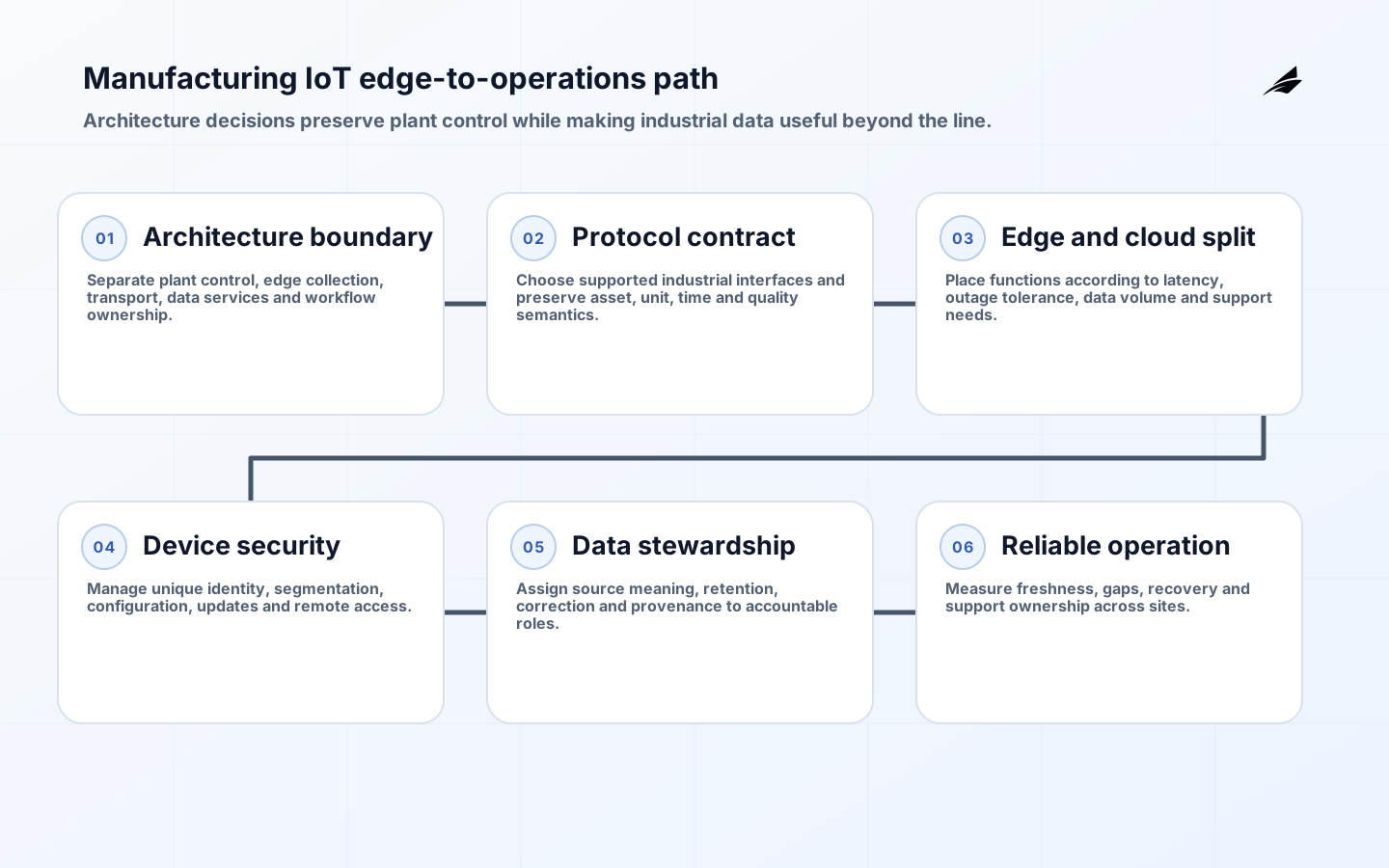
A production architecture normally has five responsibilities: equipment or control sources, edge collection, governed transport, data services, and an operator-facing workflow. These are logical responsibilities rather than mandatory products. A historian may provide both source and storage; an industrial PC may act as protocol adapter and local application host. Draw trust boundaries, owners, failure behavior and management paths separately from the telemetry path. That reveals whether a convenient connection creates an unsafe administrative route.
Use ISA-95 to describe how enterprise planning, manufacturing operations and control responsibilities meet. Keep deterministic control and safety functions local unless a formal engineering process authorizes a different design. Cloud analytics can calculate a recommendation, but the plant must define how that recommendation is reviewed and what happens when it is late or unavailable. An architecture diagram is incomplete until it shows time synchronization, device management, observability and support access.
| Question | Preferred evidence | Warning sign |
|---|---|---|
| Who owns the asset identity? | Mapped hierarchy with named steward | Different names in MES, CMMS and historian |
| What runs at the edge? | Documented latency, outage and protocol rationale | Gateway chosen only because a vendor bundles it |
| How is data trusted? | Units, timestamps, quality and provenance | A tag name is treated as a complete contract |
| What happens offline? | Local operation and queue limits tested | The diagram assumes continuous internet access |
Which protocols should the software use?
Choose protocols according to supported equipment interfaces, information semantics, security and operating constraints. OPC UA can model structured industrial information and supports application and user security concepts. MQTT can be useful for brokered event transport when topic design, authentication, retained messages, quality of service and replay behavior are explicitly governed. Modbus and vendor protocols may require a gateway that protects controllers from uncontrolled polling and translates raw registers into named engineering values.
Protocol choice does not solve data meaning. Document namespace, asset, unit, timestamp, quality and version for every payload. Avoid using one flat topic tree as the asset model. Test reconnect and duplicate behavior because at-least-once delivery can repeat messages. For commands, separate telemetry transport from authorized action handling, include idempotency and expiry, and retain a clear audit trail. A protocol benchmark in a laboratory cannot establish that a production controller will tolerate the same collection pattern.
What should run at the edge and what can run in cloud services?
Run a function near the process when it needs low latency, must continue through a wide-area outage, uses high-volume raw data, or depends on a plant-only protocol. Edge functions commonly include protocol adaptation, buffering, filtering, local rules and health reporting. Use cloud or central services for fleet management, cross-site analysis, long-term storage and workflows that tolerate network latency. The split should follow failure and support requirements rather than fashion.
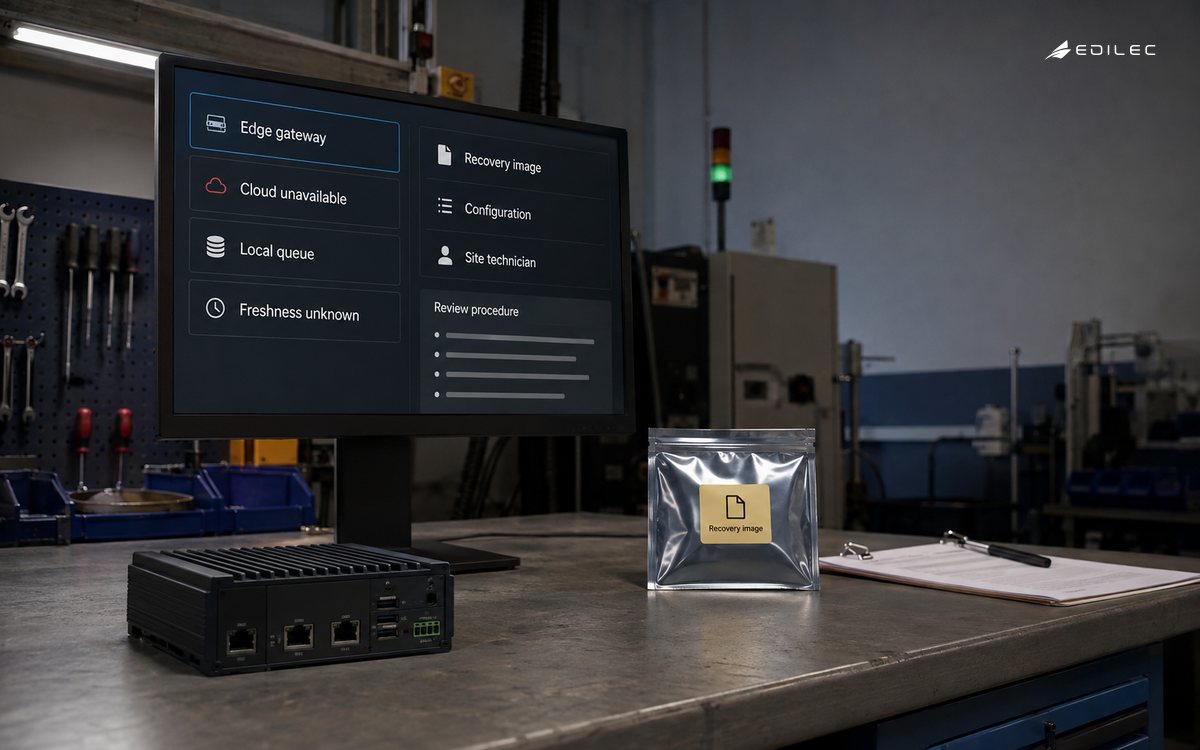
Treat edge software as a managed product. Define its operating system, hardware profile, remote administration path, update mechanism, logs, storage limits and replacement procedure. If a gateway fails at 2 a.m., a site technician needs an approved image and configuration recovery process. If cloud ingestion fails, the edge needs bounded queues and visible data freshness. Hybrid architecture is successful only when teams can diagnose which side owns a gap.
How should device identity and OT security work?
Each managed gateway or capable device should have a unique identity, restricted interfaces and a documented configuration. Credentials need issuance, protected storage, rotation, revocation and recovery. Segment collection services from enterprise users and prohibit direct inbound access from the internet to plant devices. Use encrypted and authenticated channels where equipment supports them, but verify that cryptographic choices, certificate chains and clock requirements remain supportable for the device lifetime.
NIST SP 800-82 emphasizes the distinctive reliability and safety needs of OT. Patch decisions therefore require testing, maintenance windows and compensating controls rather than an office-style automatic-update assumption. Maintain a software and firmware inventory, monitor cybersecurity state, and define how a vulnerable but irreplaceable device is isolated. Remote vendor access should be time-bound, approved, recorded and separated from routine telemetry.
Who owns industrial IoT data and how long should it be retained?
Ownership is distributed. Controls teams own many source definitions; operations owns process interpretation; maintenance owns equipment relationships; quality owns release and disposition records; cybersecurity owns access policy; and the application team owns transformations and service behavior. Assign a steward for each shared data product and keep provenance through derived metrics. Declaring that a central platform owns all plant data usually hides rather than resolves these responsibilities.
Retention follows the decision and regulatory need. High-frequency vibration may be summarized after diagnosis, while batch genealogy and quality evidence may need longer retention. Define raw, curated and aggregate tiers; legal holds; deletion; tenant or site boundaries; and cost limits. Keep enough raw evidence to reproduce material alerts and investigate model or threshold changes. Do not retain sensitive production or personnel data indefinitely simply because storage is inexpensive.
| Data class | Typical purpose | Governance question |
|---|---|---|
| Raw telemetry | Diagnosis and feature reconstruction | How long is replay genuinely useful? |
| Curated events | Applications and cross-site analysis | Which quality rules and versions produced the record? |
| Maintenance outcomes | Validation and improvement | Who can correct closure codes? |
| Audit and configuration | Security and change evidence | Can the team reconstruct who changed what and when? |
How reliable must a manufacturing IoT service be?
Set reliability from the supported operation. A monthly energy report can tolerate delay; a condition alert before a narrow maintenance window may not. Define service-level indicators for data freshness, completeness, event-processing latency, gateway availability and notification delivery. Avoid one platform uptime number that hides stale plant data. A green web service is not useful when a site collector stopped sending twelve hours ago.
Design degraded behavior for each dependency. Operators should see when values are delayed or unavailable. Queues need capacity and discard policy. Applications need idempotent replay and gap detection. Support teams need site, asset and pipeline correlation identifiers. Test recovery with real outage durations and event volumes, then measure how long the system takes to become current. Reliability includes restoration and data reconciliation, not merely server restart.
What should a manufacturing IoT delivery partner provide?
A capable partner should produce an asset and interface inventory, architecture and network flows, data contracts, threat model, deployment automation, gateway management plan, acceptance tests, operating runbooks and ownership matrix. It should explain where vendor products end and custom responsibility begins. Demonstrations should use representative timestamps, quality states and failure scenarios rather than polished synthetic data alone.
Commercial scope should distinguish site discovery, reusable platform work, per-asset engineering, per-site commissioning and ongoing operations. Require source control, infrastructure and configuration ownership, component inventories, license records and knowledge transfer. The plant should be able to replace a gateway, rotate a certificate, trace an alert and recover a release without depending on one individual from the supplier. Handover is an operating test, not a document delivery event.
Key takeaways
- Architecture should expose logical responsibility, trust boundaries and failure behavior.
- Protocol choice must be paired with an explicit industrial data contract.
- Edge placement follows latency, outage and support needs; cloud placement follows fleet and scale needs.
- Reliability is measured at the plant data and workflow level, not only service uptime.
- A partner must leave deployable assets, runbooks and transferable operational knowledge.
Frequently asked questions
Can an existing historian be the IoT source?
Often yes. A historian can reduce controller load and provide quality and time context, but teams must verify tag meaning, update behavior, retention, access limits and whether the required latency is available.
Is MQTT better than OPC UA?
They solve different concerns and can coexist. OPC UA is strong for industrial information models and secure client-server interaction; MQTT is useful for brokered message distribution. The choice depends on source support, semantics, topology and failure behavior.
Is a digital twin required?
No. Begin with a governed asset model and the minimum state needed for the workflow. A broader twin is justified only when its relationships, behavior and lifecycle serve defined decisions.
Who should support the system after launch?
Use shared ownership with clear boundaries: plant controls for source interfaces, platform teams for edge and ingestion, application teams for workflows, cybersecurity for policy, and a named service owner for end-to-end outcomes.
Conclusion
Manufacturing IoT architecture is credible when every connection has a purpose, owner, security boundary and tested failure mode. The best answer is rarely 'put everything in the cloud' or 'keep everything on premises.' It is a supportable division of responsibilities that preserves plant control while making industrial information dependable enough for daily decisions.