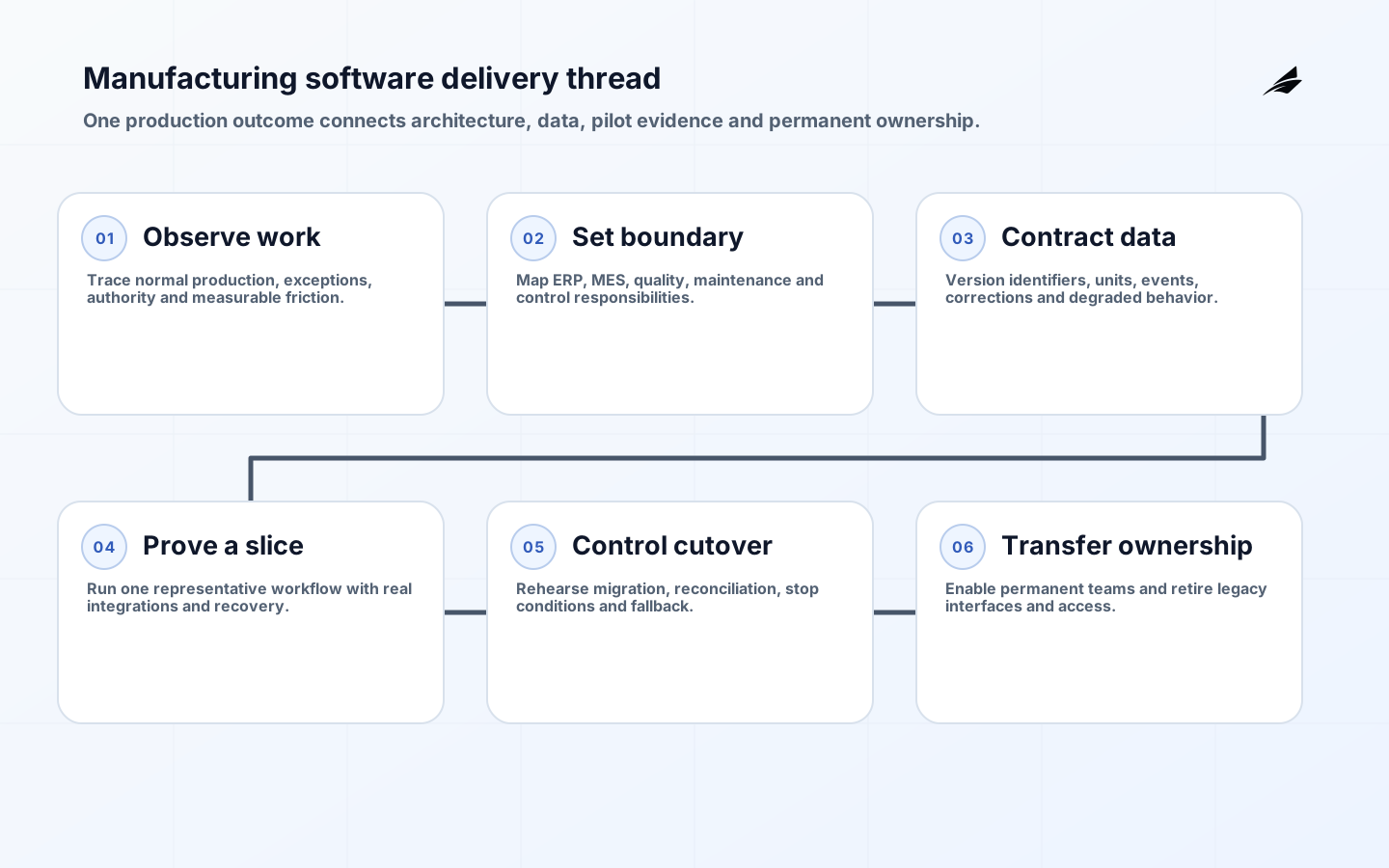
Custom manufacturing software development succeeds when it improves a specific production decision without weakening safety, traceability or recovery. The implementation must fit an installed estate of ERP, MES, quality, maintenance, warehouse, historian and control systems. Treating a plant like an ordinary office application creates hidden dependencies and brittle cutovers. The project needs a shared model of workflows, equipment, records and authority before interface code begins.
This checklist is for manufacturers commissioning a production application, replacing spreadsheets or extending a commercial platform with custom workflows. It covers discovery through steady operation. Use each item as an acceptance question with a named owner and observable proof. The objective is not to reproduce every legacy screen; it is to create a simpler, supportable service that preserves the rules and evidence the plant genuinely needs.
1. Charter the production outcome and control boundary
Describe the moment the software will improve: release an order, record consumption, route a nonconformance, schedule maintenance or reconcile finished goods. Name the user, current delay, authoritative record and measurable outcome. State clearly whether the application recommends, records or directly controls an action. Acceptance evidence should identify the responsible owner, the source record, the expected result and the decision required when the result is missing.
Map operations, quality, engineering, maintenance, IT, OT security, supply chain and finance stakeholders. Record who approves process rules, stops production and accepts temporary workarounds. Observe more than one shift and include rework, substitution, downtime and connectivity loss. Test the normal path, boundary conditions and a realistic failure path; a successful demonstration alone does not prove the manufacturing software service is ready.
| Area | Evidence | Owner question |
|---|---|---|
| Workflow | Observed normal and exception paths | Who decides when the process may deviate? |
| Estate | Supported inventory and dependency map | Which hidden job still consumes this data? |
| Authority | Role and decision matrix | Who may correct, override or stop work? |
| Outcome | Baseline and acceptance measure | What result justifies wider rollout? |
2. Baseline the installed manufacturing estate
Inventory applications, equipment interfaces, gateways, zones, databases, files, reports, identities and scheduled jobs used by the target workflow. Record versions, support status, owners, vendors and change windows. Distinguish documented interfaces from direct database reads or file drops that grew informally. Keep the definition and its effective date with the implementation so later teams can explain why historical and current behavior differ.
Use ISA-95 as vocabulary for logical boundaries rather than a rigid network picture. Identify information belonging to business planning, manufacturing operations and control. For every exchange, record direction, cadence, identifier, unit, timestamp, volume and unavailable-system behavior. Make exceptions visible in the same operating workflow instead of routing them to private spreadsheets or undocumented support messages.
3. Model orders, materials, equipment and quality explicitly
Create a domain model using plant terms. Define order, operation, resource, material lot, serial, equipment state, inspection, defect, hold and release. Identify stable business identifiers separately from vendor keys and state invariants such as genealogy that cannot be silently reassigned. Use progressive exposure and explicit stop conditions so the team can learn from production without placing the entire estate at risk.
Version recipes, routings, specifications and product structures so historical records remain interpretable. Model corrections as explicit actions with reason, authority and audit evidence. Document rounding, unit conversion, time zones and effective dates before different systems produce contradictory results. Measure the business completion time and error consequence, not only component uptime or the number of tasks closed.
4. Design integration contracts and degraded modes
Prefer supported APIs, events and industrial standards over direct vendor-database writes. For OPC UA, specify nodes, data types, status, timestamps, security and subscription behavior. For ERP or MES exchanges, define idempotency, acknowledgements, retry, ordering and reconciliation. Preserve identifiers, timestamps and version information across handoffs so reconciliation can distinguish delay, duplication and correction.
Decide what work continues when ERP, cloud connectivity, a gateway or the new application is unavailable. Define local queues, operator notice, maximum outage, duplicate handling and later reconciliation. Do not promise offline operation without complete identity, reference data and conflict rules. Document the recovery sequence and exercise it with representative state before relying on it during a live incident.
5. Build security around OT and production constraints
Segment routes between cloud, enterprise and operational zones. Use named service identities, least privilege, managed secrets and auditable support access. NIST SP 800-82 explains that OT performance, reliability and safety shape security decisions, so coordinate scanning, patching and failover with plant owners. Apply least privilege to people and services, and record material administrative actions with enough context for later review.
Threat-model remote access, file transfer, device enrollment, privileged workflows and supplier dependencies. Require secure defaults and supported components under NIST SSDF practices. Establish vulnerability triage that accounts for exploitability, exposure, production consequence and safe maintenance windows. Review this control when scope, integrations, users or obligations change; a launch-time decision should not become a permanent assumption.
6. Deliver a narrow end-to-end production slice
Choose one representative plant, product family and workflow with real integrations and meaningful exceptions. Build the complete path from source event through user action, authoritative update, monitoring and recovery. A thin slice is small in scope, not partial in operability. Separate a commercial promise from the operational mechanism and evidence that will make the promise dependable.
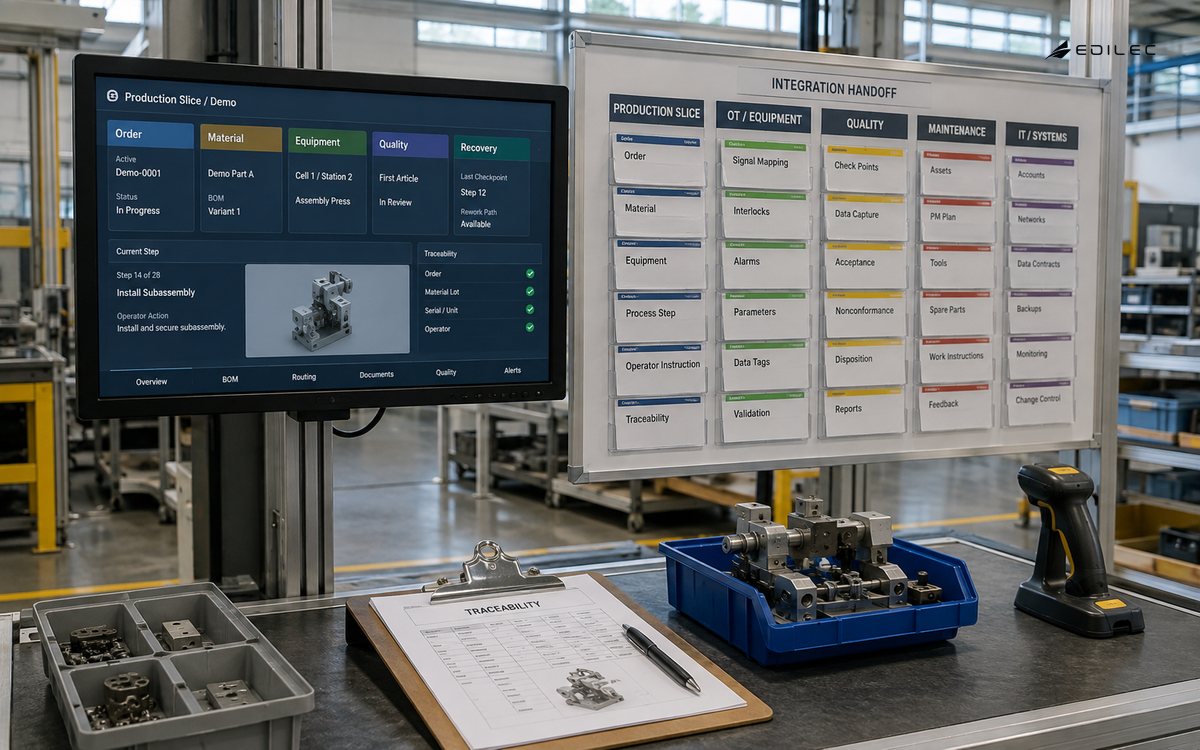
Run a shadow phase comparing the new result with existing records, and investigate every material difference. Activate for a bounded cohort with stop conditions and rapid support. Define how work recorded during fallback will be reconciled. Give users a clear degraded state and next action instead of allowing partial data or failed automation to appear complete.
| Gate | Required proof | Do not proceed when |
|---|---|---|
| Architecture | Approved boundary, contracts and threat model | Control authority is ambiguous |
| Pilot | Representative data, users and recovery rehearsal | Critical exceptions exist only in slides |
| Activation | Reconciled shadow results and live telemetry | Duplicate effects remain unexplained |
| Scale | Repeatable site onboarding and support | Each plant requires an undocumented code fork |
| Decommission | Retention and downstream closure | Legacy consumers remain unknown |
7. Prove migration, load and recovery
Profile source data before transformations. Define mapping, cleansing, deduplication and exception ownership. Reconcile counts and business totals at each stage, then sample complete genealogy or quality chains. Preserve source snapshots and transformation versions. Automate repeatable verification where it shortens feedback, while retaining accountable human judgment for consequential ambiguity.
Test shift changes, planning peaks, batch completion, reconnect storms and backlogs. Measure end-to-end latency and operator wait. Rehearse restoration and selective reprocessing from checkpoints, confirming repeated messages do not duplicate material, inventory or financial effects. Version configuration with code and deployment records so a defect can be reproduced, contained and corrected without guesswork.
8. Establish ownership and repeatable plant onboarding
Create a service catalog, on-call path, incident model and responsibility matrix across manufacturer, software team and vendors. Document certificate renewal, account provisioning, master-data change, interface versioning and plant configuration. Avoid invisible site-specific forks. Define a small set of leading and lagging measures, then remove metrics that have no owner or operating response.
Measure completion time, manual re-entry, exception age, reconciliation variance, critical-period availability, change failure and recovery. Review outcomes with operations and quality. A custom application becomes an asset only when permanent teams can change and recover it without its original developers. Include site onboarding effort and configuration divergence so growth does not conceal a collection of unsupported local variants.
Complete the manufacturing implementation acceptance pack
Before declaring the implementation complete, reconcile the agreed outcome, process model, production configuration and operational evidence. The acceptance pack should identify authoritative records, interface contracts, role decisions, migrated populations, unresolved exceptions, security findings, performance limits, recovery results and legacy dependencies. Link each item to a named owner and source artifact. A signed checklist without reproducible evidence will not help the next plant or the team responding to an incident.
- Confirm every production and quality rule has an accountable business owner.
- Reconcile representative orders, lots, serials, holds and financial movements.
- Verify named access, support escalation, backup restoration and offline procedures.
- Demonstrate that permanent staff can deploy, diagnose and recover the service.
- Record legacy records, interfaces and licenses that remain to be retired.
Use the same pack as the template for each additional site. Local differences should appear as approved configuration, interface or process decisions, with corresponding tests and support responsibilities. If onboarding requires undocumented changes by the original project team, the product is not yet repeatable. Resolve that gap before a rollout schedule multiplies it across the estate.
Key takeaways
- Anchor scope to one production decision and make control authority explicit.
- Use ISA-95 terminology to clarify enterprise, operations and control boundaries.
- Version domain rules and integration contracts, including delayed and duplicate behavior.
- Pilot a complete operable slice with reconciliation and recovery evidence.
- Scale through repeatable configuration and ownership, not plant-specific forks.
Frequently asked questions
Should custom software replace the MES?
Only when the business case and permanent operating capability justify it. Often a better design keeps the MES as execution authority and adds a focused workflow or integration service. Define duplicated capabilities, record authority and upgrade implications before deciding; a core MES replacement is a transformation program.
Can plant software be cloud-only?
It can when availability, latency, residency and degraded operation match production needs. Some functions can wait for connectivity; others need edge capability or a local fallback. Document the maximum tolerable outage and reconcile local actions after reconnection.
How long should the first implementation take?
Estimate after discovering workflows, interfaces, data quality and site constraints. A narrow end-to-end pilot can be delivered sooner than an estate-wide replacement, but dates without interface access and plant participation are unreliable. Plan around verified production outcomes rather than feature counts.
Conclusion
Custom manufacturing software development combines systems integration, operational change and product engineering. The implementation should preserve production truth while simplifying how people make decisions. Clear boundaries, versioned contracts, controlled pilots and recovery evidence prevent the new service from becoming another fragile plant dependency.
Start by tracing one real order or quality event across every system and human handoff. Make its authority, identifiers, failure behavior and acceptance evidence explicit. That thread will expose the architecture and delivery work that matters before broad scope turns uncertainty into cost.