Plan SaaS product development for manufacturing
Selecting a SaaS product development company for manufacturing is an operating-design decision before it is a tooling decision. Manufacturing product sponsors, plant technology teams and software leaders must decide whether the proposed product can improve a defined plant decision without weakening safety, availability, cybersecurity or data stewardship. A useful plan makes that outcome testable, assigns authority wherever work crosses systems or teams, and preserves enough evidence to explain a normal release, degraded period or disputed result.
This guide treats SaaS product development for manufacturing as a lifecycle. Discovery establishes the outcome and constraints; architecture makes boundaries explicit; implementation creates controlled paths; acceptance proves those paths with representative scenarios; and operation turns failures into measurable improvement. The advice draws on Guide to Operational Technology Security SP 800-82 Rev. 3, Cybersecurity Framework Manufacturing Profile, Smart Connected Manufacturing Systems Group, Smart Manufacturing Systems Readiness Level Tool, OPC UA Part 4 Services, Method Service Set, Secure Software Development Framework SP 800-218. Those references provide standards and implementation guidance, while the service owner still must define what is acceptable for the specific product, customer and risk context.
Continue with Edilec's manufacturing SaaS implementation checklist, manufacturing SaaS delivery FAQ and manufacturing IoT software delivery plan. These companion guides separate product-company selection from plant rollout and device-integration decisions.
Start with the decision and operating boundary
The first workshop should produce a one-sentence decision statement: whether a proposed manufacturing SaaS product can improve a defined plant decision without weakening safety, availability, cybersecurity or data stewardship. Add the accountable role, decision cadence, maximum tolerable delay and consequences of a wrong answer. This prevents the engagement from becoming a catalogue of features. It also separates a genuine requirement from a preference that can wait. For this topic, the initial boundary is the line between enterprise SaaS, site services, edge gateways and operational technology that directly controls physical processes. Anything outside that line should be named as a dependency, exclusion or later phase rather than left to assumption.
| Design question | Decision to record | Acceptance evidence |
|---|---|---|
| Outcome | Whether a proposed manufacturing SaaS product can improve a defined plant decision without weakening safety, availability, cybersecurity or data stewardship. | Named owner, baseline and measurable target |
| Boundary | The line between enterprise SaaS, site services, edge gateways and operational technology that directly controls physical processes. | Included assets, exclusions and dependency map |
| Authority | Who may approve, override, contain, restore or communicate. | Role tests and exercised escalation path |
| Failure | What can retry, wait, degrade, roll back or stop. | Scenario result with timestamps and owner |
| Exit | Which records, automation and knowledge remain portable. | Export, handback and deletion rehearsal |
Design an architecture that preserves context
A dependable design for SaaS product development for manufacturing connects an enterprise control plane, tenant-aware SaaS services, site-local edge services, protocol adapters, immutable event records and governed analytics. The interfaces matter as much as the components. Stable identifiers should follow a request, tenant, device, release or business record through every handoff. Time, version, actor, decision basis and outcome should be queryable without reconstructing events from screenshots. Access must be derived from verified identity and constrained at the point where a protected action or record is reached.
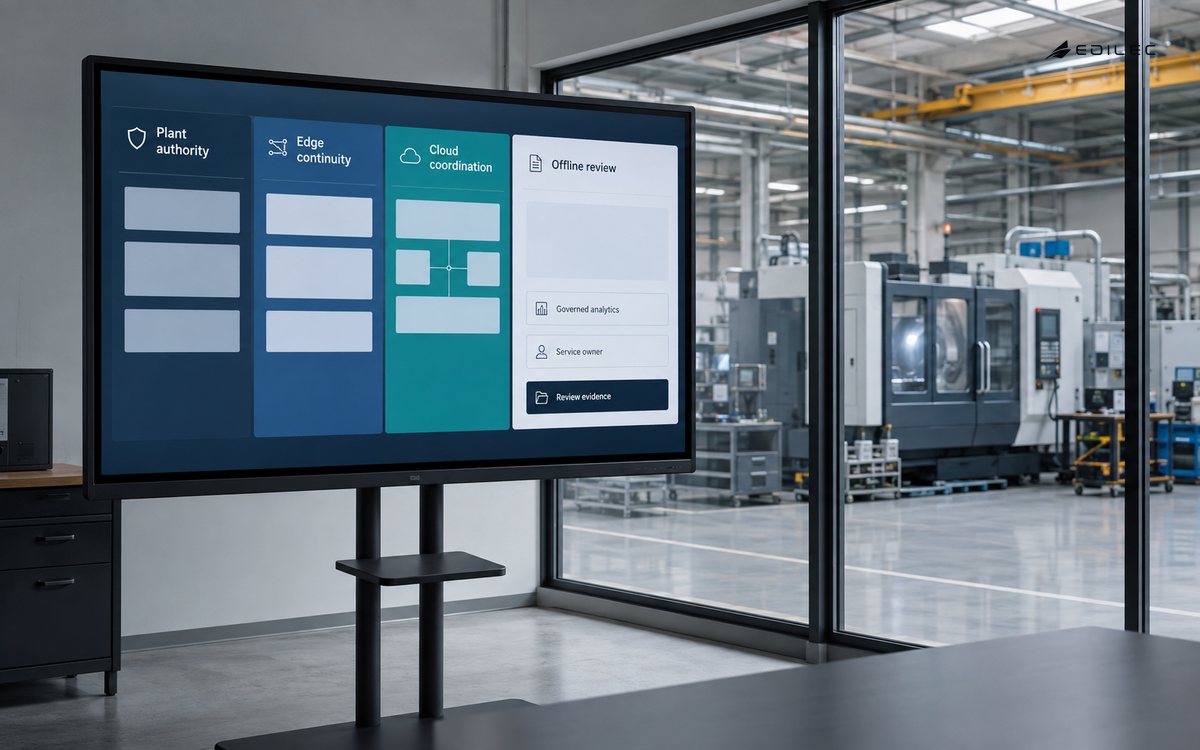
For SaaS product development for manufacturing, design degraded behavior deliberately. State what remains available when a dependency is slow, a queue is backlogged, a credential expires, an edge site disconnects or a deployment introduces an incompatible change. Decide where work is buffered, how long it is retained, how duplicates are detected and how a person distinguishes current from stale evidence. Recovery is part of architecture: backups, replay, rollback and manual workarounds need owners and tested stopping conditions.
Worked example: test the operating model
A quality team needs cross-site defect analysis while each plant must continue recording inspections during a WAN outage. The product keeps the inspection workflow and local queue at the site, synchronizes idempotently after reconnection, and marks late or conflicting records instead of silently overwriting them.
For SaaS product development for manufacturing, turn the example into an acceptance exercise. Seed an ordinary case, a malformed case, an unauthorized case, a dependency timeout and a partial-success case. Ask the operating team to diagnose the state, select an allowed response, communicate appropriately and confirm the final record. Capture where the team needed undocumented knowledge or excessive access. Those observations should change the design or runbook before wider rollout, not become informal tribal knowledge after launch.
Risks and controls that deserve explicit review
| Risk | Control question | Evidence |
|---|---|---|
| Treating a plant like a continuously connected office | For manufacturing SaaS delivery, ask: How will the team prevent, detect and recover from this design failure? | offline workflow completion trend, scenario result and named owner |
| Sending control commands through an unbounded cloud path | For manufacturing SaaS delivery, ask: How will the team prevent, detect and recover from this operational failure? | event delivery lag and reconciliation rate trend, scenario result and named owner |
| Ignoring equipment identity and time synchronization | For manufacturing SaaS delivery, ask plant-to-cloud delivery review, while checking the owner,: How will the team prevent, detect and recover from this design failure? | plant availability impact trend, scenario result and named owner |
| Mixing customer or plant data without explicit tenancy rules | For manufacturing SaaS delivery, ask plant-to-cloud delivery review, while checking the owner,: How will the team prevent, detect and recover from this operational failure? | defect decision lead time trend, scenario result and named owner |
| Deploying intrusive security scans against fragile OT devices | For manufacturing SaaS delivery, ask plant-to-cloud delivery review, during failure rehearsal,: How will the team prevent, detect and recover from this design failure? | security exception age trend, scenario result and named owner |
| Piloting without an exit and rollback plan | For manufacturing SaaS delivery, ask plant-to-cloud delivery review, during failure rehearsal,: How will the team prevent, detect and recover from this operational failure? | adoption by role and site trend, scenario result and named owner |
Risk review should prioritize consequence and exploitability rather than the number of checklist items. For SaaS product development for manufacturing, common failure modes include treating a plant like a continuously connected office; sending control commands through an unbounded cloud path; ignoring equipment identity and time synchronization. The next layer includes mixing customer or plant data without explicit tenancy rules; deploying intrusive security scans against fragile OT devices; piloting without an exit and rollback plan. Each risk needs a preventive control, an observable signal, a response authority and a recovery test. If one of those is absent, the residual risk should be visible to the person accountable for the outcome.
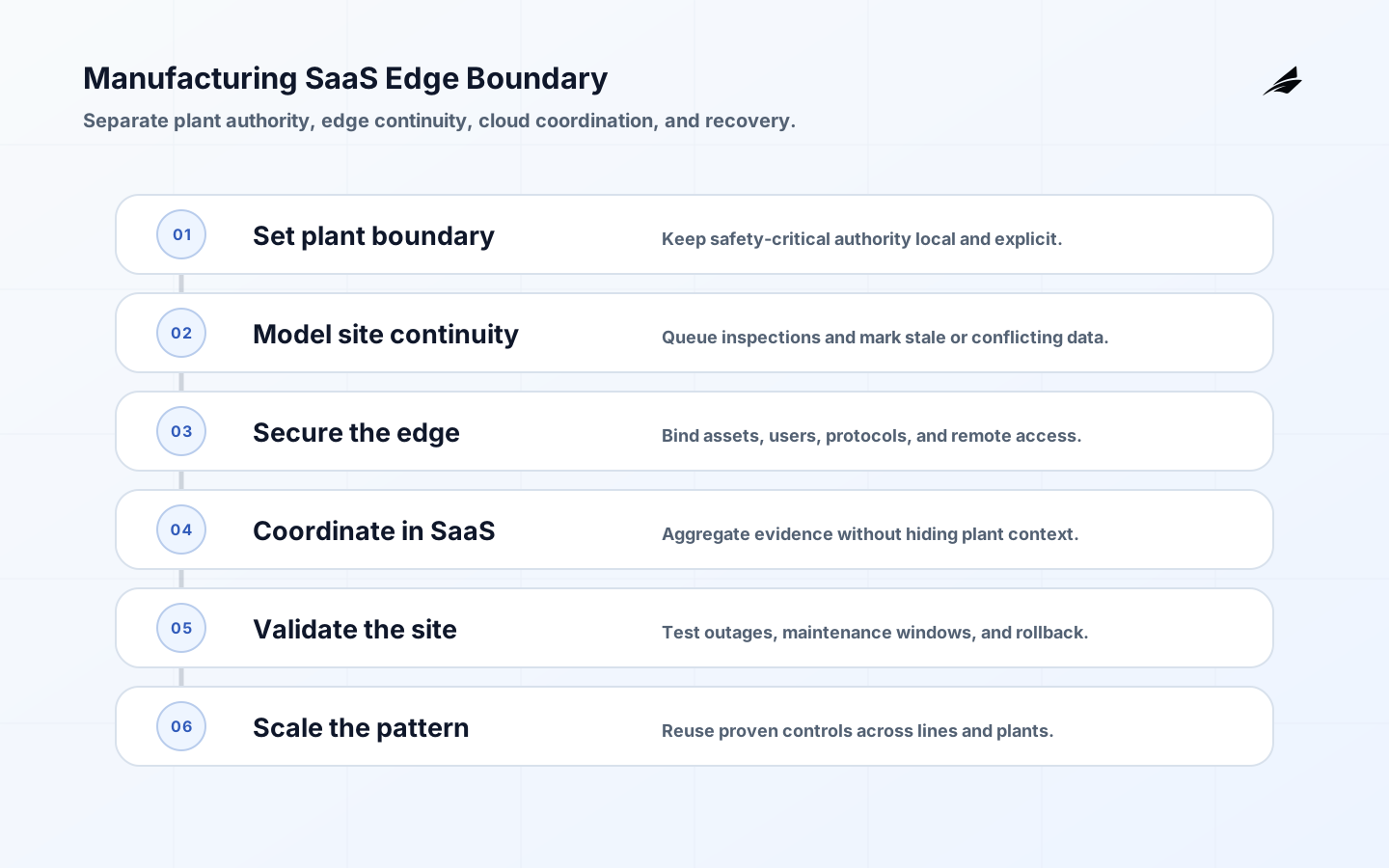
Implement in six controlled stages
Plan cost around work and risk drivers
For SaaS product development for manufacturing, estimate cost from observable drivers: number and criticality of services, transaction or event volume, integrations, environments, support coverage, regulatory obligations, data retention, recovery objectives, expected change and the amount of undocumented legacy behavior. Separate one-time discovery and transition from recurring operation. Also separate standard work from projects and exceptional changes. A low headline fee can be expensive if routine lifecycle work is excluded or if every defect becomes a chargeable request.
Operate with decision-grade measures
The operating review for SaaS product development for manufacturing should track offline workflow completion, event delivery lag and reconciliation rate, plant availability impact, defect decision lead time, security exception age, adoption by role and site. Segment results where a global average hides risk: by service, tenant, plant, workflow, release, route or severity as appropriate. Pair rates with sample review so a green dashboard cannot conceal a harmful edge case. Every measure needs a definition, data owner, reporting cutoff and response threshold.
For SaaS product development for manufacturing, a useful monthly review asks what changed, which decision the evidence supported, which exception repeated and what control or design will be improved. Distinguish a one-off incident from a structural weakness. Retire noisy alerts and measures that do not change action. Rehearse recovery and exit periodically, because portability and handback decay when they are never exercised.
Practical acceptance checklist
- The outcome, scope and accountable owner for SaaS product development for manufacturing are written and approved.
- Dependencies, data classifications, identities and decision rights are mapped.
- Normal, unauthorized, degraded and recovery scenarios have been exercised.
- Telemetry exposes state, version, cutoff and ownership without unnecessary sensitive data.
- Security and privacy controls apply at the protected resource or action, not only in the interface.
- Measures have definitions, targets, owners and a response when they breach.
- Runbooks, automation, records and exit artifacts are stored in agreed locations.
- Open risks have an owner, due date and explicit acceptance or remediation decision.
Set a manufacturing boundary that safety can trust
A manufacturing SaaS product should improve a plant decision without pretending that a cloud service is the plant. Define the boundary between enterprise workflows, site services, edge gateways, protocol adapters, and control systems before estimating features. Identify which actions can be advisory, which can be queued, and which must remain local. The boundary becomes an acceptance artifact: reviewers can see where a loss of connectivity changes behavior and who has authority to restore normal operation.
For a quality workflow, keep inspection capture and the minimum queue available at the site, then synchronize with explicit identity, time, version, and conflict rules. Do not silently overwrite a late record simply because the cloud view arrived first. Mark conflicting evidence, preserve the source record, and give a named quality role a way to resolve it. This design is slower to explain than “real time everywhere”, but it is safer to operate.
Cost should reflect plant variation. Count sites, equipment families, protocols, edge hardware, data retention, environments, support windows, cybersecurity testing, recovery objectives, and the effort required to standardize local procedures. Separate a repeatable site pattern from one-off integration work. A SaaS product development company for manufacturing should show which costs fall with reuse and which remain proportional to every plant or line.
Security review needs operational technology context. Use least privilege, strong asset identity, controlled remote access, segmented trust boundaries, secure development practices, and a change process that respects maintenance windows. Test with representative equipment or a safe simulator, and define a stop condition for intrusive scans or a deployment that threatens availability. The delivery plan should name the plant authority who can pause the rollout.
Key takeaways
- SaaS product development for manufacturing should begin with an accountable decision and a bounded first release.
- Architecture must preserve identity, context, authority and evidence across handoffs.
- Acceptance should include representative failures and recovery, not only a demonstration.
- Cost and service measures should reward dependable outcomes rather than activity volume.
- Operational learning, security review and exit readiness continue after launch.
A manufacturing SaaS delivery plan becomes practical when the team can explain who decides, what is included, how evidence moves, which failures are tolerated and how recovery is proven. Start with the bounded decision, implement the smallest complete operating path, and require scenario-based acceptance. That approach produces a service that can be operated, audited and improved instead of a collection of features that works only while conditions are ideal.
Frequently asked questions
Should manufacturing SaaS control equipment directly?
Usually the first design should keep safety-critical control local and use the SaaS layer for coordination, analysis, workflow, or bounded advisory actions. Any exception needs a specific safety, security, latency, and recovery case.
How do we plan for plant connectivity loss?
Define the local workflow, queue retention, identity and timestamps, duplicate handling, conflict resolution, operator visibility, and replay behavior before implementation. Exercise the case with a real or representative site.
What makes a manufacturing SaaS vendor credible?
Clear OT boundaries, evidence from representative environments, secure development and access controls, measurable recovery, transparent cost drivers, named ownership, and a practical exit or handback plan.
Conclusion
A dependable manufacturing SaaS delivery decision is visible in its boundaries, examples, ownership, failure behavior, and evidence. For manufacturing SaaS delivery, start with one complete workflow, make the hard case observable, and expand only when the people responsible for the outcome can operate and recover it. For manufacturing SaaS delivery, that discipline keeps the implementation useful after launch, when conditions are less tidy than the first demonstration.