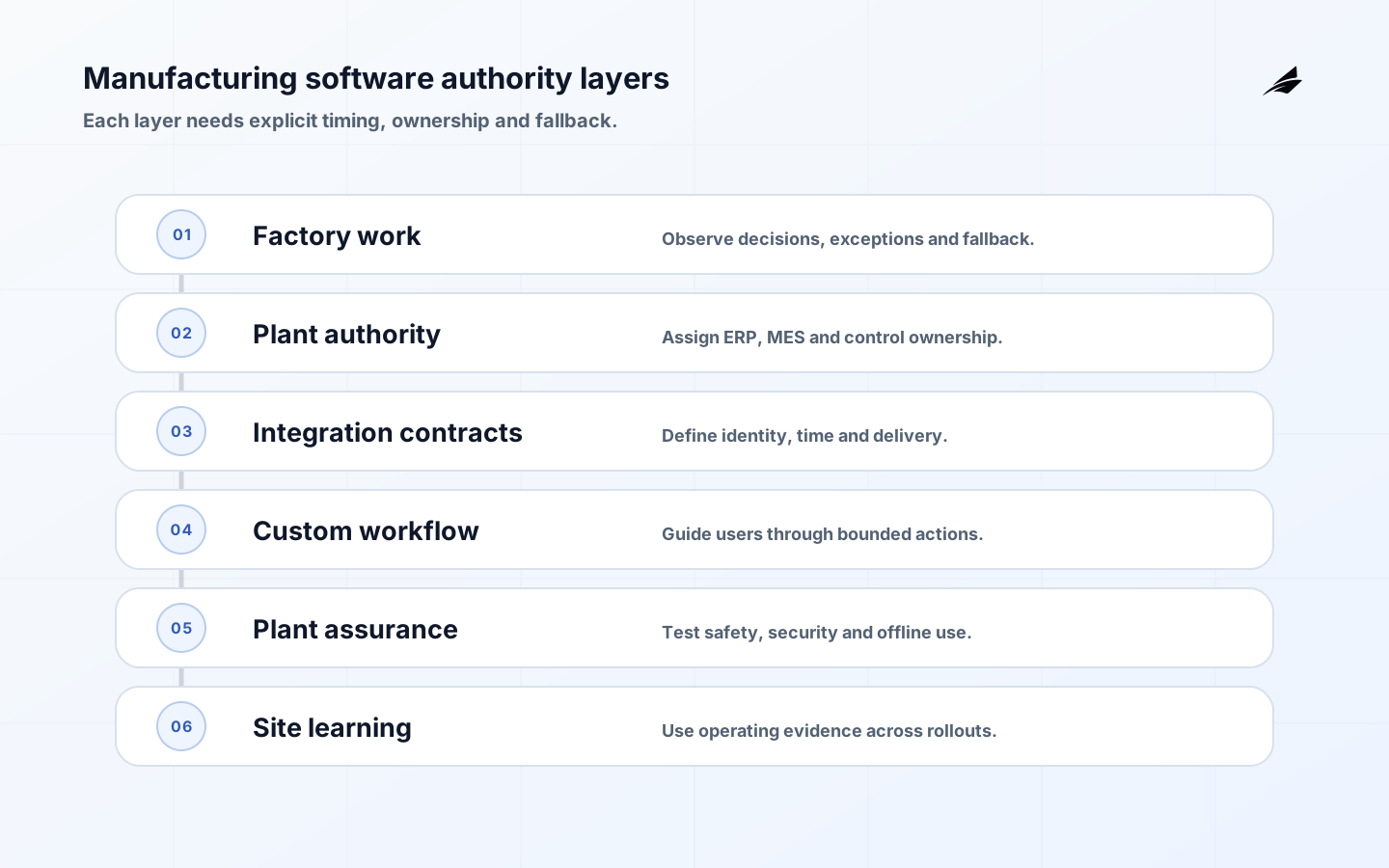
Custom software development services for manufacturing should improve a specific production or maintenance decision without weakening safety, traceability or plant continuity. The work may connect ERP, MES, quality, maintenance, warehouse and control systems, but the goal is not maximum connectivity. It is a dependable operating workflow with clear authority, qualified data, controlled change and a fallback that plant staff can execute when software or networks are unavailable.
This FAQ helps operations, engineering and IT leaders evaluate scope and delivery. The manufacturing software scope guide covers investment planning, while the manufacturing implementation checklist supplies acceptance gates. The central discipline is to observe actual factory work before designing a digital ideal.
What manufacturing workflows are good candidates?
Good candidates have repeated coordination pain and a measurable operating outcome: production dispatch, electronic work instructions, genealogy, quality hold and release, downtime response, maintenance planning, material movement or energy management. Follow the current journey across shifts. Record who decides, which identifiers and timestamps matter, how exceptions are handled and what paper, radio or spreadsheet workaround keeps the plant moving.
Do not begin by replacing every legacy application. Define one line, product family, site or workflow and its interfaces. Name the authoritative system for orders, recipes, material, equipment state, quality disposition and financial posting. Preserve independent safety controls and regulated records according to domain requirements. The application should never imply authority to command equipment merely because it can read operational data.
| Workflow | Primary outcome | Critical exception |
|---|---|---|
| Production dispatch | Right work and resources reach the line | Order or material mismatch |
| Work instructions | Operator receives approved revision in context | Offline station or superseded instruction |
| Quality hold | Affected material is contained and traceable | Late result or partial genealogy |
| Maintenance | Fault becomes prioritized, prepared work | Unsafe access or missing spare |
| Material movement | Inventory and physical location agree | Unscanned substitution or split lot |
| Performance analysis | Loss is classified for action | Bad state model or missing time |
How should ERP, MES and control boundaries be defined?
Use logical responsibilities rather than treating the familiar automation pyramid as a mandatory network design. The ISA-95 standard establishes terminology and models for interfaces between control and enterprise functions. Apply it to clarify production schedules, capabilities, material, equipment, personnel, performance and quality exchanges. Record direction, owner, timing, identifiers and reconciliation for each interface.
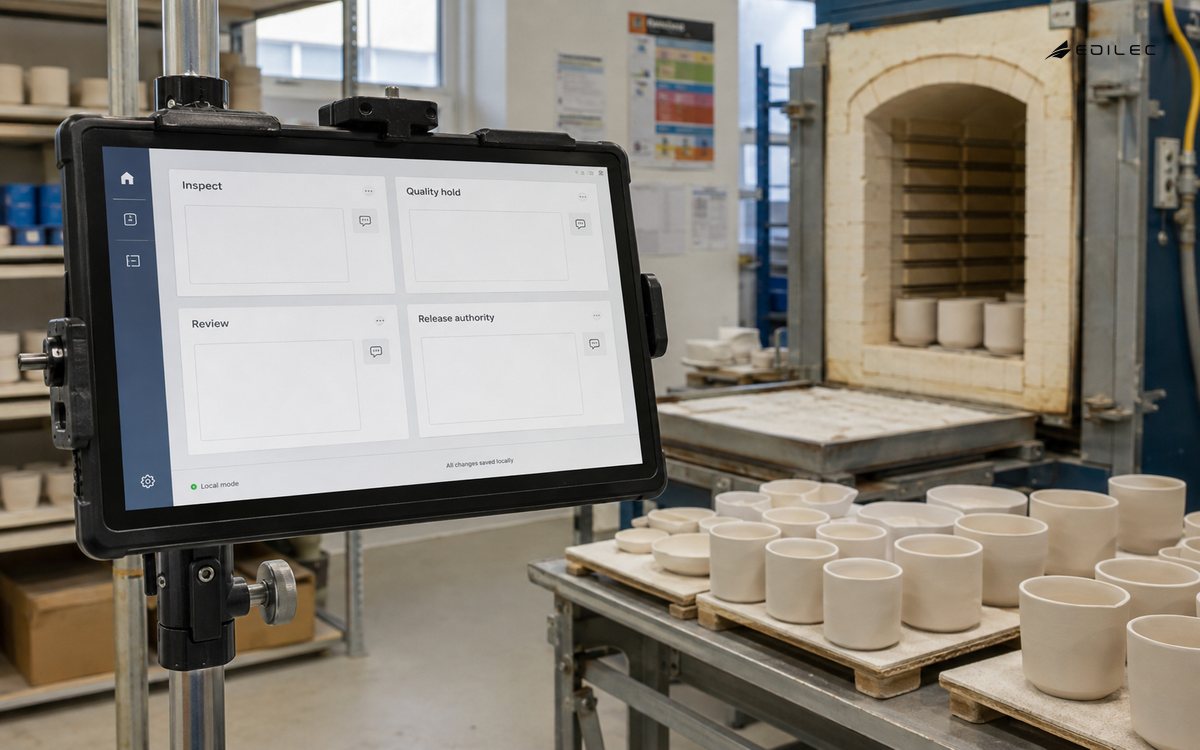
For industrial information exchange, OPC UA defines information, message, communication and conformance models across sensors, control systems, MES and ERP. It can provide secure, discoverable semantics, but an integration still needs a bounded data model, certificates, trust lists, performance limits and operational ownership. Do not expose a broad control namespace when the application needs a small read-only equipment state.
How are safety and cybersecurity handled?
Conduct hazard and threat analysis with operations, controls engineering, safety, security and maintenance. Identify actions that could affect equipment, product quality, environment or people. Use read-only integration by default and narrowly authorize commands with equipment-state preconditions, rate limits, acknowledgement and local protection. Network loss or stale data should produce a qualified state, not an instruction that looks current.
The NIST Cybersecurity Framework 2.0 organizes outcomes across Govern, Identify, Protect, Detect, Respond and Recover, while CISA's Cross-Sector Cybersecurity Performance Goals prioritize a baseline for IT and operational technology. Use them to set outcomes, then tailor controls to plant risk. Maintain asset and software inventories, segment access, protect remote support, test backups and define incident authority across IT and operations.
The development service itself should follow secure practices. NIST's SSDF covers preparing the organization, protecting software, producing well-secured software and responding to vulnerabilities. Require protected source and builds, dependency inventory, test evidence, signed releases where appropriate and a vulnerability process that accounts for narrow plant maintenance windows and unsupported operating systems.
What makes plant data trustworthy?
Define equipment, product, material and location identifiers before multiplying integrations. Preserve event time, receipt time, source, engineering unit, quality and version. Model equipment states and production boundaries with operations staff; utilization metrics are meaningless if planned stop, starved, blocked and fault states are inferred differently by site. Keep raw evidence available for investigation, but publish governed transformations for operational decisions.
Design every interface for duplicate, delayed, missing and out-of-order events. Use idempotent consumers, durable checkpoints, dead-letter handling and reconciliation against the authoritative system. A message broker delivering an event does not prove the ERP transaction committed or the physical material moved. Expose integration health in operating language: which orders, lines or lots are affected and what fallback should be used.
| Interface contract | Required definition | Test case |
|---|---|---|
| Identity | Equipment, order, lot and location mapping | Unknown and duplicated identifier |
| Time | Event, receipt, timezone and clock quality | Late event and clock drift |
| Semantics | State, unit, version and allowed transition | Unsupported or out-of-sequence state |
| Authority | System allowed to create or change the record | Conflicting updates |
| Delivery | Retry, idempotency and replay window | Duplicate and broker outage |
| Reconciliation | How physical and digital state are compared | Partial commit or missed scan |
How should manufacturing software be piloted?
Choose a representative but recoverable line and include different shifts, operators, products and exception paths. Establish a baseline for cycle time, manual entry, queue age, quality escapes, downtime or another outcome the workflow can influence. Run the new system alongside the existing record only for a defined comparison period. Reconcile differences and remove hidden engineering assistance before calling the pilot successful.
Test loss of network, stale master data, unavailable ERP or MES, printer failure, bad scan, user lockout, duplicate event, wrong product, partial batch and shift handover. Confirm that local fallback is current, accessible and later reconcilable. Rollout by line or site with entry and stop criteria. A global template should define stable interfaces and governance while allowing documented local differences for equipment, regulation and work practice.
What drives cost and vendor selection?
Cost follows integration variability, legacy access, plant validation, edge hardware, cybersecurity, uptime, data quality, training, deployment windows and multi-site differences. Include discovery on the floor, test environments, simulators, travel, shift support, licensing, infrastructure, monitoring, support and future equipment change. Estimate the cost of production interruption and manual reconciliation, not only developer hours. Time-box uncertainty before offering a broad fixed commitment.
Select a vendor that can discuss manufacturing operations, integration failure and support, not merely framework expertise. Ask for a proposed line walk, interface contract, offline test and handover example. Keep source, accounts, credentials, schemas, infrastructure, test fixtures and operating evidence under manufacturer control. For another safety-sensitive comparison, see the healthcare operations software guide and its implementation checklist.
How should the system be operated across sites?
Create a service model that spans plant operations, controls engineering, IT, security, quality and the software supplier. Define who owns the workflow, interfaces, edge infrastructure, certificates, data models, releases, incidents and local fallback. Support hours should reflect production schedules and site time zones. A central team can own the product while named site champions validate local readiness and coordinate change.
Release software by representative site cohorts. Record application, configuration, edge and interface versions together, and maintain compatibility across the rollout window. Before each wave, verify training, spare or replacement equipment, network capacity, support contacts and fallback materials. Stop expansion when production, quality, security or reconciliation thresholds fail. Avoid letting a deadline convert known local exceptions into permanent undocumented behavior.
Review the product monthly using workflow completion, exception age, manual re-entry, data reconciliation, support demand, reliability and confirmed operating benefit. Separate software defects from master-data, equipment and process causes without losing shared accountability. Quarterly, retire unused reports and interfaces, renew certificates, exercise restore and review supplier support. Site variation should inform the common product backlog rather than create unmaintained forks.
Maintain a plant-ready release packet for every supported version: compatible interface and edge versions, database change, required certificates, deployment duration, rollback or roll-forward route, validation steps and operator-facing change. Schedule against production and maintenance plans. Confirm the packet using the same limited permissions available to site support, not an engineer's unrestricted account.
Include shift handover in release acceptance. The outgoing team should explain changed behavior, current exceptions and fallback to the incoming team using the production record. This catches knowledge that exists only in the launch meeting and confirms that support can continue after the implementation team leaves the site.
Key takeaways
- Start with an observed plant workflow, named outcome and safe manual fallback.
- Define ERP, MES, control and custom-application authority at every interface.
- Use read-only access by default and bound any operational command with plant protections.
- Preserve identity, time, unit, quality and reconciliation in the data contract.
- Pilot across real shifts and failure paths before copying a site template.
- Retain manufacturer control of source, credentials, schemas, tests and support evidence.
Additional manufacturing software FAQ
Should custom software replace an MES? Only when the business case and lifecycle justify it. Many teams need a focused workflow or integration around an existing MES, not a new system of record.
Can cloud services connect directly to machines? Technical possibility is not sufficient. Evaluate safety, latency, availability, cybersecurity, vendor support and local fallback, and isolate control authority.
How long should a plant pilot run? Long enough to include representative products, shifts, maintenance and exceptions. Set evidence thresholds rather than choosing duration by calendar alone.
What is the strongest acceptance evidence? Intended plant staff complete the workflow and recover from integration loss using production permissions, with physical and digital records reconciled afterward.
Conclusion: fit software to factory authority
Custom software development services for manufacturing create durable value when they respect plant reality and make an operating decision faster or safer. Scope one workflow, clarify system authority, qualify data, test failure with real shifts and retain control of the delivered capability. Connectivity is useful only when the factory can understand and recover it.