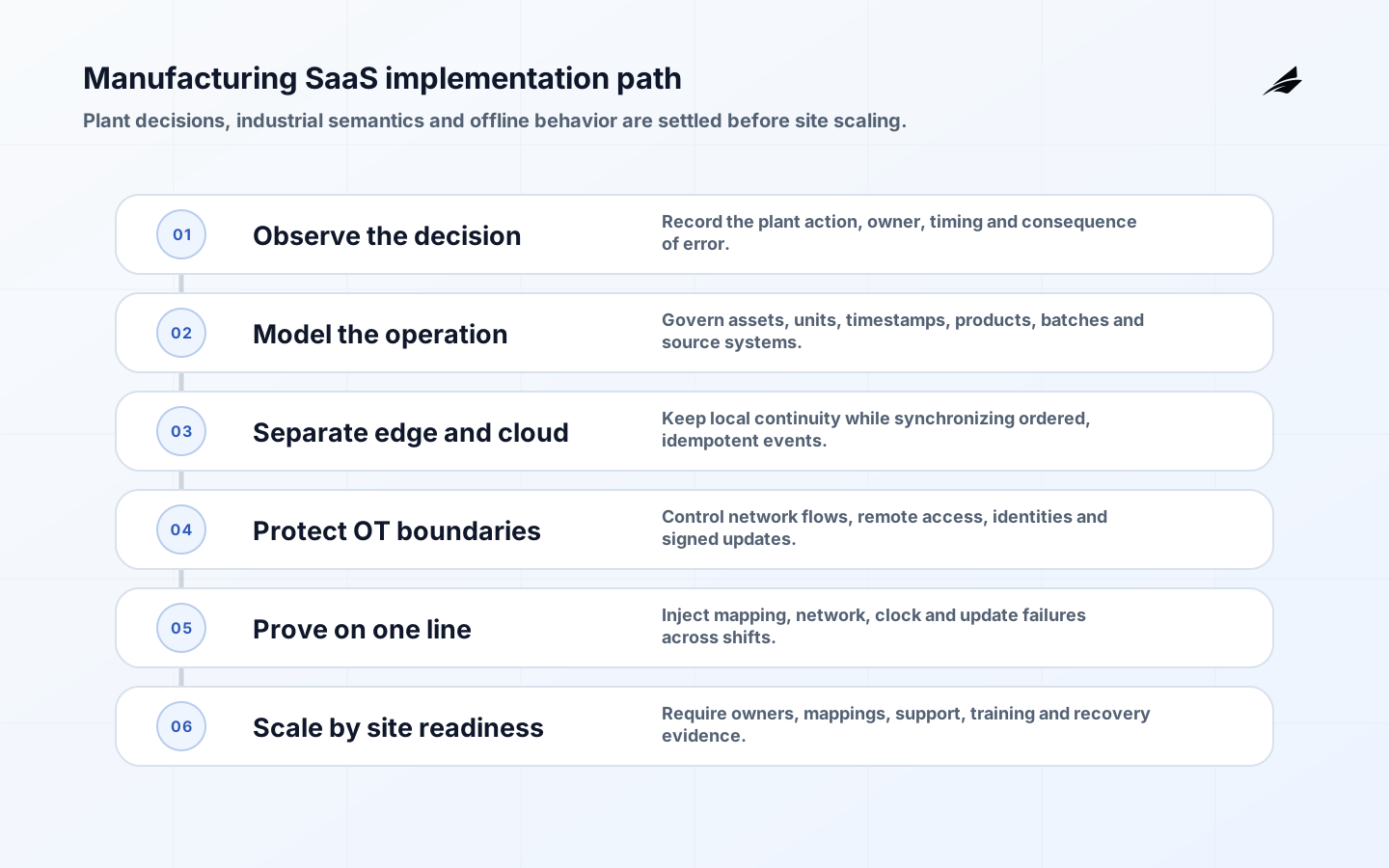
Manufacturing SaaS product development succeeds when software fits plant work without weakening safety, availability or operational control. A factory is not a generic collection of IoT devices. Production lines contain controllers, historians, quality systems, maintenance practices and vendor equipment with long lifecycles and strict timing. The SaaS product must respect what can be observed, what may be commanded and what must continue when cloud connectivity fails. A polished dashboard built before these boundaries are understood usually creates unreliable data and unsafe expectations.
This implementation checklist is designed for manufacturers selecting a product partner and for teams building the product. It moves from workflow and architecture through industrial integration, security, rollout and operations. NIST SP 800-82 Rev. 3 emphasizes that operational technology has unique performance, reliability and safety requirements. OPC UA supplies a platform-independent information and communication model, but each deployment still needs site-specific semantics, security and conformance testing.
1. Start with a plant decision and its operating constraint
Choose one decision such as whether to stop a machine, schedule maintenance, release a batch or investigate a quality deviation. Observe the people who make it across shifts. Record the source records, acceptable data age, units, production state, exception path and consequence of a wrong recommendation. Distinguish advisory software from control. A cloud application that can issue commands requires a substantially different safety, authorization and validation case from one that only reports historical performance.
Define success in production terms: fewer unplanned stops, faster root-cause investigation, improved first-pass yield, lower manual entry or more complete traceability. Establish a baseline and identify confounders such as product mix and planned maintenance. Avoid promising a percentage improvement before representative data exists. The first release should support a narrow workflow end to end and preserve the current safe manual procedure until operators and owners accept the new path.
| Discovery question | Why it matters | Evidence |
|---|---|---|
| Which decision changes? | Prevents dashboard-first scope | Observed workflow and decision owner |
| How fresh must data be? | Determines edge, network and storage design | Latency and outage tolerance |
| Can software command equipment? | Changes safety and authorization case | Hazard and control-boundary review |
| Which record is authoritative? | Avoids conflicting production truth | System-of-record map |
| What happens offline? | Protects plant continuity | Degraded-mode procedure |
2. Establish equipment identity and manufacturing semantics
Create stable identities for site, area, line, cell, asset, sensor, product, order and batch. Keep vendor tag names at the integration edge and map them into a governed information model with units, quality, timestamp and source. Preserve raw observations where audit or reprocessing requires them, but do not treat every tag as valuable product data. Version mappings and validate them after controller, firmware or line changes. A value without context can be numerically valid and operationally wrong.
Use industrial standards where they reduce custom coupling. OPC UA can represent information models, services and secure communications across industrial components. Select supported profiles and test interoperability with the actual devices and gateways, not only a simulator. Document how MES, ERP, historian, CMMS and quality systems exchange identifiers and state. Resolve conflicts explicitly: a work order from ERP, actual machine state and operator disposition may each be authoritative for a different field.
3. Separate edge continuity from cloud coordination
The edge should buffer data, enforce local protocol boundaries and maintain required operation during cloud or WAN loss. Define store-and-forward capacity, ordering, duplicate handling, clock behavior and backpressure. If the product issues approved commands, place deterministic safety controls outside the SaaS path and require local interlocks. Cloud services can coordinate fleets, analytics and user workflows, but the plant must understand exactly which function degrades when connectivity is absent.
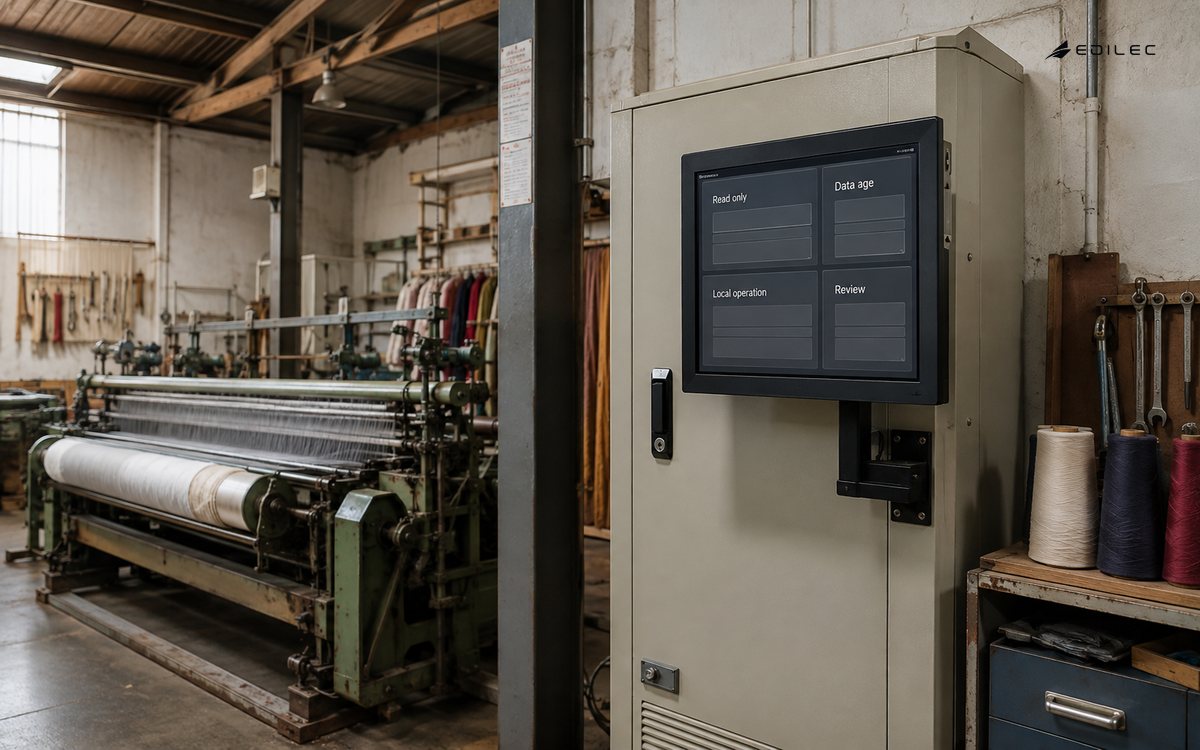
Design synchronization as a state machine. Every message needs source identity, event time, ingestion time, schema version and idempotency behavior. Test delayed, duplicated, reordered and corrupt payloads. Decide how late data changes a previously calculated KPI and whether users are notified. Monitor gateway health, queue depth, mapping failures and time drift. Remote updates need signed artifacts, staged rollout, rollback and a method to recover a gateway that cannot reconnect.
4. Protect OT boundaries and remote operations
Segment enterprise, cloud, site and control networks according to risk and required flows. Default-deny inbound paths to OT; use controlled brokers or gateways for outbound telemetry where possible. Inventory assets and supported protocols. Authenticate devices and services with identities that can be rotated. Separate operator, engineer, vendor and platform privileges. Remote access should be approved, time bounded, attributable and recorded. Shared vendor accounts and permanent tunnels make incident containment and accountability difficult.
Threat-model the complete product, including support consoles, update infrastructure, mobile devices and data exports. Apply NIST SSDF practices to the SaaS and edge software. Maintain component inventories and vulnerability handling, while accounting for plant availability and vendor support before patching. Security controls must be tested for latency and reliability impact; NIST’s smart-manufacturing work specifically recognizes this operational tension. Define an emergency mode that protects safety and production when identity or cloud control is unavailable.
| Acceptance area | Test scenario | Pass evidence |
|---|---|---|
| Data semantics | Unit or mapping changes | Versioned mapping and detected mismatch |
| Resilience | WAN loss and backlog replay | Bounded buffer with ordered reconciliation |
| Security | Expired device identity and remote-access request | Rejected connection and complete audit |
| Release | Faulty gateway update | Staged rollback without unsafe state |
| Operations | Night-shift alert and ownership transfer | Runbook completed by named team |
| Exit | Export site model and history | Documented, readable customer copy |
5. Design for operators, engineers and enterprise users
Role-based screens should reflect different decisions, not merely hide menu items. Operators need current state, clear alarms and minimal interaction. Engineers need trends, context and diagnostic depth. Managers need comparable outcomes with definitions and freshness. Show data quality and connection state next to the result. Avoid color as the only signal and test in the lighting, noise, gloves, screen size and language conditions of the plant. Preserve acknowledgement and handover between shifts.
Administration is part of the product. Provide governed asset onboarding, mapping review, threshold changes, user access, retention and audit export. Changes that affect calculations or alarms need preview, approval and version history. Support multi-site templates without erasing local differences. A central team can define a standard model while each plant retains approved overrides. Report configuration drift so global comparisons do not silently combine incompatible definitions.
6. Pilot on a representative line and scale by readiness
Select a line with a meaningful problem, engaged operators and manageable consequence. Capture baseline data before deployment. Run the product in observation mode, compare its records with existing systems and investigate discrepancies. Exercise offline behavior, gateway replacement, user access, an incorrect mapping and rollback. Train across shifts and include maintenance and security staff. Accept the pilot only when operators can use it during normal and degraded conditions without the development team standing beside them.
Scale using site-readiness gates: network and gateway standards, named owners, asset inventory, approved security flow, data mapping, training, support and recovery. Maintain a rollout backlog for local integrations and product gaps. Do not clone a successful pilot blindly; equipment, work practices and data quality vary. Track product and plant outcomes together, and review whether improvements persist after novelty and additional project support disappear.
Worked example: condition monitoring without unsafe control
A manufacturer wants earlier warning of bearing failure on a packaging line. The first release observes vibration and temperature but cannot command the machine. The edge gateway maps vendor tags to governed asset IDs and units, buffers eight hours and forwards signed batches. The cloud service calculates a health indicator, marks data freshness and creates a maintenance review task. Operators retain the existing local protection and shutdown procedure. The CMMS remains authoritative for work completion.
The pilot injects wrong units, clock drift, duplicated batches, WAN loss and a gateway update failure. Each condition produces a visible state rather than a plausible but incorrect chart. Maintenance engineers compare recommendations with inspection results, while security verifies remote-access and update records. Scale is approved only after the night shift completes the workflow and the team proves that cloud loss does not suppress local alarms or create an unsafe command expectation.
A product change later adds a new sensor model only after its units, sampling, identity and failure states pass the same contract tests. This keeps site expansion from weakening the accepted semantic and safety boundary.
Key takeaways
- Anchor the product in one production decision and measurable plant outcome.
- Govern asset identity, units, timestamps and authoritative records.
- Make edge continuity and synchronization behavior explicit.
- Treat OT segmentation, remote access and updates as core product requirements.
- Scale through site-readiness and degraded-mode tests, not dashboard adoption alone.
Frequently asked questions
Does OPC UA solve all manufacturing integration?
No. It provides common models and communication mechanisms, but teams still need supported profiles, plant semantics, identity mapping, security configuration and conformance testing with actual equipment.
Is an edge gateway always required?
Not always, but it is often useful for protocol isolation, buffering, local policy and continuity. The decision depends on device capability, network design, latency and the function that must survive cloud loss.
Should a SaaS product directly control machinery?
Only after a formal safety and security analysis. Deterministic interlocks and safety functions should remain in appropriate local systems. Cloud-originated commands need strict authorization, bounds, audit and failure handling.
Conclusion
A professional manufacturing SaaS product makes plant decisions clearer without making production dependent on hidden cloud assumptions. Build from observed work, model industrial data precisely, protect the OT boundary and prove offline behavior. A partner is ready to scale when it can demonstrate a complete line workflow, not merely a visually impressive interface.