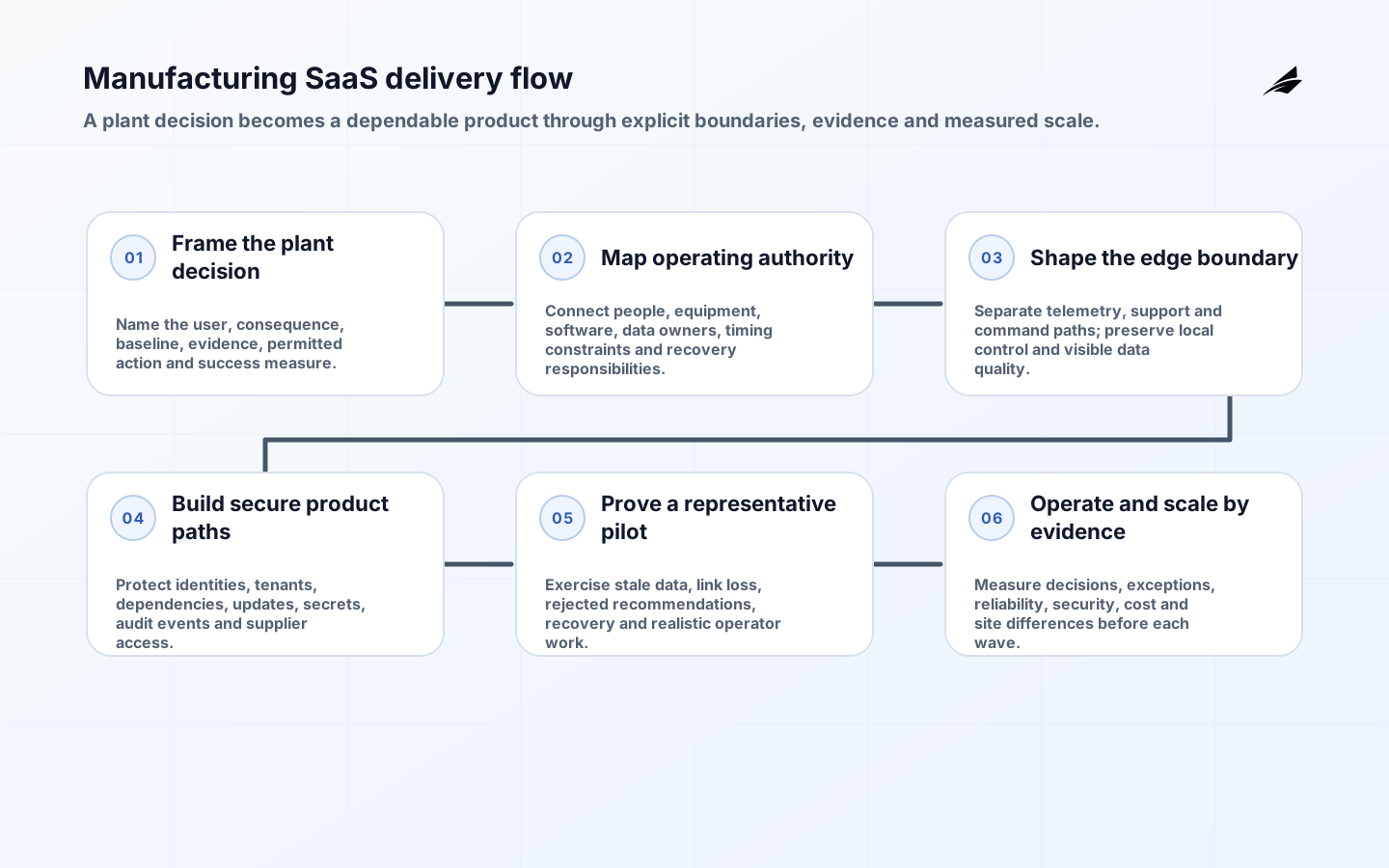
SaaS product development for manufacturing is successful when a plant can make a better operational decision without losing control of safety, availability, data meaning or recovery. The product may expose production visibility, quality analytics, maintenance coordination, energy insight or supply planning, but the commercial promise is not the dashboard. It is the repeatable decision behind the dashboard: what a user can know, what action is allowed, what happens when the data is late and how the team proves the result after a fault.
Use the manufacturing SaaS scope and delivery plan to frame budget and risk, the manufacturing SaaS implementation checklist when work enters delivery, and the custom manufacturing software checklist when a shared product must meet a plant-specific process. The guidance below combines those buyer questions with the evidence needed to operate a connected product responsibly.
The design baseline is deliberately cross-functional. NIST SP 800-82 Rev. 3 describes OT security alongside performance, reliability and safety. The NIST Manufacturing Profile supplies a risk-based way to compare current and target cybersecurity outcomes. The OPC UA specification-parts overview maps the specification family for information models, security, mappings and profiles. These sources guide design; the product owner still has to define an acceptable outcome for a particular process, site and risk tolerance.
Choose a plant decision before a product backlog
Start with a decision that is frequent enough to matter and bounded enough to test. Examples include prioritizing a maintenance response, releasing a batch after quality review, reconciling a production schedule or escalating an abnormal energy pattern. Name the user, the decision window, the baseline, the desired change and the consequence of a wrong recommendation. A phrase such as improve OEE or connect the factory is a useful ambition but not an acceptance criterion. A good first slice describes the trigger, evidence, permitted action, exception route and final record.
Map the decision with the people who carry its consequence. A supervisor may need an explanation and a manual override, while an engineer needs signal quality and a maintenance history. The product should distinguish observed facts from calculated indicators, recommendations from commands and current state from historical context. If a result can influence a safety or quality release, the workflow must make human authority explicit rather than allowing a role with broad screen access to become an accidental approver.
| Decision element | Questions to settle | Evidence for acceptance |
|---|---|---|
| User and consequence | Who acts, who is affected and what is the cost of a wrong result? | Named owner, impact statement and escalation path |
| Input authority | Which system or person is authoritative for each value and timestamp? | Source map with freshness and quality states |
| Allowed action | Is the output read-only, a recommendation, an approval or a command? | Role policy, audit event and reversible test |
| Failure behavior | What happens when a source is late, wrong, disconnected or unavailable? | Degraded-mode scenario and recovery runbook |
Map the plant operating model and data authority
Before choosing a cloud service, map the plant as an operating system of people, equipment, software and records. Capture the boundary between enterprise planning, site operations, line supervision, control systems, equipment and physical process. This is not an argument for a single reference architecture; it is a way to reveal where latency, authority, maintenance windows and failure consequences change. A cloud analytics service may tolerate minutes of delay, while a closed-loop control function may depend on deterministic local behavior that a wide-area link cannot guarantee.
Create a data contract for each important signal or business record. Include identifier, unit, time basis, source, quality flag, retention, correction rule and owner. Separate event time from ingestion time so a late machine event is not mistaken for a current condition. Record whether a value is measured, derived or manually entered. The NIST Smart Manufacturing Systems Readiness Level tool is useful as a diagnostic lens because it examines organizational, IT application, performance-management and information-connectivity maturity across factory activity levels. It is an assessment aid, not a shortcut around process knowledge.
Design the boundary between SaaS, edge and OT

Keep the edge boundary explicit. A gateway or local service can normalize protocols, buffer data during a link outage, enforce local credentials and publish only the fields the SaaS product needs. It should not become an undocumented second control system. Define who owns its configuration, how it is patched, what data it stores, how it is recovered and whether it can issue any command. The SaaS layer should know when data is stale or incomplete rather than presenting a clean-looking number with no quality state.
For every cross-boundary flow, document initiator, destination, protocol, identity, direction, rate, payload, failure behavior and owner. Use separate paths for telemetry, configuration, support and control. If the product only needs a recommendation, do not create a command path. If a command is required, make it narrow, authenticated, authorized, attributable and reversible where the process allows. NIST's smart manufacturing cybersecurity research is relevant because it focuses on security measures whose performance impact can be understood in the manufacturing environment.
Make interoperability explicit and testable
Interoperability is more than making a connector return a payload. Define the meaning of assets, states, units, alarms, batches, work orders and genealogy at the boundary. The OPC UA specification-parts overview maps address spaces, information models, security, profiles, mappings and publish-subscribe behavior to the relevant specifications; use only the portions the participating systems support and document the chosen profile. For older equipment, a translation layer may be necessary, but translation should preserve source identity and quality rather than silently inventing semantics.
Test normal and awkward cases together: clock skew, duplicate events, missing values, out-of-order messages, unit conversion, daylight-saving transitions, recipe changes, asset replacement and a site with no external connection. Validate both machine-readable behavior and the operator's interpretation. Version the contract, identify incompatible changes, and retain a replayable sample that represents the real process. A connector that succeeds in a demo but cannot explain a late or corrected event is not an integration foundation.
| Boundary risk | Design response | Proof to retain |
|---|---|---|
| Ambiguous meaning | Versioned asset and signal model with units and quality | Contract test and owner sign-off |
| Link interruption | Local buffering, bounded retry and explicit stale state | Offline and catch-up exercise |
| Duplicate or late event | Stable event identifier and deterministic reconciliation | Replay test with corrected history |
| Unsafe command path | Read-only default, narrow authority and independent approval | Denied-action and rollback scenario |
| Supplier or protocol change | Compatibility matrix and change notification obligation | Upgrade rehearsal with representative client |
Secure the product lifecycle and supplier path
Treat security as a product property that follows the code, infrastructure, device identity, tenant, data and support relationship. Use individual accounts, least privilege, strong authentication and separate administrative paths. Protect secrets and keys outside application source, record privileged actions, and make tenant isolation testable. A SaaS provider should explain how it handles vulnerabilities in its own code, dependencies, build system, images, agent and edge package. The NIST Secure Software Development Framework provides a common vocabulary for these practices and for supplier conversations.
Manufacturing security also has a change-control dimension. Establish maintenance windows, emergency changes, patch qualification, backup ownership and an approved rollback for the site components the product depends on. Segment customer tenants and plants without hiding shared failure modes. Contract for vulnerability notification, evidence access, subcontractor visibility, support identity, data return and secure deletion. A provider's assurance document is useful, but it does not replace a local decision about what must remain available during a network, identity or cloud incident.
Pilot with production-shaped evidence
Choose a pilot site and process that are representative, not merely convenient. Use realistic data volume, device age, operator roles, network constraints, shifts, exception rates and maintenance practices. Define success and stop conditions before the pilot starts. Test data loss, stale telemetry, failed authentication, revoked access, edge restart, provider unavailability, duplicate events and a human decision that rejects the product recommendation. The question is whether the team can keep the plant safe and explain the final state when a dependency is wrong.
Acceptance should produce an evidence bundle: approved scope, data contracts, architecture, threat and risk decisions, test results, open exceptions, runbooks, support contacts, recovery targets and owner sign-off. Measure the product against the baseline, including operator effort and rework. If the product improves a metric only because a manual check moved somewhere else, the result is not yet proven. Keep a rollback boundary that the site team can execute without waiting for a product roadmap.
Operate, measure and scale by evidence
After the pilot, run the product as a service with a named owner and an observable operating rhythm. Monitor user-facing decision latency, successful and rejected outcomes, data freshness, exception volume, edge health, access events, vulnerability age, incident recurrence and cost per site or line. Review changes with product, plant, engineering, quality and security representatives. Keep a current inventory of connected assets and versions so a field issue can be narrowed to affected deployments.
Scale in waves that preserve learning. A second site should add a meaningful difference such as protocol variation, local policy, shift pattern or network constraint; otherwise it only confirms the first site's assumptions. Reassess readiness, support capacity and recovery evidence before enabling a new authority or command. Retire unused data flows and permissions. A manufacturing SaaS product becomes durable when each expansion leaves behind a clearer contract, better runbook and more trustworthy evidence than the previous wave.
Key takeaways for manufacturing SaaS buyers
- Fund a bounded plant decision with a named user, consequence, baseline and measurable outcome.
- Keep SaaS, edge and OT responsibilities visible, especially where latency, safety or recovery changes.
- Make data meaning, quality, ownership and correction behavior part of the product contract.
- Default to read-only access and add command authority only with narrow policy, approval and rollback.
- Pilot realistic failure modes and retain evidence that operators can use during an incident.
- Scale by site differences and operating evidence, not by copying a demo configuration.
Frequently asked questions
What should a manufacturing SaaS product prove first? It should prove one named plant decision with representative data, bounded authority, safe degraded behavior and an accountable owner. Feature breadth can follow after that path works under normal and abnormal conditions.
Should a manufacturing SaaS product connect directly to controllers? Usually not by default. Keep real-time or safety-critical control local where required, and use an explicit edge boundary with least-privilege interfaces, visible quality states and a recovery path.
How is readiness measured before a multi-site rollout? Assess the target site's process, people, data, applications, performance measures, connectivity, support and recovery. Resolve the highest-risk gaps in a representative pilot before expanding authority or scope.
Which metrics matter after launch? Combine the funded business result with decision quality, latency, exception rate, availability, recovery evidence, operator effort, security findings and cost. A single adoption number cannot show whether the product is safe or useful.
Conclusion
SaaS product development for manufacturing earns trust through a complete operating path: a useful decision, an honest data contract, a deliberate edge boundary, secure delivery, scenario-based acceptance and measurable service ownership. The strongest product is not the one with the most connected machines. It is the one a plant can understand, challenge, recover and improve when conditions stop looking like the demo.