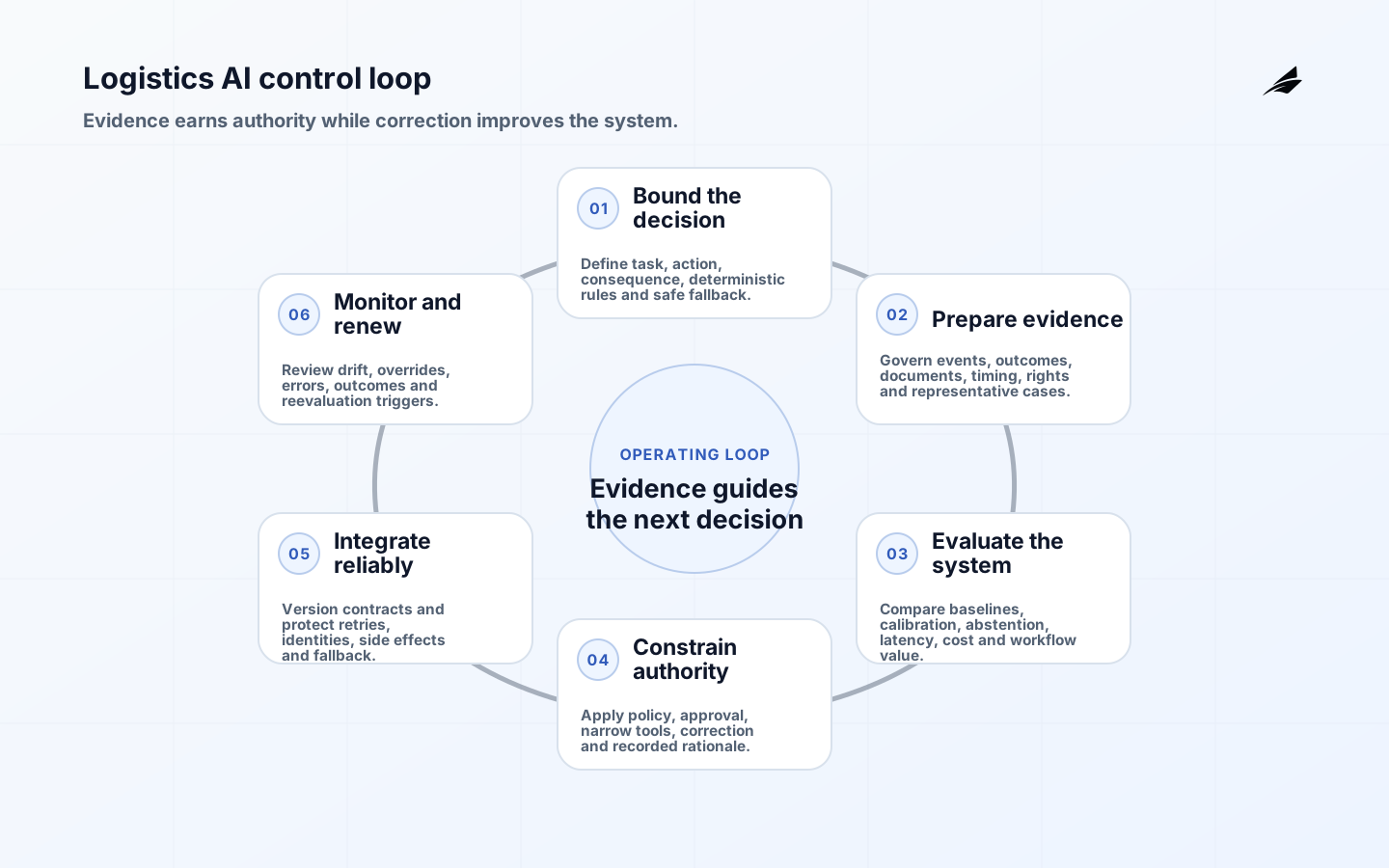
AI workflow automation services for logistics should improve a bounded operational decision while preserving traceability and human authority. Suitable work includes classifying exceptions, extracting documents, predicting delay, prioritizing cases and recommending actions. This FAQ addresses informational and commercial search intent: what to automate, what evidence to require and how to keep an imperfect model from silently controlling physical operations.
For delivery planning, use Edilec's logistics AI automation scope and risk guide and implementation checklist. The startup AI workflow guide is useful when the operating team is small. Keep model choice downstream of the business decision and failure consequence.
Key takeaways
- Automate a decision with known inputs, authority and fallback, not an entire logistics function at once.
- Separate deterministic rules from model inference and retain evidence for both.
- Evaluate on representative routes, partners, documents and disruptions, including abstention and escalation.
- Give users a clear way to correct outcomes and feed confirmed corrections into governed improvement.
- Monitor business impact, data drift, override patterns, latency and cost after deployment.
Which logistics workflows fit AI automation?
Good candidates contain repeated judgments over variable data and have a measurable downstream action. Examples include extracting shipment documents, matching proof of delivery, classifying delay reasons, predicting arrival windows, detecting suspicious route or temperature patterns and prioritizing service cases. Start where a recommendation can be reviewed before it commits inventory, money, compliance status or physical control.

Keep deterministic constraints outside the model: legal limits, customer exclusions, hazardous-material rules, approved carrier lists and maximum authority. AI can rank or explain within those boundaries. Avoid use cases where labels are unavailable, rare failure dominates, the environment changes faster than evaluation or no one can define a safe fallback.
| Use case | Useful AI role | Required control |
|---|---|---|
| Document intake | Extract and classify fields | Confidence threshold, source citation and review queue |
| ETA or delay | Forecast and rank risk | Calibration by lane and fallback to last reliable estimate |
| Exception triage | Summarize and route cases | Deterministic priority floor and user correction |
| Anomaly detection | Surface unusual patterns | Investigation workflow and false-positive budget |
| Action recommendation | Propose next best step | Policy boundary, approval and recorded rationale |
What data is needed?
Map authoritative identifiers, events, documents, outcomes and correction history. Assess completeness, timing, lineage, access rights and selection bias by partner, geography, customer and disruption type. The GS1 EPCIS and CBV implementation guideline provides a shared event vocabulary for supply-chain visibility, but governance is still needed for master data and late corrections.
Create a feature and label specification tied to the decision timestamp. Prevent leakage from information that became available only after the outcome. Define retention and permitted use for documents and personal data. For generative functions, separate retrieved enterprise evidence from model instructions and retain source references so reviewers can verify important claims.
Where should humans remain in control?
Classify actions by consequence and reversibility. Low-impact classification may flow automatically above a validated threshold. Customer commitments, payments, compliance decisions, inventory disposition and equipment commands usually need approval or stronger deterministic constraints. Human review is a designed control only when reviewers see relevant evidence, have time to decide and can override without penalty.
Define abstention and fallback. When data is missing, out of distribution or conflicting, the system should route to a known queue or rule-based path rather than fabricate certainty. The OECD principle on robustness, security and safety highlights traceability and lifecycle risk management; preserve inputs, model version, policy result, output, user action and final outcome.
How should the system be evaluated?
Build a frozen evaluation set representing ordinary work, peak seasons, rare disruptions, difficult documents, new partners and protected or commercially sensitive groups where relevant. Measure task-specific quality, calibration, abstention, latency and cost. Evaluate workflow outcomes such as time to resolution, missed critical cases, override rate and downstream correction, not only model accuracy.
Use the NIST AI RMF to organize governance, context mapping, measurement and risk management. The AI RMF Core treats these as continuous lifecycle functions. Set release gates and compare a candidate with the current process and a simple rule baseline. Test adversarial documents, prompt injection where applicable, dependency failure and unauthorized data access.
| Evidence area | Pre-release gate | Production signal |
|---|---|---|
| Task quality | Meets threshold on representative cases | Confirmed error and correction rate |
| Calibration | Confidence predicts observed reliability | Accuracy by confidence band and cohort |
| Control | Unsafe actions blocked and escalation works | Policy violations, overrides and queue age |
| Operations | Latency, availability and fallback pass load test | Timeout, dependency and fallback frequency |
| Value | Improves agreed workflow against baseline | Resolution time, loss avoided or service outcome |
| Economics | Unit cost is viable at expected volume | Cost per processed and accepted case |
How should AI integrate with logistics systems?
Place AI behind a versioned service contract and orchestrate it with deterministic workflow state. Do not give a model broad database or tool access. Expose narrow actions with authorization, validation, idempotency and audit. Carry shipment, order, asset and case correlation identifiers through TMS, WMS, ERP, document store and notification systems.
Design retries and compensation for every side effect. A repeated inference is harmless only if downstream actions are idempotent. Separate model deployment from workflow release when possible, and retain the ability to pin or roll back versions. Apply the NIST SSDF to the surrounding software and supply chain; AI-specific evaluation does not replace secure engineering.
What changes in production operations?
Maintain an inventory of use case, owner, model, data sources, allowed actions, evaluation version and risk tier. Monitor input drift, missing fields, output distribution, calibration where outcomes arrive, overrides, complaints, queue age, latency, provider failures and unit cost. Segment by lane, partner, facility and workflow so local degradation is visible.
Define triggers for automatic fallback, model rollback, threshold adjustment and full suspension. Review sampled decisions and all high-impact errors. Govern changes to prompts, retrieval sources, features, labels, models and policies as production releases. Schedule reevaluation when business process, carrier mix or external conditions change.
What should a service contract contain?
Specify the decision boundary, data rights, approved model providers, hosting regions, retention, evaluation dataset, acceptance metrics, human-review design, security testing, monitoring, incident handling, intellectual property and exit deliverables. Require disclosure before material model or subprocessor changes. Tie payment gates to workflow evidence rather than a demonstration.
Clarify variable inference and data costs, support hours, reevaluation work and model-provider pass-through charges. Require export of prompts, policies, evaluation cases, metrics and operational history where legally and technically possible. The customer must be able to suspend the capability without losing the underlying logistics workflow.
Prepare people and process for AI-assisted work
Document the current case-routing and decision practice with frontline staff, including exceptions that formal procedures omit. Explain which step the system changes, what evidence it presents and what it cannot decide. Train users with realistic errors and abstentions, not only correct examples. They need to recognize when source data is missing and how to escalate without working around the system.
Design correction as part of the interface. Capture whether the user changed a field, rejected a recommendation, selected another action or discovered a source-system defect. Separate a model correction from a policy exception. Confirmed outcomes can support reevaluation, but they should not flow directly into training without review, rights checks and protection against feedback loops.
Measure adoption carefully. High acceptance may indicate useful recommendations or automation bias; high override may indicate poor quality or legitimate local context. Review samples from both. Keep productivity targets from pressuring staff to accept uncertain outputs, and provide a route for carriers, customers or employees to contest consequential records when applicable.
For predicted arrival or delay, evaluate calibration and usefulness by horizon. An estimate that is accurate two hours before arrival may be too late to change labor or customer plans. Measure whether the forecast arrives early enough for the intended action and whether confidence supports a different response. Preserve the prior estimate so improvements and instability can be audited.
For document automation, retain page or field evidence and validate identifiers, quantities, dates and dangerous-goods attributes with stricter rules than descriptive text. Route low-quality scans and conflicting fields to review. Never allow generated summaries to replace the authoritative bill, proof, customs or compliance document in the system of record.
Production support needs both model and workflow expertise. Define who investigates a strange output, a missing source event, a policy block and a provider outage. Give support staff a diagnostic view with versions and correlation identifiers while restricting sensitive content. Measure time to explanation as well as time to technical recovery.
Keep an independent sample of cases for periodic human review, including automatically accepted work. Review should look for systematic omissions, harmful shortcuts and changes in operating context, not merely score outputs against old labels. Findings should update data, policy, training or evaluation with a documented owner and release decision.
Frequently asked questions
Does logistics automation require generative AI?
No. Forecasting, optimization, classification and anomaly detection may be better suited to conventional models or rules. Generative AI is useful for unstructured documents and summaries but adds grounding, injection and verification concerns. Select the simplest method that meets the decision need.
When can a workflow become fully automatic?
After the action is bounded, reversible or low consequence; evaluation demonstrates stable performance across relevant cohorts; abstention works; monitoring detects degradation; and an owner can suspend it. Increase authority gradually. High aggregate volume can make individually small errors material.
How should return on investment be calculated?
Compare accepted workflow outcomes with the baseline, including review labor, false actions, corrections, model and integration cost, support, and avoided loss or delay. Use a controlled pilot where possible. Do not count recommendations that users ignore as realized value.
Conclusion
AI workflow automation services for logistics create value when inference is one governed component in a reliable process. Bound authority, prepare event and outcome data, compare against simple baselines, preserve human correction and monitor real effects. Evidence should earn each increase in automation; enthusiasm should not substitute for control.