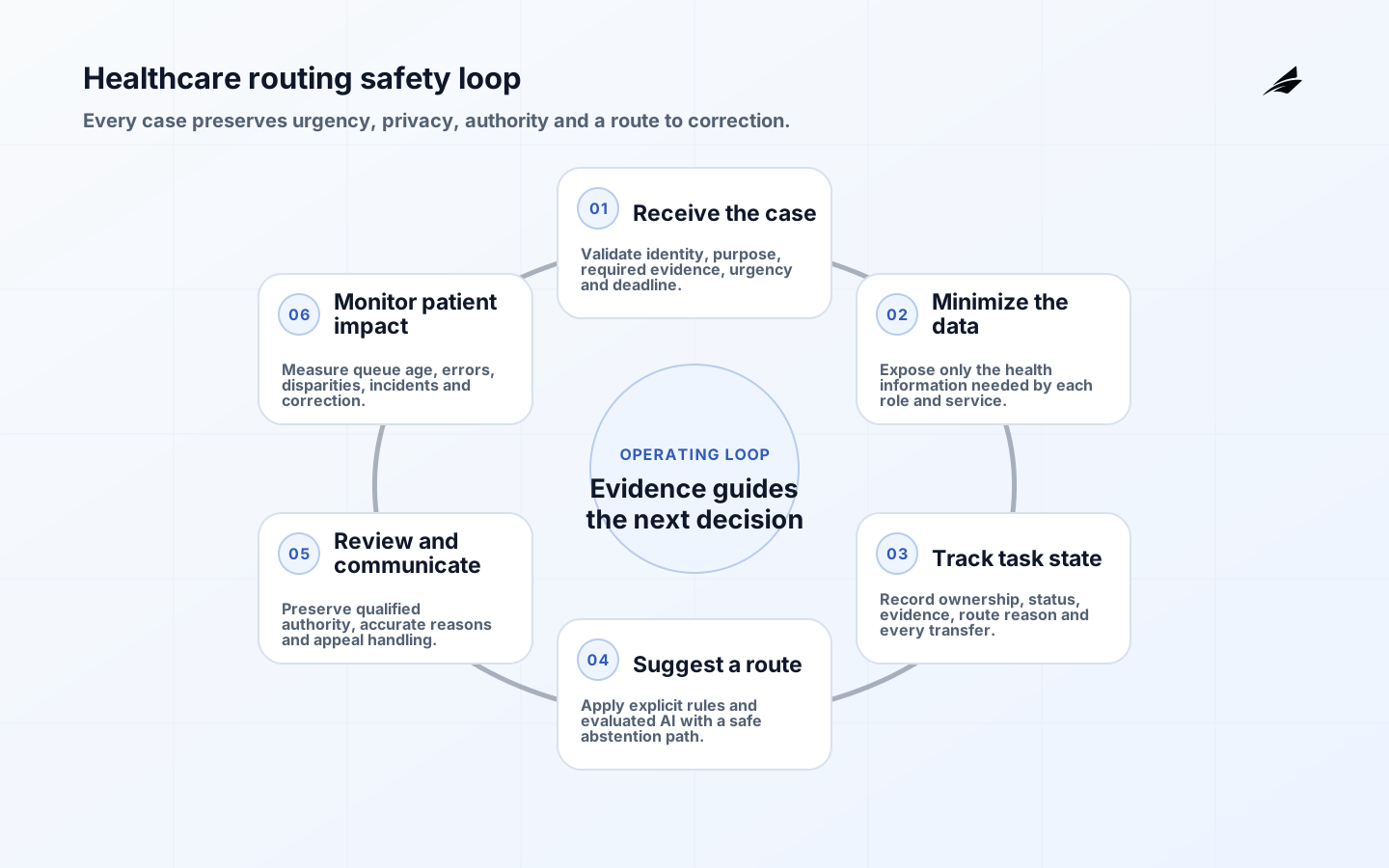
AI approval routing automation for healthcare can classify requests, identify missing information, prioritize queues and suggest the right reviewer. It should not blur clinical judgment, coverage policy or delegated authority. A safe design records why a case followed a route, protects health information, preserves time-sensitive escalation and lets staff correct the system without losing context. This guide focuses on business and operational routing, with prior authorization as a concrete example rather than a claim that one workflow fits every care setting.
Use the healthcare routing implementation checklist for build acceptance and the healthcare approval-routing FAQ for procurement. The manufacturing approval-routing guide offers a useful contrast where patient and health-data duties do not apply. Establish clinical, operations, privacy, security, compliance, data and technical owners before selecting a model.
Define the routing boundary and patient impact
Map request intake, validation, assignment, review, decision, communication, appeal and closure. Record actors, deadlines, required evidence, policy versions and urgent paths. Separate routing from the substantive decision: a model may identify that oncology review is needed without deciding medical necessity. State whether a delayed or incorrect route could delay care, disclose information, create inequity or miss a regulatory time frame. Risk tier and human oversight should follow those consequences.
For impacted payers and transactions, the current CMS-0057-F overview describes operational provisions beginning in 2026 and API requirements primarily in 2027, with exact dates varying by payer type. Confirm applicability and current CMS guidance. Design deadlines, denial reasons, metrics and API exchange as explicit requirements rather than assuming AI changes them. Automation should reduce burden while preserving the rule's patient, provider and payer obligations.
| Routing action | Suitable automation | Human authority |
|---|---|---|
| Completeness check | Detect required fields and attachments | Resolve ambiguous evidence |
| Queue assignment | Suggest specialty and urgency | Override and handle exceptions |
| Policy retrieval | Present current applicable criteria | Interpret applicability |
| Decision draft | Structure evidence and rationale | Make authorized determination |
| Communication | Populate approved template | Approve material adverse message |
Create a durable case and task record
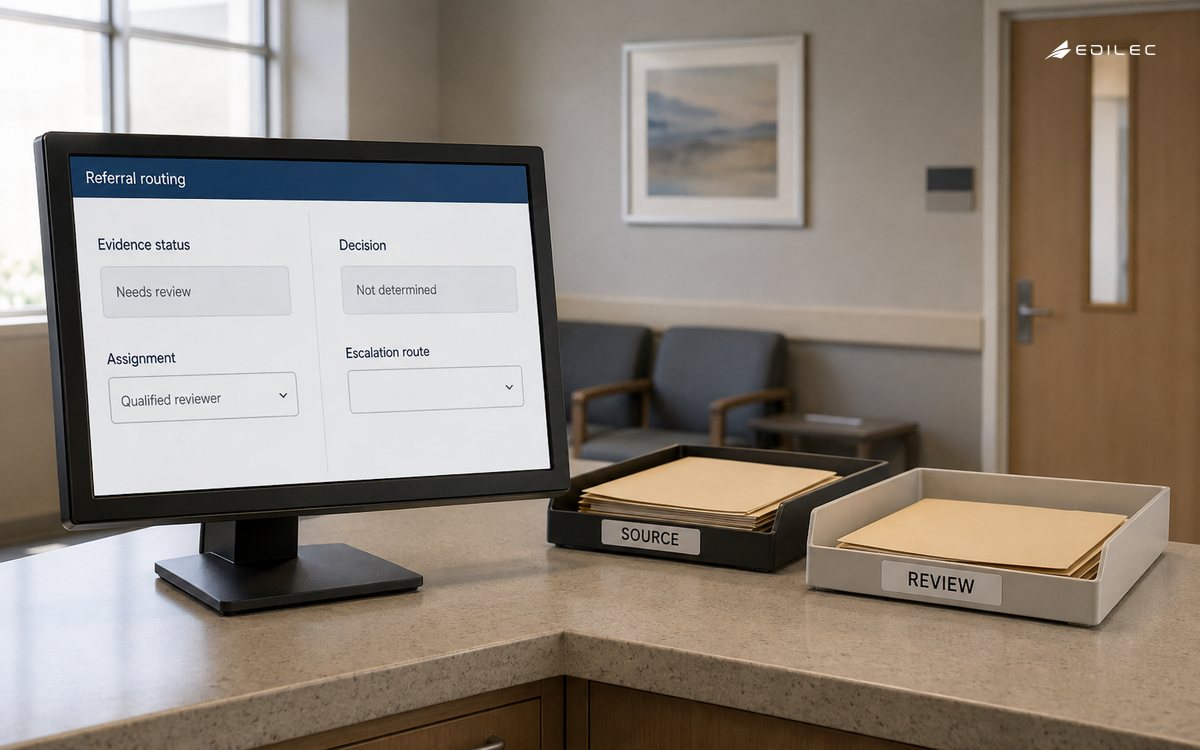
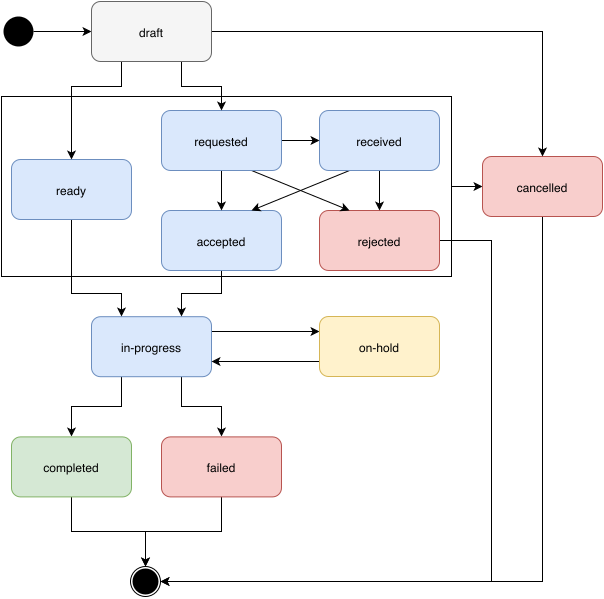
Assign one case identifier across intake, documents, routing, review and response. Store prior and new states, actor or service, timestamp, reason, route rule or model version, evidence references and deadlines. Represent return, cancellation, escalation, reassignment and appeal as distinct events. The HL7 FHIR R5 Task resource describes task status, ownership, inputs, outputs and history for interoperable healthcare workflows. Adopt the applicable FHIR version and implementation guide used by counterparties; R5 concepts do not make every R5 exchange production-compatible.
Keep operational task state separate from clinical or claim content and link to authoritative records. Define idempotency and version handling so retries do not create duplicate cases and updated evidence does not disappear beneath an earlier decision. Record which evidence the reviewer actually saw. Where several systems participate, reconcile status and deadlines; a message accepted by an interface does not prove the request reached the right clinical queue.
Limit and protect health information
Determine whether the organization and vendor are covered entities, business associates or otherwise subject to privacy duties. The current HHS Security Rule summary describes administrative, physical and technical safeguards for electronic protected health information, including risk analysis and access review. Route only the fields and documents needed for the task, use role-based access, protect data in transit and at rest, and prevent sensitive case details from leaking through broad notifications.
Map all electronic protected health information created, received, maintained or transmitted by the workflow, including prompts, model logs, reviewer comments, exports, support captures and backups. The HHS risk-analysis guidance emphasizes accurate, thorough and ongoing assessment of risks to confidentiality, integrity and availability. Apply retention, deletion and vendor data-use restrictions to every copy. Do not allow production cases to train a model unless the approved legal, contractual and governance basis permits it.
Constrain and evaluate the AI component
Use deterministic rules for statutory deadlines, coverage identifiers, explicit authorization limits and known routing tables. Use AI where language variation or document classification creates real ambiguity. Create a labeled evaluation set across specialties, languages, facilities, payer products, urgent cases, rare routes, missing evidence and appeals. Measure route accuracy, top-k usefulness, abstention, false urgency, missed urgency and staff correction. Report results by meaningful cohorts where sample size and privacy allow.
The NIST AI Risk Management Framework supports governance, context mapping, measurement and management of AI risks. Operationalize those ideas with a use-case owner, inventory, approved purpose, test record, change review, limitations, monitoring and retirement. Set confidence or rule thresholds from consequence and queue capacity, not a universal number. Low confidence should produce a safe route to trained staff, and a novel document type should not be forced into the nearest familiar category.
| Failure mode | Detection | Safe response |
|---|---|---|
| Wrong specialty | Reviewer correction and transfer rate | Reassign with history and protect deadline |
| Missed urgency | Clinical audit and time-to-review | Immediate escalation and incident review |
| Missing evidence | Downstream return reason | Request specific information |
| Policy drift | Version mismatch or outcome shift | Freeze route and update criteria |
| Data exposure | Access or output anomaly | Contain, investigate and notify as required |
| Queue overload | Age and capacity threshold | Load-balance or invoke manual plan |
Design effective human review and appeal
Show reviewers the original request, relevant evidence, current policy, routing reason, confidence and deadlines. Let them correct route and reason with minimal friction. Do not frame model output as a completed decision when the person remains accountable. Sample agreement and disagreement, and watch for automation bias when override rates collapse after interface changes. Staff need authority and protected time to escalate systemic issues, not an expectation to clear a queue at any cost.
Preserve appeals and reconsideration as first-class workflows with independent or appropriately qualified review where required. A corrected route must not erase the original action or consume the claimant's deadline. Communications should use accurate reasons tied to the decision evidence and policy. Generative text may structure a draft, but an authorized person should verify factual support and approved language for material notices. Provide accessible channels for patients and providers who cannot use the primary digital route.
Integrate for replay, reconciliation and observability
For each interface, document system of record, schema, authentication, consent or authorization context, timeout, retry, deduplication, reconciliation and support owner. Validate identifiers and terminology; reject malformed messages without losing the case. Use correlation IDs across gateway, workflow, model and reviewer logs while limiting exposed health information. Test partial failure such as an accepted attachment with a failed case update. The repair queue must show enough context to act without granting every operator broad clinical access.
Monitor case arrival, completeness, route distribution, queue age, deadline risk, transfers, overrides, appeals, interface failures and outcomes. Segment carefully to identify unequal burden or systematic misrouting. Alert on business impact, not every low-confidence result. Maintain downtime procedures with paper or manual intake where necessary, then reconcile cases after restoration. Recovery is incomplete until deadlines, status and communications are correct across participating systems.
Roll out through shadow and assisted routing
Begin with historical replay, then shadow current routing without affecting queues. Compare recommendations with actual routes and expert review. Next, show suggestions to one bounded team while retaining manual assignment. Automate only low-risk, high-confidence routes after correction, deadline and privacy evidence meet pre-agreed thresholds. Keep kill switches at model, route and organization levels. A rollout gate should consider patient impact and control performance alongside productivity.
Train operations and clinical staff on limitations, correction, urgent escalation, privacy and incident reporting. Run tabletop scenarios for wrong urgency, unavailable model, duplicate case, exposed attachment and sudden queue surge. Procurement should cover data use, subcontractors, model changes, availability, breach cooperation, audit evidence, portability and secure deletion. Review the first complete operational cycle and a representative appeal set before expanding to more specialties or decisions.
Make queue capacity part of the safety design. Forecast arrival by hour and day, qualified reviewer availability, expected handling time, transfers and urgent reserve. A model that routes more accurately can still increase harm if it sends too many cases to a scarce specialty queue. Use workload limits and deadline-aware balancing, but never downgrade clinical urgency to improve throughput. During unusual surges, display the active contingency mode, protect urgent work, communicate delays and capture which cases were rerouted so normal processing and audit can be restored afterward.
Key takeaways
- Separate AI routing assistance from clinical, coverage and approval authority.
- Record task state, deadlines, evidence, route reason and every correction durably.
- Minimize health data across prompts, logs, support and training paths.
- Evaluate urgent, rare and unequal-impact failures, not only average accuracy.
- Scale from shadow mode with manual fallback and patient-impact stop criteria.
Frequently asked questions
Can AI deny a healthcare request?
That depends on the exact decision, jurisdiction, payer, policy and delegated authority, but a routing model should not silently become a denial engine. Obtain legal and clinical review. Preserve qualified human authority, accurate reasons, evidence, deadlines and appeal rights wherever required.
Can protected health information be sent to a model API?
Only after confirming the parties, permitted purpose, contract, safeguards, data use, retention, locations and risk treatment. Minimize the payload and test logging behavior. A vendor's general security statement is not a substitute for the organization's risk analysis and required agreement.
What accuracy is enough?
There is no universal threshold. Set requirements by harm, case type, fallback capacity and comparison with current practice. Missed urgency may deserve a much stricter threshold than an easily reversible administrative transfer. Include abstention, correction and deadline outcomes in acceptance.
Conclusion
Healthcare approval routing deserves the same care as the decisions and patients it serves. Bound the model's role, preserve authoritative task and evidence records, minimize health data, support real human correction and expand only through measured gates. Done well, automation reduces avoidable queue work while making authority, deadlines and exceptions easier to see.