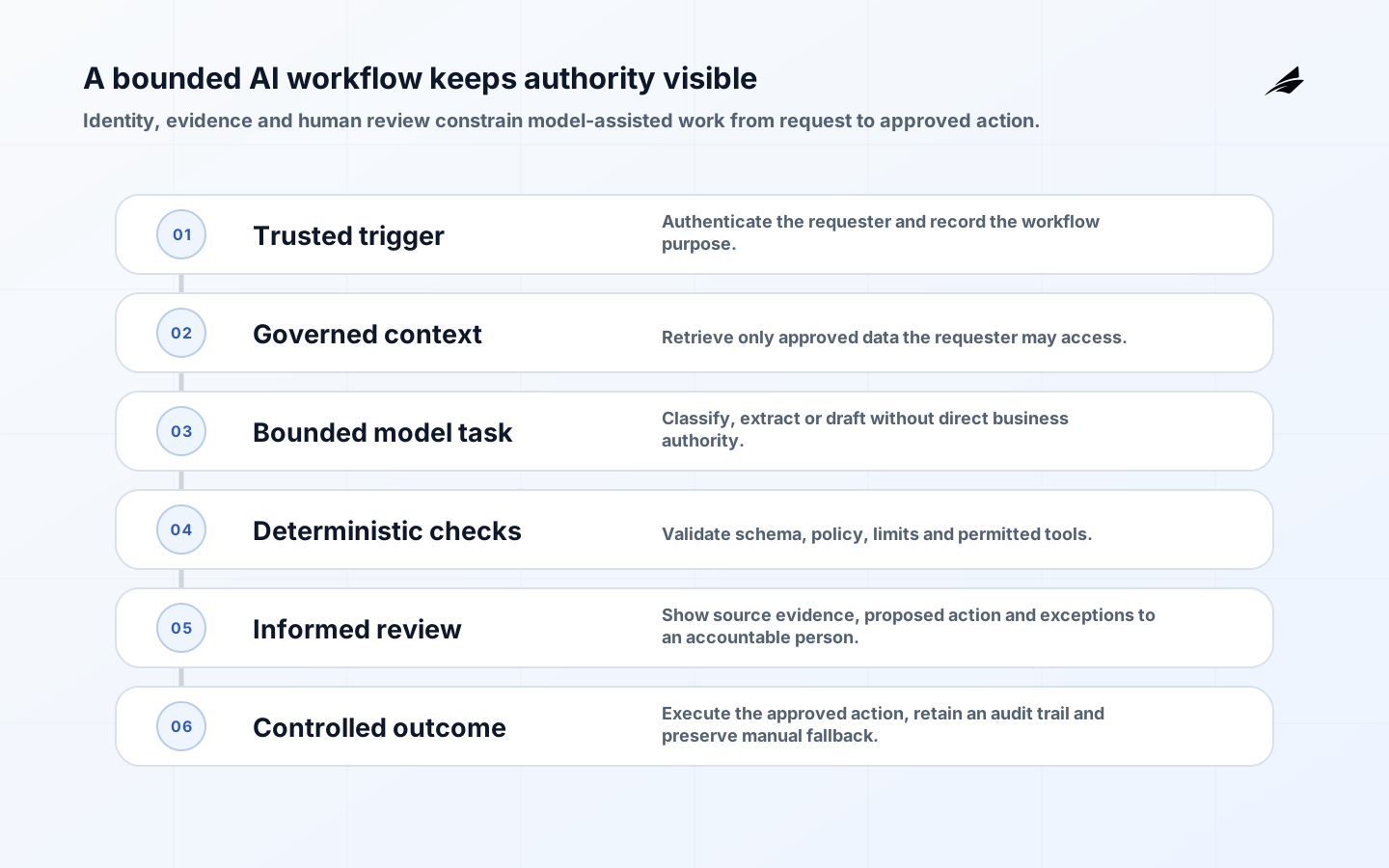
AI workflow automation combines deterministic process logic with one or more model-assisted steps: classifying an incoming request, extracting facts, drafting a response, finding relevant policy, summarizing a case or recommending the next action. The useful question is not whether a model can produce an answer. It is whether the entire workflow can produce a dependable business outcome with clear ownership, bounded permissions, evidence, exception handling and a safe path back to manual work.
Enterprise teams should begin with a process that is understood well enough to measure but constrained enough to control. A high-volume queue with repeatable inputs and a reviewer already in the loop is usually easier to assess than a rare, consequential decision spread across undocumented systems. The enterprise systems service can be considered only after the organization has defined the outcome and evidence it expects; a tool purchase cannot substitute for that work.
Scope a workflow, not a model demonstration
Map the process from trigger to completed record. Name the source of each input, the system of record, every decision, the allowed action, the approver, the output consumer and the point at which responsibility transfers. Separate deterministic rules from probabilistic judgment. Tax calculation, entitlement checks and access grants usually belong in tested rules or authoritative services. Language interpretation and drafting may be model-assisted, with review proportionate to the consequence of an error.
| Scope decision | Evidence to collect | Acceptance boundary |
|---|---|---|
| Business outcome | Current cycle time, backlog, rework and service target | A named outcome improves without degrading quality or control |
| Input quality | Representative documents, languages, missing fields and adversarial cases | Unsupported or ambiguous inputs route to an exception |
| Model task | Classification labels, extraction schema or drafting rubric | Evaluation thresholds are defined by risk tier |
| System action | APIs, roles, transaction limits and approval rules | The automation cannot exceed its documented authority |
| Human review | Reviewer role, evidence shown and escalation path | A reviewer can understand, correct and stop the action |
| Operations | Logs, alerts, fallback, retention and support ownership | The workflow remains supportable when a dependency fails |
Design orchestration, grounding and human control together
A production design normally needs an orchestrator, identity-aware connectors, an approved model endpoint, policy enforcement, a durable workflow state, evaluation telemetry and an audit record. Retrieval-augmented generation may ground responses in approved content, but retrieval adds its own failure modes: stale documents, over-broad access, weak chunking, missing citations and irrelevant results. Access filtering must happen before content reaches the model, not after a response is drafted.
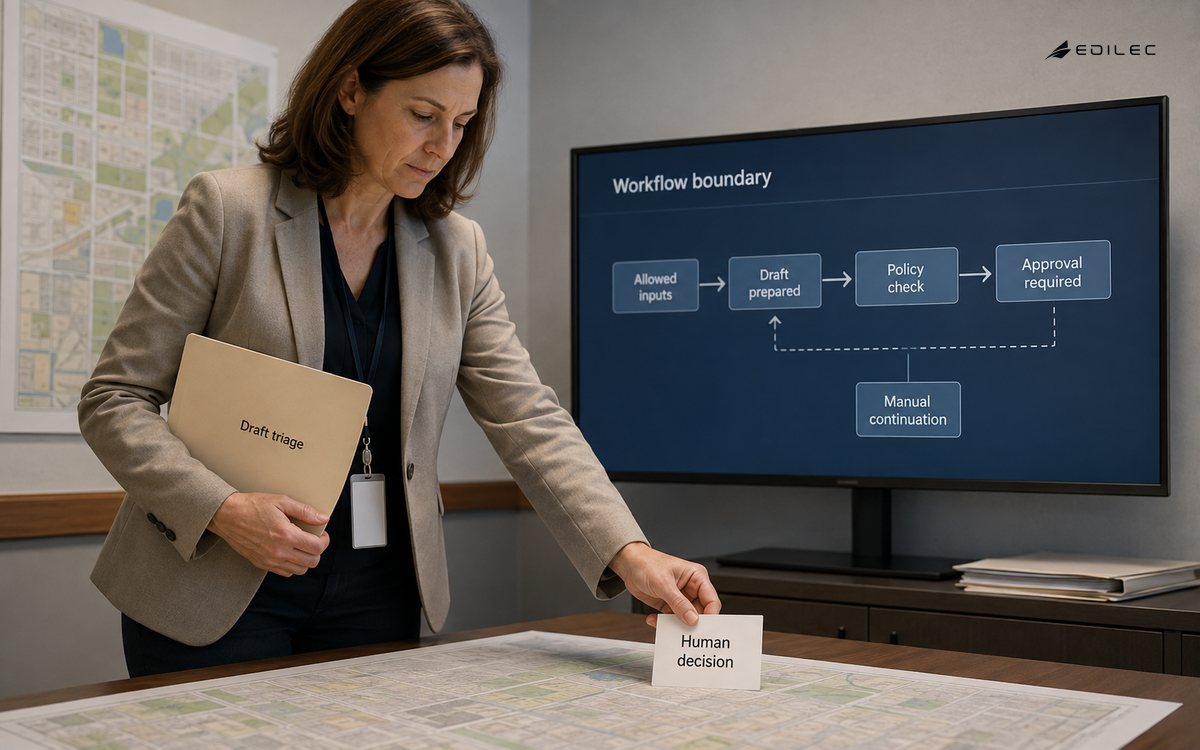
Human review is a designed task, not a generic button. Show the original input, extracted facts, supporting sources, uncertainty or validation failures, the proposed action and what will happen after approval. Capture corrections in a form that can improve tests. For low-consequence suggestions, sampling may be appropriate after evidence supports it. For legal commitments, safety decisions, payments, employment actions or privileged access, required review may remain the correct operating model.
Estimate delivery and operating cost from workload behavior
There is no responsible universal price for an AI automation project. Cost depends on discovery, integration count, data readiness, model usage, latency, evaluation depth, security requirements, reviewer effort and support coverage. Estimate a range with assumptions and volumes. Model consumption is only one line item; teams frequently undercount exception handling, content governance, observability, repeated evaluation after changes and the period when manual and automated paths operate together.
Commercial evaluation should cover data use, retention, regional processing, model-change notice, service objectives, audit access, incident notification and exit. Confirm whether prompts, retrieved content and reviewer corrections are used to improve a provider's models, and whether that behavior can be controlled contractually and technically. Keep workflow records and evaluation sets portable enough to compare another model or return to manual operation. Vendor approval does not approve every use case; each workflow still needs a purpose, data and risk assessment.
| Cost area | What drives it | How to control it |
|---|---|---|
| Discovery and process design | Unknown variants, policies and ownership | Time-box discovery and select one bounded workflow |
| Integration and data | Connector maturity, permissions, document quality and residency | Reuse governed interfaces and remediate the smallest necessary dataset |
| Build and evaluation | Risk tier, test-set breadth, models and environments | Use versioned evaluations and explicit release gates |
| Runtime | Request volume, context size, model, retries and storage | Route tasks to the least capable model that meets measured needs |
| Human operation | Review rate, exception rate and handling time | Improve inputs and interfaces before removing controls |
| Change and assurance | Policy updates, model changes, audits and incident response | Assign lifecycle ownership and budget recurring evaluation |
Example: service-request triage with bounded assistance
Consider a hypothetical internal service desk that receives free-text requests and attachments. The first release classifies the request, extracts a small approved field set, retrieves the relevant procedure and drafts a routing note. It does not approve access, execute a refund or close the ticket. A coordinator reviews the source, fields, cited procedure and destination queue. Missing evidence, conflicting instructions and low-confidence classifications become exceptions.
This slice can be tested against previously resolved, appropriately handled tickets without claiming a business result in advance. The team can compare routing accuracy, correction types, review time, exception rate and downstream rework with the baseline. Only after monitored production evidence should it consider straight-through routing for a narrow, low-consequence category. That expansion requires a fresh risk decision, not merely a lower model temperature.
Treat AI-specific and workflow risks as one register
| Risk | Control | Signal |
|---|---|---|
| Prompt injection or hostile content | Treat inputs as untrusted; isolate instructions; allow-list tools and outputs | Blocked attempts, unusual tool requests and policy violations |
| Sensitive data disclosure | Minimize data, enforce source permissions and redact where required | Access denials, leakage tests and retention exceptions |
| Unsupported or fabricated output | Ground where useful, require evidence and validate structured fields | Citation coverage, factual-error review and correction rate |
| Excessive agency | Use transaction limits, least privilege and human approval | Attempted out-of-scope actions and approval overrides |
| Model or content drift | Version dependencies and rerun a fixed plus refreshed evaluation set | Performance by segment and release-to-release change |
| Automation bias | Design independent review and track reviewer reversals | Approval speed, correction patterns and sampled audit findings |
Deliver in measured, reversible stages
- Frame: name the process owner, affected people, intended outcome, prohibited actions and risk tier.
- Discover: map process variants, systems, data rights, manual effort, failure history and baseline measures.
- Prove: build an offline prototype and evaluate representative, difficult and hostile cases before connecting write actions.
- Pilot: run with a small user group, required review, complete logging, a kill switch and a documented manual fallback.
- Expand: increase categories or autonomy one decision at a time, using a release gate and segment-level evidence.
- Operate: monitor quality, security, cost, latency, exceptions and user impact; reevaluate after model, prompt, policy or data changes.
- Retire or revise: remove automation that cannot meet its acceptance boundary or no longer serves the process.
A release record should identify the model and configuration, prompt or policy version, retrieval corpus, evaluation result, approved tools, risk acceptance and rollback owner. Incident response must cover wrong actions as well as outages. Preserve enough trace data to investigate within privacy and retention constraints. Do not silently swap a model or knowledge source in a consequential workflow; treat the change as a release that may alter behavior.
Include affected employees and process users in design reviews. They often know exceptions, workarounds and harm scenarios that system inventories miss. Explain when AI assistance is used, how feedback is handled and who remains accountable. Training should cover verification and escalation, not just interface operation. Monitor whether automation shifts work to another queue or creates pressure to approve suggestions too quickly.
Key takeaways
- Automate a bounded workflow outcome, not an impressive standalone response.
- Keep permissions and consequential decisions in enforceable controls outside the model.
- Estimate integration, evaluation, review and operations alongside model consumption.
- Use representative and adversarial evaluation before pilot, then monitor by workflow segment.
- Expand autonomy only when evidence supports a specific additional action.
Frequently asked questions
What is a good first AI workflow?
Choose a frequent, measurable process with accessible inputs, an existing owner, reversible outputs and manageable consequences. Classification, extraction, summarization and drafting can be suitable when a reviewer can verify the result. Avoid beginning with a poorly understood process or an action whose error cannot be recovered.
Does human review make automation pointless?
No. Assistance can reduce search, preparation and routing effort while a person retains accountable judgment. Review also produces correction data and operational evidence. The review rate should follow consequence and measured performance, not a blanket ambition for full autonomy.
Should the team choose a model first?
Define the task, data constraints, quality rubric, latency and cost envelope first. Then compare candidate models using the same representative evaluation. A smaller or specialized model may be preferable when it meets the acceptance boundary with lower latency, cost or data exposure.
How should success be measured?
Measure the full workflow: quality by category, cycle time, exception and correction rates, downstream rework, user impact, security events and cost per completed outcome. Token usage or model accuracy alone cannot show whether operations improved.
Conclusion
Enterprise AI workflow automation succeeds when it turns uncertain model behavior into a controlled service. Start with a bounded outcome, preserve authoritative rules, expose evidence to reviewers, limit agency and evaluate the complete path. A reversible pilot can earn broader scope; an unmeasured demonstration cannot. The durable asset is not a prompt. It is an owned workflow whose quality, authority, cost and failure modes remain visible throughout its life.