AI workflow automation services for startups are valuable when they remove a measurable constraint without creating an invisible decision-maker. A young company may want to classify support requests, extract invoice fields, prepare sales research or draft routine responses. The hard questions are not whether a model can produce an impressive example, but whether the workflow has reliable inputs, controlled actions, economic value and an owner when the model is wrong.
The answers below help founders and operators decide what to automate, what to keep deterministic, and what must remain under human authority. For planning assumptions and delivery sequencing, use the companion scope, cost and risk guide and startup implementation checklist.
1. Which use case should AI workflow automation services for startups tackle first?
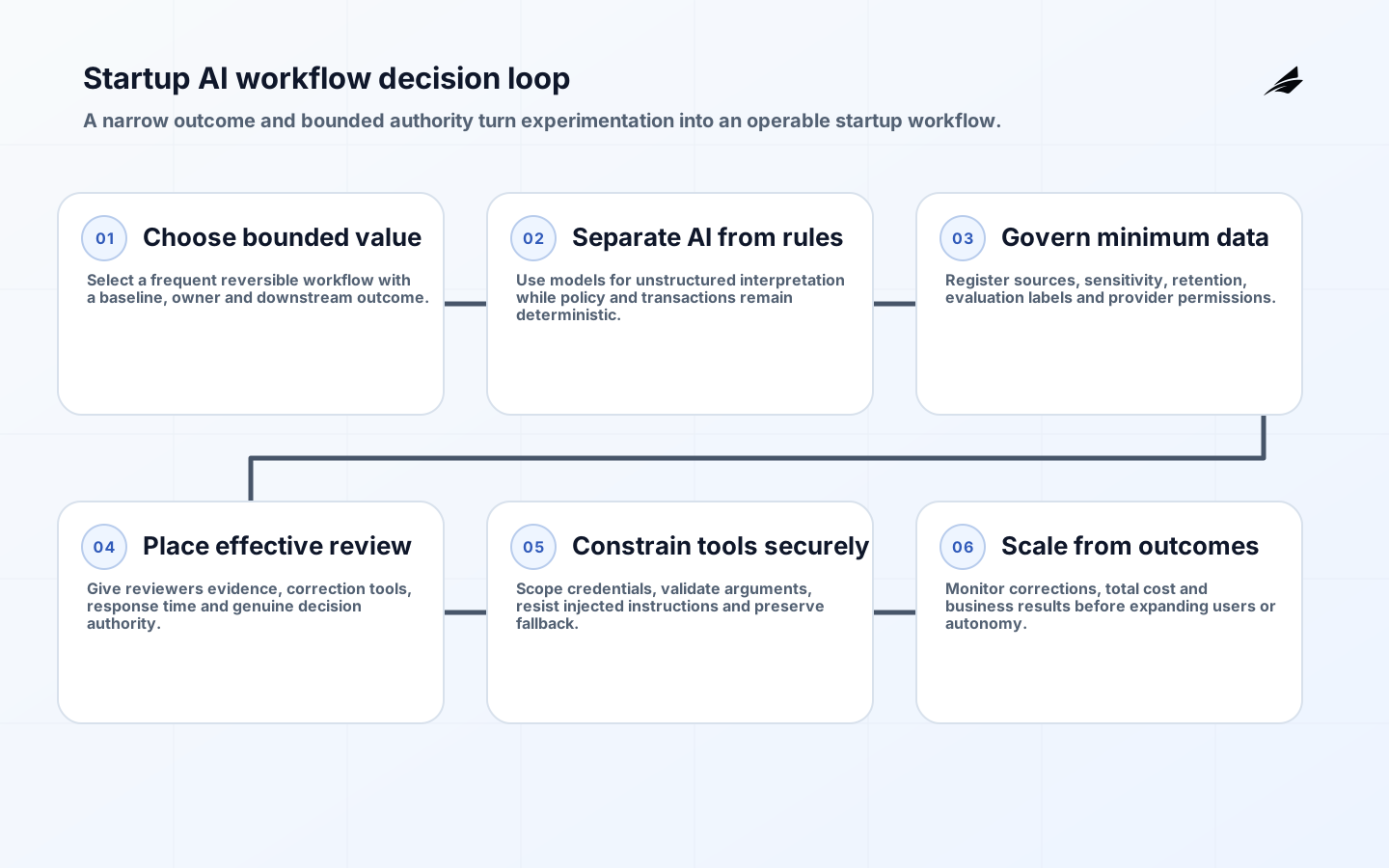
Choose a high-frequency, bounded workflow with observable inputs and a reversible output. Document the trigger, current steps, exception rate, waiting time, cost of correction and final decision owner. Good early candidates assist with triage or preparation while leaving consequential approval in an existing system. Avoid starting with a process that nobody understands, has shifting policy or depends on undocumented judgment from one employee.
Define value as a service outcome: faster qualified response, lower backlog age, fewer transcription errors or more complete records. Time saved is only real if downstream teams can use it. Include the cost of integration, review, model calls, monitoring and exception handling. A small manual sample can establish the baseline before any vendor or architecture decision.
| Candidate | Useful first boundary | Reason to defer |
|---|---|---|
| Support triage | Suggest category and priority with agent confirmation | No labeled history or priority policy |
| Invoice intake | Extract fields and flag low-confidence records | Automatic payment without reconciliation |
| Sales research | Prepare cited account brief | Use of unapproved personal data |
| Customer reply | Draft from approved knowledge with human send | Model can change entitlements or promises |
2. When should the workflow use AI rather than rules?
Use deterministic software for arithmetic, eligibility, limits, state transitions and permissions whenever rules can express the requirement. AI can help with unstructured language, images, fuzzy classification and drafting. Many dependable workflows combine both: a model extracts or proposes, a policy engine validates, and a transactional service commits. This separation makes failures easier to find and prevents probabilistic text generation from silently becoming business authority.
Run a representative evaluation before committing to AI. Compare a simple rules baseline, model-assisted path and current manual process on the same cases. Include messy inputs, rare categories, adversarial text and missing context. The winning design is the one that meets the service threshold at sustainable total cost, not the one with the most advanced model.
3. What data is needed, and how should it be governed?
Create a compact data register: source, owner, purpose, sensitivity, retention, quality limitations and whether model-provider terms permit the intended use. Remove unnecessary personal or confidential fields before prompts and logs. Separate evaluation data from ad hoc examples, preserve a holdout set, and document labeling guidance so changing reviewers do not redefine success.
NIST’s AI Risk Management Framework treats risk across design, development, deployment and use. Its Core organizes work into Govern, Map, Measure and Manage. For a startup, that can be lightweight: one named owner, a use-case card, an evaluation set, risk thresholds, change records and a clear stop mechanism. Lightweight should mean proportionate, not undocumented.
| Evidence | Minimum contents | Decision supported |
|---|---|---|
| Use-case card | User, purpose, inputs, output, prohibited actions | Whether automation is appropriate |
| Evaluation set | Normal, edge, failure and abuse examples | Whether quality clears release threshold |
| Risk register | Harm, likelihood, control, owner, residual risk | Whether exposure is accepted |
| Run record | Model, prompt, tools, policy and outcome versions | Whether an incident can be reconstructed |
4. Where is human review necessary?
Human review belongs where errors are consequential, ambiguity is material or policy requires accountable judgment. Define the reviewer’s evidence, authority, response time and override path. A button labeled approve is not meaningful oversight if the reviewer cannot see source material, understand uncertainty or correct the underlying record. Measure correction patterns and review burden; a workflow that transfers hidden labor to another team has not been automated well.

Set abstention rules for unsupported or conflicting evidence. The system can ask for missing information, route an exception or return the source without generating a conclusion. For generative systems, NIST’s Generative AI Profile provides lifecycle actions addressing risks including confabulation, privacy, security and harmful content. Apply only the controls relevant to the use case, but record why they are sufficient.
5. How should a startup secure an AI-enabled workflow?
Authenticate every user and service, scope tool credentials to the smallest action, validate model-produced arguments and enforce permissions in the target system. Retrieved documents, emails and webpages are untrusted input; their instructions must not override application policy. Use allowlisted tools and destinations, rate limits, transactional idempotency, secret isolation and approval for high-impact changes. The OWASP LLM project is a useful threat-model prompt for injection, sensitive disclosure and excessive agency.
Secure delivery matters even when most capability comes from APIs. NIST’s SSDF supports protecting build environments, tracking components, reviewing code and preparing vulnerability response. Inventory model, library, connector and prompt dependencies. Test provider outage, quota exhaustion and model-version change. Never let verbose prompt or response logs become an uncontrolled copy of customer data.
6. How do cost, rollout and production ownership work?
Model unit economics per completed workflow, not per API call. Include retrieval, retries, evaluation, review, exceptions, observability and support. Set budgets and alerts by tenant or workflow where possible. Cache only when data freshness and privacy permit it. A cheaper model that causes more review can be more expensive overall, while a larger model may be unnecessary after better instructions and structured context.
Roll out to a small cohort with a fallback to the prior process. Assign an operational owner who can disable a tool, change a threshold, revert a prompt or provider version, and communicate incidents. Monitor quality samples, abstentions, corrections, latency, access failures, spend and downstream outcomes. Re-evaluate after policy, data, model or workflow changes rather than assuming the launch benchmark remains valid.
7. What should the delivery contract and handover contain?
Whether work is internal or supplied, define acceptance around workflow evidence rather than a model demonstration. The agreement should identify allowed data, environments, provider accounts, code and prompt ownership, evaluation cases, security requirements, observability, documentation and exit assistance. Require disclosure of third-party models, connectors and material limitations. Production credentials and billing accounts should belong to the startup so a relationship change cannot strand the workflow.
Handover should include architecture and data flows, a model and dependency inventory, versioned prompts and policies, runbooks, evaluation assets, thresholds, known failure classes and provider contacts. Rehearse a provider outage, injected document, incorrect high-impact suggestion and cost spike with the people who will respond. The operating owner must be able to pause automation, drain queued work, restore the manual path and identify affected cases.
Set a change policy proportionate to risk. Low-impact wording adjustments may use automated evaluation and peer review; new tools, sensitive sources or autonomous actions require renewed threat modeling and business approval. Retain comparison results around every material change. This record lets a small team move quickly while still identifying which prompt, model, source or workflow edit caused a production regression.
Review the workflow with the people who receive its downstream output. Sales, finance or support may discover that a technically correct classification creates a queue they cannot process. Check accessibility, language coverage and time-zone behavior for the actual cohort. Document exclusions and provide a correction route visible at the moment of use. A narrow service with transparent limits creates more durable trust than broad automation whose exceptions are hidden.
Before expansion, compare the original assumptions with current company conditions. A startup can change audience, policy and systems within weeks. Confirm that the same process owner, data purpose, review capacity and risk tolerance still apply. If growth has made failures more consequential, strengthen identity, monitoring and approval before adding volume. Scale is a fresh evidence-based decision, not an automatic consequence of a successful pilot.
Keep a small reserve for exceptions and investigation. Automation capacity is not only model throughput; a sudden quality regression can create manual work exactly when the team is busiest. Estimate how many cases reviewers can safely process, set a queue threshold and stop new automated actions before backlog destroys effective oversight. This operational circuit breaker is often more valuable than attempting to tune the model during an active incident.
Key takeaways
- Automate a bounded service outcome, not an undefined collection of tasks.
- Keep rules, permissions and transactions outside probabilistic generation.
- Give reviewers evidence and genuine authority to correct or stop work.
- Evaluate edge cases and abuse paths before exposing action tools.
- Track total cost and downstream correction, not token price alone.
Frequently asked questions
Should a startup build or buy the automation platform?
Buy commodity orchestration when it meets identity, data, integration and observability needs. Build the parts that encode differentiated workflow or product behavior. Preserve exportable records, explicit interfaces and a manual fallback so vendor replacement does not halt the business.
What quality score is good enough?
There is no universal percentage. Set thresholds from the consequence of each error class and the effectiveness of review. Measure precision, recall or task-specific correctness by segment, then add abstention, correction and business-outcome measures. Rare severe failures deserve separate gates.
Does the first workflow need an autonomous agent?
Usually not. A constrained sequence with one model step, deterministic validation and explicit approval is easier to test and operate. Add planning or multiple tools only when evaluation shows that the added autonomy creates material value that simpler orchestration cannot deliver.
Conclusion
Startup automation earns trust through narrow authority, observable evidence and fast recovery. The best first implementation proves a business outcome while keeping policy, permissions and consequential decisions explicit. That foundation lets the company scale automation deliberately instead of accumulating opaque operational risk.