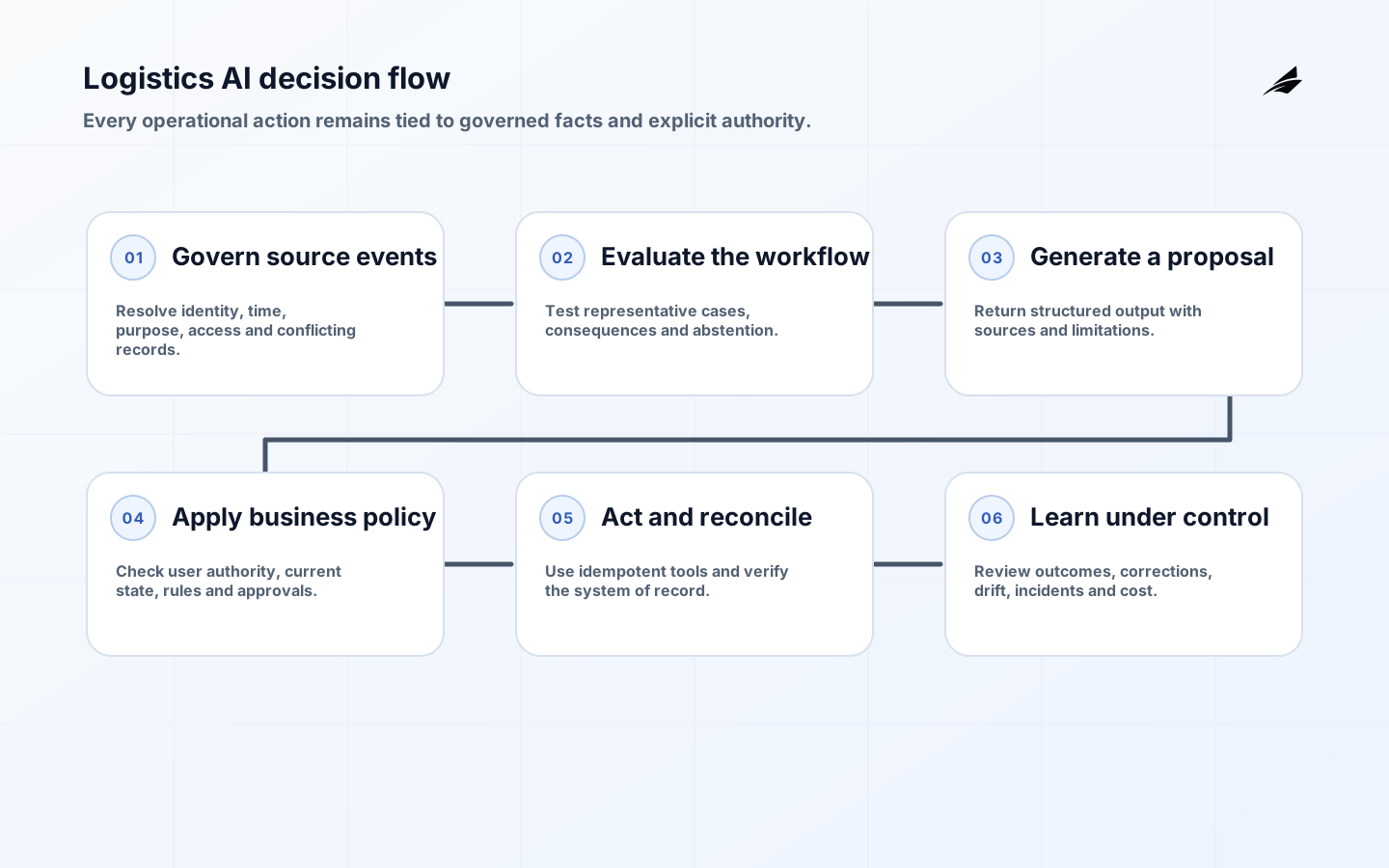
Logistics AI workflow automation should improve a named operational decision while preserving the records, authority and fallback that keep freight moving. Useful candidates include exception triage, document extraction, estimated arrival review, appointment coordination, inventory discrepancy investigation and carrier communication. This checklist takes a workflow from baseline to controlled production. It avoids treating a model response as the transaction itself: orders, shipments, inventory, customs status and proof of delivery remain governed business records.
Start with Edilec's logistics AI delivery plan for scope and economics, then use the logistics automation FAQ for procurement questions. Teams proving their first automation can also use the startup workflow checklist to keep the initial platform small.
1. Select a bounded operational decision
Describe the current trigger, workers, systems, decision, action, exceptions, volume, elapsed time and failure impact. Choose a use case with enough recurring work and reviewable outcomes. State what the AI may recommend, draft or execute and what always requires human approval. A document assistant that proposes fields for a coordinator to confirm has a different risk profile from an agent that changes a delivery appointment or releases inventory. Set an expiry for the pilot and predefine scale, redesign and stop criteria.
Establish a baseline from representative periods, sites, carriers, languages and exception types. Measure end-to-end completion time, rework, missed service commitments, worker effort and downstream corrections. The NIST AI Risk Management Framework organizes risk work around Govern, Map, Measure and Manage and emphasizes lifecycle context. Use it to map affected people, customers, suppliers and safety or legal consequences before choosing a model.
| Automation class | Suitable authority | Required control |
|---|---|---|
| Extract | Propose fields from documents or messages | Source citation and field validation |
| Classify | Route an exception to a queue | Confidence threshold and catch-all path |
| Recommend | Suggest carrier, slot or response | Constraints, explanation and human decision |
| Communicate | Draft or send bounded messages | Approved facts, recipient and send policy |
| Transact | Update a system of record | Deterministic authorization and reconciliation |
2. Govern source data and event meaning
Inventory orders, transport records, warehouse events, telematics, partner messages, documents and master data. Record owner, lawful purpose, sensitivity, retention, freshness, quality and permitted use. Do not ingest an entire mailbox or shared drive when the task needs a bounded folder and fields. Separate customer or trading-partner data by tenant and contract. Mask unnecessary personal data in development and evaluation. Ensure operators can see which source and timestamp support a recommendation.

Supply-chain events need shared semantics. GS1 EPCIS represents visibility through what, when, where, why and how and supports sensor data and certifications. Whether or not EPCIS is adopted, define object identity, business step, disposition, location, event time, correction and chain of custody. AI cannot repair ambiguous identifiers or silently reconcile contradictory systems. Establish precedence and an exception route when sources disagree.
3. Build an evaluation that represents operations
Create a versioned evaluation set from ordinary work and costly edge cases: missing pages, handwriting, unit variation, late events, duplicate references, multilingual notes, damaged labels, unusual routes and contradictory updates. Protect personal and commercial data. Define field-level or decision-level metrics plus abstention behavior. For generative systems, the NIST Generative AI Profile highlights risks including confabulation, privacy, information integrity and security; test the risks applicable to the workflow.
Compare the complete assisted process with the baseline, including review and correction time. Average accuracy can hide severe errors: a wrong temperature unit or consignee is not equivalent to punctuation in a draft note. Segment results by site, partner, document type and language. Define thresholds for automatic acceptance, mandatory review and abstention. Have domain operators examine both false positives and false negatives, and record known limitations in the release decision.
4. Separate model output from business authority
Build the production skeleton early: workforce identity, tenant-scoped source access, retrieval filters, model gateway, tool authorization, workflow state, observability, cost allocation and fallback. Validate model output against a schema and deterministic business rules. The model may propose an appointment; policy should verify facility hours, entitlement and conflict before an API call. Use idempotency keys and read the system of record after action rather than trusting model narration. Keep a manual or rules-based path for provider outage.
Treat documents, emails, web content and partner messages as untrusted input. The OWASP prompt-injection guidance explains how natural-language data can manipulate model behavior. Limit available tools and data by user and task, isolate instructions from content, validate outputs and require confirmation for consequential actions. Filters are supplemental; least privilege and independent authorization provide the stronger boundary.
5. Deliver a secure, observable service
Apply the NIST Secure Software Development Framework to code, prompts, retrieval configuration, schemas and deployment. Review changes, protect repositories and build systems, record component versions and test known failure paths. Pin model versions when possible or run regression evaluations before a provider change. Do not log complete prompts and documents by default. Capture enough trace context to reconstruct source references, policy decisions, tool calls, outcome and correction without creating a sensitive shadow archive.
Release by a bounded queue, site, customer or exception type. Define health, pause and rollback conditions. Show users the source, confidence or limitation appropriate to the task, and make correction quick. Record overrides with reason categories, not as evidence that workers resisted adoption. Provide support for wrong answers, missing sources, unauthorized data, failed tool calls and provider incidents. Rehearse revoking model and tool access while the manual workflow continues.
| Production signal | Decision it supports | Warning pattern |
|---|---|---|
| Outcome improvement | Whether automation adds business value | Usage rises but service failures do not fall |
| Human review time | Whether assistance saves labor | Review exceeds baseline handling |
| Abstention quality | Whether uncertainty is controlled | Hard cases become confident actions |
| Correction rate and severity | Where model or policy fails | Rare errors have high operational impact |
| Tool reconciliation | Whether actions completed correctly | Model reports success without record change |
| Cost per completed case | Whether scale is affordable | Retries and long context dominate cost |
6. Govern scale and operational change
Assign a service owner, workflow owner, data owners and risk approver. Monitor input drift, source freshness, evaluation performance, overrides, security events, provider changes and cost. Re-evaluate after new document templates, routes, facilities, carriers, policies or model versions. Sample production cases with operators, including cases the system abstained from. Maintain an incident path for harmful action, data exposure and sustained bad recommendations. Stop automation cleanly without losing workflow history.
Scale one dimension at a time: volume, sites, customers, languages or authority. Verify that outcome, risk and economics remain acceptable after each expansion. Do not grant transaction authority merely because classification accuracy improved. Maintain a decision record linking requirements, tests, residual limits, owner and review date. Retire duplicate pilots and revoke their access. A portfolio becomes trustworthy when weak uses can stop as deliberately as strong uses scale.
Design adoption around exception work
Observe how coordinators actually use the service during peak and disrupted periods. The interface should distinguish sourced facts, model suggestions, policy decisions and confirmed record changes. Make the next safe action obvious and preserve a route to inspect the original document or event. Train users on limitations and escalation using realistic cases rather than feature tours. Do not hide abstentions to make automation rates look stronger; a well-routed abstention is often safer and faster than a confident wrong answer that creates downstream rework.
Plan reconciliation across organizational boundaries. A carrier, warehouse and customer may each hold different timestamps or status. Define which record controls each decision, how disputes are surfaced and who may correct history. When the service drafts partner communications, it should not invent certainty that internal records do not support. Preserve the exact facts sent, recipient, approval and resulting update. Sample closed exceptions to verify that communication and system state agree, particularly after retries or manual intervention.
Procurement should cover model and application responsibilities separately. Record provider data use, retention, regions, subprocessors, model-change notice, availability, rate limits, incident notification and export. Keep prompts, evaluation sets, policy and workflow code under customer control where possible. Define transition behavior if a model or vendor is replaced. A portable model gateway helps, but portability is proven only when evaluation, source permissions, tool behavior and operating evidence can move without rebuilding the business workflow from memory.
Before final acceptance, have an operator outside the project team process a normal case, an abstention, a source conflict and a failed action using only the production interface and runbooks. Record where they need informal help. Repair those gaps before increasing volume or reducing review, because operational independence is part of model readiness.

Key takeaways
- Automate a named logistics decision, not an abstract promise to add AI.
- Keep governed operational records authoritative and make source conflicts explicit.
- Evaluate the complete workflow across costly edge cases and operator review time.
- Put deterministic authorization and reconciliation between model output and business action.
- Scale cohort or authority only when value, risk, support and unit cost remain acceptable.
Frequently asked questions
Which logistics workflow is a good first use case? A frequent, reviewable task with bounded consequences and reliable source records. Can AI update a transport or warehouse system directly? Yes, but only through scoped tools, deterministic policy, idempotency and reconciliation proportionate to impact. How should model accuracy be measured? By decision consequence and segment, then combined with review time and workflow outcomes. What happens during a model outage? Queue eligible work or route it to the documented manual or rules-based path. Should every correction retrain the model? No; validate the correction, protect privacy and distinguish model, source, policy and interface failures first.
Conclusion
Production logistics AI is a controlled decision service inside a larger operational workflow. Bound the authority, govern event meaning, test representative variation, validate every consequential action and preserve fallback. With clear ownership and recurring evaluation, automation can shorten exception work without weakening the records and accountability on which logistics depends.