A five-person business does not need an “AI strategy” before it can improve invoice intake or lead follow-up. It needs a precise account of the work consuming attention, the records employees trust, and the decisions an owner refuses to delegate. AI workflow automation services for small business are valuable when they reduce repeated reading, copying and classification while leaving payments, promises and access changes under explicit control. This guide uses invoice intake as a running example, then shows how the same discipline applies to support triage and sales administration.
Define the service boundary before selecting technology
Start with one frequent, rules-aware workflow such as invoice intake, lead qualification or support triage. Observe real cases, including exceptions, reversals and incomplete inputs. Record who initiates the work, which system owns each fact, who may approve an outcome, what makes an action irreversible and how staff recover when an integration fails. This boundary prevents small business AI automation from becoming a vague transformation program. It also exposes policy disagreements before software silently turns them into inconsistent behavior.
For invoice intake, acceptance criteria should name the mailbox or upload channel, required supplier fields, duplicate-check rule, accounting record, approval threshold and evidence retained with the posting. A missing purchase order should create an exception, not an invented value. A supplier-bank change should require independent verification. The workflow should state what happens during an accounting outage and how queued items avoid duplicate posting. These details turn a demonstration into a service that a small team can safely run during busy weeks.
Architecture and ownership
The architecture must preserve authority across system of record and event trigger, policy and retrieval service, approval queue and exception inbox, audit log and operational dashboard. Each component needs an owner, a versioned contract and observable failure behavior. Avoid direct point-to-point writes from an interface or model into a critical record. A narrow orchestration layer can validate identity, current state, policy and idempotency before an action proceeds, while an audit event records the evidence and rule version used.
| Architecture area | Required design decision | Evidence before release |
|---|---|---|
| system of record and event trigger | For this design choice, name the accountable owner, supporting evidence, exception route, and next measurable check. | Approved data-flow and owner |
| policy and retrieval service | Within this design choice, name the accountable owner, supporting evidence, exception route, and next measurable check. | Authorization and negative tests |
| approval queue and exception inbox | When implementing this design choice, name the accountable owner, supporting evidence, exception route, and next measurable check. | Versioned interface plus retry behavior |
| audit log and operational dashboard | Before releasing this design choice, name the accountable owner, supporting evidence, exception route, and next measurable check. | Dashboard, alert and recovery runbook |
A six-stage delivery path
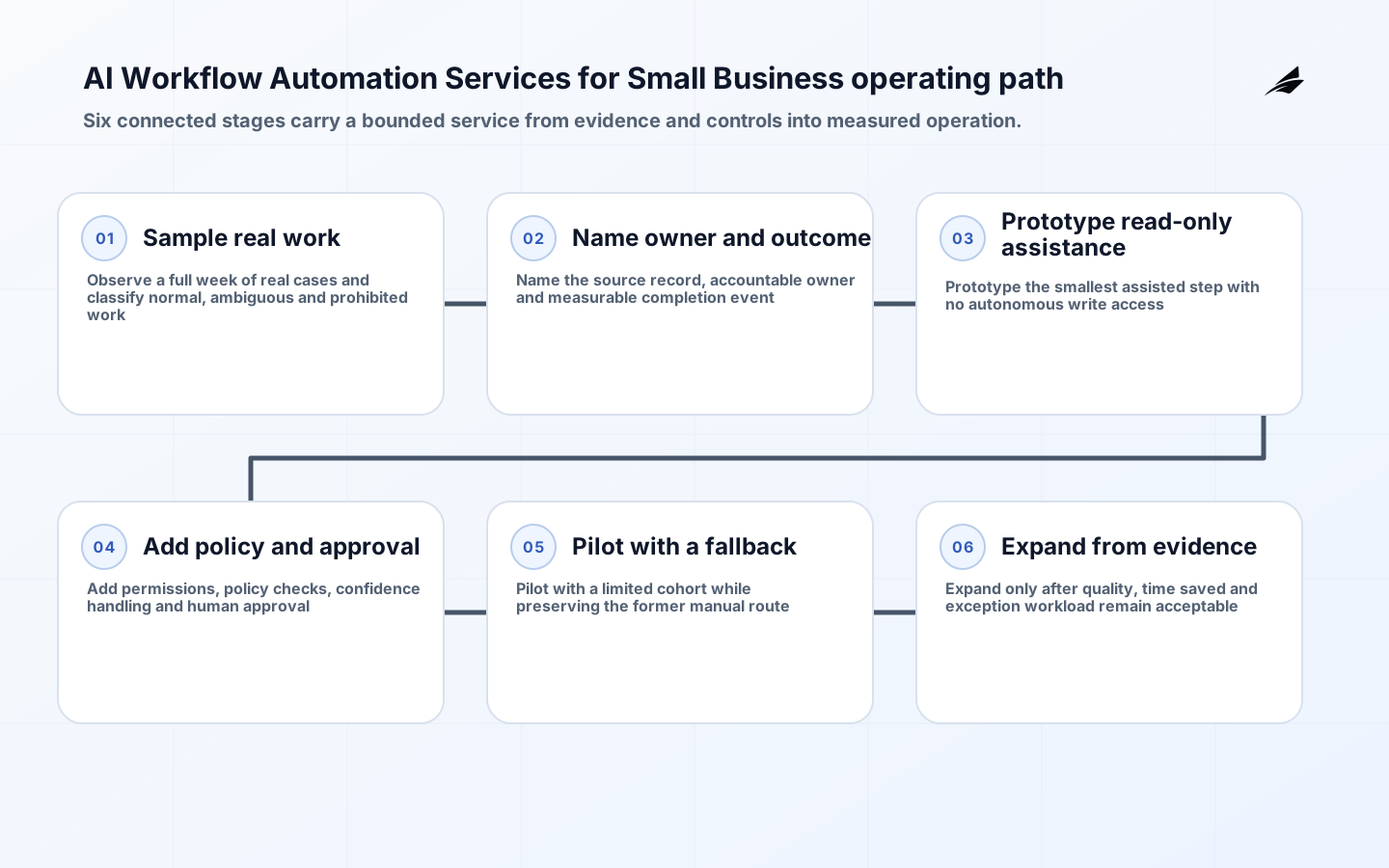
Deliver the first workflow as a sequence of observable decisions. Begin by sampling invoices that were paid, rejected, corrected and disputed. Build extraction against those cases, then connect a read-only accounting sandbox. Add duplicate detection and approval rules before enabling a posting action. During the pilot, compare the automated packet with the bookkeeper’s original evidence and record every correction. Only after reconciliation is consistently clean should the system write a draft transaction, and final payment authority should remain separate.

- Observe a full week of real cases and classify normal, ambiguous and prohibited work.
- Name the source record, accountable owner and measurable completion event.
- Prototype the smallest assisted step with no autonomous write access.
- Add permissions, policy checks, confidence handling and human approval.
- Pilot with a limited cohort while preserving the former manual route.
- Expand only after quality, time saved and exception workload remain acceptable.
Controls and failure modes
Small-business controls must be simple enough to operate without a dedicated governance team. Use the company identity provider instead of shared automation accounts; restrict the integration to the specific ledger and fields it needs; and send owner approval to a queue that shows the invoice, supplier history and rule outcome together. Record the prompt or extraction version, source document hash and final human decision. If the model provider, email service or accounting API fails, preserve the item in a visible queue and let staff complete it manually.
| Failure mode | Design response | Operating signal |
|---|---|---|
| Wrong or incomplete source data | Validate required fields and show source links before a recommendation is accepted. | Correction rate and missing-field rate |
| Unreviewed consequential action | Require approval for payments, customer commitments, access changes and irreversible updates. | Actions blocked or escalated |
| Provider or integration outage | Queue work idempotently and retain a documented manual procedure. | Recovery time and duplicate writes |
| Costs rising faster than value | Measure cost per completed case, including retries and human correction. | Cost per accepted outcome |
Measure outcomes, not activity
A dashboard should connect technical behavior to the intended operating result. Track median hands-on minutes per completed case; first-pass acceptance without material correction; percentage of cases routed to a human for a stated reason; rework, duplicate-action and rollback counts. Segment results by workflow type and material risk instead of hiding poor tails inside a global average. Review a sample of accepted, corrected, escalated and failed cases. When a metric moves, retain enough trace evidence to identify whether the cause was source data, policy, interface behavior, model output, reviewer workload or downstream execution.
Measure the pilot against a month of ordinary work, not a staged sample. Compare hands-on minutes, invoices returned for missing evidence, duplicate attempts, late approvals and correction entries. Review the ten most expensive or slowest cases individually because averages hide supplier changes and unusual tax treatment. A worthwhile result is not maximum straight-through processing; it is fewer routine touches without a rise in financial corrections, vendor complaints or end-of-month reconciliation effort. The owner should decide expansion from this combined evidence.
Cost, timeline and commercial model
Cost is driven less by the model name than by integration depth, messy historical records, exception diversity, review requirements and ongoing evaluation. Start with a fixed discovery and pilot envelope; separate one-time integration work from recurring model, hosting, monitoring and support charges. Timeline should be expressed as evidence-bearing stages: discovery, thin-slice build, controlled pilot and measured expansion. Procurement should require source access, documentation, data export, incident support and transition assistance. A lower quote is not cheaper if it omits evaluation, operating ownership or the path away from the chosen provider.
Rehearse the operating model before expansion
A useful rehearsal for AI workflow automation services for small business follows one representative case from intake through final evidence. The team should interrupt the exercise after each transition and ask which record is authoritative, whether the acting identity has permission, whether the rule is current, and whether retrying would create a duplicate outcome. Run the same case with a missing field, delayed dependency and unavailable reviewer. This reveals assumptions that unit tests and polished demonstrations often miss, especially where system of record and event trigger meets policy and retrieval service.
Next, simulate the two most consequential failure modes: wrong or incomplete source data and unreviewed consequential action. Operators should identify the alert, inspect the trace without broad production access, contain further actions, communicate with affected users and restore a known state. Record elapsed time and every manual workaround. If the team cannot determine what happened from the retained evidence, the workflow is not ready for a wider cohort, even if its normal path appears efficient.
The release evidence for a small-business invoice workflow should fit in one operational folder: the approved process map, supplier-field definitions, integration permissions, duplicate rule, approval thresholds, test cases, exception queue owner and manual posting procedure. Add a list of recurring charges for model use, storage, monitoring and support. This compact packet is more useful than a large architecture deck because the owner can use it to review a new employee, investigate a disputed invoice or move the workflow to another provider.
Ask the bookkeeper who did not configure the system to process a changed bank account, a duplicate PDF and an accounting outage. They should be able to see why each item stopped, identify the evidence required and resume without creating a second transaction. Then ask the owner to revoke the automation identity and confirm that no hidden credential keeps working. These exercises test the conditions most likely to hurt a small company: cash error, invisible backlog and dependency on one installer’s memory.
Practical takeaways
- Anchor AI workflow automation services for small business to one named outcome and accountable owner.
- Treat one frequent, rules-aware workflow such as invoice intake, lead qualification or support triage as the first deliverable, not an assumption.
- Keep permissions, policy and irreversible actions in deterministic services with review evidence.
- Pilot with representative exceptions and retain a tested manual route.
- Measure median hands-on minutes per completed case alongside quality, risk and human workload.
- Expand only when the current release is supportable, observable and recoverable.
Frequently asked questions
- What should the first engagement deliver? It should deliver a process map, data and authority model, risk register, thin-slice backlog, evaluation plan, cost range and explicit decision on what will remain manual.
- How long should a pilot run? Long enough to include ordinary cases, realistic exceptions and at least one controlled recovery exercise. Calendar duration matters less than representative evidence and a pre-agreed exit decision.
- Can a team buy a platform before discovery? A short technical trial can inform discovery, but procurement should follow the service boundary and control requirements. Otherwise the available product features begin defining the business process.
- Who owns the released service? A business owner is accountable for policy and outcomes; a technical owner is accountable for reliability and change; security, privacy and domain specialists approve relevant controls. A vendor can support these roles but should not replace them.
- How is success demonstrated? Compare the agreed baseline with completed outcomes, corrections, exceptions, failures, cost and user impact. Pair aggregate metrics with case review so a favorable average cannot conceal harmful edge cases.
Conclusion
Small-business automation succeeds when it gives time back without making the business harder to understand. A narrow invoice, lead or support workflow can produce meaningful savings, but only if source records remain visible, consequential actions stay reviewable and exceptions have an owner. Build one complete path, price its ongoing operation honestly and keep the manual route alive until evidence supports retirement. That approach creates a durable capability instead of another subscription that staff quietly work around.