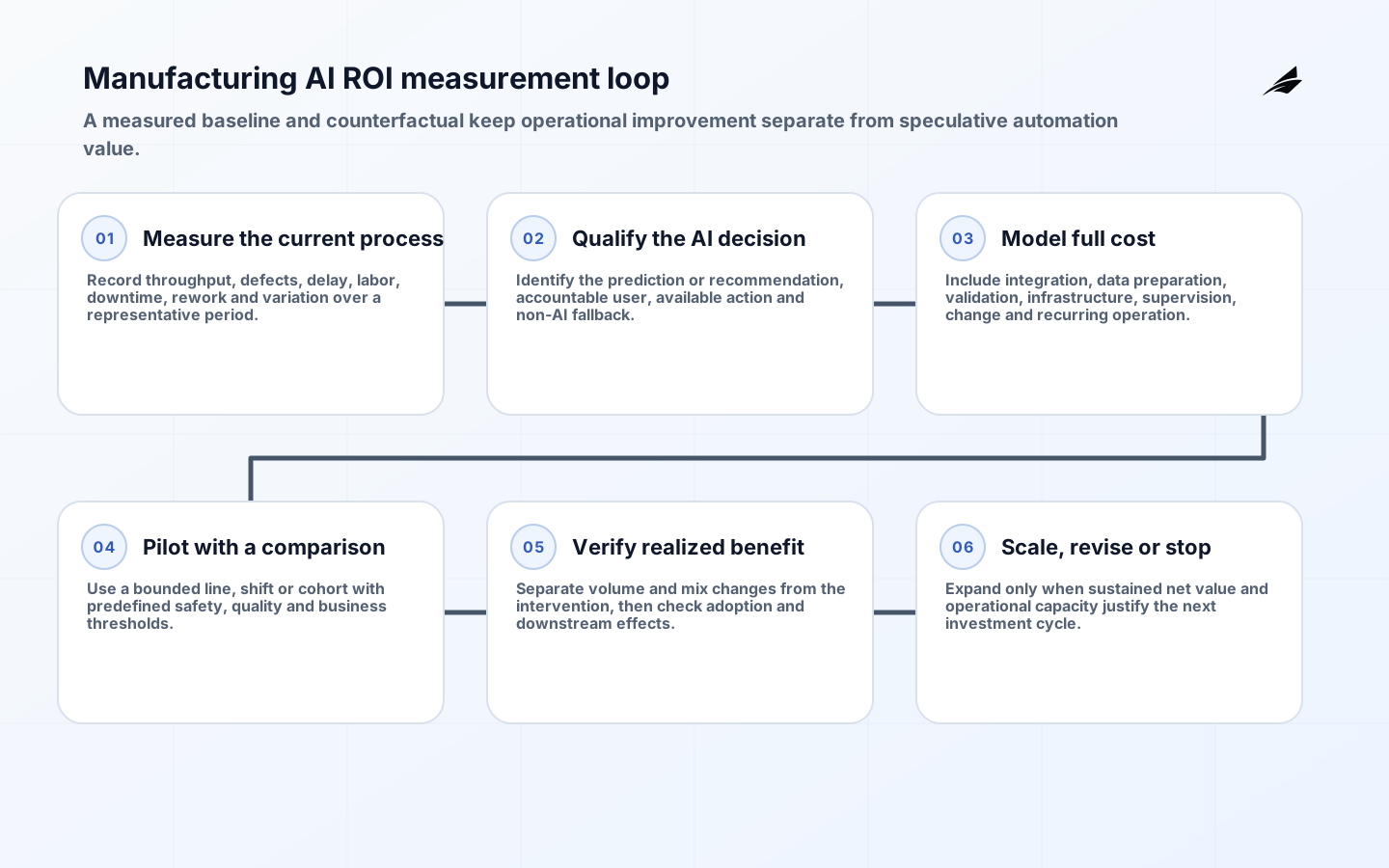
AI automation ROI planning for manufacturing starts with a production loss that operators and finance can both recognize. It does not start with model accuracy or a catalog of possible use cases. A prediction has value only when it reaches a timely, permitted intervention and changes an outcome such as unplanned downtime, scrap, energy use, schedule adherence or maintenance labor. The business case must therefore include the decision path, operational technology constraints, human response, false-action cost and evidence needed to attribute improvement.
The manufacturing ROI practical guide helps frame candidate value, while the evidence-based implementation checklist turns assumptions into tests. Teams handling higher-consequence clinical workflows can compare the healthcare ROI checklist. This FAQ focuses on what should enter the calculation and how to avoid claiming savings that ordinary process changes actually produced.
What unit of value should the business case use?
Choose a unit tied to a completed production outcome: avoided minutes of constrained-line downtime, accepted units per input, maintenance work orders completed before failure, energy per good unit, or schedule variance avoided. Define the denominator and population. An improvement in alerts per day is not value if operators ignore them. A reduction in mean time to repair may be valuable only on assets that constrain throughput. Write the formula, data owner, accounting treatment and review period before the pilot.
Separate gross opportunity from realizable value. If a line loses one hundred hours annually, the workflow cannot recover all of them. Some failures are unpredictable; some warnings arrive too late; maintenance windows and parts may be unavailable; operators may already intervene. Estimate addressable cases, detection coverage, action rate and successful intervention rate. Apply a confidence range rather than one precise payback number.
| Outcome | Baseline evidence | Value caution |
|---|---|---|
| Avoided downtime | Asset state, stop reason, duration and constrained throughput | Do not value idle time on non-constraining equipment as lost output |
| Reduced scrap | Defect class, input lot, process state and accepted units | Account for inspection changes and rework moved elsewhere |
| Maintenance efficiency | Work order, labor, parts, failure mode and completion | Separate predictive work from deferred maintenance |
| Energy efficiency | Metered energy, production mix and good units | Normalize for product, shift, weather and operating mode |
How should a credible baseline be established?
Use enough history to cover product mix, shifts, seasons, maintenance cycles and rare but material failures. Validate timestamps across historian, MES, CMMS, quality and finance records. Define reason-code quality and missing-data treatment. Review the baseline with operators because a logged stop may hide cleaning, changeover or material shortage. Freeze the baseline method before seeing pilot results, then document any necessary change openly.
Where possible, use a phased or matched comparison rather than a simple before-and-after chart. Roll out across similar assets or lines at different times, or compare intervention-eligible events with a defensible control group. Track concurrent changes such as new tooling, supplier improvement, staffing and preventive-maintenance policy. The purpose is not academic certainty; it is to avoid paying for apparent value that cannot be attributed to the automation.
How does a model output become production value?
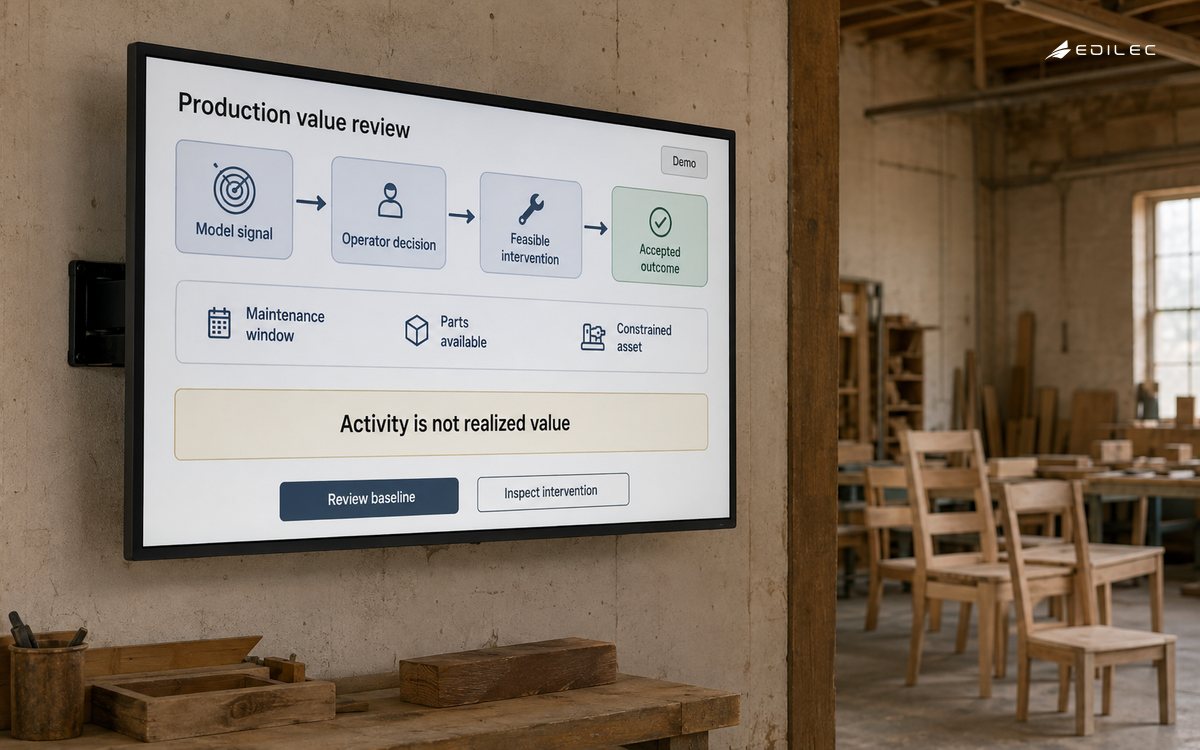
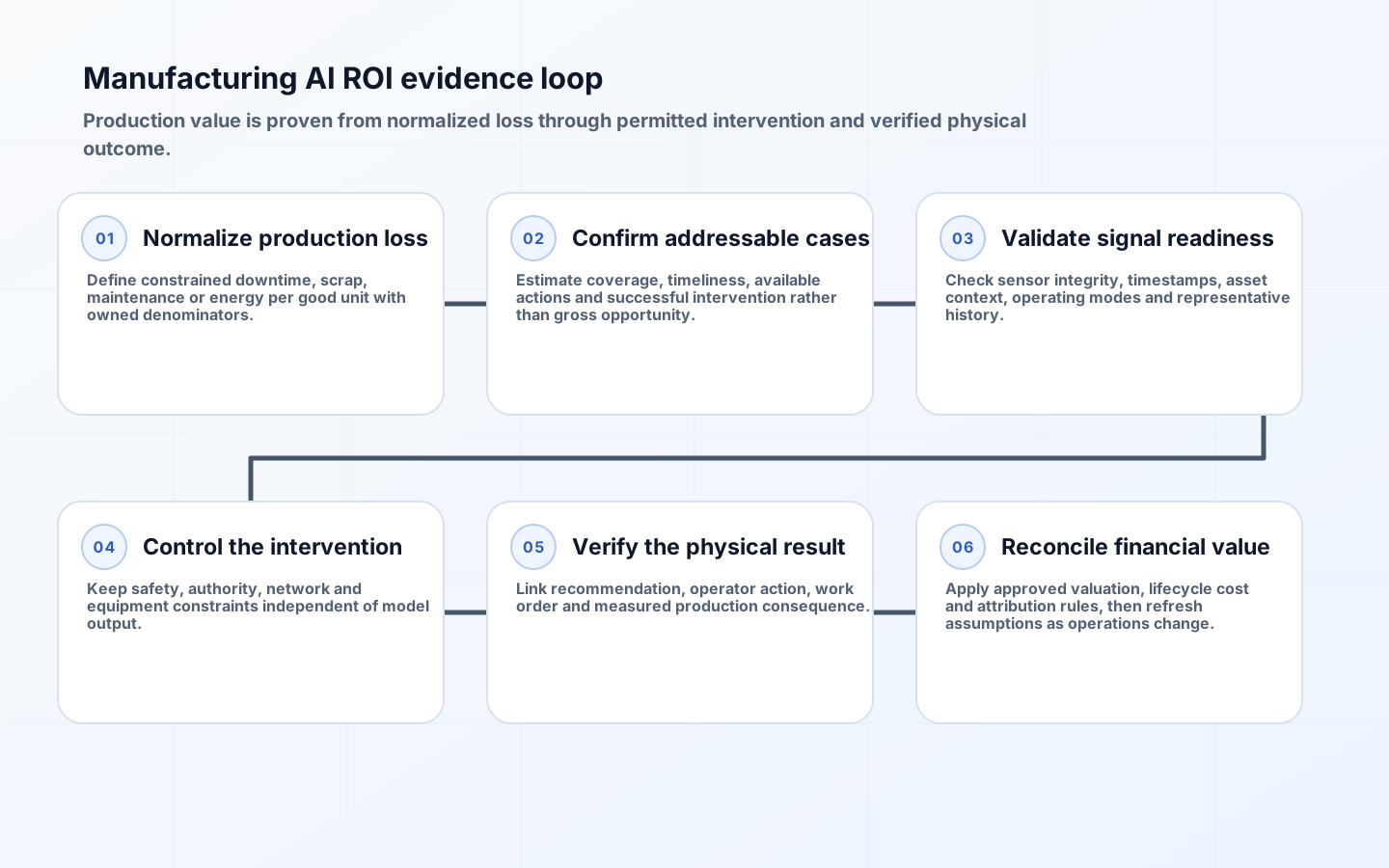
Map the full chain: sensor or record, feature calculation, model output, threshold, operator display, acknowledgement, work order or process change, and verified result. Assign latency limits and ownership at every handoff. A strong classifier with a two-day review queue cannot prevent a failure expected in four hours. Measure coverage, precision and recall where appropriate, but also alert timeliness, operator acceptance, action completion and outcome confirmation.
Keep safety and control policy outside the model. NIST OT guidance stresses performance, reliability and safety requirements that differ from ordinary IT. Start with advisory or maintenance-planning uses unless a formal hazard and control process justifies automated actuation. Segment networks, authenticate data paths and commands, constrain write authority and provide a tested manual mode. No ROI estimate should assume that a model can bypass established interlocks or qualified operators.
Which costs belong in manufacturing AI ROI?
Include instrumentation gaps, historian access, labels, data engineering, edge compute, model development, integration, operator interface, cybersecurity, validation, training and change management. Ongoing costs include monitoring, recalibration, model or rule updates, cloud or inference use, network support, incident response and periodic benefit verification. Add the cost of false positives, missed events and production tests. A pilot that borrows expert time without valuing it understates the cost of scale.
Treat data and integration work as reusable assets only when the organization will actually govern them. A standardized asset hierarchy, event envelope or condition-monitoring pipeline may support future use cases; a one-off spreadsheet does not. Use scenario ranges for asset count, event volume, review effort and maintenance. Compare the AI option with simpler controls such as threshold alarms, process standardization, sensor repair or scheduling changes.
| Cost category | Often missed item | Planning evidence |
|---|---|---|
| Data | Clock alignment, missing sensors and label review | Asset-by-signal readiness inventory |
| Plant integration | Change windows, vendor access and rollback | Approved interface and commissioning plan |
| People | Operator review, reliability engineering and training | Time study and role allocation |
| Risk | False intervention, cyber exposure and recovery | Hazard review, threat model and tested fallback |
| Lifecycle | Drift, new product mix and model retirement | Monitoring owner and recalibration trigger |
What should a value-proving pilot include?
Select one asset family, failure mode or quality decision with enough events to evaluate. Establish data readiness and failure-handling criteria before deployment. Run shadow predictions first, then supervised recommendations. Capture what the operator knew, whether the recommendation arrived in time, what action occurred and whether the expected physical result followed. Include normal operation, sensor faults, communication loss, maintenance state and product changes.
Set go, revise and stop criteria. A pilot may demonstrate technical accuracy yet fail because actions are unavailable or review effort is excessive. Expansion requires stable data, acceptable false-action burden, tested OT security, operator adoption and a financial effect that survives normalization. Preserve negative results; they help prevent another team from repeating an unsuitable use case.
How should benefits be governed after rollout?
Maintain a benefit ledger that links each claimed outcome to source events, intervention and financial rule. Review it with operations and finance. Monitor model performance, data quality, action rates and outcome rates by asset, site, shift and product. Watch for alert fatigue and work displaced to maintenance or quality teams. When the process, equipment or economics change, recalculate the baseline and benefit range.
Use NIST's govern, map, measure and manage cycle to keep risk and value connected. Record model purpose, owners, affected workers, data sources, test coverage, deployment version, incidents and retirement criteria. Pause the workflow if input integrity, safety controls or outcome attribution no longer support the approved business case. ROI governance is not a finance report added later; it is part of operating the system.
Account for learning and change-management effects separately. Early gains may come from the attention a pilot brings to reason codes, preventive maintenance or standard work. Those improvements are valuable, but attributing all of them to AI will overstate scale economics. Record process changes and compare sites where the workflow is and is not deployed. Operators should be able to challenge a recommendation and add a reason that reliability engineers can review. A system that suppresses local expertise may improve a dashboard while weakening resilience.
For multi-site rollout, treat each site as a new operating context rather than cloning a model blindly. Compare equipment variants, sensor calibration, product mix, maintenance policy, network architecture and labor practices. Define which features and thresholds are global and which require site approval. Revalidate safety and cybersecurity controls before connecting to plant systems. Report benefits by site until evidence supports aggregation, because one strong line can otherwise hide a poor or unsafe deployment elsewhere.
Define retirement economics as well as expansion economics. A model may become unnecessary after equipment replacement, a process redesign or a new controller capability. Set triggers for declining event coverage, obsolete sensors, unsupported software and benefit below operating cost. Archive the evidence and remove credentials, integrations and monitoring deliberately. Continuing to run an unowned model creates cost and cyber exposure even when nobody relies on its recommendation. Confirm that operators know when the recommendation is no longer available and which standard procedure replaces it. Update training and maintenance documentation at the same time. Remove obsolete dashboards and alerts immediately. Verify decommissioning afterward.
Key takeaways
- Define value as a verified production outcome with a stable denominator.
- Model addressable and realizable benefit separately from gross loss.
- Measure the entire path from signal through intervention and physical result.
- Include OT integration, safety, people and lifecycle costs in the business case.
- Expand only when value remains after normalization and risk controls work under failure.
Frequently asked questions
| Question | Answer |
|---|---|
| What payback period is acceptable? | It depends on capital policy, risk and reuse; present a range with assumptions rather than inventing a universal threshold. |
| Is OEE enough to prove value? | No. OEE can guide investigation, but use the constrained outcome and explain availability, performance and quality changes separately. |
| Can synthetic data replace plant history? | It can test software and rare conditions, but benefit claims still need representative operational evidence. |
| Should a pilot control equipment automatically? | Usually begin advisory; automated control requires a stronger safety, security, validation and authority case. |
| Who signs off ROI? | Operations owns the physical outcome, finance owns valuation rules, engineering owns system evidence and risk owners approve residual exposure. |
Conclusion
AI automation ROI planning for manufacturing is credible when a model output can be traced to a permitted intervention and a verified production result. Build the baseline carefully, value only addressable loss, include full lifecycle cost and protect OT safety. A smaller use case with durable evidence is more investable than a broad forecast built from model activity and optimistic assumptions.