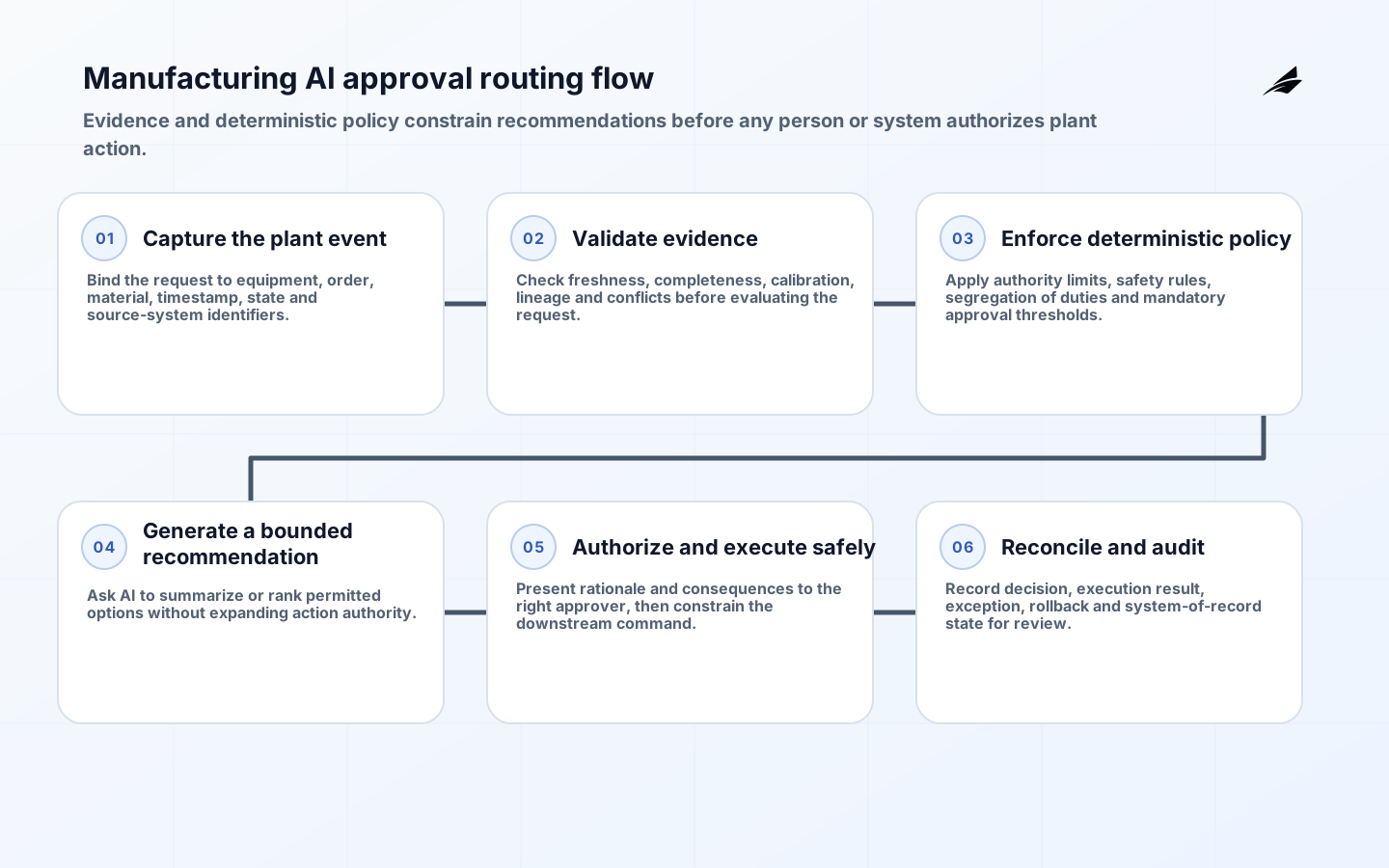
AI approval routing automation for manufacturing sits between business workflow and physical operations. It can recognize request types, assemble evidence and identify qualified reviewers, yet the consequences may reach a production line, product lot or maintenance decision. The architecture must distinguish assistance from authority at every step.
This FAQ addresses the questions plant, quality, engineering, security and IT leaders should settle together. It treats approval as a controlled record with an accountable decision, not a notification that disappears into email. The exact legal and quality requirements depend on product, jurisdiction and operating context, so local owners must confirm them.
What does AI approval routing automate?
The system can identify a request class, verify required fields, retrieve related records, estimate consequence, recommend an authorized route, summarize evidence and watch deadlines. Those tasks reduce clerical delay. The workflow engine still records state, enforces mandatory roles, prevents self-approval, captures decisions and triggers downstream work.
Approval is not one category. A schedule adjustment may fit deterministic limits; a quality disposition may require specialist judgment; a process deviation can demand several authorities and a fixed duration. Design a separate policy for each class rather than training one model to imitate historical routing.
Who remains accountable for the decision?
The person or role granted authority by company policy and applicable requirements remains accountable. The model cannot acquire authority because historical approvers usually accepted similar requests. Organizational identity, delegation, plant scope, competence and limits should be evaluated by deterministic policy at decision time.
NIST AI RMF material on human-AI interaction stresses clearly defined roles. Put that clarity in the interface: identify which content was generated, which evidence was retrieved, what policy requires and what the approver is authorizing. Preserve override and challenge without punishing people for disagreeing with the recommendation.
| Decision | Primary authority question | Evidence that must be visible |
|---|---|---|
| Deviation | Who may accept temporary process variance? | Limit, duration, product and risk |
| Quality disposition | Who may release, rework or reject? | Lot, specification and inspection |
| Maintenance deferral | Who accepts continued operation risk? | Asset condition and contingency |
| Material change | Who confirms technical compatibility? | Material, recipe and validation |
| Schedule override | Who owns customer and capacity trade-off? | Orders, resources and constraints |
Can historical approvals train the router?
History can provide examples, but it may encode obsolete roles, inconsistent practice or decisions made under different conditions. Clean the dataset by policy version, plant, product and outcome. Exclude records whose evidence or final authority cannot be verified. Use history to evaluate likely routes, not to redefine policy silently.
Test whether prior data underrepresents night shift, smaller sites or rare high-consequence cases. A model optimized for volume may route unusual requests poorly. Keep mandatory routing rules outside learning and maintain examples where the correct behavior is to ask for evidence or decline a recommendation.
How should ERP, MES, QMS and maintenance systems connect?
Use stable identifiers and explicit ownership. ERP may own orders and material masters; MES owns production execution; QMS owns deviations and dispositions; maintenance systems own assets and work. ISA-95 offers models for enterprise and manufacturing operations integration, but the implementation still needs field, event and error contracts.
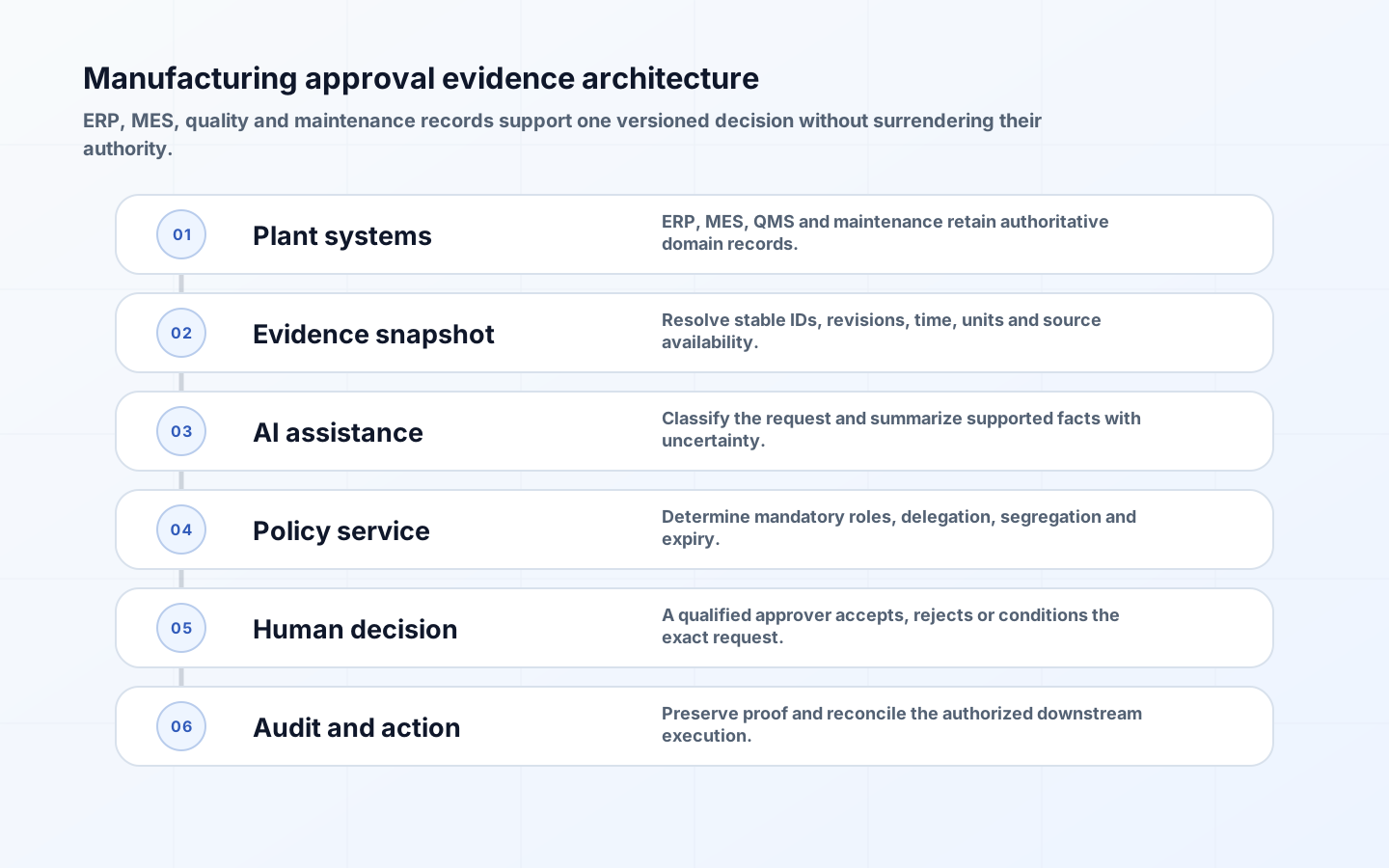
Avoid copying every record into the model context. Retrieve the minimum current facts and link the signed approval to immutable evidence references or retained snapshots. Define what happens when a source is unavailable or changes after submission. A material request change should create a new version and invalidate approvals that no longer match.
How does the design protect safety and quality?
Start with hazard and quality analysis for the approval class. Identify decisions the AI must never make, evidence that cannot be optional, independent process limits and emergency response. The workflow should not connect a probabilistic recommendation directly to machine control. Existing validated controls remain authoritative.
Make unsafe states difficult: no implicit approval after timeout, no reuse of a signature after request changes, no invisible delegation, and no route that bypasses quality because production is urgent. Test adverse combinations and restore the non-AI workflow during outage. The NIST smart manufacturing roadmap highlights reliability, safety and integration as central industrial AI challenges.
| Condition | Unsafe behavior | Required response |
|---|---|---|
| Missing source data | Fill gaps from probability | Hold and request evidence |
| Approver unavailable | Choose a convenient manager | Use authorized delegation or escalation |
| AI service outage | Stop all approvals indefinitely | Continue deterministic manual route |
| Request amended | Keep previous signature | Invalidate and re-approve |
| Conflicting records | Select one silently | Expose conflict to responsible owner |
Is a click enough to prove approval?
Proof depends on the decision and applicable policy. At minimum, bind the authenticated subject, role, request version, evidence set, decision, time and policy version. Sensitive approvals may require step-up authentication or a regulated electronic-signature process. A chat reaction without context is weak evidence.
Protect the record from alteration and make retrieval possible by asset, lot, order and change. Retain model and routing output as supporting evidence, but do not confuse it with the human's reason. Let approvers add conditions and rationale in structured fields where they affect execution.
What happens during urgent or unusual work?
Emergency procedures should be defined before the emergency. Identify temporary authority, maximum duration, permitted request classes, required contemporaneous evidence and post-event review. Urgency can shorten the route, but it should not erase identity or accountability. Log when contingency mode starts and ends.
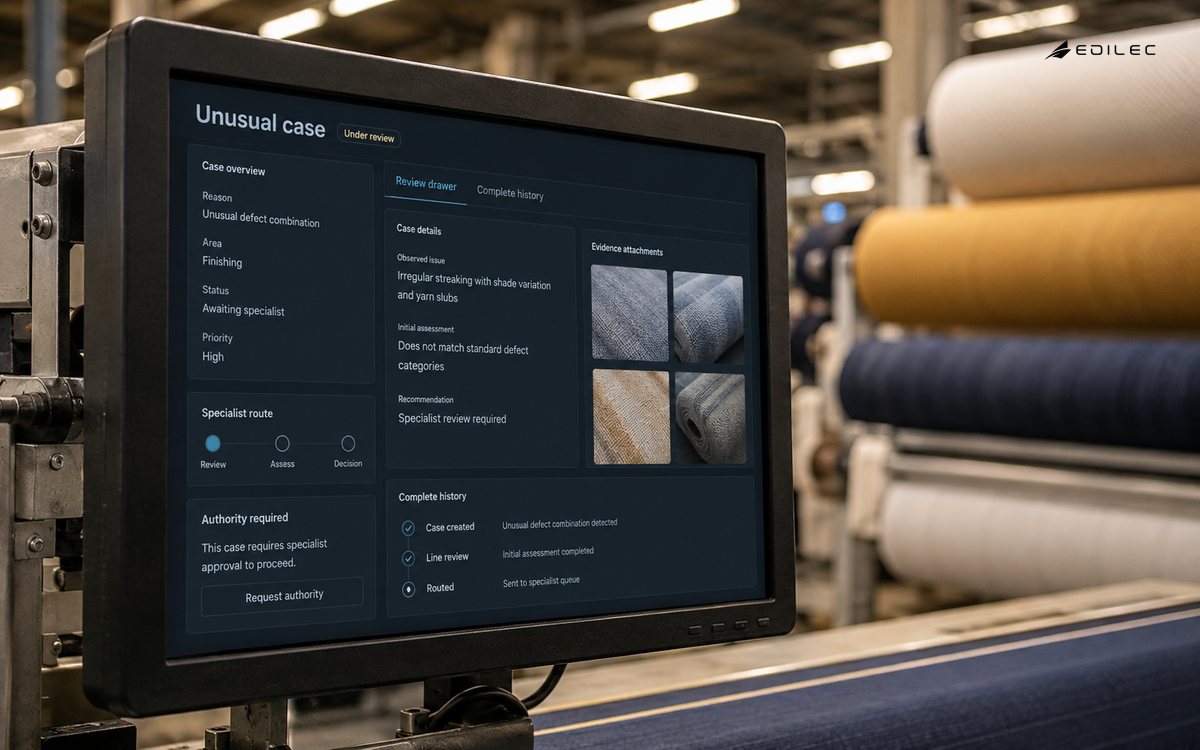
Unusual cases should not be forced into the nearest common class. Provide a specialist route with the complete history. Monitor repeated exceptions because they may reveal an obsolete policy, bad form or changing operation. Improvement may require redesigning the process rather than adding another model prompt.
How should performance be measured?
Measure time to complete evidence, time awaiting qualified review, routing correction, requests returned, overrides, deadline escalation and downstream quality outcome. Segment by class, plant and shift. A lower median approval time can hide a growing tail of complex work or inappropriate approvals.
Sample decisions for faithful summaries, authority and condition compliance. Compare predicted urgency with real consequence. Review near misses and cases where an approver followed the recommendation despite uncertainty. Use production feedback to update evaluation only after expert adjudication.
Should manufacturers buy or build the solution?
A product may provide workflow, identity, signatures and connectors, while custom work captures plant policy and data contracts. Evaluate offline continuity, audit export, model choice, policy versioning, tenant isolation, deployment constraints and vendor access. Demonstrate integration with representative records rather than relying on a generic demo.
Building everything offers control but creates a long-term security, reliability and validation obligation. Select the smallest custom boundary that preserves important plant decisions. Contract for data return, incident notice and change transparency. Know how approvals continue if the vendor or model is unavailable.
What should an audit or review be able to reconstruct?
A reviewer should be able to identify the request version, physical objects and orders affected, evidence available at decision time, applicable policy, route, qualified approvers, delegations, AI recommendation, human rationale and downstream execution. Preserve timestamps and source identities. Avoid retaining unnecessary personal or model data merely because it is easy to log.
Reconstruction should work after organization and system changes. Stable subject and asset identifiers are more reliable than display names. Export records in a usable form and verify retention and deletion. If a vendor hosts the workflow, contract for access to evidence during incidents, audits and exit.
Use review findings to improve controls rather than score individual approvers in isolation. Repeated missing evidence may indicate a poor intake form; recurring delegation may reveal staffing risk; recommendations that are always overridden suggest a bad routing feature. The audit trail has operational value only when it can change the system.
Choose review frequency from consequence and change rate. High-impact deviations may require continuous sampling, while stable low-risk schedule approvals can be reviewed periodically. Increase sampling after policy, organization, integration or model changes. Document why the chosen cadence is sufficient and who can tighten it after an incident.
The same review should examine rejected requests and conditions attached to approval. A system trained only on accepted history can learn an incomplete picture of risk. Preserve why evidence was insufficient and whether the requester corrected it, because safe refusal is a core manufacturing outcome rather than a routing failure.
Related reading
Use the companion Manufacturing Approval Implementation Checklist, the general AI Approval Routing FAQ, and Manufacturing AI ROI Planning for implementation and investment evidence.
Frequently asked questions
Does AI replace the approver? Not for consequential manufacturing decisions. It can organize and route evidence, while authorized roles remain responsible.
Can silence count as approval? No. Timeout should escalate or expire the request; it should not create consent.
Must every recommendation be explained? The interface should show the evidence, policy and relevant uncertainty so a reviewer can make an independent decision.
How often should routing be reviewed? Review after policy, organization, plant, product or model changes and on a cadence driven by consequence and observed errors.
Key takeaways
- AI assistance does not create manufacturing authority.
- Historical routes must be reconciled with current policy before use.
- Plant systems remain authoritative for their records and events.
- Urgency needs a designed contingency, not silent control bypass.
- Measure decision quality and downstream outcomes alongside speed.
Conclusion
Manufacturing approval routing is a governance system with AI inside it. The design succeeds when evidence reaches the right qualified person, the decision remains bound to exact plant context, and unusual conditions fail safely. Keeping authority, signatures and execution deterministic allows AI to reduce coordination effort without obscuring responsibility.