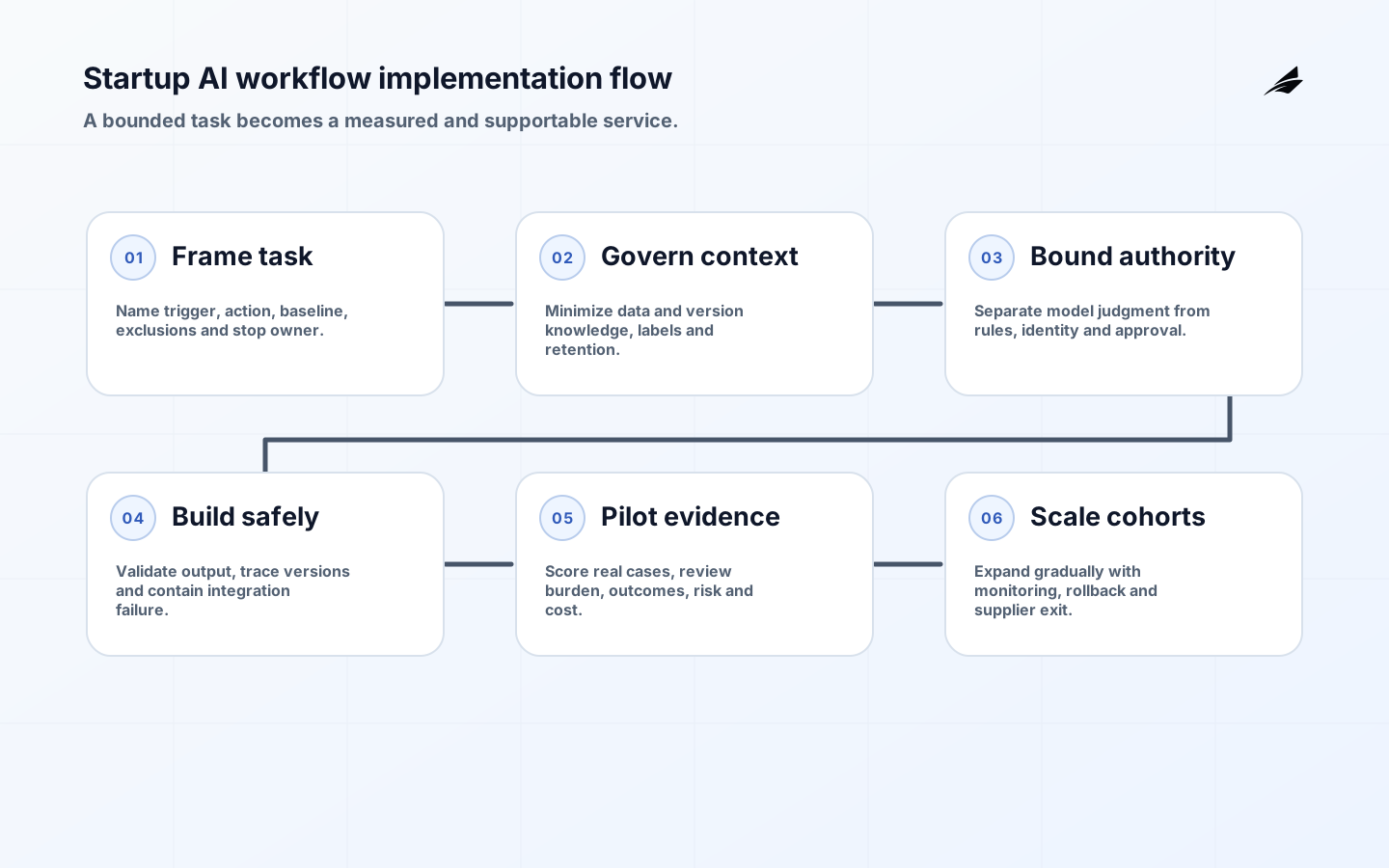
AI workflow automation for startups should remove a specific operational constraint without creating an invisible decision maker. Good candidates have repeated inputs, observable outcomes, enough examples to test, and a safe way for a person or deterministic rule to catch uncertainty. Examples include classifying inbound requests, extracting fields from known documents, preparing a draft response, matching records or routing an exception. Avoid beginning with high-consequence approvals, open-ended autonomous agents or a promise to automate an entire function. A narrow workflow can produce value, evidence and reusable controls before the company commits scarce engineering and operating capacity.
This checklist turns the startup AI workflow delivery plan into implementation gates; the startup automation FAQ covers vendor and cost questions. The NIST AI Risk Management Framework organizes work around Govern, Map, Measure and Manage. A small company does not need a large committee for each function, but it does need named accountability, documented context, representative evaluation and an operating response when the system is wrong.
1. Define the workflow outcome and baseline
Write the trigger, eligible population, input, current steps, systems touched, output, reviewer, downstream action and completion condition. Measure current volume, handling time, queue age, error and rework on a representative period. Separate delay caused by judgment from delay caused by missing data or poor system integration; AI does not fix a broken ownership boundary. Name the customer or employee consequence of a wrong, late or missing result. State excluded cases and a manual path.
Set a hypothesis such as reducing median triage time while keeping material misroutes below an agreed threshold. Include quality, cost and risk guardrails. Do not use saved model seconds as the benefit if staff still perform every old step. Track realized capacity, response time, conversion, backlog or another outcome that matters. Give a product or operations owner authority to stop the workflow when harm or cost exceeds the boundary.
2. Establish data rights and a minimal context set
Inventory prompts, documents, customer records, knowledge sources, labels, feedback, logs and generated outputs. For each, record source, owner, purpose, sensitivity, retention, allowed provider use, access and deletion route. Minimize context to what the task needs. Redact or tokenize sensitive fields when they add no decision value. The NIST Privacy Framework helps connect processing activities to privacy risk; use it to ask how collection, inference, retention or an erroneous output could affect people.
Build an evaluation set from real workflow variation, including poor scans, short messages, multiple languages, novel products, conflicting records and adversarial content where relevant. Remove test items from prompt examples and tuning data so evaluation remains meaningful. Label ambiguity rather than forcing reviewers to invent certainty. Store correction reasons in structured form; a thumbs-up signal rarely explains whether the issue was extraction, policy, source quality, reasoning or tone.
| Checklist area | Implementation evidence | Owner | Release blocker |
|---|---|---|---|
| Purpose | Workflow map, baseline and excluded cases | Operations owner | No measurable action or fallback |
| Data | Purpose, rights, minimization and retention record | Data owner | Sensitive input lacks approved handling |
| Evaluation | Versioned representative cases and rubric | Product owner | High-consequence segment absent |
| Integration | Scoped identities, idempotency and audit trail | Engineering owner | Model can perform unbounded action |
| Review | Reviewer authority and escalation | Functional lead | Human review is nominal or overloaded |
| Operations | Telemetry, incident and rollback runbook | Service owner | No route to pause or reconstruct an event |
3. Design bounded AI and deterministic controls
Separate deterministic workflow logic from probabilistic tasks. Use ordinary rules for authorization, arithmetic, required fields, policy thresholds and irreversible actions. Use the model for classification, extraction, summarization or drafting where its uncertainty can be evaluated. Constrain output with a schema, allowed values and validation. Ground answers in approved sources when the task requires company knowledge, and attach source references for a reviewer. Treat retrieved documents and user input as untrusted content, not instructions with authority.

The NIST Generative AI Profile identifies risks that can be amplified by generative systems. Translate relevant risks into tests and controls instead of adopting every possible control. The OWASP LLM Top 10 is useful for threat modeling prompt injection, sensitive-information disclosure, excessive agency and unsafe output handling. Limit tools, destinations, amounts and record scopes; require approval for consequential actions.
4. Build secure integrations and reproducible releases
Use a dedicated service identity with least privilege. Keep secrets outside prompts and code, validate all model output before it reaches a database or API, and make write operations idempotent. Record input references, workflow version, prompt or policy version, model identifier, tool calls, validations, reviewer decision and final action without logging unnecessary personal data. Define timeouts, retry limits, duplicate prevention, rate limits and a dead-letter path. A fallback should preserve the work item and context rather than silently discarding it.
Version code, prompts, schemas, evaluation data and deployment configuration together. NIST SP 800-218A extends secure-development practices for generative AI and dual-use foundation models. For a startup consuming a model API, the practical lesson is still supply-chain discipline: know the provider and version, protect development environments, review dependencies, test changes and retain evidence. Prevent a vendor model update from reaching production without the agreed regression gate.
5. Evaluate behavior, workflow and economics
Score the exact task, not generic intelligence. For extraction, measure required-field accuracy and critical-field errors. For routing, use precision and recall by class, plus cost-weighted misroutes. For drafting, use a rubric covering factual support, policy compliance, completeness, tone and forbidden claims. Report by meaningful segments and include abstention. A model can have a strong overall score while failing the rare cases that matter most.
Run the workflow in shadow mode before it acts. Compare output with current decisions, investigate disagreement and measure reviewer time. Then pilot a limited cohort with clear stop conditions. Calculate variable model, retrieval, integration, observability, review, correction and vendor costs. Include error cost and engineering maintenance. The least expensive model per token may be expensive per correctly completed work item.
| Measure | Why it matters | How to interpret | Action trigger |
|---|---|---|---|
| Task quality by segment | Exposes uneven failure | Compare with approved threshold | Pause affected segment |
| Abstention and escalation | Shows uncertainty handling | Neither zero nor unlimited is ideal | Tune boundary and reviewer capacity |
| End-to-end cycle time | Tests actual flow benefit | Include queue and review time | Fix bottleneck outside model |
| Correction rate and reason | Directs improvement | Separate source, model and policy causes | Prioritize recurring cause |
| Cost per accepted outcome | Combines spend and utility | Include human and platform cost | Change model or workflow |
| Incident and near miss | Captures consequential failure | Review severity and recurrence | Contain, learn and retest |
6. Roll out with human authority and rollback
Train reviewers on what the system does, evidence it shows, known limits, how to disagree and where to report a concern. Do not measure acceptance rate as productivity; it pressures people to approve weak output. Plan queue capacity for model or provider outage. Use feature flags and cohort controls so the team can stop one task or customer segment without disabling the entire operation. Preserve the last known good configuration and test rollback.
Expand only when a cohort meets outcome, quality, risk and cost thresholds over enough volume and time. Recheck performance after source, policy, model, prompt, integration or customer-mix changes. Assign review dates for retained logs and evaluation sets. Contract for data use, security notification, service continuity, model changes, export and deletion. Keep the ability to replace the model provider by using internal workflow interfaces and portable evaluation evidence.
Before closure, run an ownership drill using a real exception. Ask an operator to find the original input, approved knowledge, workflow version, model output, validation result, reviewer decision and downstream action. Then have the team correct the case, notify an affected user if needed and explain whether the evaluation set or source process must change. This drill tests whether observability is usable by the people who carry the operational duty. It also reveals whether provider dashboards, internal logs and business records can be reconciled without privileged vendor help. Record the elapsed time and missing evidence, assign fixes and repeat before expanding authority. Include a founder or functional leader so operational accountability is visible outside engineering. For a contrasting higher-complexity operating environment, review the manufacturing automation delivery plan and note which controls should remain lightweight at startup scale.
Key takeaways
- Choose one bounded workflow with a measurable baseline and safe manual path.
- Minimize context, document data rights and build representative evaluation cases.
- Keep authorization, validation and irreversible decisions deterministic.
- Constrain tools and identities; record enough evidence to reconstruct outcomes.
- Measure complete accepted work, review burden, risk and cost together.
- Scale by cohort and retain practical stop, rollback and supplier-exit controls.
AI workflow automation for startups FAQ
Does a startup need its own model? Usually not. Start with an appropriate managed or open model and invest in workflow, data, evaluation and controls. Train or tune only when evidence shows that it is the best way to address a material gap.
How much data is enough for a pilot? Enough to represent normal, difficult and high-consequence cases and to support the chosen metric. A small, carefully reviewed set can guide discovery, but production approval needs stronger evidence and ongoing sampling.
Should every output receive human review? Review all consequential output until evidence supports a narrower policy. Low-risk cases may move to sampled review; high-risk or uncertain cases should remain supervised or manual.
What is the first scaling bottleneck? Often reviewer capacity, integration exceptions or source quality rather than model throughput. Measure the complete queue before buying more model capacity.
Conclusion
AI workflow automation for startups succeeds when a small team can explain the task, evidence, authority and failure response. Implement one bounded path, keep deterministic control around probabilistic output, evaluate representative work and scale from measured outcomes. This creates operational leverage without turning an early experiment into an unowned decision system.