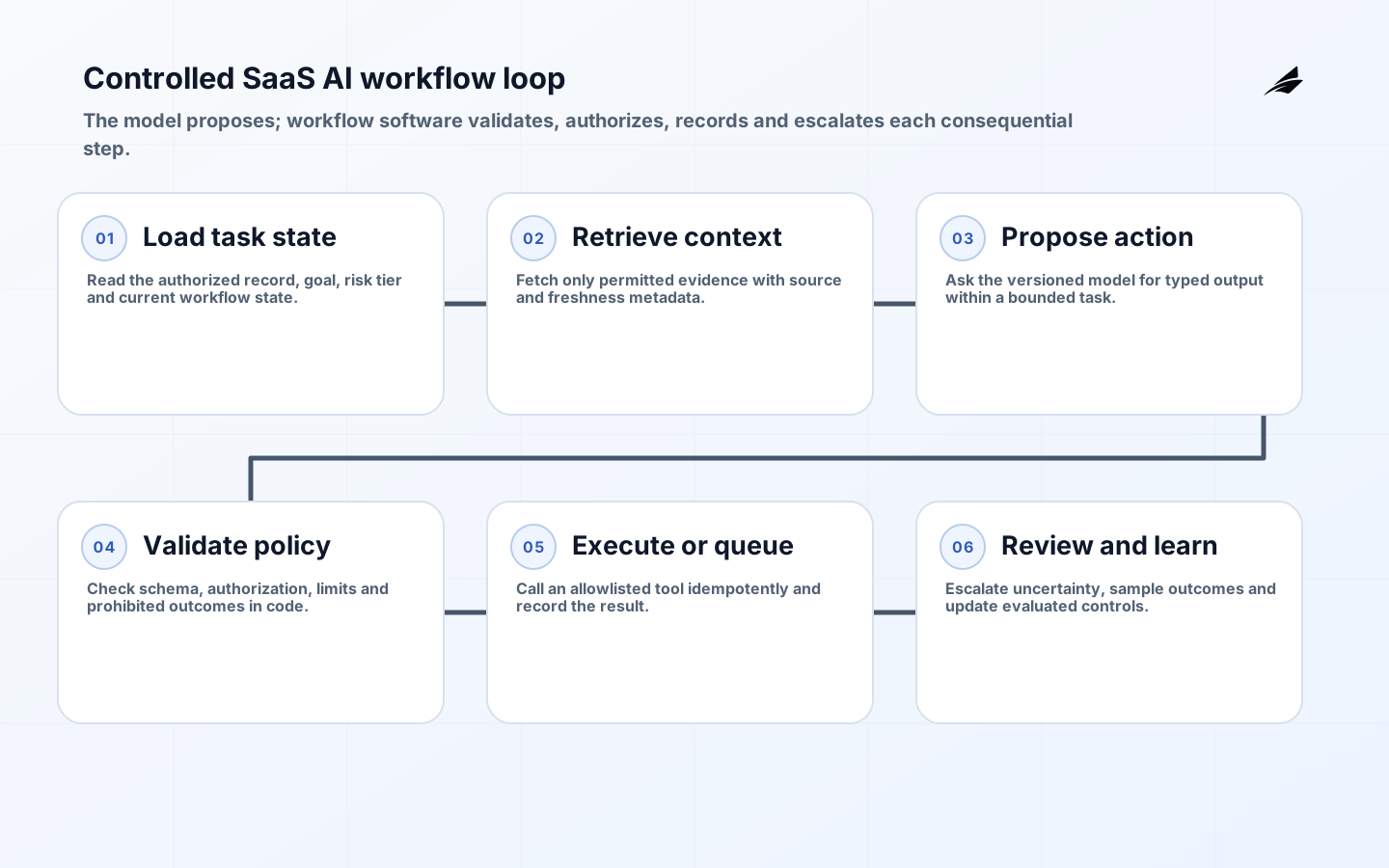
AI workflow automation services for SaaS companies combine deterministic software, enterprise data, models and human decisions to complete bounded work. The model should not become the workflow. A dependable design keeps state, permissions, validations, retries and audit evidence in ordinary software while using the model for tasks where probabilistic interpretation adds value. This FAQ addresses the questions product, operations, security and engineering teams should settle before an assistant, classifier or agent can affect customers or business records.
The guidance complements the AI automation delivery plan and implementation checklist. NIST’s AI RMF frames work through Govern, Map, Measure and Manage; its generative AI profile adds risks and actions specific to generative systems. Those resources support a risk-based approach, but each SaaS company still needs use-case evidence, legal review where applicable and an operating owner.
What is a good first AI workflow?
Choose a high-volume task with visible inputs, a defined acceptable output and a safe correction path. Examples include drafting a support response for approval, classifying an inbound request, extracting fields from a known document type or proposing the next step in a controlled queue. Avoid beginning with a vague mandate to “run operations.” Write the current baseline for time, accuracy, rework and escalation, then state what the system may recommend, what it may execute and what it must never do.
Map the workflow as states and transitions. Identify the authoritative record, permitted tools, data classifications, timeout behavior, duplicate protection and human checkpoints. A model response is untrusted input even when it comes from a reputable provider. Validate structure and business rules before using it, and re-check authorization when an action executes. This makes the workflow testable independently of a specific prompt or model version.
| Automation class | Suitable action | Required control |
|---|---|---|
| Assist | Draft, summarize or retrieve | User reviews before use |
| Recommend | Rank or propose a next step | Evidence and reason shown |
| Execute bounded | Update an allowed low-impact field | Policy validation and rollback |
| Escalate | Route uncertain or consequential cases | Named queue and response target |
| Prohibited | Irreversible or unowned high-impact action | Technical denial, not prompt wording |
How should accuracy and quality be evaluated?
Build an evaluation set from representative work, difficult edge cases and known failure modes. Preserve the expected decision, acceptable variation and harm if wrong. Measure task-specific outcomes such as extraction correctness, groundedness, policy compliance, escalation precision, user acceptance and downstream rework. A single average score can conceal severe failures in a small but important group. Segment results by language, customer type, document quality, workflow stage and risk tier where those dimensions matter.
Run evaluations when the model, prompt, retrieval corpus, tool contract or policy changes. Add production sampling with privacy-appropriate review and a route for users to challenge outcomes. Evaluation is not only model testing: verify retrieval permissions, stale records, tool side effects, latency, cost and failure recovery. Record versions and inputs sufficiently to reproduce a disputed result without retaining sensitive content longer than necessary.
Where should human approval remain?
Place approval where consequences are material, ambiguity is high or policy requires accountable judgment. The reviewer needs the proposed action, source evidence, affected record, uncertainty, policy checks and alternatives. A button labeled approve is not meaningful if the person cannot inspect context or correct the result. Define timeout and reassignment behavior so approval queues do not silently stop the business process.
Use thresholds as routing aids rather than proof of correctness. High-confidence cases can still be wrong, and model confidence may not be calibrated to the business outcome. Combine deterministic rules, risk tier, novelty, data sensitivity and evaluation evidence. Sample automated cases even after performance stabilizes. When overrides recur, treat them as product evidence: improve data, policy, interface or workflow rather than asking reviewers to absorb permanent defects.
How are prompt injection and tool misuse controlled?
Assume external text may contain instructions designed to redirect the model. Separate instructions from retrieved content, label provenance, minimize tool permissions and validate every tool call outside the model. Use allowlisted operations with typed arguments, server-side authorization, transaction limits and idempotency. Do not give a general-purpose agent a broad production credential. OWASP’s LLM guidance is useful for threat identification, while NIST SSDF provides the surrounding secure development and vulnerability-response discipline.
Protect secrets and personal data across prompts, logs, traces, caches and vendor boundaries. Decide which fields may leave the service boundary, apply minimization or redaction, and understand provider retention and training settings. Filter outputs for data leakage only as one layer; upstream authorization and retrieval scoping are stronger controls. Test indirect injection in documents and web content, excessive tool use, denial of wallet, cross-tenant retrieval and attempts to bypass approval.
How should integrations and failures behave?
Wrap each external system in a narrow adapter that exposes business operations rather than arbitrary queries. Specify input schema, authorization, timeout, retry class, rate limit, idempotency and observable outcome. Persist workflow state outside the model so processing can resume after a crash or vendor outage. Use queues for work that can complete asynchronously, dead-letter handling for exhausted retries and reconciliation for any action whose response is uncertain.

Design a degraded mode before launch. Retrieval may be unavailable while the core SaaS product remains healthy; a model may be slow while a user can complete the task manually. Decide whether to fall back, queue, disable or escalate based on consequence. Make the state visible to users and support teams. A silent lower-quality fallback can be more harmful than a clear pause because it changes behavior without changing expectations.
What should be logged and monitored?
Observe the business workflow and the AI components together. Track completion, rejection, escalation, correction, latency, token or provider cost, retrieval quality, tool errors and policy denials. Correlate model calls, retrieval, tool execution and final state with a workflow identifier. OpenTelemetry can carry traces, metrics and logs, but avoid high-cardinality or sensitive attributes. Store model and prompt versions as controlled metadata rather than copying entire private conversations into general logs.
Create alerts for conditions requiring timely action: a surge in failed tools, cross-tenant authorization denial, queue age, provider outage or safety-policy breach. Review drift and quality on a slower cadence using sampled outcomes. Give each metric an owner and decision rule. Cost monitoring should include retries, long contexts, retrieval and reviewer time; a cheap model call can support an expensive workflow if it creates repeated correction.
| Evidence | Question answered | Review cadence |
|---|---|---|
| Offline evaluation | Can the version handle representative and adversarial cases? | Before material changes |
| Production sample | Are real outcomes useful and policy-compliant? | Risk-based recurring review |
| Workflow telemetry | Where do delay, failure and escalation occur? | Continuous and weekly |
| Access record | Which identity retrieved data or executed a tool? | Continuous and audit review |
| Cost allocation | What does a successful unit of work cost? | Monthly or release review |
Can the workflow depend on one model provider?
It can, if the dependency is understood and acceptable. Document model identifiers, contractual data terms, regional needs, quotas, latency, deprecation, content-policy effects and incident communication. Keep business state and tool contracts outside provider-specific conversation objects. A portability layer is valuable when requirements justify it, but lowest-common-denominator abstraction can hide useful capabilities. Test the fallback that the service actually intends to use rather than claiming theoretical multi-provider support.
Key takeaways
- Keep workflow state, permissions and side-effect controls outside the model.
- Evaluate complete tasks and harmful edge cases, not only text quality.
- Use human review where consequence or ambiguity demands accountable judgment.
- Treat retrieved content and model output as untrusted input.
- Measure outcomes, corrections, failures and unit cost in production.
Frequently asked questions
Does every automation need an AI agent?
No. Deterministic rules, forms and workflow engines are better when inputs and decisions are explicit. Use an agentic loop only when choosing among bounded actions from changing context provides value, and retain a maximum-step limit, tool allowlist and stop conditions.
How is return on investment measured?
Compare the full baseline and future workflow: throughput, cycle time, error, rework, escalation, customer outcome, model cost, integration cost and reviewer effort. Attribute benefits only after a stable observation period and keep safety or compliance guardrails alongside financial measures.
Must customer data be used to train a model?
Usually not. Inference, retrieval and model training are different data uses. Select the minimum needed for the task, configure provider controls, document retention and obtain appropriate authority before any training or evaluation use. Provide deletion and access processes where required.
Treat prompt, model, retrieval collection and tool contract as separately versioned dependencies. A release note should identify which changed, which evaluations ran and what rollback means. This prevents a provider update or corpus refresh from changing production behavior without the same scrutiny applied to application code.
Plan decommissioning at launch. Define how queued tasks finish, how stored prompts or outputs are retained or deleted, how tool credentials are revoked and how users return to a manual workflow. Keep enough version and decision evidence to explain historical actions after a model is unavailable. A safe exit test prevents a promising experiment from becoming an undocumented permanent dependency.
Set a maximum autonomous duration, step count and spending limit for every run. When a limit is reached, preserve state and route the task to a named queue instead of asking the model to keep trying. This bounds cost and prevents loops from becoming invisible operational incidents.
Conclusion
A production AI workflow is an accountable software system with a probabilistic component. Bound the use case, validate every action, preserve human authority where it matters and instrument the entire path. When evaluation, security, failure handling and ownership are designed together, AI can reduce repetitive work without making the SaaS product’s decisions opaque or its operations fragile.