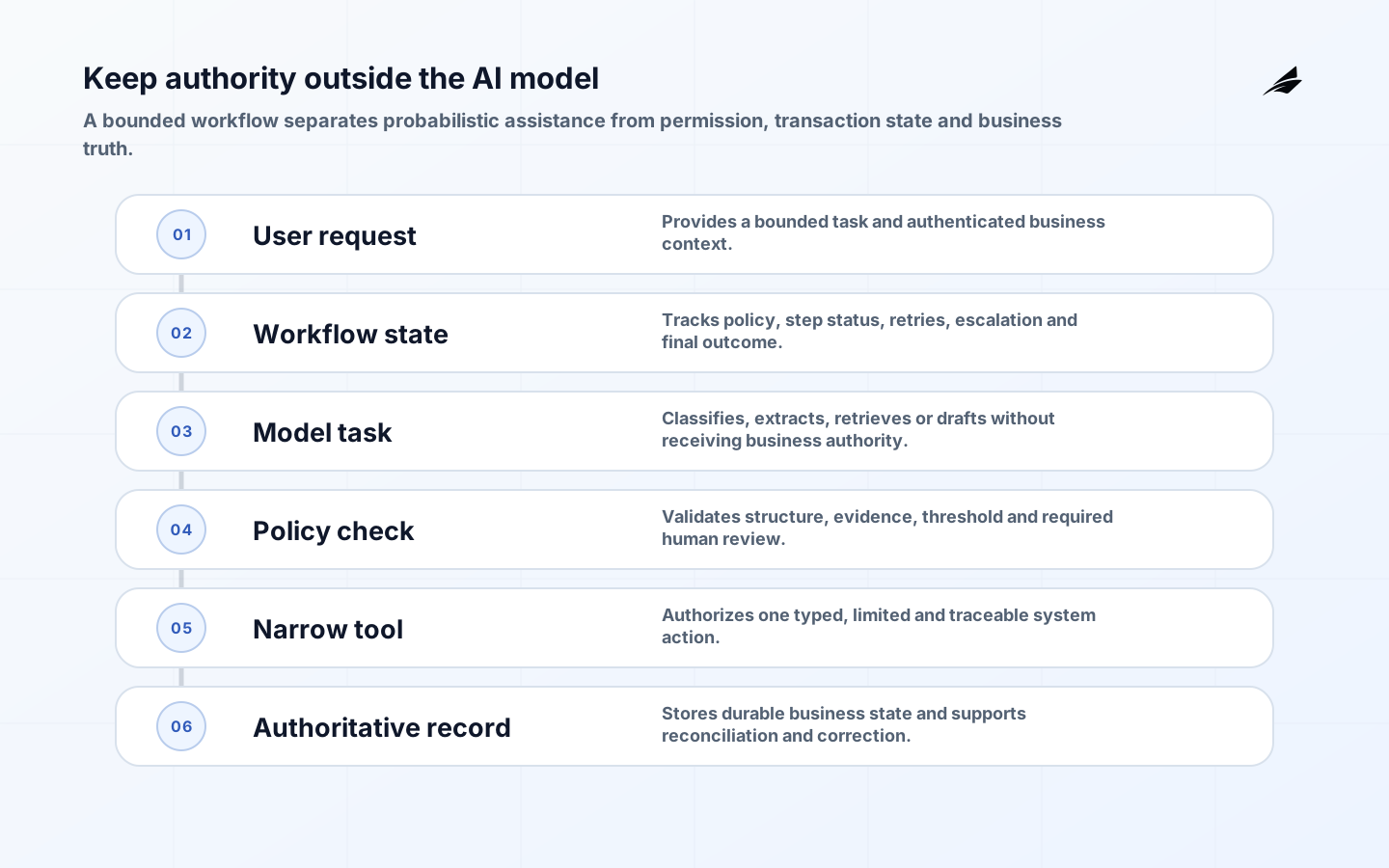
AI workflow automation combines a probabilistic model with deterministic software, enterprise records and human decisions. It can classify an incoming request, extract fields, draft a response, retrieve approved knowledge or recommend a route. It should not be treated as a free-standing employee. The surrounding workflow must define authority, data access, validation, exception handling, monitoring and accountability.
These questions help enterprise teams separate a useful assisted workflow from an uncontrolled demonstration. NIST's AI Risk Management Framework is voluntary and context-driven: Govern, Map, Measure and Manage work together. That is an appropriate posture because the same model behavior can have very different consequences in internal summarization, customer communication or a decision affecting rights and access.
Frequently asked questions
Questions about use-case fit
What is AI workflow automation?
It is a designed sequence in which an AI capability performs a bounded task within a business process and other components control records and actions. A model might propose a category, while a workflow engine validates required fields, applies policy, asks for human review and records the final decision. This division matters: fluent output is not evidence of truth, permission or transaction success.
Which tasks are good starting points?
Prefer high-volume, reviewable tasks with clear inputs, observable outcomes and a practical fallback. Examples include classifying service requests, extracting candidate fields from standard documents, finding relevant approved guidance or drafting text for an authorized reviewer. Start where an error is detectable and recoverable. Avoid choosing a use case solely because a model demo looks impressive.
Which workflows need greater caution or a different approach?
Use greater assurance where output can materially affect safety, employment, finance, eligibility, legal position, essential services or sensitive disclosure. Applicable law and sector rules may constrain or prohibit particular uses. Deterministic rules may be superior when the requirement is stable and exact. If the enterprise cannot define acceptable error, responsible authority or a fallback, the workflow is not ready for automation.
| Use-case trait | Favors an early pilot | Calls for caution |
|---|---|---|
| Consequence | Low and reversible | Material or difficult to remedy |
| Review | Output can be checked before action | Error may remain invisible |
| Ground truth | Representative labeled cases exist | Correctness is subjective or delayed |
| Data | Approved, bounded and understood | Sensitive, uncertain provenance or excessive |
| Fallback | Current process can continue | Automation becomes a single point of failure |
Questions about workflow design
Does every AI workflow need a human in the loop?

Not every output requires item-by-item review, but every workflow needs accountable human governance. Choose review based on consequence, uncertainty and detectability. Options include review before action, review only below a confidence or policy threshold, sampling after action, or automated validation with human escalation. Define what the reviewer can see, how disagreement is recorded and whether workload makes genuine review possible.
Can the model update enterprise systems directly?
A model should not receive broad authority merely for convenience. Put actions behind narrow, typed tools or APIs that authenticate the calling service, authorize the specific action, validate parameters and enforce business state. High-consequence or irreversible actions may require approval. Use idempotency and durable transaction status so retries do not duplicate work. The system of record, not the model conversation, remains authoritative.
Does retrieval eliminate inaccurate answers?
No. Retrieval can provide relevant approved material, but the system can retrieve the wrong passage, omit context or generate an unsupported conclusion. Govern document sources, permissions, versions and freshness. Evaluate retrieval and generation separately, require citations where reviewers need them, and design a no-answer path. A confident response should never override missing evidence.
Are autonomous agents necessary for workflow automation?
Usually not for an initial enterprise release. A bounded sequence with explicit steps, tools and stop conditions is easier to test and audit. More autonomy increases the possible action paths and makes permissions, cost, looping, recovery and evaluation harder. Add planning freedom only where evidence shows it improves the outcome enough to justify the expanded control surface.
| Component | Should own | Should not be trusted to infer |
|---|---|---|
| Model | Classification, extraction, drafting or recommendation | Identity, permission or transaction completion |
| Workflow service | State, routing, thresholds, retries and escalation | Business authority not encoded in policy |
| Tool/API | Validated narrow action and durable result | Intent from unconstrained text alone |
| System of record | Authoritative business state | Model confidence |
| Human owner | Policy, exceptions, risk acceptance and improvement | Perfect review under impossible workload |
Questions about data, privacy and security
What data diligence is required?
Inventory prompt inputs, retrieved sources, model outputs, feedback, logs and downstream records. For each, define purpose, classification, legal basis where applicable, access, retention, location, provider handling and deletion. Minimize before sending data to a model. Confirm current service terms and technical settings rather than assuming prompts are not stored or used. NIST's Privacy Framework can help connect data processing to organizational privacy risk.
What is prompt injection and why does it matter?
Prompt injection occurs when untrusted instructions influence model behavior, including instructions hidden in documents or retrieved content. Treat external content as data, not authority. Separate trusted instructions, restrict tools, filter and validate actions, enforce authorization outside the model and assume model-level defenses may fail. OWASP's LLM risk guidance and MITRE ATLAS provide useful threat categories for testing.
Are AI controls enough on their own?
No. The application still needs conventional secure engineering: protected source and build systems, dependency management, secrets, access control, logging, incident response and vulnerability handling. Apply NIST SSDF practices to the complete system. AI-specific evaluation complements rather than replaces application security testing and supplier diligence.
Questions about evaluation and monitoring
How should an enterprise evaluate an AI workflow?
Build a representative evaluation set from approved cases, including rare, ambiguous, multilingual, adversarial and policy-boundary examples where relevant. Define task measures and consequence-weighted error categories before testing. Evaluate the complete workflow, not only a model response: retrieval, policy, tool calls, human review, latency, cost and fallback all affect the outcome. Keep a holdout set and review leakage.
Can a confidence score decide when to automate?
Only after calibration against representative cases and consequences. A score may not mean probability of correctness, and it can shift when data, prompt, model or tools change. Thresholds are policy decisions informed by evidence. Monitor errors around the boundary and preserve an abstain or escalation route.
What should be monitored after launch?
Track workflow outcomes, error categories, overrides, abstentions, escalations, tool failures, unauthorized attempts, latency, usage and cost. Segment where lawful and useful to detect uneven performance. Monitor model, prompt, retrieval corpus, policy and tool versions. Review samples and incidents because aggregate accuracy can hide a severe recurring failure.
How should variable AI cost be controlled?
Model usage is only one cost. Include retrieval, storage, observability, evaluation, human review, security testing, support and fallback work. Set budgets and rate limits by workflow, monitor cost per completed acceptable outcome, and investigate loops or unusually large context. A cheaper model is not economical if it increases corrections or risk. Reassess architecture and caching only with privacy, freshness and quality controls intact, and require approval before a material supplier or pricing change alters the operating case.
| Measure | What it reveals | Possible response |
|---|---|---|
| Task error by consequence | Quality where mistakes matter | Adjust threshold, workflow or model |
| Human override | Disagreement and review burden | Improve guidance or retrain routing |
| Abstention and escalation | Boundary of automated coverage | Refine scope or preserve fallback |
| Tool failure and denial | Integration and security behavior | Repair contract or permissions |
| Unit usage and latency | Operational sustainability | Budget, cache or simplify safely |
| Incident pattern | Unexpected harm or abuse | Contain, investigate and update controls |
Questions about providers and rollout
What should an AI workflow services provider deliver?
Expect a use-case and risk assessment, workflow and data design, model and supplier decisions, threat model, evaluation plan and results, production controls, monitoring, runbooks, known limitations and transition artifacts. Clarify who approves model changes, investigates incidents, updates evaluation sets and pays variable service costs. Preserve enterprise access to prompts, code, configurations, evidence and records subject to contract.
How should a pilot be rolled out?
Use shadow mode or advisory output first where practical, then a defined cohort with limited permissions. Compare against the current process, sample outcomes and reconcile every system action. Set pause criteria for harmful errors, data exposure, control bypass or operational overload. A pilot succeeds when it resolves uncertainty, even if the decision is not to expand.
For example, a hypothetical internal service desk might let AI suggest a category and approved knowledge article while an agent retains dispatch authority. The workflow records suggestion, evidence and final choice. It cannot close tickets, reveal restricted articles or call administrative tools. The team evaluates misroutes, unsupported suggestions, review time and security tests before considering narrower auto-routing for low-consequence categories.
A practical rollout sequence
- Govern: assign owners, prohibited uses, risk criteria and supplier requirements.
- Map: document context, users, affected parties, data, authority and fallback.
- Measure: create evaluation cases, baselines, red-team scenarios and acceptance thresholds.
- Build: implement bounded tools, deterministic controls, telemetry and versioning.
- Pilot: use shadow or advisory mode, limited cohorts and explicit pause conditions.
- Manage: review evidence, incidents and changes; expand, constrain or retire deliberately.
Key takeaways
- Automate a bounded task inside an owned workflow, not an undefined job role.
- Keep authority, validation and transaction state outside the model.
- Evaluate complete workflows on representative and adversarial cases.
- Match human review, permissions and rollout to consequence and detectability.
- Version and monitor models, prompts, knowledge, policy, tools and outcomes together.
Conclusion
Enterprise AI workflow automation should make responsibility clearer, not more mysterious. Choose a recoverable task, preserve authoritative systems, constrain actions, minimize data and demand evaluation evidence before expanding. The goal is a useful workflow whose errors can be detected, contained and improved, with humans retaining the authority and information needed to govern it.