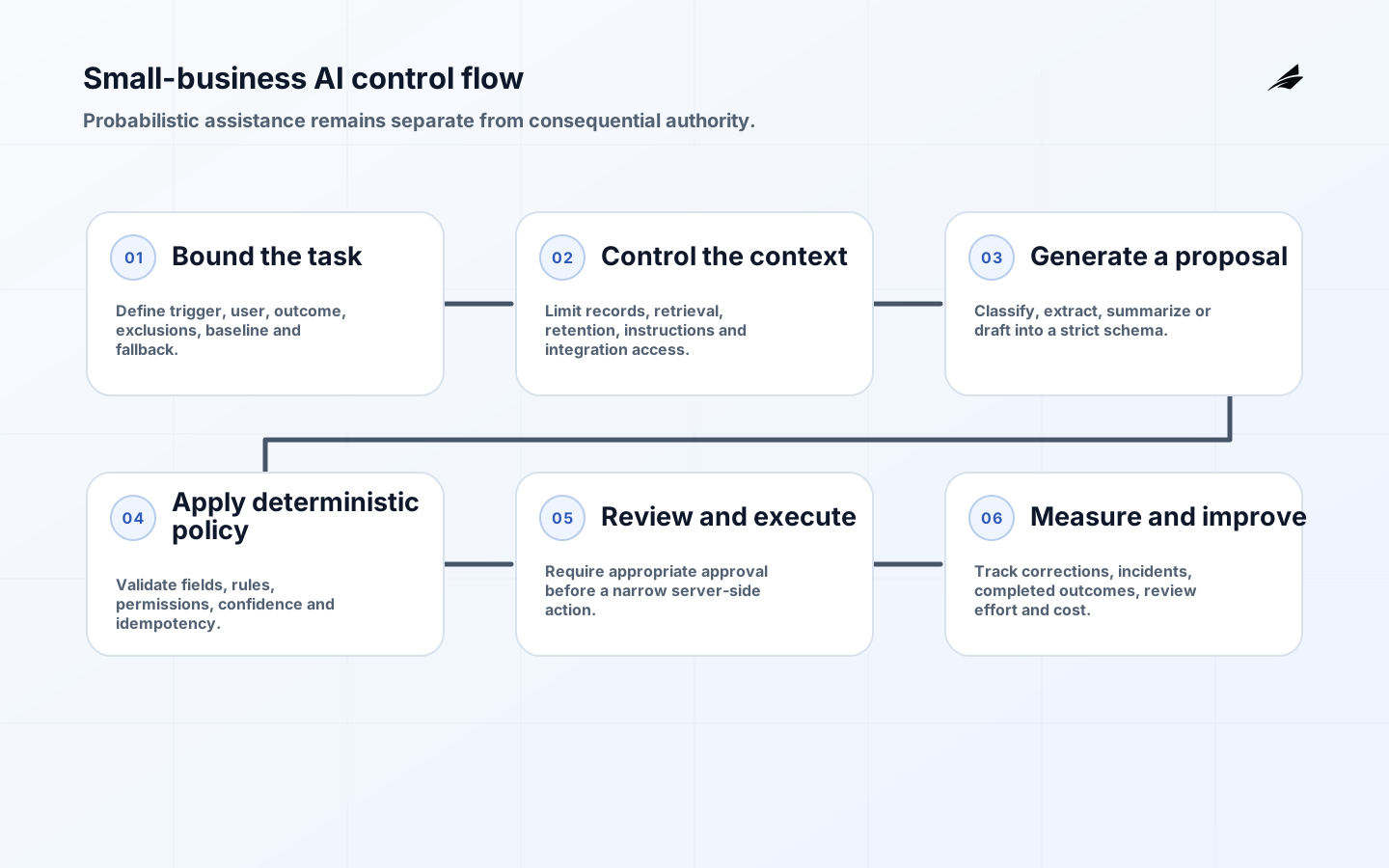
AI workflow automation services for small business can classify requests, extract fields, draft messages, summarize records and recommend next actions. They create value when a bounded task becomes faster or more consistent without giving an uncertain model inappropriate authority. The important design is the workflow around the model: approved data, deterministic rules, human review, system permissions, fallback and measurement. This FAQ explains how to choose and operate that design.
The small-business AI scope and cost guide and implementation checklist support a live project. Earlier-stage teams can compare the startup AI workflow delivery plan and startup implementation checklist.
Which workflows are good first candidates?
Start with a frequent, text- or document-heavy task that has clear inputs, a reviewable output and a measurable baseline. Examples include routing a shared inbox, extracting invoice fields, drafting a response from approved policy or summarizing a service case. Avoid first automating decisions that determine employment, credit, medical care, legal rights or irreversible financial action. Consequence, not novelty, should determine oversight.
Write the task as a contract: trigger, authorized user, allowed records, expected output, prohibited action, review owner, completion state and fallback. Measure current volume, handling time, wait time, error, rework and customer outcome. The NIST AI Risk Management Framework organizes work through Govern, Map, Measure and Manage. Use those functions continuously rather than treating them as a one-time checklist.
| Candidate task | Suitable AI role | Authority boundary |
|---|---|---|
| Inbox triage | Classify and propose queue | Rules or reviewer performs routing when consequence is material |
| Invoice intake | Extract fields and flag differences | Accounting system validates and approver releases payment |
| Customer response | Draft from approved sources | Employee reviews and sends sensitive or exceptional cases |
| Meeting follow-up | Summarize and propose actions | Named owner confirms commitments and dates |
| Lead enrichment | Summarize permitted business information | Sales policy controls contact, retention and suppression |
How should an AI workflow be controlled?
Separate probabilistic proposal from deterministic execution. The model may classify, extract or draft into a strict schema. Application code then validates required fields, types, totals, allowed values and business rules. A policy layer determines whether human approval is required. Only a narrow server-side identity performs the authorized action. The model should never decide its own permissions or construct unrestricted calls from generated text.

Make actions idempotent so retries do not send duplicate messages or create duplicate records. Use a business key, action status and concurrency guard. Record source references, model and instruction version, validation, approval, final action and correction. Provide a manual queue when the model, source or dependency is unavailable. Users need a clear way to reject, edit and report a problematic proposal.
What data and privacy questions matter?
Inventory every input and destination: inboxes, files, CRM, accounting, support, model provider and logs. Identify owner, sensitivity, permission, retention, region and deletion process. Minimize the fields supplied to the model. Mask direct identifiers in testing, prevent secrets from entering prompts and restrict retrieval by the user's actual access. Logs should not become an uncontrolled duplicate of customer documents.
The NIST Privacy Framework treats privacy as enterprise risk management rather than only data security. Consider whether collection, inference, use or disclosure can create adverse effects for people. Tell staff and customers what is material to their interaction, preserve correction and deletion processes, and obtain qualified advice for applicable law. Vendor promises do not replace the business's own data responsibilities.
How is workflow quality evaluated?
Build a representative evaluation set from permitted historical or synthetic cases. Include routine, ambiguous, incomplete, multilingual, malformed and high-consequence examples. Keep it separate from prompt tuning. Choose metrics from error cost: precision when false matches are expensive, recall when missed cases matter, field accuracy for extraction, groundedness for answers and review time for usability. Report critical errors separately from an average score.
The NIST Generative AI Profile describes risks including confabulation, information integrity, privacy, security and human-AI configuration. Test instructions hidden in retrieved documents, unsupported claims, sensitive disclosure and attempts to invoke tools. Human review must be tested too. Reviewers need source context, time, authority and a UI that makes material differences visible rather than encouraging automatic approval.
| Release gate | Evidence | Example threshold |
|---|---|---|
| Use-case fit | Baseline and bounded decision contract | Named owner accepts exclusions and fallback |
| Data readiness | Source authority, access and retention tests | No unauthorized record appears in retrieval |
| Quality | Versioned evaluation by failure class | Zero unresolved critical action errors |
| Workflow control | Schema, policy, approval and idempotency tests | Unauthorized and duplicate actions are blocked |
| Operations | Monitoring, support and rollback drill | Team disables the feature within its objective |
| Value | Time, rework, outcome and total cost | Measured benefit persists after review effort |
What security controls are proportionate?
Apply normal application security to the complete workflow. The NIST Secure Software Development Framework covers protected code, secure production and vulnerability response. Protect repositories and automation, scan dependencies, isolate secrets, patch integrations and restrict administrative access. Use separate development and production accounts. Review plugins, model tools and external connectors as code with data and action authority.
Use the NIST Cybersecurity Framework 2.0 to assign governance, assets, protection, detection, response and recovery. A small business can implement this simply: named owner, system inventory, multifactor access, backups, useful logs, incident contacts and a tested disable switch. Decide how to revoke vendor access, rotate integration credentials and export required records if the service closes or changes terms.
How should a small business select a vendor?
Ask the actual delivery team to demonstrate one workflow with your representative cases. Inspect architecture, permissions, evaluation, logs, fallback and support. Clarify where data is processed, whether it trains shared models, retention, subprocessors, regions, encryption, incident notification, model-change notice and deletion. Confirm ownership of prompts, code, connectors, evaluation cases and generated records. Ensure the business can export and continue manually.
Avoid buying a generic automation count. Define which processes, integrations, environments, evaluation rounds, training and support are included. Fixed price fits a bounded pilot; time and materials fits uncertain integration; a managed fee can cover operation and improvement. Price model usage, automation runs, storage, connector tiers, implementation, internal review, exceptions and exit. A cheap model can be expensive when poor outputs create rework.
How should rollout and monitoring work?
Begin in shadow mode, where proposals do not change records. Compare them with normal handling and refine the evaluation. Then release to a small trained group with mandatory review. Expand by task class only when critical errors, correction and value meet threshold. Version prompts, model, retrieval, rules and integrations together. A model update is a production change that requires regression tests, cohort exposure and rollback.
Monitor queue age, dependency failure, model latency, parse failure, policy rejection, human correction, override, critical error, completed outcome and cost per case. Sample quality with privacy-aware review and investigate shifts by source or case type. Review whether users are bypassing the workflow or over-trusting it. Keep an incident path for harmful output, unintended disclosure and unauthorized action. Retain evidence proportional to risk and legal need.
Implementation example: invoice exception intake
A 35-person distributor receives invoices through email. AI extracts supplier, invoice number, purchase order, amount and bank-detail-change signal. The workflow is advisory: it cannot change supplier records, approve payment or post to the ledger. Server-side rules verify totals, duplicates and supplier identity. Missing purchase orders and any bank change go to a senior reviewer with source image and system record side by side.
The evaluation includes credit notes, duplicates, tax differences, poor scans and documents containing instructions aimed at the model. Shadow mode measures field correction and review time. A unique invoice key prevents duplicate creation, and unavailable source systems send work to the old queue. Production monitoring separates routine extraction from critical misses. The business expands only after the team demonstrates credential revocation, feature disable and recovery of pending cases. The result saves entry time without delegating financial authority.
Key takeaways
- Start with a bounded, frequent and reviewable workflow tied to a measured baseline.
- Keep model proposals separate from deterministic policy, permission and execution.
- Minimize data and preserve access, correction, retention and deletion controls.
- Evaluate representative failure classes and the effectiveness of human review.
- Roll out from shadow mode with versioned components, fallback and rollback.
- Measure completed outcomes, exceptions, rework, operational user impact and staff confidence alongside model quality, review effort and service cost.
Additional small-business AI automation FAQ
Do we need to train a model? Usually not for a first workflow. Start with an existing model, clear instructions, retrieval from approved sources and evaluation. Fine-tuning is justified only by measured need and maintainable data.
Can AI send customer emails automatically? It can for narrow, low-consequence templates after validation and monitoring. Sensitive, novel, contractual or complaint responses should receive appropriate review.
How quickly can a pilot launch? A narrow workflow can be tested in weeks when access and examples are ready. Integration, policy, evaluation and staff availability usually determine duration more than model setup.
Who owns an AI error? The business remains accountable for the workflow it deploys. Assign owners for product, data, review, security and incident response, and define vendor obligations contractually.
Conclusion
Small-business AI automation should earn authority through evidence. Select one useful task, control its context, evaluate important errors, keep consequential actions behind policy and review, and release gradually. Recheck the business case after model fees, review effort, exception handling and support are measured in normal operation. Train users on the workflow boundary, not on trusting polished language, and keep the manual route usable during outages or disputed results. Review permissions and retained data whenever a connector, model or process owner changes. A modest workflow that staff can understand, stop and improve is more valuable than broad automation whose decisions and data paths nobody can explain.