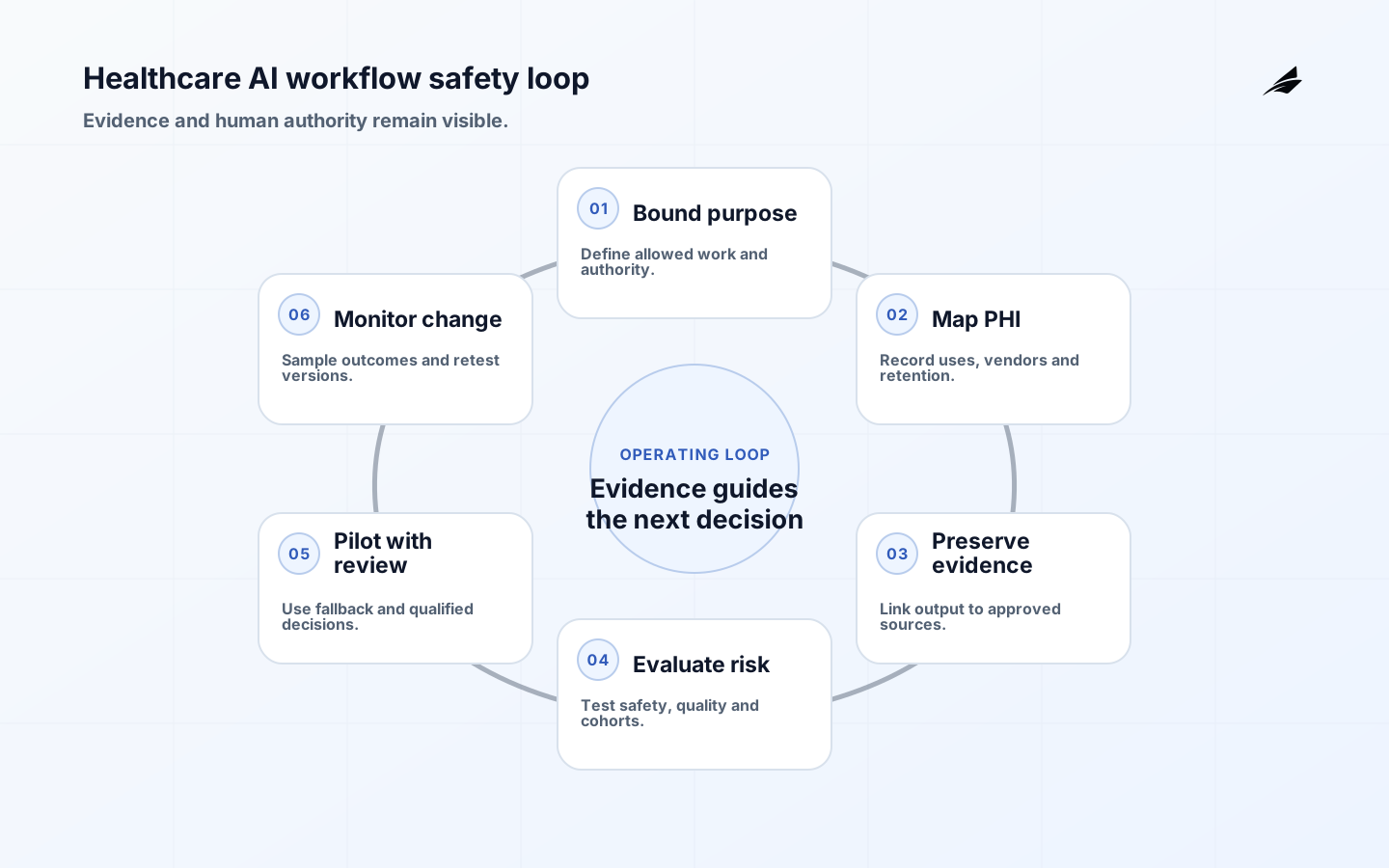
AI workflow automation for healthcare should begin with a bounded work problem and explicit human authority. Good candidates include referral intake, prior-authorization packet preparation, coding assistance, appointment exception routing, document classification and drafting responses for review. The objective is not to make a model 'practice medicine.' It is to reduce delay and repetitive handling while preserving clinical judgment, patient rights, privacy, security and a reliable record. A defensible service defines what the system may read, infer, recommend and change, plus when it must stop and route work to a qualified person.
This guide is for provider, payer and healthcare operations teams evaluating a delivery partner or internal program. The companion healthcare AI workflow checklist supports implementation, while the healthcare automation FAQ covers common governance questions. Requirements vary by organization, activity, jurisdiction and product classification. Engage privacy, security, clinical safety, compliance and legal owners early; no technology label makes a workflow compliant or clinically appropriate.
1. Choose a workflow where assistance can be bounded
Observe the current journey with front-line staff. Record triggers, inputs, queues, decisions, exceptions, turnaround, rework and systems updated. Separate deterministic rules from language tasks and professional judgment. A narrow first use case should have frequent work, identifiable source evidence, reversible output and an owner able to review errors. Avoid starting with autonomous diagnosis, treatment or denial decisions when the organization has not yet proved governance, evaluation and incident handling on lower-impact assistance.

Write allowed and prohibited actions. An intake assistant may classify a document, extract fields with evidence and draft a task, but it should not invent missing clinical facts or close an ambiguous referral. Define the user who accepts output, the authoritative record, the timeout and fallback. The startup healthcare automation delivery plan shows a smaller operating model; healthcare enterprises usually need deeper integration and role governance.
| Workflow decision | Question | Acceptance evidence |
|---|---|---|
| Purpose | Which delay, error or workload should improve? | Baseline and target by cohort |
| Authority | What may AI prepare, recommend or execute? | Action policy and human decision rights |
| Evidence | Which source supports every material output? | Field-level citation or linked record |
| Exception | When must work stop or escalate? | Tested route with service target |
| Record | What becomes part of the designated record? | Approved write and correction process |
| Fallback | How does work continue during degradation? | Exercised manual path |
2. Map PHI, vendors and permitted use
Create a data-flow map for prompts, retrieved records, model inputs and outputs, traces, feedback, evaluation sets, caches and support access. HHS cloud guidance states that a cloud provider creating, receiving, maintaining or transmitting ePHI on behalf of a covered entity or business associate is a business associate even when it lacks the decryption key. Determine roles and execute appropriate agreements before PHI enters a service; encryption alone does not settle use, integrity, availability or breach duties.
Apply minimum-necessary access, purpose limitation, retention and deletion to each data path. Separate development from production and use de-identified or synthetic data where it can test the behavior faithfully. Restrict vendor and support access, log it and address subcontractors. HHS business associate guidance explains written assurances and permitted uses. Contract terms should address model training, secondary use, data location, incident notification, return, deletion and patient-access support as applicable.
3. Design an evidence-preserving architecture
Keep workflow state outside the model. An orchestrator should retrieve authorized context, call versioned models and tools, validate structured output, enforce action policy and write an attributable record. Use user and workload identity rather than shared credentials. Tool permissions must be narrower than the agent's conversational scope. Separate read, draft and execute capabilities; high-impact writes require deterministic checks and appropriate approval. Store source references, model and prompt versions, tool outcomes and reviewer disposition without logging unnecessary PHI.
Use established interoperability contracts rather than scraping screens where practical. HL7's FHIR workflow guidance describes resources for definitions, requests and events and notes that FHIR does not impose one workflow architecture. Map status and identifiers carefully, preserve provenance and handle duplicate or late events. Integration success is not merely an HTTP response: the receiving system must reach the intended business state, and reconciliation must expose conflicts.
4. Evaluate quality, safety and human factors
Build an evaluation set from representative normal, rare and adversarial cases, with privacy-approved handling. Score extraction or classification against labeled truth, but also measure unsupported statements, missing evidence, dangerous omissions, calibration, subgroup behavior, reviewer agreement and exception routing. NIST's AI RMF organizes risk work through Govern, Map, Measure and Manage. It is voluntary guidance, not a certification; use it to make context, testing and treatment decisions visible.
Test the full sociotechnical workflow. Reviewers need enough evidence and time to make a real decision, not a preselected approval button. Measure automation bias, correction effort and whether output presentation obscures uncertainty. ONC's HTI-1 materials describe algorithm-transparency requirements for predictive decision support in certified health IT. Applicability depends on the product and role, but the underlying procurement questions are broadly useful: intended use, data, validation, performance, update and risk-management information.
| Evaluation dimension | Measure | Release question |
|---|---|---|
| Task quality | Precision, recall, field accuracy or groundedness | Does output meet the stated purpose? |
| Safety | Harmful omission, unsupported action and escalation miss | Are consequential failures contained? |
| Equity | Performance by relevant cohort and site | Does aggregate performance hide disparity? |
| Human use | Review time, override, acceptance and correction | Can staff judge output effectively? |
| Operation | Latency, availability, cost and fallback use | Can the service be supported? |
| Control | Unauthorized action and data-boundary tests | Do policy boundaries hold? |
5. Model cost across delivery and oversight
Estimate discovery, integration, privacy and security work, labeling, evaluation, workflow design, training, change support and monitoring separately from model consumption. Runtime cost depends on volume, context size, model choice, retrieval, retries and retention, but human review and exception work may dominate. Compare cost per completed, quality-accepted case with the current baseline. Include vendor minimums, network and data services, observability, incident work and future model or interface changes.
Use ranges tied to assumptions: monthly cases, pages per case, percentage requiring review, average review minutes and escalation rate. Pilot data should replace estimates before broad commitment. Savings cannot be claimed from theoretical minutes if staffing, queue or quality does not change. Track displaced work and new work, including corrections and patient or clinician inquiries. The manufacturing AI workflow guide offers a useful contrast: both require controlled automation, but healthcare privacy, safety and record obligations shape different acceptance evidence.
6. Deliver through evidence gates
Stage work through observed baseline, governed prototype, offline evaluation, shadow operation, limited pilot and controlled expansion. Shadow mode compares output without influencing care or operations. The NIST AI RMF Core makes risk management continuous across the lifecycle; use each gate to revisit context and measured risk. A pilot should include difficult cases, support hours and rollback. Require approved data flows, acceptable evaluation by cohort, tested permissions, reliable integration, usable review, incident procedures and measured economics.
Monitor source drift, input mix, output quality samples, reviewer override, exception age, security events, latency and cost. Version prompts, retrieval configuration, models and decision rules. A material update should trigger proportionate regression evaluation and change approval. Provide a kill switch that stops automated writes while preserving manual work. Incident review should determine whether to correct data, instructions, integration, policy, training or scope rather than defaulting to another prompt edit.
Change management must account for patient and workforce experience. Explain the system's purpose, limitations, data use and escalation path in language appropriate to each audience. Train reviewers with known failure cases and observe whether the interface encourages thoughtful review or rapid acceptance. Provide a route to report incorrect records and harmful behavior, then connect those reports to correction and evaluation. Adoption is not measured by the percentage of staff clicking the feature; it is measured by completed work, safe overrides, understandable decisions and sustained quality under normal staffing pressure.
Key takeaways
- Choose a bounded workflow with reversible output, source evidence and an accountable reviewer.
- Map every PHI flow, vendor role, permitted use, retention path and support access.
- Keep workflow state and action policy outside the model, with narrowly scoped tools.
- Evaluate safety, subgroup behavior, human use and operations alongside task accuracy.
- Model human review and integration cost, not only model consumption.
- Expand through shadow and pilot evidence with fallback and change control.
Healthcare AI workflow automation FAQ
Must every vendor sign a BAA? Under HIPAA, a vendor that is a business associate needs an appropriate agreement; role depends on the activity and relationship. HHS guidance should be applied with privacy and legal owners. A vendor claim of 'no data retention' does not by itself settle status.
Can the model write directly to an EHR? Technically possible does not mean appropriate. Start with draft or queued actions. Any write should use scoped identity, schema validation, authorization, provenance, idempotency, correction and monitoring proportionate to consequence.
How much human review is enough? It depends on harm, reversibility, evidence and observed performance. Define review authority per action, sample lower-risk work after validation and retain full review where judgment or consequence requires it.
Does a successful pilot prove enterprise readiness? Only if it uses representative data, integrations, permissions, users, exceptions and support. A curated demo cannot establish safety, economics or operability across sites.
Conclusion
Healthcare automation succeeds when it improves a real queue without making authority, evidence or accountability vague. Scope one workflow, map PHI and vendor duties, build an evidence-preserving architecture, evaluate the whole human process and deliver through controlled gates. The result should let staff handle more work with clearer information and a safer exception path. If the organization cannot explain why an output was produced, who accepted it and how to stop it, the service is not ready to expand.