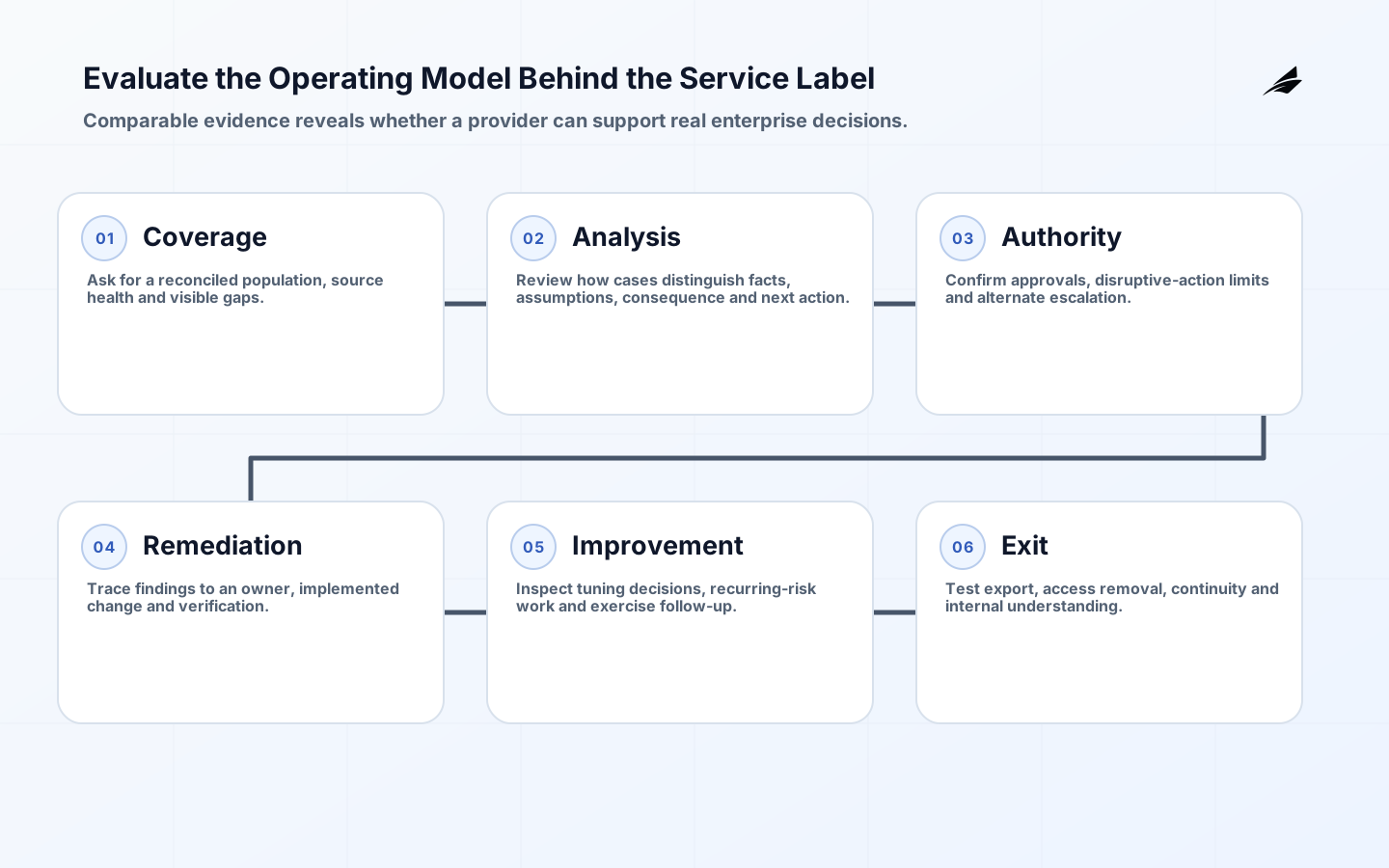
Enterprise cybersecurity services are easier to compare when buyers ask who owns decisions, what population is covered and what evidence proves the work. Labels such as managed detection, advisory, vulnerability management or zero trust can hide materially different services. This FAQ helps security, technology, procurement and business leaders examine the operating model behind the label. See the scope and delivery guide and implementation checklist for planning detail.
Key takeaways
- Buy defined outcomes and decision paths, not a list of products or broad capability labels.
- Keep enterprise authority for risk acceptance, disruptive action, incident command and business communication.
- Demand reconciled coverage and representative case evidence before relying on a recurring service.
- Evaluate quality, remediation and learning alongside service-level clocks.
- Plan data, content, access and continuity for exit before the service is mobilized.
What can enterprise cybersecurity services include?
The portfolio may include risk governance, architecture, identity, exposure management, application security, cloud and endpoint engineering, security monitoring, incident response, recovery assurance, testing and compliance support. Some are finite projects; others are recurring operations. A provider may deliver one component, coordinate several or operate a platform. The buyer should define each component through inputs, covered population, actions, outputs, authority and exclusions.
| Service | Useful outcome | Boundary to clarify |
|---|---|---|
| Advisory and governance | Risk decisions connect to business priorities | Whether advice includes implementation or assurance |
| Security engineering | Controls are designed and deployed safely | Systems, change authority and operating owner |
| Exposure management | Weaknesses are prioritized and verified | Discovery, remediation and exception responsibility |
| Monitoring and response | Events become coordinated decisions | Telemetry, hours, authority and incident command |
| Application security | Software delivery includes secure practices | Repositories, suppliers and release gates |
| Recovery assurance | Critical services restore with integrity | Objectives, systems, data and exercise scope |
What is the difference between consulting and managed service?
Consulting usually produces analysis, design, implementation or assurance over a defined period. A managed service performs recurring activities under an operating agreement. One engagement can contain both, but acceptance differs: a project is judged by agreed artifacts and implemented behavior; a service is judged by sustained coverage, case quality, response, remediation interfaces and improvement. Mixing them without separate scope makes transition work invisible.
Ask what happens after a recommendation. Does the provider implement, create a ticket, advise an internal team or verify completion? Who updates detection after an architecture change? Who owns a control after engineering? Every handoff needs a receiver, expected evidence and escalation path.
Can cybersecurity risk be outsourced?
Execution can be outsourced; enterprise accountability and consequence cannot. The organization still chooses risk appetite, prioritizes business services, accepts residual risk, authorizes disruptive action, handles legal and regulatory duties, and maintains continuity. NIST CSF 2.0 places governance at the center of cybersecurity risk management. Contracts allocate work and remedies, but do not make a provider the owner of the enterprise’s mission.
How should providers be evaluated?
Give candidates the same representative scenarios and scope assumptions. Ask how they establish coverage, handle missing telemetry, distinguish fact from hypothesis, obtain business context, escalate, support containment, verify remediation and learn from cases. Review anonymized deliverable structures and a sample case timeline. Confirm which named roles perform the work, specialist escalation, subcontractors and location of service data.
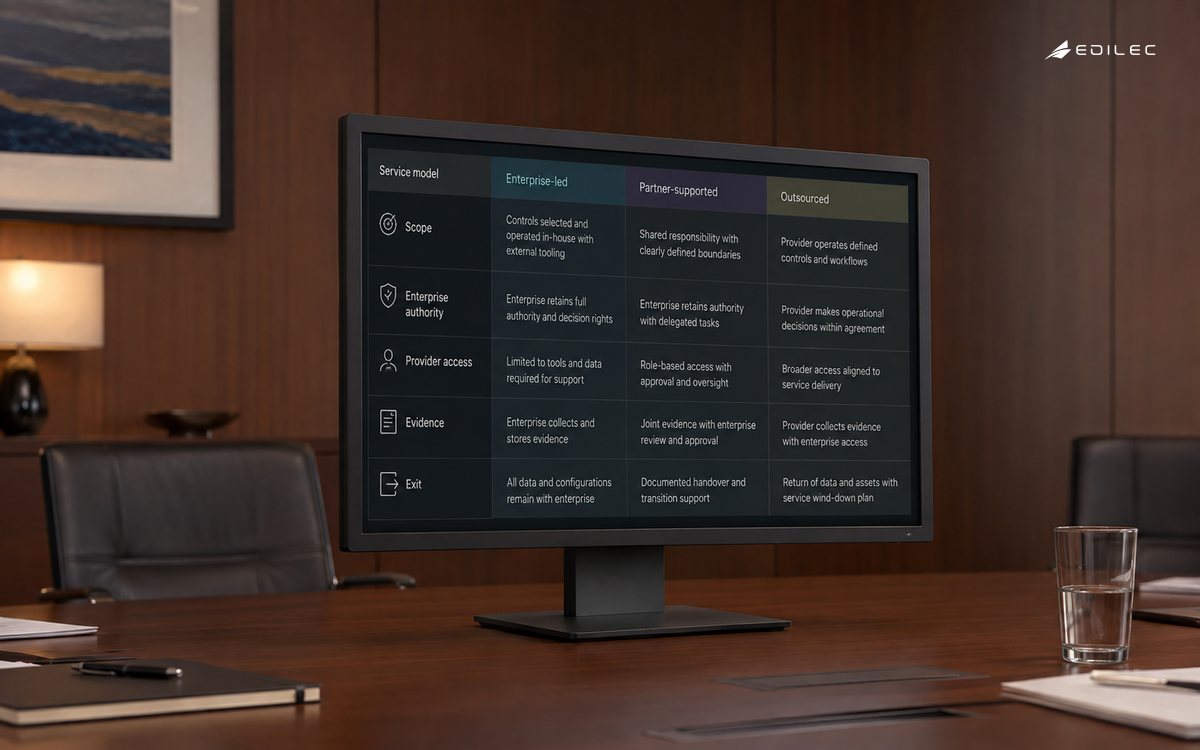
- Inspect service definitions, exclusions, dependencies and response-clock rules.
- Ask for connector health, asset reconciliation and case-quality methods.
- Review privileged access, support-channel security and provider incident notification.
- Test export of rules, queries, cases, architecture and reports.
- Check financial and operational terms with procurement and qualified counsel without treating contract review as technical assurance.
| Evaluation area | Strong evidence | Warning sign |
|---|---|---|
| Coverage | Population denominator and health monitoring | Licensed count presented as protected count |
| Analysis | Facts, assumptions, consequence and next action | Alert text forwarded without context |
| Authority | Named approvals and safe emergency path | Provider may act whenever necessary |
| Improvement | Tuning and recurring-risk backlog with owners | Success measured by alert volume |
| Exit | Documented formats, access removal and continuity | Custom content cannot be transferred |
What drives enterprise cybersecurity service cost?
Cost follows coverage, service hours, telemetry and storage, environment diversity, case demand, specialist depth, integrations, assurance, exercises and transition. Internal cost includes owner time, investigation context, remediation engineering, legal and privacy participation, tool overlap and supplier management. A lower service fee can be poor value if cases are unactionable or the enterprise must perform hidden triage.
Ask for assumptions, included volumes, treatment of incident surges, pass-through technology charges, rate or scope change triggers and exit assistance. Compare scenarios using the same coverage and quality definitions. Do not infer risk reduction from price, staffing count or a single response target.
Which service levels matter?
Acknowledgement and response clocks matter only when start, pause and stop rules are explicit. Pair time measures with coverage, source health, investigation quality, correct severity, containment decision, remediation verification and customer feedback. A fast acknowledgement of an alert from an unknown fraction of assets is weak evidence. Sample closed cases to inspect whether facts, authority and outcomes support the reported metric.
| Measure | Define precisely | Pair with |
|---|---|---|
| Coverage | Eligible population, reporting source and health threshold | Known gaps and owner |
| Acknowledgement | Start event, staffed hours and valid pauses | Case completeness |
| Decision time | Decision type and required authority | Correct severity and consequence |
| Remediation age | Risk basis, exception clock and closure | Verification evidence |
| Detection test | Scenario, expected source and pass condition | Learning action |
What access should a provider receive?
Provide the least privilege required for each service activity. Use named or federated identities, strong authentication, time-bounded elevation, approval, session evidence and periodic review. Separate routine analysis from engineering and emergency action. Inventory integration credentials and support accounts as carefully as human administrators. Test revocation and continuity before an incident.
Data scope matters as much as technical privilege. Security telemetry may contain personal data, secrets, content or sensitive architecture. Define collection purpose, fields, location, transfer, retention, legal hold, access by subcontractors, return and deletion. Prefer links to enterprise-held evidence where copies are unnecessary.
How should incident response work across organizations?
Define severity, contact paths, command roles, evidence handling, containment authority, communications and recovery handoff before operations begin. The provider should explain what it knows, what it infers, what remains unknown and what decision is needed. Enterprise service owners supply business context; incident command coordinates action. NIST SP 800-61 Rev. 3 treats response as part of broader cybersecurity risk management rather than an isolated queue.
Exercise realistic dependencies: an unavailable identity system, provider outage, compromised administrator, missing log source or regional disruption. Run a tabletop and safe technical tests. Record actions and update architecture, detections, runbooks and risk. A completed exercise without owned improvements is theater.
Does buying a zero trust or detection tool deliver the outcome?
No product alone establishes zero trust, detection quality or a security operating model. NIST SP 800-207 focuses on protecting resources through explicit authentication and authorization rather than implicit network trust. Implementation requires identity, device or workload signals, policy, enforcement, telemetry and governance. Tools can enable those decisions but cannot supply accurate ownership or risk appetite.
Likewise, adding telemetry does not guarantee useful detection. Sources need health monitoring, field understanding, scenarios, tested logic, enrichment, attended queues and response authority. Evaluate the complete decision path before expanding data volume.
What risks deserve explicit controls?
| Risk | Consequence | Control |
|---|---|---|
| Coverage illusion | Leaders assume unmonitored assets are protected | Reconcile populations and report gaps |
| Provider privilege | A supplier account becomes a high-impact path | Bound, monitor, review and revoke access |
| Case ping-pong | Incidents wait between queues | Define ownership and escalation |
| Automation error | Containment interrupts critical operations | Use pre-authorization, safeguards and rollback |
| Lock-in | History and logic are lost at transition | Retain content and test exports |
| Skills erosion | Internal team cannot direct response | Pair operations and run internal-led exercises |
How should transition and exit be planned?
Before mobilization, decide ownership and export format for cases, rules, queries, integrations, runbooks, reports and architecture records. Define retention after termination, credential removal, replacement overlap and continuity for open incidents. Keep enterprise copies current. During transition, nominate one case authority so old and new providers do not issue conflicting actions.
Exit readiness should be tested periodically, not only when a contract is ending. Export a sample, restore documentation, revoke a test account and run an internal-led scenario. Findings belong in the service improvement backlog.
Additional frequently asked questions
Should one provider deliver the full portfolio? Consolidation can simplify interfaces, while concentration can reduce independence and resilience. Decide by dependency, specialist need and exit capability.
Can a provider certify the enterprise as secure? No. Providers can supply evidence and scoped assurance. Security is not absolute, and formal compliance conclusions depend on the applicable regime and authorized assessor.
Who owns remediation? Name the system or control owner. The provider may recommend, implement or verify, but closure criteria and funding remain explicit.
How quickly should value appear? Early outputs may include a reconciled baseline and tested case path. Sustainable risk change depends on remediation and operating adoption, so avoid universal timelines.
What should executive reports show? Material scenarios, coverage confidence, unresolved decisions, risk movement, control health and improvement actions rather than raw alert totals.
Conclusion
A strong enterprise cybersecurity service is a transparent operating relationship: known coverage, bounded authority, useful evidence, tested response, owned remediation and a workable exit. Compare providers on those properties, not on broad labels. Cybersecurity services can provide further context, while every actual capability, commitment and result must remain defined by a specific agreement.