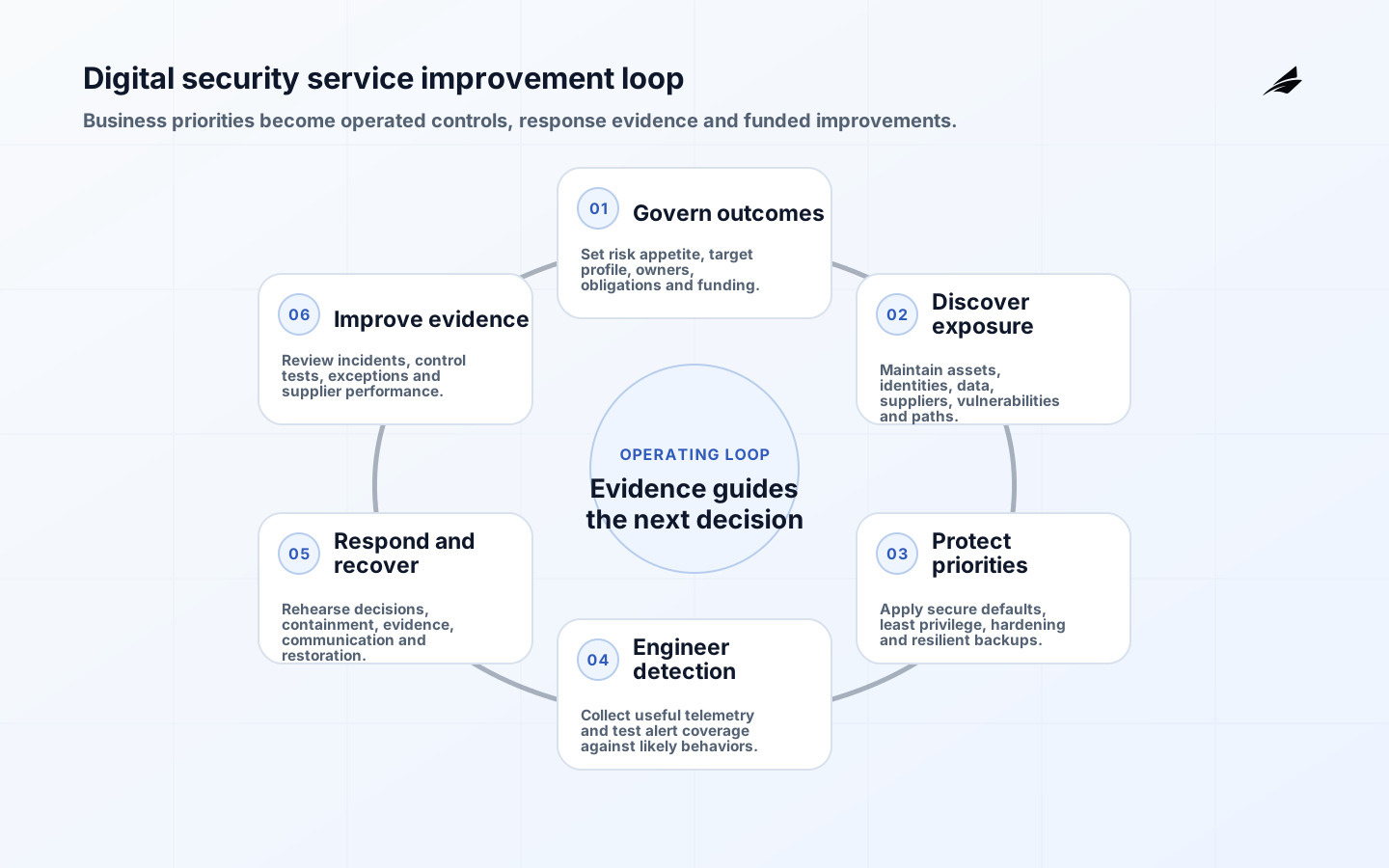
Digital security services are the people, processes and technology that govern, prevent, detect, respond to and recover from cyber risk across digital products and operations. Buying a tool or outsourcing a monitoring queue does not create a service. Implementation succeeds when critical business outcomes have named control owners, verified coverage, useful telemetry, practiced decisions and recovery evidence.
Use this digital security services implementation checklist with the security service scope and cost guide, digital security FAQ, cybersecurity services checklist and cybersecurity provider FAQ. Tailor controls to threats, obligations, organization size and business consequence rather than applying a generic stack.
Set governance and a target security profile
NIST Cybersecurity Framework 2.0 organizes outcomes through Govern, Identify, Protect, Detect, Respond and Recover. Start with business services, risk appetite, obligations, dependencies and accountable executives. Describe a current profile from observed evidence and a target profile from priority outcomes. Fund gaps according to consequence and exposure. The new Govern function reinforces that strategy, policy, roles, oversight and supply chain are part of cybersecurity, not administrative work outside it.
Create a service charter for each major capability: identity, vulnerability management, security monitoring, incident response, secure development, third-party risk or recovery. State customers, scope, service owner, control owners, service objectives, escalation, evidence, exclusions and dependencies. Separate the accountability of the organization from tasks a provider performs. Risk acceptance should remain with authorized business leadership and have expiry, compensating controls and review.
| Service outcome | Evidence of operation | Owner question |
|---|---|---|
| Critical assets are known | Reconciled inventory, owner and unsupported-state report | Who resolves unknown or disputed ownership? |
| Access is authorized | Joiner, mover, leaver, privilege and emergency-use records | Who approves each sensitive entitlement? |
| Exposure is reduced | Prioritized findings, remediation proof and exceptions | How quickly are exploited paths closed? |
| Threats are detected | Mapped telemetry, tested alert and investigation record | Which important behaviors remain invisible? |
| Incidents are contained | Rehearsal and live decision timelines | Who can isolate systems and communicate? |
| Services recover | Restored journey, data reconciliation and lessons | Has recovery been proven at business level? |
Verify asset, identity, data and supplier coverage
Build inventories by reconciling authoritative sources: cloud accounts, domains, networks, endpoints, identity systems, application portfolios, repositories, certificates, data stores, SaaS procurement and supplier records. Record business owner, technical owner, criticality, environment, exposure, data, support life and telemetry. Measure unknown and stale assets. Discovery is continuous because digital services can be created faster than a quarterly review.
Treat identities as people, workloads, devices and automation. Establish identity proofing appropriate to risk, strong authentication, least privilege, privileged elevation, service credential lifecycle and rapid removal. CISA’s Zero Trust Maturity Model describes identity alongside devices, networks, applications and workloads, and data, with visibility, automation and governance across them. Use it as a roadmap, not a product shopping list.
Implement priority protection and secure defaults
Start with controls that reduce common high-consequence paths: phishing-resistant authentication where appropriate, removal of exposed or shared administration, hardened configurations, rapid treatment of known exploited vulnerabilities, protected backups, segmentation, secure remote access, encryption and safe secrets management. Define exceptions by owner and expiry. Coverage should be measured against the asset and identity inventory, not licenses purchased.
Shift preventable product risk toward design and suppliers. NIST’s SSDF gives software producers practices for preparing, protecting, producing and responding. When procuring, ask for secure defaults, vulnerability disclosure, supported authentication, logging, update integrity, support life, component transparency and evidence. CISA’s guidance on choosing secure and verifiable technologies supports buyers demanding products they can assess rather than inheriting opaque risk.
Prioritize vulnerability and supply-chain risk
A scanner finding is not a risk decision. Combine exploit evidence, exposure, asset consequence, control path, prevalence and remediation feasibility. Establish emergency treatment for actively exploited or critical paths, routine service levels for other findings and an exception process with compensating controls. Verify remediation through version, configuration or retest. Track recurrence and root causes, not only closed ticket count.
NIST SP 800-161 Revision 1 integrates cybersecurity supply-chain risk management into organizational risk work. Maintain supplier and product criticality, ownership, services, access, data, dependencies, support, incidents and exit. Verify exact product and service scope in assurance reports. Contract notification, cooperation, component or vulnerability information where appropriate, secure transition and deletion. Review concentrated dependencies across services; several suppliers may rely on the same cloud, library or identity provider.
| Implementation risk | Control test | Useful measure |
|---|---|---|
| Inventory blind spot | Create an unregistered asset through an approved test path | Time to discovery and owner assignment |
| Excess privilege | Sample sensitive roles and attempt unauthorized action | Critical entitlement review and removal age |
| Noisy detection | Replay representative behavior and benign variants | Detection coverage, precision and investigation time |
| Unrecoverable backup | Restore a complete service into isolation | Recovery time, data loss and reconciliation defects |
| Provider ambiguity | Run a joint incident scenario with escalation | Time to authority, evidence and containment decision |
| Control drift | Change a governed configuration and observe detection | Drift age and exception closure |
Engineer detection from likely behavior and decisions
Start with threat-informed scenarios for critical services, then identify the decisions defenders need and the telemetry required. Validate time, identity, asset and configuration context. Build detections with assumptions, severity, owner, investigation steps, expected false positives and test cases. Monitor log delivery and parsing so missing evidence is itself visible. Retain data according to purpose, privacy, legal and cost requirements; more logs are not automatically better detection.
Exercise the full path from event to business response. Can the analyst identify the affected service, owner and likely blast radius? Can someone isolate an account or workload at night? Does the provider preserve evidence? Measure coverage of priority behaviors, alert-to-triage, decision time, false-positive burden, cases without asset owner and recurrence after closure. Mean time measures without severity and quality can reward premature closure.
Integrate incident response and recovery across the lifecycle
NIST SP 800-61 Revision 3 aligns incident response with all CSF 2.0 functions rather than treating it as a late technical phase. Define incident authority, severity, legal and regulatory consultation, communications, evidence, supplier coordination, containment options, recovery priorities and lessons. Maintain contacts and alternative channels. Rehearse decisions with executives, service owners, technology teams, communications and providers using realistic uncertainty.
Recovery must restore a trustworthy business service, not only power on systems. Establish clean-environment strategy, protected and tested backups, dependency order, data reconciliation, credential reset, customer support and heightened monitoring. Define minimum service and manual workarounds. Exercise destructive, identity, cloud and supplier scenarios. Record actual recovery time and data loss against objectives and fund gaps; an untested recovery plan is an assumption.
Follow a six-stage digital security service procedure
Approve governance and target outcomes first. Reconcile assets, identities, data and suppliers. Implement a small priority set of protections with verified coverage. Build and test detections for likely behavior. Rehearse incident decisions and restore complete services. Review evidence and update investment, architecture, supplier and workforce plans. Each stage should leave an owner, measurable result and exception path.
- Set risk appetite, target profile, obligations, service owners, control owners and funding authority.
- Reconcile asset, identity, data, dependency and supplier inventories; measure unknown coverage.
- Apply priority protections and secure defaults, with verified deployment and expiring exceptions.
- Engineer threat-informed telemetry and detections, then test alert-to-decision workflows.
- Rehearse containment, communications, evidence, service restoration and data reconciliation.
- Review incidents, tests, drift, supplier evidence and recovery gaps to reprioritize improvements.
Example: an organization introduces managed detection for its cloud estate. Before sending logs, it reconciles accounts and owners, defines critical admin and data behaviors, ensures identity and audit sources are enabled and agrees incident authority. The provider tests detections with controlled events, opens cases in the shared system and joins a credential-compromise exercise. Acceptance depends on coverage and decision performance, not the number of events ingested.
Select and govern security service providers
Evaluate the proposed people, coverage model, data locations, tools, detection content, threat expertise, escalation, evidence access, secure development, subcontractors, insurance, financial health and exit. Ask the team to investigate a representative scenario using sample data. Inspect a report and case record. Contract access to raw and processed evidence needed for oversight. Avoid a provider-controlled portal becoming the only history of the customer’s incidents.
Define service objectives around useful outcomes: telemetry health, priority detection coverage, response decision time, vulnerability treatment, recovery exercises and corrective-action closure. Volume metrics such as alerts reviewed can hide poor quality. Hold joint service reviews with business and technical owners. Track assumptions, repeated incidents and provider dependencies. Rehearse transition by exporting rules, cases, asset context and runbooks and by removing provider access cleanly.
Key takeaways
- Implement digital security services from business risk outcomes and a target profile, not from an isolated tool list.
- Reconcile assets, identities, data and suppliers continuously so control coverage has a valid denominator.
- Verify secure defaults and protection outcomes, including supplier responsibilities and expiring exceptions.
- Test detections, incident authority and recovery as complete decision paths under realistic conditions.
- Measure risk-reducing outcomes and retain customer access to evidence, configuration and exit artifacts.
Frequently asked questions
Can cybersecurity accountability be outsourced?
No. Providers can perform monitoring, testing, engineering and response tasks, but the organization remains accountable for business risk, obligations and service decisions. Keep informed owners, direct evidence access and authority for containment, communication and acceptance.
Does a security operations center provide complete coverage?
Not automatically. Coverage depends on known assets, useful telemetry, tested detections, investigation context and response authority. Measure priority behavior and service coverage. A staffed queue cannot detect what the organization does not log or understand.
Should every team aim for the highest maturity level?
No. Choose target outcomes according to business need, threat and resources. Maturity models support sequencing and discussion; they do not prove risk is acceptable. A well-operated basic control can matter more than an advanced capability with weak coverage.
Which cybersecurity metric belongs on an executive dashboard?
Use a small set tied to business decisions: critical service control coverage, high-risk exposure age, tested detection gaps, incident impact, recovery exercise results and overdue accepted risks. Include trend, target and accountable action. Avoid a context-free single score.
Conclusion
Digital security services become effective when governance, coverage, controls, detection, response and recovery form one evidence loop. Name accountable owners, verify the denominator, test the path from event to decision and restore real services under pressure. The best implementation is not the largest security stack; it is the one that repeatedly shows how risk is reduced and where the next investment belongs.