Digital security services provide people, processes and technology to reduce cyber risk across identities, endpoints, networks, cloud, applications and data. The label can describe anything from a periodic assessment to continuous monitoring and response, so buyers need to define the outcome and boundary before comparing providers. This FAQ addresses what a managed security service should cover, which responsibilities stay with the customer, what evidence to require and how both parties should work during an incident.
Use the Security Services Digital scope and delivery guide to establish budget and sequencing, then carry accepted controls into the Digital Security Services Implementation Checklist. NIST CSF 2.0 provides a useful common language across Govern, Identify, Protect, Detect, Respond and Recover. Select outcomes from a risk-based target profile instead of asking a provider to apply every available tool equally.
What can digital security services include?
Common services include security assessment, architecture, identity hardening, vulnerability management, endpoint detection and response, cloud posture management, security information and event management, threat hunting, incident response retainers, awareness and compliance evidence support. A managed security service provider may operate controls continuously; a consulting provider may design or assess them; a product vendor may monitor only its own platform. Map each proposed activity to a risk outcome and a customer asset population.
Coverage must state environments, hours, languages, telemetry, response authority and exclusions. “24x7 monitoring” is incomplete without the monitored sources, use cases, triage time, escalation route and action permissions. Confirm whether the service investigates, contains or merely notifies. Identify dependencies such as current asset inventory, supported agents, identity integration and customer on-call availability. A useful statement of work makes uncovered assets and degraded telemetry visible.
| Service component | Provider output | Customer dependency | Evidence of operation |
|---|---|---|---|
| Vulnerability management | Validated findings and prioritized remediation advice | Asset ownership and patch authority | Coverage, age, exceptions and retest result |
| Detection and response | Triage, investigation and agreed containment | Telemetry, contacts and decision rights | Alert timeline, evidence, action and disposition |
| Identity security | Configuration review and risky-access monitoring | Authoritative identity lifecycle | Enrollment, privilege, exception and access-review records |
| Cloud posture | Misconfiguration and exposure analysis | Account inventory and policy context | Assessed resources, drift and closure status |
| Incident readiness | Runbooks, exercises and specialist support | Executive, legal, privacy and operations participation | Exercise findings, owner and tested correction |
Which responsibilities remain with the customer?
The customer owns business risk, asset and data classification, policy, legal obligations, acceptable interruption, remediation priorities and acceptance of residual risk. A provider can recommend and operate controls but cannot decide how much customer harm is tolerable. The customer must maintain executive sponsorship, a service owner, reliable contacts, supplier oversight and enough internal capability to understand alerts and authorize consequential action.
Create a responsibility matrix at control-task level. Separate configure, monitor, investigate, approve, act, communicate, evidence and improve. Include the technology vendor where relevant. CISA and international partners warn that MSP access can create downstream risk; both sides should secure remote access, use multifactor authentication, retain important logs, exercise response and manage supply-chain exposure. Provider access should use named identities, least privilege, segmentation, approval for elevation and prompt revocation at exit.
How should a provider be evaluated?
Evaluate the actual service team and operating process, not only certificates and tool logos. Ask for role coverage, staff location, turnover, escalation depth, quality review and a walkthrough of a representative incident. Test how the provider distinguishes true compromise from noisy telemetry and how it communicates uncertainty. References should match the intended scale, sector and service. Review financial resilience, subcontractors, data locations, insurance and dependency on proprietary platforms.
Inspect the provider’s own security: secure administration, separation between customers, endpoint controls, vulnerability handling, software supply chain, logging, backup, incident notification and business continuity. Require disclosure of material incidents and changes affecting the service. Independent assurance can support due diligence, but scope, period and exceptions matter. Contract a right to receive relevant reports and remediation status without demanding sensitive details that would weaken the provider.
What should service levels and metrics measure?
Define the clock and evidence for acknowledge, triage, notify and act. Severity should reflect the customer’s impact context, not only a generic alert label. Include availability of the service, telemetry health, investigation quality, containment authorization, reporting cadence and missed-service remedies. Do not promise a universal response time where evidence collection or customer approval determines the path. State pause conditions and how the clock treats unavailable customer contacts.
Measure risk and control outcomes alongside provider activity. Useful indicators include monitored asset coverage, privileged account protection, critical exposure age, detection validation rate, investigation accuracy, time to engage the right owner, containment time, repeat incident themes and closure of exercise findings. Ticket counts and blocked events can rise because coverage improved, not because security worsened. Review trends with threat, asset and business changes.
| Weak metric | Stronger measure | Why it is more useful |
|---|---|---|
| Alerts processed | Validated cases by outcome and coverage | Separates workload from security value |
| Average response time | Time by severity from evidence availability to each decision | Shows where delay and authority sit |
| Vulnerabilities found | Exposure-weighted remediation age and exceptions | Connects findings to exploitable risk |
| Endpoints licensed | Healthy reporting endpoints in the required population | Measures effective coverage |
| Incidents prevented | Tested detection, containment and recovery outcomes | Avoids an unverifiable counterfactual claim |
How should provider and customer respond to an incident?
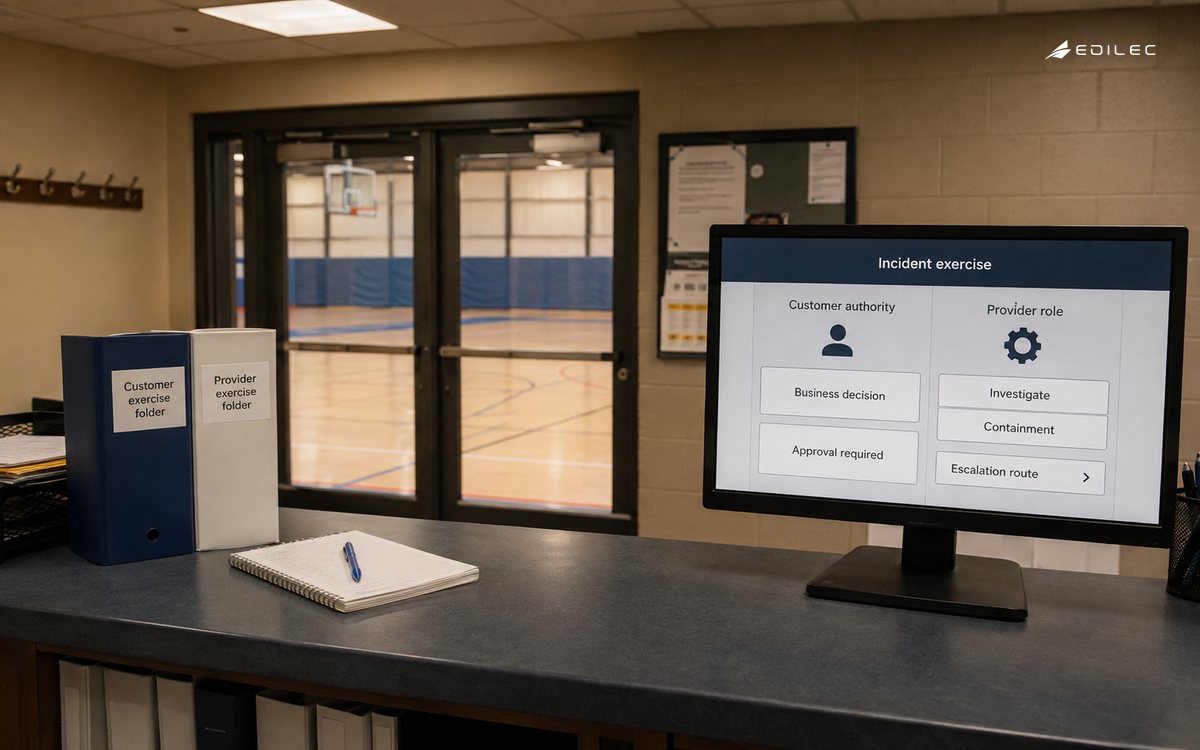
Build one coordinated response plan. NIST SP 800-61 Revision 3 integrates incident response into broader cybersecurity risk management. Define severity, evidence custody, decision authority, communication channels, privacy and legal escalation, law-enforcement contact, insurer obligations and recovery ownership. The provider should know which actions are preauthorized, such as isolating one endpoint, and which require approval, such as disabling a business-critical identity service.
Exercise scenarios involving compromised provider credentials, missing telemetry, ransomware, cloud token theft and a provider outage. Use out-of-band contacts and verify they work. During an event, preserve a shared timeline with facts, hypotheses, actions and decisions. After recovery, both parties should examine root conditions, detection quality, access, handoffs and contract gaps. The customer needs timely export of relevant evidence in usable formats even if the commercial relationship is under stress.
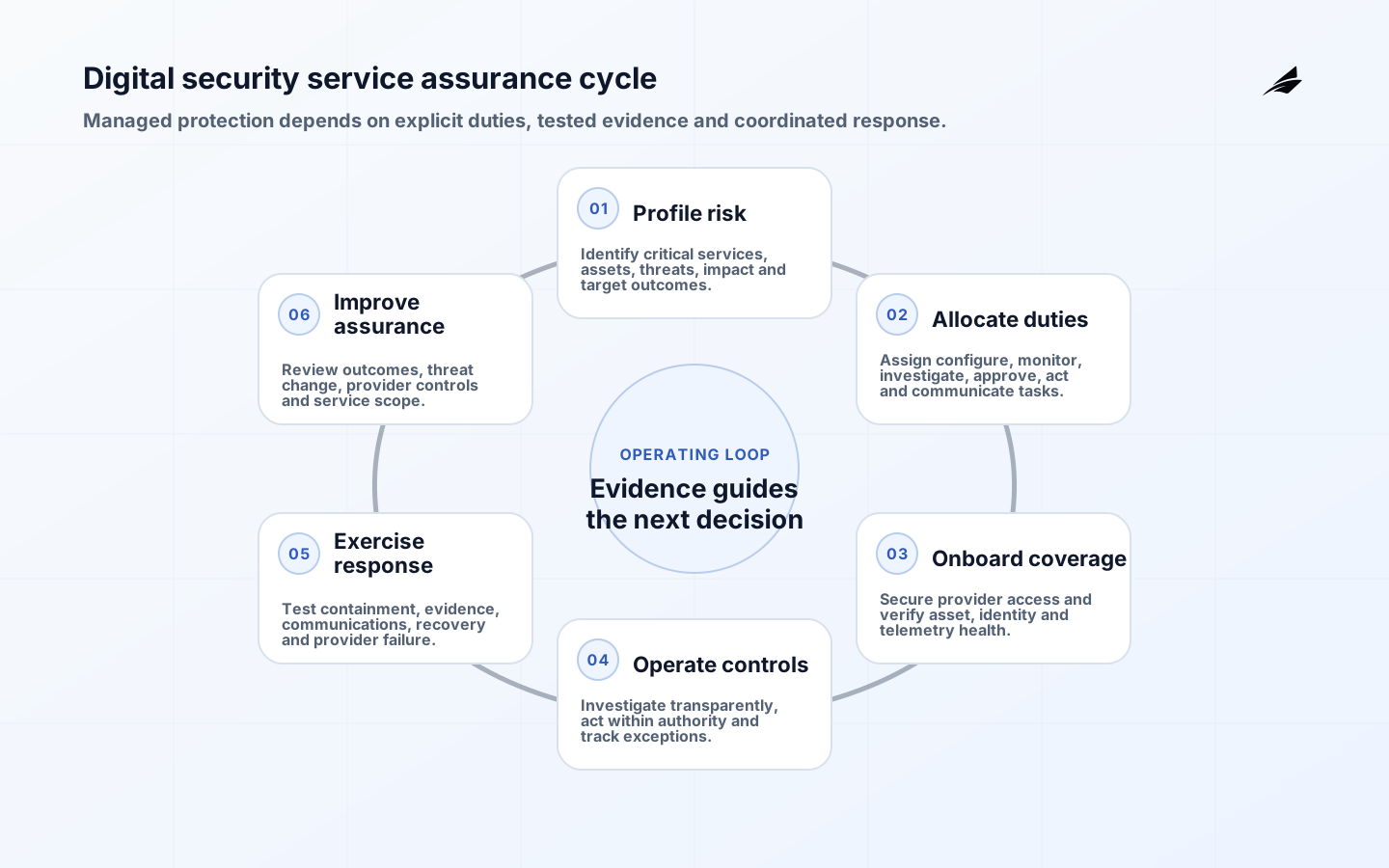
Use a six-stage assurance cycle
- Profile business risks, critical services, assets, threats and target cybersecurity outcomes.
- Allocate provider, customer and technology-vendor duties for every control and response action.
- Onboard identities, assets and telemetry; test coverage, separation and escalation paths.
- Operate controls with traceable investigation, authorized action and transparent exceptions.
- Exercise incidents and verify recovery, evidence access and out-of-band communication.
- Review outcome metrics, threat change and provider assurance; improve or re-scope the service.
Run the cycle at onboarding, after major environment change and at least at the governance cadence set by risk. A Cybersecurity Services Implementation Checklist can help coordinate control ownership across a wider program. Keep the ability to export configuration, cases and evidence, and maintain a transition plan if the service is reduced or replaced.
Contract data handling, evidence and exit
Security-service data may include logs, credentials, endpoint details, employee identifiers, incident communications and threat intelligence. Classify it, define purpose and location, restrict provider personnel, and set retention and deletion. Clarify which evidence the customer can export during normal operation and an incident. Logs stored only in a provider portal can become inaccessible when they are most contested. Address lawful requests, confidentiality, cross-customer intelligence and the provider’s use of customer data to improve models.
Specify material notification for incidents, control failures, subcontractor changes and service architecture changes. Define service credits or other remedies without allowing a payment to substitute for response. Include transition assistance, configuration and case export, credential revocation, data return or deletion and continuity during termination. Test an export before renewal. A customer should be able to change providers without losing the history needed to detect recurring threats or investigate prior events.
Validate controls instead of trusting dashboards
Use safe technical tests and evidence sampling to confirm telemetry, alert routing and response. Examples include sending a known benign authentication pattern, simulating endpoint isolation in a test group, expiring a provider role and restoring a protected sample. Review a sample of closed cases for reasoning and source evidence. Compare asset inventory with reporting coverage. Independent tests should be coordinated so they do not create unsafe action or concealment from responders.
When validation fails, classify whether the cause is customer configuration, provider process, product limitation or responsibility ambiguity. Assign correction and retest. Repeated failures should affect service scope and supplier review. This practice turns quarterly governance from a presentation into assurance that controls work under current identities, assets and integration paths.
Key takeaways
- Define covered assets, telemetry, hours, authority and exclusions in operational terms.
- Keep risk acceptance and business decisions with the customer.
- Assess the provider’s own privileged access, separation and incident readiness.
- Measure effective coverage and verified outcomes, not activity volume.
- Exercise a shared response and preserve evidence portability before a crisis.
Frequently asked questions
Can a small company use a managed security service?
Yes. Start with critical identities, endpoints, cloud accounts, backups and an incident route rather than buying maximum platform breadth. The customer still needs an accountable leader and reachable decision maker. A focused service with healthy telemetry and practiced response is more useful than nominal coverage across unsupported assets.
Does an MSSP replace an internal security team?
Usually not. It can supply continuous monitoring and specialist depth, but internal staff retain business context, architecture knowledge, remediation coordination and risk ownership. The size of the internal function varies; the responsibilities do not disappear. Design the relationship so internal capability improves rather than atrophies.
Conclusion
Digital security services work when coverage, authority and evidence are explicit. Profile the risks, divide duties precisely, secure provider access, test telemetry and response, then govern the service through verified outcomes. A supplier can extend security capacity substantially, but only a coordinated customer-provider system can manage the resulting risk.