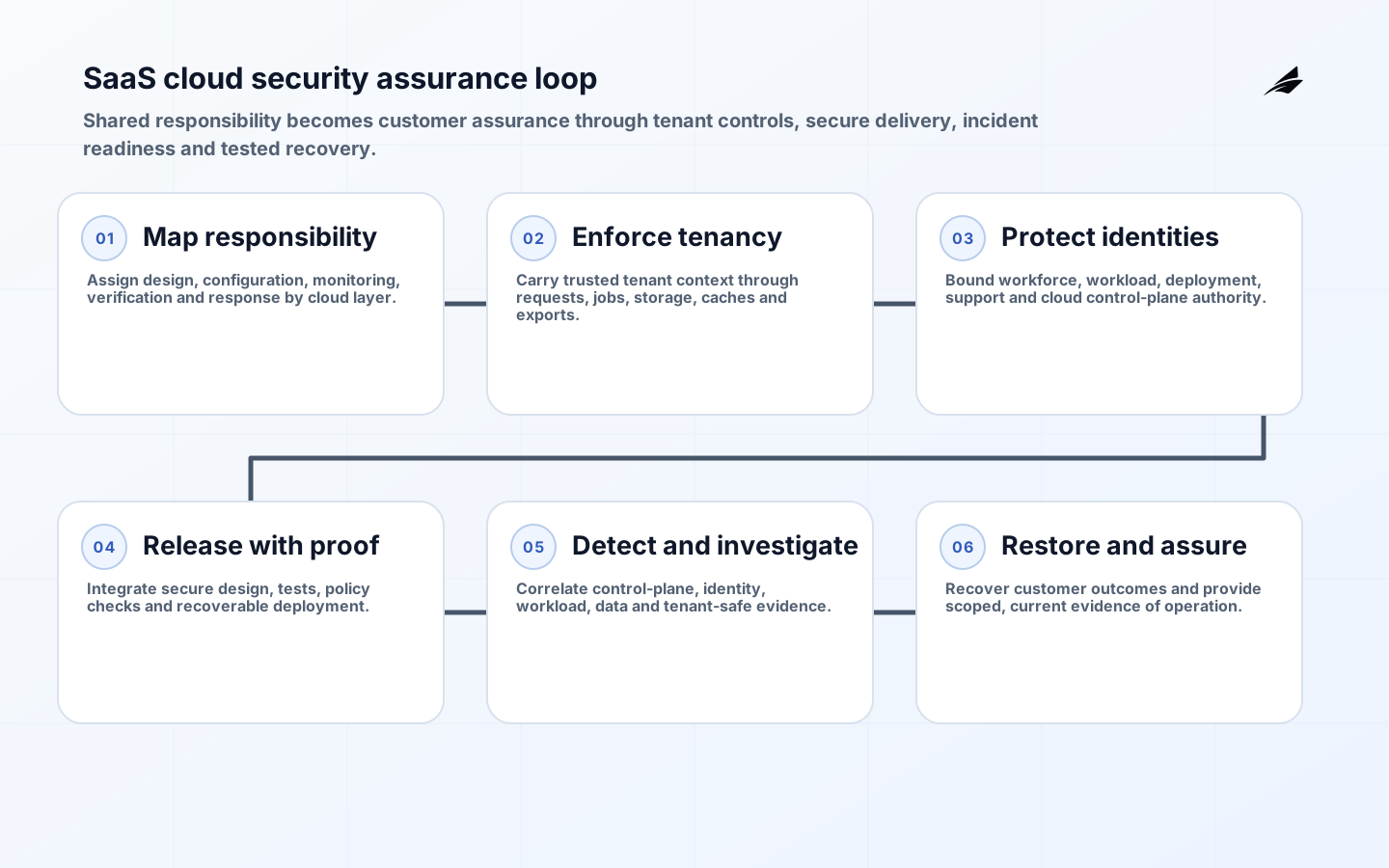
Cloud consulting cybersecurity for SaaS companies should connect customer risk to architecture, delivery and daily operations. Buying a cloud service transfers some physical and platform duties, but the SaaS provider still decides tenant boundaries, identities, permissions, application behavior, data use, logging, resilience and customer communication. A useful consulting engagement makes those responsibilities explicit, tests the highest-consequence paths and leaves the team with repeatable controls rather than a report that ages immediately.
This FAQ frames the decisions a growing SaaS company should settle. NIST Cybersecurity Framework 2.0 supplies outcome categories; NIST zero-trust and cloud-forensics guidance covers resource access and investigation; CISA's Cloud Security Technical Reference Architecture emphasizes shared services, migration and cloud security posture management. Apply them proportionately to the service, customers and obligations. The related SaaS cloud security checklist can turn answers into delivery evidence.
What should a cloud security consulting engagement deliver?
Start with a service map: customer journeys, tenants, data, cloud accounts, regions, identity systems, deployment path, dependencies, support access and recovery. Create a current and target risk profile, prioritize a small number of material scenarios and assign owners. Deliver tested architecture changes, policies as code where appropriate, detection and recovery exercises, not only recommendations. Every finding needs affected assets, consequence, evidence, owner, remedy, acceptance test and target date.
Define success before assessment: eliminate unowned public exposure, prove tenant authorization, remove standing administration, restore a critical data store, or exercise a cloud-credential incident. Match depth to stage. An early SaaS may need secure foundations and a focused threat model; an enterprise provider may need multi-account governance, forensic readiness, supplier assurance and customer evidence. Avoid claiming that a generic “best practice” is mandatory without connecting it to threat, contract or applicable requirement.
How should shared responsibility be documented?
Map responsibility by layer and action. The cloud provider may secure facilities and managed-service infrastructure; the SaaS company configures services, identities, networks, keys, workloads and data; customers administer their users, integrations and content within product controls. For each control name who designs, configures, monitors, verifies and responds. Those roles can differ. Include platform support and subprocessors, and record where evidence is available or inherently limited.
Turn boundaries into interface contracts. How are provider advisories received? Who changes an organization policy? How does customer offboarding invoke deletion? Who can access a production tenant during support? How are provider incidents correlated with customer impact? Review responsibility when a service changes from virtual machines to a managed database or from self-managed identity to a provider. The service name changes the allocation; accountability for customer outcomes remains with the SaaS business.
| Boundary | SaaS responsibility | Proof |
|---|---|---|
| Cloud account | Ownership, guardrails, logging and break glass | Policy tests and access review |
| Application | Secure design, build and vulnerability response | Release and remediation evidence |
| Tenant | Isolation, authorization and data lifecycle | Negative tests and deletion record |
| Supplier | Due diligence, contract, monitoring and exit | Inventory and exercised contingency |
| Customer | Safe controls, guidance and material notification | Configuration evidence and communication |
What proves multi-tenant isolation?
Define tenant context at authentication and carry it through requests, jobs, queues, caches, search indexes, objects, analytics and exports. Enforce scope in trusted service code or data policy, never only in the interface. Decide how users with multiple memberships select context and how administrators delegate access. Apply tenant-aware rate, storage and workload controls so one tenant cannot consume unbounded shared capacity. Separate legal entities or regions where contracts or risk require it.
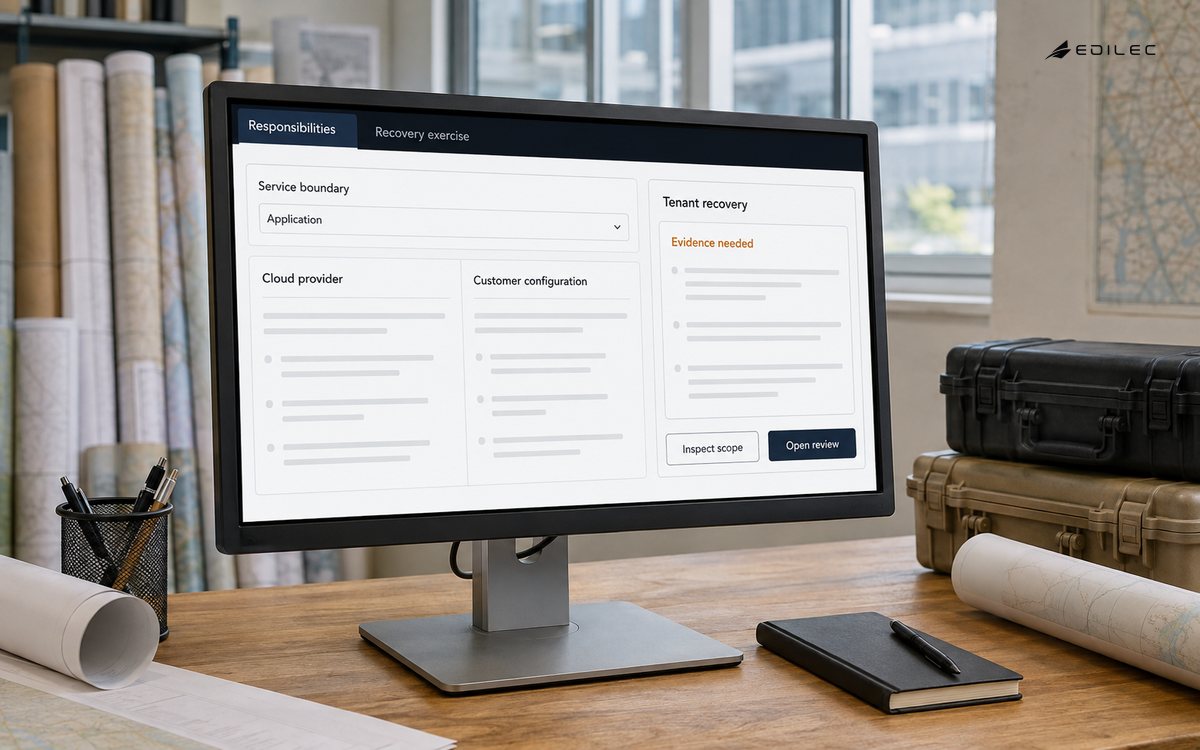
Test horizontal and vertical authorization with valid low-privilege identities. Change identifiers, replay background jobs, inspect signed download URLs, query search and reporting paths, test deleted and suspended tenants, and verify support tooling. Include infrastructure identities and data pipelines. A penetration test can sample isolation, but continuous unit, integration and policy tests prevent regression. Treat any cross-tenant exposure as a high-consequence incident with evidence preservation and notification analysis.
Which identity and data protections matter most?
Require strong authentication for workforce and administrators, federation for suitable customers, least privilege and time-bound production elevation. Separate deployment, security and support authority. Use workload identities and short-lived credentials rather than static cloud keys. NIST SP 800-207A describes identity-based policy for users, services and applications across cloud-native environments. Network controls still matter, but a trusted subnet should not grant a service broad access by itself.
Inventory data by tenant, purpose, sensitivity, region, authoritative system, retention, backup and deletion. Minimize collection and restrict production copies. Encrypt transport and storage with managed key lifecycle; use separate keys or stronger isolation where threat and commitments justify them. Control exports and bulk queries. Deletion must cover primary stores, derived indexes and scheduled backup expiry, with transparent exceptions for lawful retention. Do not log secrets, authentication tokens or unrestricted customer content in centralized observability.
How should cloud security fit into software delivery?
Use NIST SSDF to define protected repositories and build systems, reviewed change, verified dependencies, secure design, testing and vulnerability response. Keep infrastructure and application configuration in version control, build immutable artifacts and promote them through controlled environments. Scan secrets and dependencies, but also test authorization, input handling, schema changes and recovery. OWASP ASVS 5.0 can supply verifiable application requirements. Protect CI/CD identities because they often have authority to change production.
Set release gates by consequence. A low-risk interface change may need automated checks and a canary; identity, tenant policy or data migration changes need deeper review and explicit recovery. Use feature flags with owners and expiry. Monitor business and security outcomes during rollout. Rollback is not always safe after data mutation, so design backward-compatible changes and roll-forward repair. Preserve source revision, artifact identity, tests, approvals and deployment events for investigation and customer assurance.
| Assurance test | Question | Pass evidence |
|---|---|---|
| Tenant escape | Can a valid user reach another tenant? | Negative tests across every data path |
| Privilege misuse | Can support or automation exceed purpose? | Time-bound grant and attributable activity |
| Cloud loss | Can policy block or detect risky configuration? | Preventive test and posture event |
| Data recovery | Can authoritative tenant data be restored? | Timed restore and reconciliation |
| Investigation | Can events be reconstructed across services? | Correlated identity, workload and control-plane logs |
What should detection and incident response cover?
Collect cloud control-plane activity, identity decisions, workload and gateway telemetry, data access, deployment, security findings and key administrative events. Use consistent time, account, workload, user and safe tenant identifiers. Detect unexpected public exposure, anomalous privilege, disabled logging, credential use from unusual contexts, cross-tenant authorization failure, bulk export, secret access and backup changes. Monitor the telemetry pipeline itself; an absent source can be a security event.
Create playbooks for compromised workforce credentials, leaked cloud keys, malicious deployment, tenant exposure, data exfiltration, supplier outage and destructive action. Define containment authority, customer-impact assessment, evidence preservation, legal and communication routes. NIST SP 800-201 highlights cloud forensic challenges and readiness. Confirm which provider logs and snapshots can be retained, in which region and for how long, before an incident. Exercise with product and support teams because they understand tenant consequence and customer workflows.
How are resilience and customer evidence proven?
Set recovery objectives by customer journey and data set. Back up data, configuration, keys, identity dependencies and deployment material with separate authority appropriate to risk. Restore into a clean environment and reconcile tenant, job and external-integration state. Test region and dependency failure, but avoid promising multi-region continuity unless data, identity, routing and operations actually support it. Measure customer-impact minutes and recovery of the complete journey, not only infrastructure availability.
Build an evidence catalog mapped to customer questions and control owners: architecture, data flows, access reviews, secure development, vulnerability response, penetration testing, availability, restore exercises, incident handling, subprocessor changes and deletion. Provide scoped, current evidence under appropriate confidentiality rather than handing over raw logs. Certifications or reports may support assurance, but they do not prove a customer's configuration or every product behavior. Answer accurately and track commitments made in security questionnaires and contracts.
What should the first 90 days prioritize?
- Map the service, tenants, data, identities, cloud accounts, suppliers and recovery dependencies.
- Remove unowned exposure, shared administration and unmanaged long-lived credentials.
- Threat-model tenant isolation, deployment authority and destructive cloud actions.
- Add policy checks and authorization tests to the delivery path.
- Centralize critical telemetry and exercise one credential-compromise playbook.
- Restore a representative tenant and reconcile the result.
- Publish owners, exceptions, customer evidence and the next risk-ranked work plan.
Sequence work by consequence and leverage. Protect identity, deployment and organization control planes before polishing low-risk findings. Fix design patterns that remove classes of defect, such as a shared tenant-scoping library or organization policy, rather than closing tickets one by one. Track risk retired, exposure age, tenant-test coverage, privileged access, restore evidence, detection exercises and overdue exceptions. The SaaS cloud security scope guide can help align effort and cost.
Key takeaways
- Document shared responsibility by action and evidence, not service label.
- Enforce and continuously test tenant context across every data path.
- Protect workforce, workload, deployment and cloud control-plane identities.
- Design forensic readiness, response and clean recovery before an incident.
- Use consulting to install repeatable controls and ownership, not produce a static report.
Frequently asked questions
Does a cloud provider certification secure the SaaS product?
No. It can provide assurance about scoped provider controls. The SaaS company remains responsible for its configuration, identities, application, tenant isolation, data use, delivery and operations, subject to the actual shared-responsibility model.
Is a penetration test enough for tenant isolation?
No. Penetration testing is a useful independent sample. Isolation also needs consistent architecture, server-side enforcement and automated negative tests for requests, jobs, exports, caches and analytics on every release.
When should a SaaS company hire cloud security consulting?
Useful triggers include enterprise sales, regulated data, major architecture change, multi-region expansion, rapid team growth, a material incident or known gaps in identity and recovery. Clear objectives make the engagement more valuable than a broad maturity review alone.
Conclusion
SaaS cloud security is credible when the company can explain responsibility, prove tenant and identity controls, release changes safely, detect misuse, investigate across provider boundaries and restore customer outcomes. Consulting should accelerate that proof and leave durable ownership with the product team. Focus first on control planes and cross-tenant consequence, then scale assurance as the service and customer commitments grow.