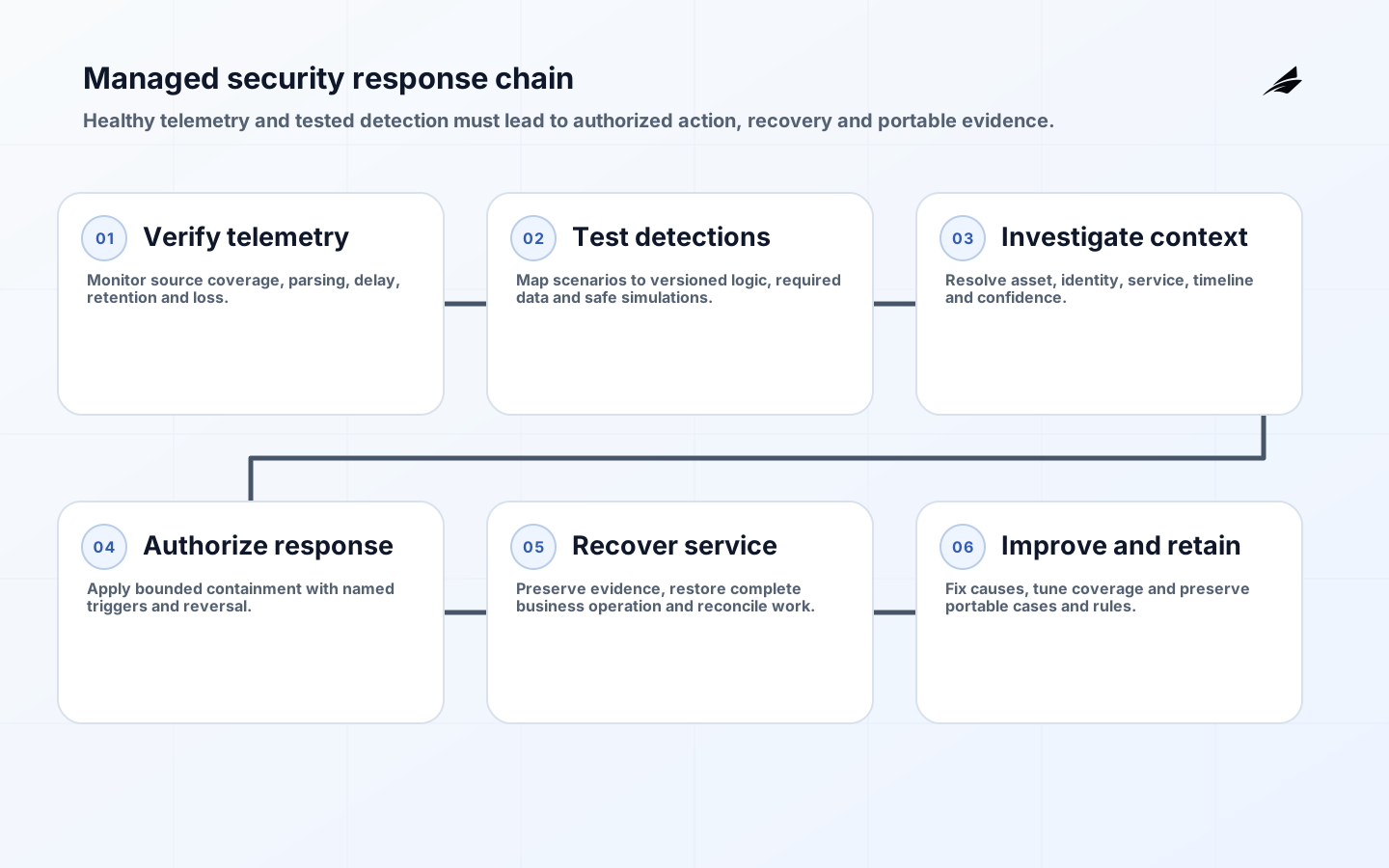
This managed security services FAQ begins with the operating boundary: a provider can add monitoring, engineering, threat detection, incident support, vulnerability operations and specialized expertise, but it does not transfer the organization’s accountability for risk and business decisions. The buyer must define what is protected, which telemetry is available, who can act, how quickly evidence moves and what happens when the provider is wrong or unavailable. “24x7 SOC” is a staffing claim, not a complete service definition.
NIST CSF 2.0 frames cybersecurity across Govern, Identify, Protect, Detect, Respond and Recover, and NIST SP 800-61 Rev. 3 integrates incident response into risk management. Those sources encourage buyers to assess the complete operating cycle rather than purchase alert forwarding. This FAQ explains how to scope a provider, evaluate detection and response, set useful objectives, protect data and preserve the ability to change providers.
What services can an MSSP or MDR provider deliver?
Managed security service providers may operate logging platforms, endpoint and network controls, detection engineering, identity monitoring, cloud posture, vulnerability workflows, threat intelligence and incident response retainers. Managed detection and response usually emphasizes detection, investigation and guided or authorized containment. Names are inconsistent, so compare catalog entries. Each entry needs covered assets, telemetry, hours, exclusions, target, deliverable and customer dependency.
Map services to critical business systems, identities, data and suppliers. A provider cannot detect activity that does not generate suitable telemetry or is outside the integrated estate. Inventory log sources, expected volume, retention, parsing, health monitoring and ownership. Define whether cloud, SaaS, OT, endpoints, email and identities are included. Baseline coverage and known blind spots before transition so later reporting does not count connected tools while critical services remain invisible.
| Service | Provider evidence | Customer responsibility |
|---|---|---|
| Telemetry operations | Source health, parsing, retention and loss reports | Authorize collection and maintain source ownership |
| Detection engineering | Versioned logic, test cases and coverage map | Prioritize scenarios and supply business context |
| Triage and investigation | Case timeline, evidence and disposition quality | Provide asset, identity and service owners |
| Containment | Authorized actions and complete execution record | Set authority, exceptions and business limits |
| Vulnerability workflow | Prioritized findings and remediation tracking | Own remediation and risk acceptance |
| Incident response | Command, preservation, recovery and lessons evidence | Direct business, legal and external decisions |
How should detection quality be evaluated?
Ask which threat scenarios matter for the organization and map them to MITRE ATT&CK techniques where useful. Coverage is not the number of rules. Require versioned detection logic, expected data, test procedure, known limitations and owner. Validate detections with safe simulations or historical replay. Measure precision, time to actionable context, missed expected detections and stale rules. A provider should tune with customer context without suppressing activity merely to reduce ticket volume.
Monitor telemetry health as a security control. Missing endpoint events, identity logs or cloud audit records can make a quiet dashboard look healthy. Define alerting for gaps, parsing failures and delayed ingestion. Preserve raw or normalized evidence in formats the customer can access during an incident and at exit. Agree on retention based on investigation and obligation, and protect the provider’s platform and support access as part of the threat model.
Who can contain an incident?
Write an action matrix for isolate host, disable account, revoke token, block indicator, rotate credential, stop workload and preserve image. For each action, state triggers, permitted assets, approval, maximum duration, notification and reversal. Pre-authorized containment can reduce harm outside business hours, but an incorrect action can stop a critical service. Use tighter authority for safety-critical or revenue-critical systems and maintain tested emergency contacts and alternates.

Run exercises that cross provider and customer boundaries. Include ambiguous detection, unavailable owner, compromised administrator, evidence preservation, cloud account isolation, restoration and external communication. NIST SP 800-61 Rev. 3 emphasizes preparation and improvement throughout risk management. The exercise should update architecture, roles and controls, not only the incident runbook. Record who has final authority to declare, close and accept residual risk.
Which service levels are meaningful?
Measure source-health response, triage, qualified notification, containment action, evidence delivery and restoration support. Define when each clock starts and pauses, severity criteria, communication channel and exclusions. Mean time to respond is easily manipulated if a ticket acknowledgement counts as response. Pair timing with quality: correct asset and identity context, defensible severity, useful recommended action and complete evidence. Review major-event duration separately from monthly averages.
Use governance to inspect misses, false escalations, repeated incidents, coverage, control changes and improvement backlog. Service credits can allocate commercial consequence but do not correct weak detection. Require problem management for systemic misses. Track customer dependencies such as absent owners or incomplete asset records fairly, while ensuring the provider actively reports them. A mature review ends with decisions and due dates rather than a slide deck of alert counts.
How should transition, data and exit be controlled?
During onboarding, baseline assets, identities, telemetry, open findings, incidents, detection rules, integrations and access. Connect a representative service and exercise data loss, detection, escalation and containment before expanding. Run shadow operations to compare current and new provider decisions. Do not switch off existing visibility until source health, case routing and evidence access are proven. Reconcile every connected source and document blind spots.
The contract should address data ownership, location, retention, subprocessors, model or analytics use, breach notification, legal hold, export and secure deletion. At exit, return detections, parsers, allowlists, cases, evidence, coverage maps, configuration and open risks in usable formats. Revoke provider identities and integrations, validate telemetry continuity and preserve investigation history. Test an export before renewal so portability is evidence rather than a clause.
| Buyer gate | Acceptance evidence | Red flag |
|---|---|---|
| Coverage | Critical services mapped to healthy telemetry and scenarios | Pricing based only on event volume |
| Detection | Tested rules with data requirements and limitations | Rule count presented as effectiveness |
| Response | Action authority and joint exercises | No after-hours decision path |
| Service levels | Quality and timing measured from defined events | Acknowledgement treated as resolution |
| Assurance | Provider access, platform and supplier controls visible | Certification offered as the only evidence |
| Exit | Tested export and identity revocation process | Cases and detections locked in provider tooling |
A practical selection and onboarding sequence
Issue scenarios rather than a feature checklist. Give shortlisted providers a sanitized architecture and ask them to explain detection, investigation, containment, evidence and improvement for realistic events. Validate named service locations, staffing, subcontractors, platform, access and customer effort. Price normal operations, growth, onboarding, incident surge and exit. Select the provider that can explain boundaries and uncertainty, not the one that promises to eliminate every threat.
- Define business services, risk scenarios, coverage, authority and evidence needs.
- Baseline assets, telemetry, current detections, open incidents and blind spots.
- Test provider investigation and response using representative scenarios.
- Contract service levels, data handling, assurance, improvement and exit.
- Transition by service cohort with shadowing and reconciled telemetry.
- Exercise incidents, review quality and test portability throughout the service.
Verify provider assurance and customer dependencies
Assess the provider’s own security architecture, identity controls, administrative access, software lifecycle, vulnerability process, incident response, resilience and subcontractors. Determine how customer telemetry is separated and which personnel can access it. Review relevant independent assessments, but map them to the actual service and delivery locations. Require prompt notification of material platform incidents and evidence that the provider can continue or recover service without losing customer cases.
Document customer prerequisites with equal precision: asset and identity ownership, telemetry configuration, contact availability, remediation teams and business service context. Track missing prerequisites as service risk, not informal excuses in incident reviews. Establish a joint improvement backlog and exercise at least one scenario where the provider platform or communication channel is unavailable. Maintain an alternate route for critical notification and evidence exchange.
At quarterly reviews, sample completed cases from detection through closure. Check whether severity was defensible, evidence was complete, actions were authorized and recurrence work was assigned. Compare provider reports with source telemetry and customer incident records. This quality sampling reveals more than aggregate response times. Use the findings to tune detections, update runbooks, repair data gaps and decide whether service scope or internal capability must change.
Key takeaways
- A managed security service is defined by covered assets, telemetry, authority and evidence.
- Detection effectiveness requires tested scenarios and healthy data, not a large rule count.
- Containment authority should be predesigned and exercised across provider and customer teams.
- Measure response quality and business outcome as well as clock time.
- Portable cases, detections and telemetry continuity are required for a safe exit.
Frequently asked questions
What is the difference between MSSP and MDR?
MSSP is a broad label for outsourced security operations. MDR usually emphasizes managed detection, investigation and response. Provider labels vary, so evaluate the exact catalog, coverage and authority.
Can a provider guarantee that breaches will not happen?
No credible provider can eliminate all risk. The service should improve prevention, visibility, response and recovery while making assumptions and blind spots explicit.
Should the provider be allowed to isolate systems automatically?
Pre-authorized containment can reduce harm, but it needs defined triggers, asset scope, reversibility, notification and exceptions. Critical systems may require human approval or narrower actions.
Conclusion
Managed security creates value when it turns suitable telemetry into timely, authorized and evidence-rich action. Buyers should contract and test that operating chain, including its blind spots and exit. A provider can extend capability, but governance, business context and risk authority remain with the organization.