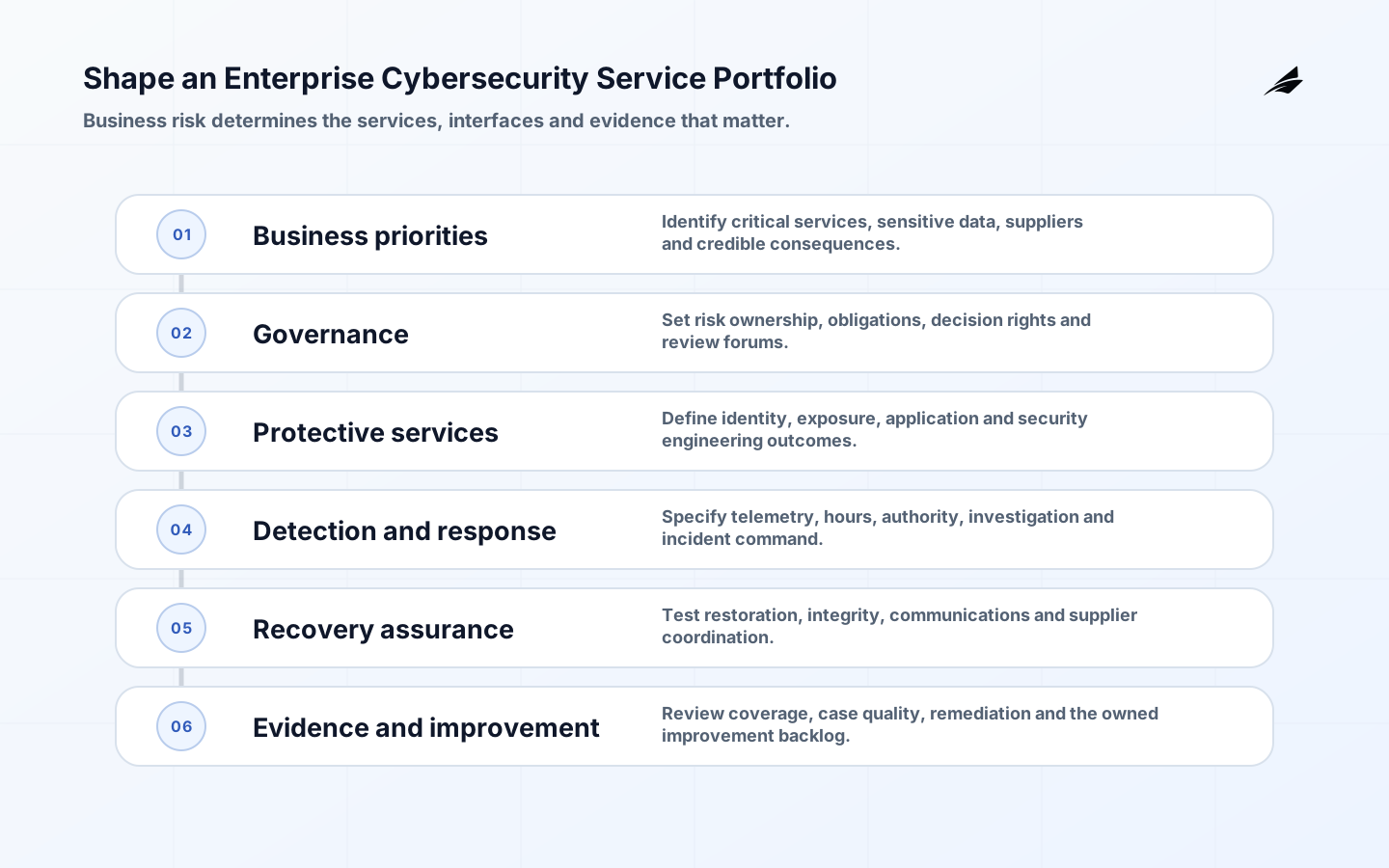
Enterprise cybersecurity services can include advisory work, engineering, monitoring, incident response, identity, vulnerability management, application security and assurance. Buying them as one vague promise makes ownership and value difficult to judge. A defensible plan starts with business risk, separates project work from recurring service, and defines evidence for operation and transition. The implementation checklist turns this plan into gates, while the enterprise cybersecurity FAQ addresses buyer questions.
Key takeaways
- Define services through outcomes, coverage, authority, evidence and exclusions.
- Keep internal accountability for risk, business priorities and production decisions even when work is outsourced.
- Estimate from protected scope, service hours, telemetry, integration and transition rather than headcount alone.
- Design detection, response, recovery and secure change as one operating system.
- Require measurable handover and exit so a provider relationship does not become an unmanaged dependency.
Translate business risk into a service portfolio
Start with critical services, sensitive data, essential suppliers and credible threat scenarios. NIST CSF 2.0 offers a common structure across Govern, Identify, Protect, Detect, Respond and Recover. Use it to identify desired outcomes and ownership, then select service components. A control catalog can support implementation, but it should not become a shopping list detached from consequence.
A service definition should name the population covered, hours and channels, work accepted, authority to act, customer dependencies, evidence produced, response targets, exclusions and review cadence. For example, “vulnerability management” may mean scanning only, or it may include asset reconciliation, risk triage, remediation coordination, exception governance and verification. Those are materially different services.
| Service component | Outcome | Boundary to state |
|---|---|---|
| Security governance | Risk decisions align with business responsibility | Who accepts risk and interprets obligations |
| Identity security | Access is appropriate, reviewed and removable | Which identity types, applications and privileged paths |
| Exposure and vulnerability | Material weaknesses are found and resolved | Asset population, testing methods and remediation ownership |
| Detection and response | Events become timely, coordinated decisions | Telemetry, hours, authority and incident command |
| Application security | Software changes include proportionate security | Repositories, pipelines, suppliers and release gates |
| Recovery assurance | Critical services restore with integrity | Systems, data, objectives and exercise frequency |
Choose the operating model deliberately
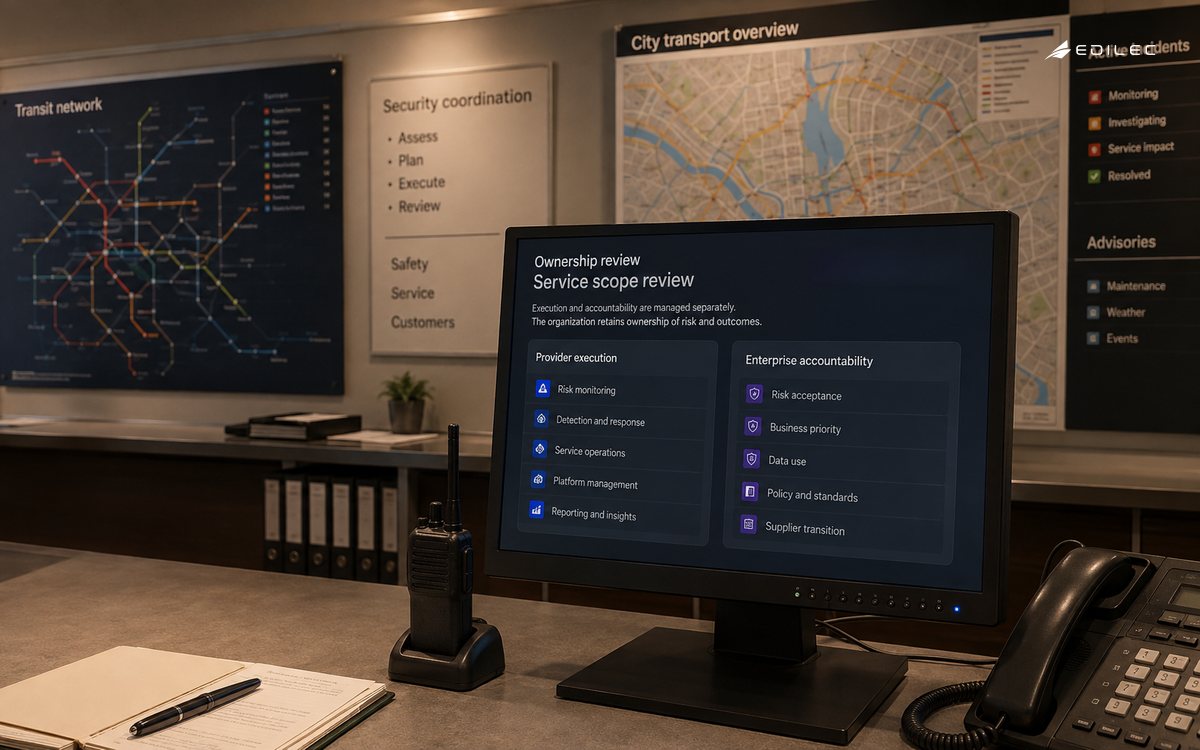
Internal, co-managed and managed models distribute execution differently; none transfers enterprise accountability. Internal teams retain context and authority but need sufficient specialist coverage. Co-managed services can add depth while preserving internal leadership, though interfaces must be explicit. Managed services can provide repeatable operations, but the customer still owns business priority, risk acceptance, data use and supplier governance.
Map every recurring decision with a responsible and accountable role. State who tunes detections, contacts a system owner, disables an identity, isolates a device, preserves evidence, communicates with regulators or customers, approves recovery and closes an incident. Providers should not improvise authority during a crisis. Where an action could interrupt operations or create legal implications, pre-agreed thresholds and escalation are essential.
Make scope and acceptance testable
| Scope dimension | Planning question | Acceptance evidence |
|---|---|---|
| Population | Which users, assets, services, regions and suppliers are covered? | Reconciled coverage register with denominator |
| Service time | When is monitoring, response or engineering available? | Tested contact and escalation schedule |
| Authority | Which actions may be taken automatically or with approval? | Decision matrix and exercise record |
| Data custody | What telemetry, evidence and personal data are processed? | Approved flow, retention and deletion controls |
| Quality | What makes analysis or remediation complete? | Sample cases against acceptance criteria |
| Transition | How do tools, history, content and access move at exit? | Tested transition plan and export format |
Avoid ambiguous verbs such as support, monitor or manage. Define inputs, decisions and outputs. If the provider monitors endpoint alerts, specify endpoint population, health monitoring, excluded systems, triage criteria, customer enrichment, incident threshold and evidence retained. If remediation is outside scope, name the team receiving the action and how completion is verified.
Estimate total cost, not the service fee alone
Major drivers include covered identities and assets, telemetry sources and volume, operating hours, environment diversity, response authority, regulatory requirements, integration work, content engineering, reporting, exercises and transition. Existing tool quality and asset data can reduce or increase effort. A low subscription price can be offset by internal triage, duplicate tools, poor integration or unsupported remediation.
| Cost area | What drives it | Often missed |
|---|---|---|
| Mobilization | Discovery, access, connectors, runbooks and tuning | Internal owner time and data cleanup |
| Recurring operation | Coverage, hours, case volume and specialist depth | Customer investigation and remediation effort |
| Technology | Licenses, storage, integrations and retention | Overlapping tools and data egress |
| Assurance | Testing, evidence, reporting and exercises | Legal, privacy and audit participation |
| Change | New systems, acquisitions, regions and threats | Connector maintenance and detection revision |
| Exit | Export, access removal, replacement overlap and knowledge transfer | Retention of case history and custom content |
Request transparent assumptions and separate pass-through costs. Use a baseline period to understand alert and case demand without allowing indefinite paid discovery. Unit measures can help compare scenarios, but they require quality definitions: cost per covered asset means little if coverage health is unknown. Reserve capacity for incidents and material change rather than assuming average demand.
Control the main delivery risks
| Risk | Early signal | Mitigation |
|---|---|---|
| Unknown coverage | Provider and enterprise asset counts disagree | Reconcile sources and report coverage health |
| Alert transfer without context | Cases bounce between queues | Define enrichment, ownership and closure evidence |
| Excessive provider privilege | Standing access exceeds routine need | Use bounded roles, approval, recording and review |
| Detection volume incentives | Reports celebrate alert counts | Measure validated cases, coverage and response quality |
| Remediation gap | Same weaknesses recur | Assign service owners and verify changes |
| Lock-in | Rules, history and workflows cannot be exported | Use enterprise ownership, documented formats and exit tests |
Example: protecting a regional order platform
Consider a hypothetical enterprise with an order platform, warehouse integration, workforce identity service and endpoint estate across two regions. It wants continuous detection and stronger vulnerability management. Discovery shows that business ownership exists for production servers but not for several integration hosts, and endpoint telemetry coverage cannot be reconciled to the asset register. The immediate need is not more alert rules; it is coverage and ownership.
The first service wave establishes an agreed asset denominator, connector health monitoring, severity and incident authority, plus a remediation route to platform and endpoint teams. A representative simulation uses a test identity and safe endpoint event to prove telemetry, enrichment, escalation and revocation. Vulnerability work starts with externally reachable and privileged systems, records exceptions and verifies fixes.
The scenario is accepted when internal incident command can use the provider’s evidence, operations can identify missing telemetry, service owners receive actionable remediation and exports are retained in enterprise systems. No breach reduction or savings are claimed; the example simply shows how dependencies and acceptance shape scope.
Deliver in controlled phases
| Phase | Work | Exit evidence |
|---|---|---|
| Frame | Outcomes, risk scenarios, obligations and authority | Approved charter |
| Baseline | Coverage, tools, teams, suppliers and process | Reconciled current state |
| Design | Service definitions, integrations, runbooks and measures | Accepted service design |
| Mobilize | Access, connectors, content, training and dry runs | Operational readiness review |
| Prove | Representative cases, simulations and recovery tests | Evidence against acceptance |
| Expand | Waves by service, region or asset class | Coverage and quality trends |
| Operate and improve | Reviews, exercises, tuning and risk decisions | Owned improvement backlog |
Run old and new services in parallel only long enough to compare coverage and preserve continuity. Define which system owns each case during overlap. Use entry and exit criteria for every wave, including connector health, on-call readiness, production authorization and rollback. A provider should not become the sole keeper of architecture, detection logic or incident history.
Measure outcomes and service health
Track covered critical services and assets, telemetry health, privileged access review, vulnerability aging by risk decision, detection test success, investigation quality, response decision time, recovery exercise results and overdue actions. Define denominators, clocks and exclusions. Mean time measures need start and stop rules and should be paired with case quality; speed without correct scope or containment can mislead.
Service reviews should resolve decisions: recurring control failure, rejected cases, expired exceptions, supplier change, emerging risks and improvement funding. Use samples of closed cases to test reasoning and evidence. Executive reporting should show material scenarios and unresolved decisions rather than a wall of operational activity.
Before renewal, repeat a bounded market and internal capability review. Compare the current service with changed business dependencies, threat scenarios, tool ownership, staffing and exit readiness. Renewal should be an affirmative risk and operating decision, not the result of discovering that records, rules or expertise cannot move. Record which improvements belong in the next term and which dependencies the enterprise will reduce.
Frequently asked questions
Should one provider deliver everything? Consolidation can simplify interfaces, but concentration can weaken independence and resilience. Decide by service dependency, specialist need and exit capability.
Are service levels enough? No. Response clocks matter, but coverage, decision quality, authority and remediation determine whether risk changes.
Can tools be retained? State ownership of licenses, configurations, rules, queries, integrations and historical data before mobilization.
How long does transition take? It depends on coverage, connectors, access, documentation, exercises and overlap. Estimate after discovery and use readiness gates.
Who owns an incident? The enterprise should retain a named incident authority. Providers execute agreed roles and escalate within the command structure.
Conclusion
Enterprise cybersecurity services work when service boundaries, authority, evidence and transition are explicit. Build the portfolio from material risk, price the full operating model, prove it through representative cases and keep enterprise owners capable of directing response and improvement. Readers evaluating delivery support can review cybersecurity services while treating every capability and outcome as subject to an agreed scope.