This cybersecurity services FAQ helps decision makers define what they are buying, which responsibilities remain internal and how to test whether a service reduces material risk. Cybersecurity services can include strategy, architecture, assessments, identity, cloud security, vulnerability management, managed detection and response, incident response, application security, resilience and compliance support. The useful unit of scope is not a tool or analyst hour; it is an outcome for defined assets, threats and business operations.
Begin with the cybersecurity services delivery plan and convert it into controls and evidence with the implementation checklist. Buyers should involve business service owners, IT and product engineering, legal and privacy roles, risk leaders and the people who will respond at 02:00. A supplier can operate contracted capabilities, but the customer still owns business priorities, lawful decisions, risk acceptance and continuity.
What should cybersecurity services include?
Scope begins with business services and impact. Identify critical operations, data, people, technologies, locations, third parties and regulatory or contractual duties. Describe plausible threat events and current controls. Then select services that close evidence-backed gaps. An organization facing repeated account takeover may need identity hardening, fraud coordination and detection tuning before a broad penetration-test program. A manufacturer with long recovery times may need asset discovery, segmentation and restoration exercises before another dashboard.
The NIST Cybersecurity Framework organizes outcomes across Govern, Identify, Protect, Detect, Respond and Recover. Use a current and target profile to communicate priorities without assuming that every outcome has the same importance. State locations, hours, systems, identities, cloud accounts, applications, interfaces and exclusions. For every exclusion, record who owns the residual risk and how an incident crossing that boundary will be coordinated.
How do consulting, testing and managed services differ?
Consulting produces decisions, designs and capability improvements; testing provides time-bound evidence about defined conditions; managed services perform recurring operations. Their boundaries can overlap, but acceptance should differ. A strategy engagement should leave prioritized decisions, owners and a funded roadmap. A penetration test should document scope, method, evidence, impact and retest status. A managed detection service should demonstrate telemetry coverage, detection logic, triage, escalation, investigation context and service review over time.
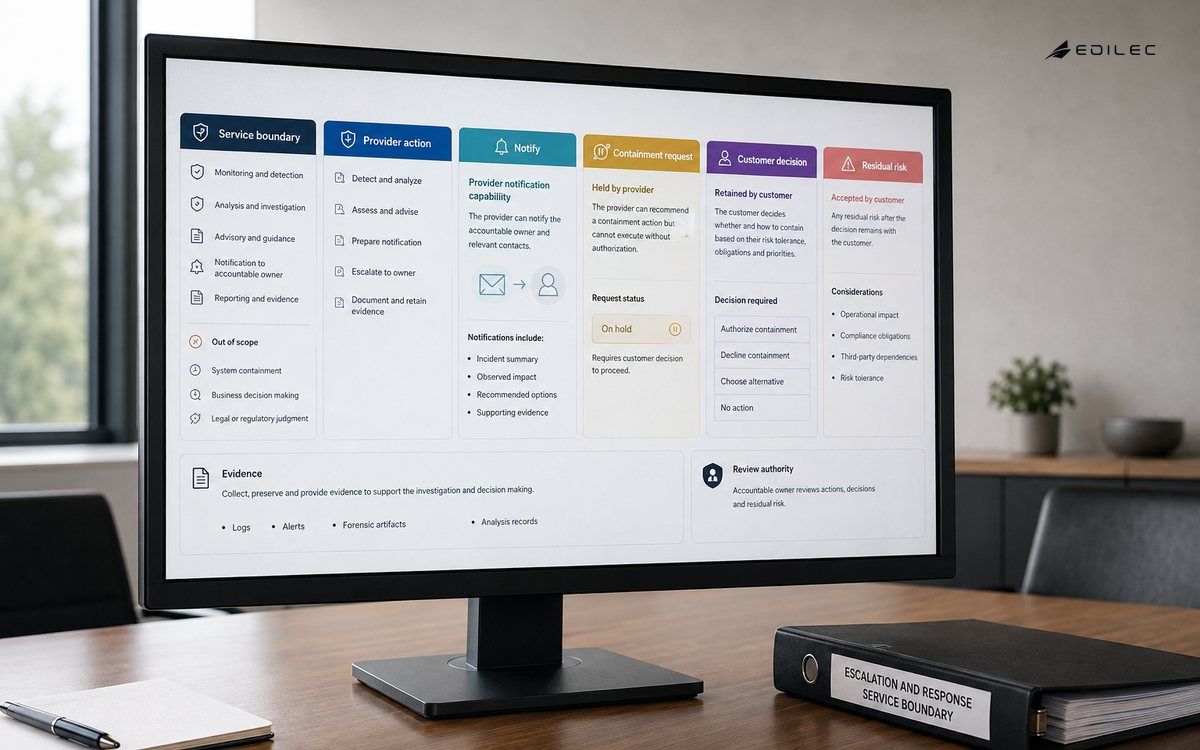
Ask whether the supplier only alerts or can contain, and under whose authority. Determine who manages endpoints, identities, network controls, cloud configuration, vulnerability remediation, evidence retention and communications. A response retainer may guarantee access to specialists but not include proactive readiness or a fixed arrival time. Translate marketing labels into a responsibility matrix, service levels, preconditions, deliverables and customer actions.
| Service type | Primary evidence | Common boundary question |
|---|---|---|
| Risk and architecture | Current/target profile, decisions and roadmap | Who funds and accepts residual risk? |
| Assessment or test | Scoped findings, evidence and retest | What was not tested and for how long is evidence useful? |
| Vulnerability management | Coverage, prioritization and remediation status | Who owns fixes and exceptions? |
| Managed detection | Telemetry, detections, triage and escalations | Can the provider contain or only notify? |
| Incident response | Readiness, investigation and recovery support | Who declares severity and directs business action? |
| Security engineering | Implemented controls and operating procedures | Who maintains the control after handover? |
How should a cybersecurity provider be evaluated?
Evaluate the provider against your scenarios, not a generic feature list. Request a walkthrough from signal to decision: how telemetry is acquired, normalized and protected; how detections are developed and tuned; how analysts investigate; what evidence reaches the customer; and how a critical event escalates if primary contacts are unavailable. Inspect staffing coverage, subcontractors, access model, data locations, retention, security program, vulnerability handling, continuity, insurance and contractual liability with qualified counsel.
Run a tabletop or controlled simulation before committing critical operations. Seed a representative event and observe detection, handoffs, context, authority and communication. Ask for sample deliverables with sensitive details removed. References are useful when their environment and service model resemble yours. Certifications and attestations can support due diligence, but they do not prove that the provider understands your assets or that the configured service will work under pressure.
Which controls should be prioritized first?
Prioritize controls that reduce common, high-impact paths and support recovery: accurate asset and service ownership, phishing-resistant multifactor authentication where feasible, protected administrative accounts, timely remediation of exploited vulnerabilities, secure backups, centralized security logging, tested incident contacts, constrained remote access, email protections and a maintained inventory of internet exposure. CISA's Cross-Sector Cybersecurity Performance Goals provide a voluntary set of high-impact practices that organizations can adapt to their risks.
Control quality matters more than nominal presence. MFA does not protect an unmonitored legacy protocol; a backup does not establish recovery until restoration and reconciliation work; a vulnerability scanner cannot fix unknown ownership; and a SIEM cannot detect events from missing sources. Define control objective, scope, owner, operation frequency, evidence, exception process and failure response. Test critical controls against representative attack and outage scenarios.
Do cybersecurity services require zero trust?
Zero trust is an architectural approach, not a product requirement for every engagement. NIST SP 800-207 shifts focus from implicit trust based on network location toward explicit decisions about subjects, devices and resources. Organizations can apply that direction incrementally by strengthening identity, device context, resource-level policy, segmentation, telemetry and continuous evaluation. The correct sequence depends on current architecture and business risk.
A provider using the term should identify resources, policy decision and enforcement points, signals, identities and migration stages. Test access denial as well as successful access, including compromised credentials, unmanaged devices, service identities and emergency administration. Avoid concentrating all access through a new platform without resilience and recovery design. Zero trust does not eliminate endpoint security, secure software, data protection or incident response.
Follow a six-stage cybersecurity service outcome roadmap
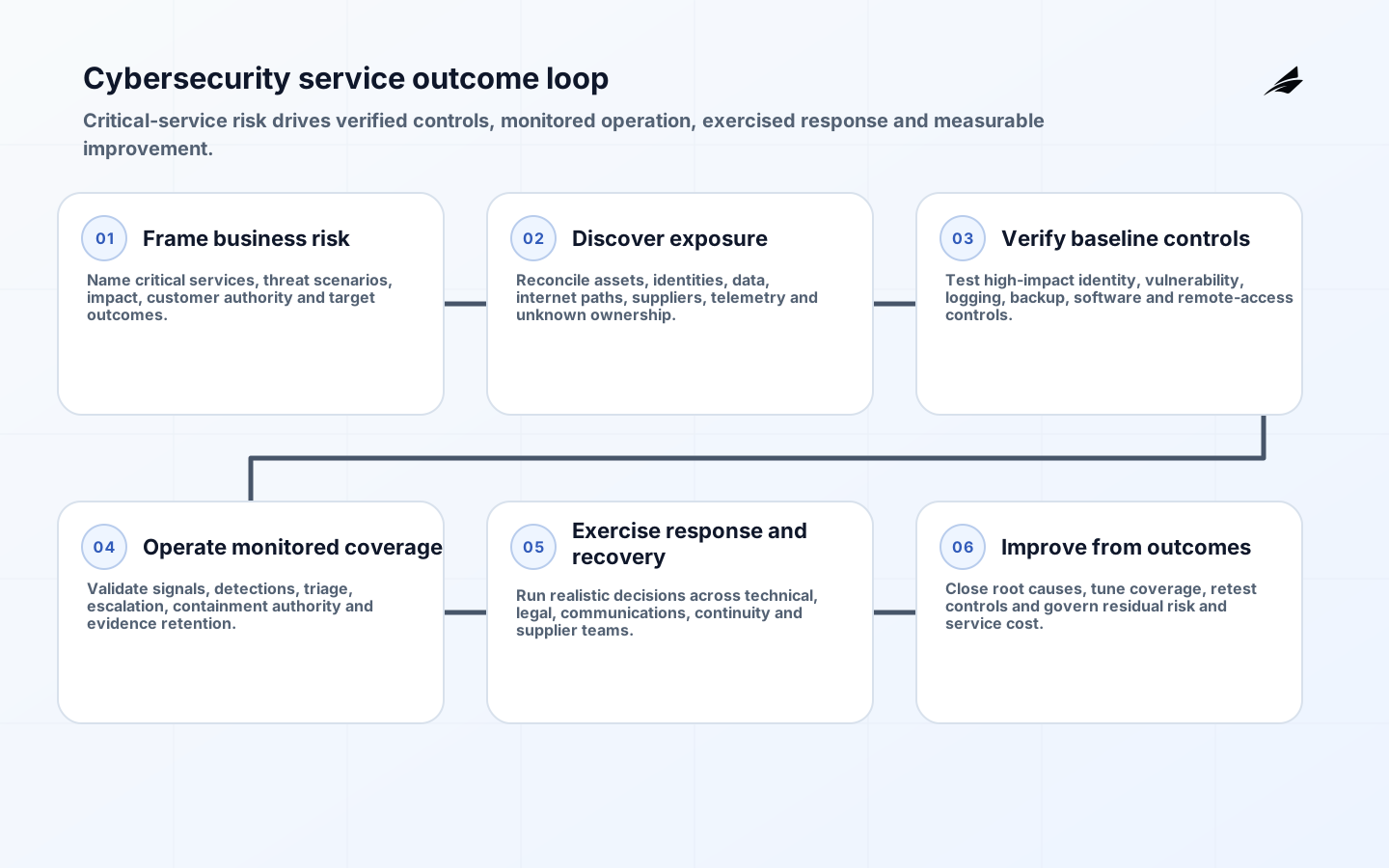
Sequence the engagement through business-risk framing, exposure discovery, baseline control verification, monitored operation, exercised response and continuous improvement. The first cycle should cover one or two critical business services deeply enough to reveal ownership and integration problems. Expand after the provider and customer prove data flow, authority, response and reporting. This avoids a wide deployment whose alerts have no accountable destination.
Each stage has an exit condition: approved risk scenarios; reconciled assets; controls tested; telemetry and detections validated; an exercise completed; and an improvement backlog governed. Use the roadmap in service reviews so findings lead to decisions rather than accumulating in reports. Supplier metrics should connect to customer action, including aging of escalations, repeat incidents, coverage changes and remediation dependencies.
What should incident response support provide?
Incident response support needs known activation routes, severity definitions, authority, secure communications, evidence handling, technical investigation, containment options, recovery coordination and post-incident learning. NIST finalized SP 800-61 Revision 3 in April 2025 and its incident response project integrates response considerations across CSF 2.0 risk management. Preparation is not a one-time plan; identities, suppliers, cloud services and business processes change.
Exercise scenarios that force decisions: ransomware affecting identity and backups, cloud credential compromise, sensitive data exfiltration, software supply-chain tampering and destructive insider action. Include executives, legal and privacy roles, communications, business operations, insurers and key providers as relevant. Measure time to establish facts, make containment decisions, activate continuity, restore priority services and reconcile records. Update technical and executive playbooks from observed friction.
How should cost and performance be measured?
Total cost includes onboarding, integration, log storage, licenses, endpoint or identity coverage, analyst capacity, retainers, premium response, customer staffing, remediation and exit. Clarify minimum commitments, overages, data export and price changes as assets or event volume grow. Compare managed service cost with the capability and residual work it replaces, not with an imaginary zero-cost internal team. Cheap alert forwarding can create expensive internal triage and missed context.
Use a balanced set of risk and operating measures. Track coverage of critical services, administrative identity protection, detection validation, exposure age, containment exercise results, restoration evidence, recurring root causes and accepted exceptions. Operational metrics such as acknowledgement time matter, but a fast closure that misses a compromise is not success. Report material changes and decisions to leadership in business language, preserving technical detail for practitioners.
| Measure | Useful interpretation | Misleading substitute |
|---|---|---|
| Critical-service coverage | Assets and telemetry mapped to owned services | Total agents installed |
| Detection efficacy | Representative adversary behavior is observed and escalated | Number of detection rules |
| Exposure reduction | High-impact paths close within risk-based targets | Raw vulnerability count |
| Response readiness | Teams make decisions in exercises with current access | Plan publication date |
| Recovery confidence | Priority services restore and records reconcile | Backup job success |
| Service value | Measured risk or operating burden improves | Monthly report volume |
Where does application and software security fit?
Security services should reach the software lifecycle when applications create material exposure. The NIST Secure Software Development Framework groups practices around preparing the organization, protecting software, producing well-secured software and responding to vulnerabilities. Translate this into requirements, threat modeling, repository and build protection, dependency visibility, code review, automated testing, artifact integrity, release gates and a vulnerability-response process.
A periodic test cannot compensate for insecure architecture and uncontrolled releases. Conversely, automated scanning alone cannot reason about authorization or business logic. Combine developer enablement, secure defaults, specialist review and independent testing according to impact. Ensure findings enter product backlogs with owners and risk-based deadlines. Track root causes and improve reusable components so the same defect pattern does not recur across teams.
Cybersecurity services takeaways
- Buy outcomes for defined business services and threat scenarios.
- Translate service labels into responsibility, authority and evidence.
- Prioritize verified controls that interrupt common high-impact paths.
- Exercise provider and customer handoffs before a real incident.
- Measure coverage, efficacy, recovery and residual customer work.
- Retain internal ownership of risk, lawful decisions and continuity.
Frequently asked questions
Can a managed provider guarantee no breach? No. A credible provider reduces likelihood, improves detection or response and states assumptions; it cannot remove all risk. Is 24/7 monitoring always required? It depends on impact and response needs, though critical internet-facing operations often need continuous coverage. How often should penetration testing occur? Use risk, material change and contractual or regulatory duties rather than an arbitrary universal interval. Does compliance prove security? No; it can provide useful control evidence within scope.
Should one provider cover everything? Consolidation can simplify integration but also concentrates access and supplier risk; assess capability and exit per service. Who remediates findings? Name customer or supplier owners contractually and operationally. What is a reasonable onboarding period? Estimate from asset discovery, access, integrations, data flow, tuning and exercises, not license activation. When can a service be accepted? When scope, telemetry, escalation, authority, reporting and continuity have passed representative tests.
Conclusion
Effective cybersecurity services turn business risk into maintained controls and tested decisions. Define critical services, choose capabilities that address credible scenarios, make responsibility boundaries explicit and validate handoffs under pressure. Metrics should show whether exposure, detection, response and recovery improve, not merely how much activity a supplier reports. The strongest relationship combines external capability with informed internal ownership and a continuously tested route to resilience.