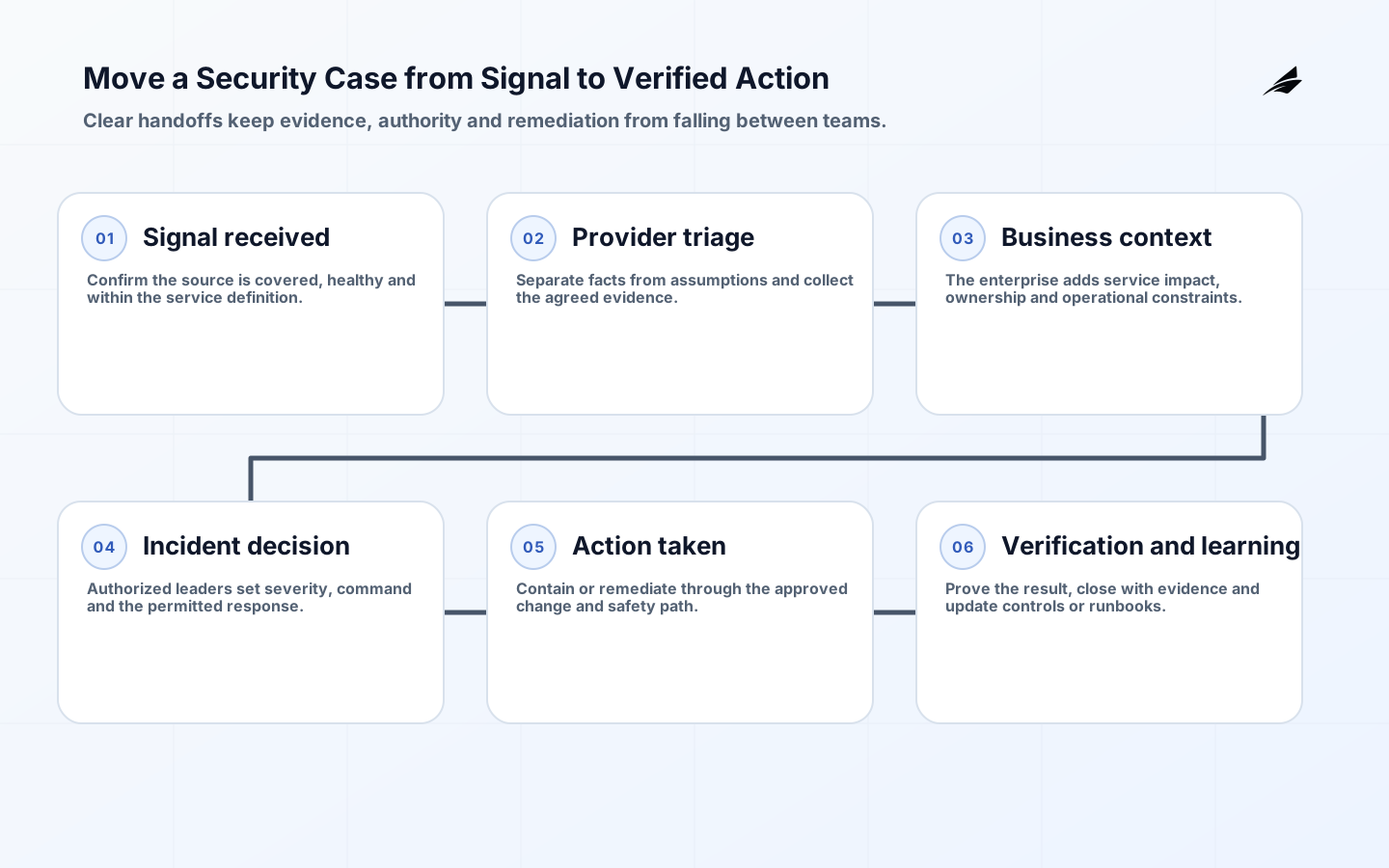
This checklist is for teams implementing advisory, engineering or managed cybersecurity services. It treats procurement as the beginning of operating-model design, not the finish. Complete each gate with enterprise and provider owners together, retain evidence in enterprise-controlled locations and document exclusions. Use the enterprise service planning guide for scope and cost, and the enterprise cybersecurity FAQ for selection questions.
Key takeaways
- Authorize business outcomes, covered populations, decision rights and exclusions before mobilization.
- Reconcile assets, identities, telemetry and owners so coverage has a denominator.
- Test representative cases and disruptive-action approvals before relying on the service.
- Measure investigation quality, remediation and control health alongside response clocks.
- Keep rules, records, access and exit materials under active enterprise governance.
Gate 1: Approve outcomes and authority
Name the executive sponsor, service owner, risk owner, incident commander, technology owners, privacy or legal contacts and provider lead. Map desired outcomes to NIST CSF 2.0 functions and to applicable requirements. State which decisions remain internal and which actions the provider may take. Define emergency authority for identity disablement, endpoint isolation, evidence capture, service interruption and external communication.
- State critical services and scenarios the service is expected to address.
- List legal entities, regions, business units, users, assets, suppliers and environments in scope.
- Separate monitoring, investigation, remediation, assurance and project engineering.
- Define hours, channels, escalation tiers and continuity when either party is unavailable.
- Approve data processing, location, retention, legal hold, deletion and subcontractors.
| Gate evidence | Pass condition | Blocker |
|---|---|---|
| Service charter | Outcome, scope and exclusions have owners | Service is defined only by product names |
| Authority matrix | Disruptive actions and approvals are explicit | Provider is told to use judgment without limits |
| Requirement map | Qualified owners confirm applicable obligations | Generic compliance claim replaces interpretation |
| Urgent route | Critical issue reaches an authorized person | Escalation depends on one unavailable contact |
Gate 2: Establish a reliable baseline
Reconcile asset inventories, identity directories, endpoint management, vulnerability systems, network sources, cloud platforms, application catalogs and supplier lists. Record which source is authoritative for each population and how often it changes. Measure telemetry coverage and connector health, not just licensed capacity. Unknown ownership, unsupported systems and duplicate records belong in the risk and mobilization backlog.
Map the current operating process from signal to business decision. Observe real cases: where context is added, who decides severity, how a service owner receives remediation, when evidence is retained and how closure is verified. This prevents a new provider from automating a process whose gaps are not understood.
| Baseline | Evidence | Owner |
|---|---|---|
| Critical services | Dependency and ownership map | Business service owner |
| Assets and identities | Reconciled populations and confidence | Technology and identity owners |
| Telemetry | Source, health, retention and use case | Security operations |
| Response | Severity, authority, contacts and runbooks | Incident commander |
| Remediation | Routing, exception and verification process | Control and service owners |
Gate 3: Design the service interfaces
For every service component, define inputs, triage or engineering steps, decisions, outputs, customer dependencies and evidence. Replace “monitor alerts” with covered source, health check, detection ownership, enrichment standard, severity method, case route, response target and closure rule. Replace “manage vulnerabilities” with discovery method, asset reconciliation, prioritization, remediation ownership, exception process and retest.
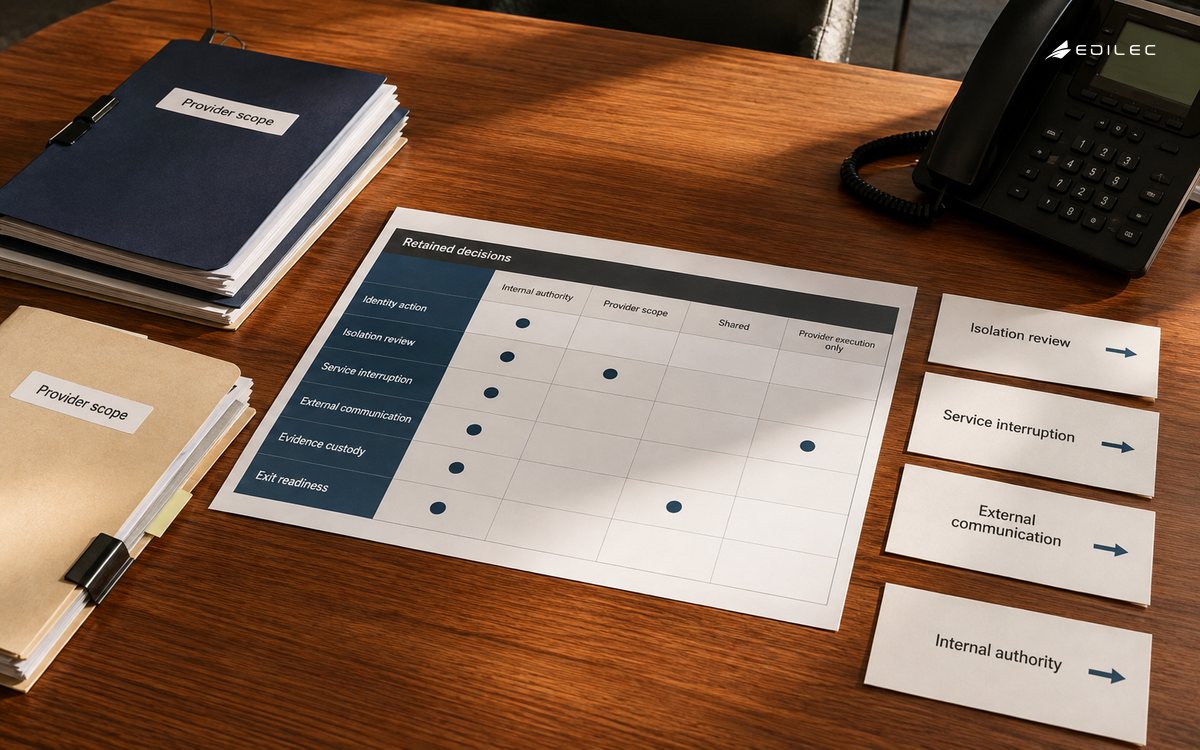
| Interface | Provider responsibility | Enterprise responsibility |
|---|---|---|
| Detection content | Develop, test, tune and document agreed rules | Provide threat context and approve material changes |
| Investigation | Gather evidence and assess against severity method | Supply business context and decision authority |
| Containment | Recommend or execute pre-authorized actions | Set safety limits and command incident |
| Remediation | Create actionable work and verify evidence | Fund, schedule and own system change |
| Reporting | Produce defined measures and risk narratives | Review decisions and resolve blockers |
Gate 4: Secure provider access and data
Use named, federated and time-bounded identities where possible. Separate routine analysis, engineering and emergency privileges. Require strong authentication, approval for elevation, logging, periodic review and prompt revocation. Provider tooling and support paths are part of the attack surface; include them in supplier assurance and incident coordination.
- Inventory every provider identity, integration credential, API token and support account.
- Restrict access by role, environment, data class and approved device where feasible.
- Record privileged sessions and test emergency revocation.
- Limit copied evidence to what is necessary and protect exports in transit and storage.
- Set retention, legal hold, return, deletion and breach-notification procedures.
Gate 5: Integrate and dry-run
Connect sources in waves and verify completeness, timestamps, field meaning, filtering, retention and health alerts. Map case fields and severity between systems. Test ticket creation, deduplication, ownership transfer, status synchronization and evidence links. Run failures deliberately: disconnect a source, send malformed data, revoke a connector credential and make the receiving queue unavailable.
Prepare playbooks for priority scenarios and common operational cases. Each should name evidence, decision points, authority, communications, containment choices, recovery handoff and closure. Keep steps adaptable; an incident playbook is a decision aid, not permission to act outside approved authority.
| Dry run | Expected evidence | Failure response |
|---|---|---|
| Telemetry loss | Health alert reaches an owner | Escalate and mark coverage degraded |
| High-severity case | Correct context reaches incident command | Use tested alternate channel |
| Containment request | Approval and execution are recorded | Stop if safety owner is unavailable |
| Remediation ticket | Affected service and verification are clear | Return incomplete work with reason |
| Provider outage | Enterprise can receive signals and coordinate | Invoke continuity and contact plan |
Gate 6: Prove the service with representative cases
Choose safe cases that exercise common and high-consequence paths: a test privileged login, an endpoint detection simulation, an exposed test service, a vulnerable package in a non-production build and a recovery tabletop. Evaluate reasoning and handoffs, not whether an alert appears. Confirm source health, enrichment, severity, authority, action, evidence, business reconciliation and closure.
| Acceptance area | Pass question | Evidence |
|---|---|---|
| Coverage | Was the test in the declared population and was source health known? | Coverage and connector records |
| Analysis | Did the case explain facts, assumptions and consequence? | Investigation timeline |
| Authority | Were decisions made by the correct roles? | Approval and command record |
| Action | Did containment or remediation follow the safe path? | Change and verification |
| Learning | Did findings update content, runbooks or risk? | Owned improvement item |
Gate 7: Transition in controlled waves
Move by business service, region, asset class or capability. During overlap, designate one system and team as the case authority to avoid duplicate or conflicting action. Set entry criteria for connector health, trained contacts, approved playbooks and provider access. Set exit criteria for tested cases, accepted measures, old-service data export and access removal.
Hold frequent operational reviews during early waves. Examine rejected cases, missing context, false closure, source gaps, delayed approvals and remediation queues. Tune with change records so reduced alert volume is not mistaken for improved security. Pause expansion when critical coverage is unknown, case routing fails or internal owners cannot support demand.
Gate 8: Operate, improve and preserve exit readiness
Transfer recurring governance into a service calendar: access review, coverage reconciliation, detection testing, vulnerability exception review, incident exercise, recovery test, supplier review and metric review. Retain architecture, rules, queries, runbooks, cases and decisions in enterprise-controlled repositories or assured export formats. Test export and provider replacement before contract end.
| Recurring review | Decision produced | Warning sign |
|---|---|---|
| Coverage health | Add, repair or formally exclude sources | Counts lack denominator |
| Case quality | Tune evidence and escalation standard | Only speed is reviewed |
| Remediation | Fund, sequence or accept residual risk | Provider closes on ticket creation |
| Privilege | Renew, narrow or remove access | Emergency role becomes routine |
| Exit readiness | Repair export, documentation or internal skill | Custom content cannot be transferred |
Implementation risks and responses
| Risk | Signal | Response |
|---|---|---|
| Unclear ownership | Cases wait between teams | Name service and risk owners |
| Data overcollection | Provider retains unnecessary records | Minimize fields and enforce lifecycle |
| Automation blast radius | Actions can interrupt critical services | Use graduated authority and proof cases |
| Metrics gaming | Alerts or tickets rise while outcomes do not | Audit samples and pair speed with quality |
| Knowledge dependency | Internal team cannot direct an incident | Run operator-led exercises and retain content |
Create an acceptance pack for each rollout wave rather than waiting for one final report. Include covered populations, degraded sources, representative case results, open risks, approved exceptions, access changes, operator feedback and the decision to proceed. This gives governance a traceable basis for expansion and allows a later reviewer to distinguish a deliberate exclusion from an overlooked asset or unfinished integration.
Frequently asked questions
Can mobilization begin before the asset baseline is perfect? Yes, if uncertainty is visible, high-risk gaps have owners and coverage claims use honest denominators. Do not present partial telemetry as complete.
Should the provider close remediation tickets? Only when closure criteria include implementation and verification, or when the contract explicitly defines handoff as the service endpoint. Reporting a ticket created as risk removed is misleading.
How many proof cases are enough? Choose enough to exercise material interfaces and authorities. Selection should follow risk and service diversity, not a universal count.
Can automated containment start immediately? Begin only with low-risk, well-understood actions or after safe simulation. High-impact action needs explicit authority, safeguards and rollback.
What must be ready for exit? Exportable history and content, current documentation, removed access, retained evidence, replacement continuity and internal people who understand the service.
Conclusion
Implementing enterprise cybersecurity services is a controlled transfer of work, data and privilege, not a connector project. Progress through gates with evidence, test decision paths before dependence, and keep internal owners able to direct incidents, remediation and transition. A service is ready when it changes risk safely and remains operable if the provider relationship changes.