Cybersecurity services help an organization understand risk, implement and operate safeguards, detect harmful activity, respond to incidents and improve resilience. The label covers very different offerings, from a short assessment to a managed security operation. Buyers need a scope tied to assets, business consequences and decision rights. Otherwise a provider can deliver reports and alerts while critical systems, response authority and recovery remain outside the service.
This guide connects to the Cybersecurity Services Implementation Checklist: From Risk Baseline to Tested Response and the cybersecurity services FAQ. Teams comparing a broader supplier portfolio can also use the related cyber security services FAQ. The aim is a governable delivery plan with evidence, not a promise to eliminate cyber risk.
What can cybersecurity services include?
Common work includes governance and risk assessment, architecture, identity, cloud and endpoint security, vulnerability management, secure software practices, security monitoring, incident response, recovery, awareness, compliance evidence and supplier risk. A provider may advise, implement, operate or independently assess a control. Those verbs matter. An assessor should not certify its own implementation without safeguards, and a monitoring provider cannot remediate systems it lacks authority or access to change.
NIST’s Cybersecurity Framework 2.0 organizes outcomes under Govern, Identify, Protect, Detect, Respond and Recover and applies across sectors and maturity levels. Use it as a common outcome taxonomy, not a product list. NIST explicitly describes CSF outcomes as non-prescriptive. The customer and provider still need to select actions and evidence appropriate to the organization’s threats, obligations, technology and risk tolerance.
| Service area | Provider output | Customer decision that remains |
|---|---|---|
| Governance and assessment | Current/target profile, risks, priorities and roadmap | Risk appetite, funding, policy and exception acceptance |
| Control implementation | Configured identity, endpoint, cloud, network or application safeguards | Business access, architecture and change approval |
| Security operations | Telemetry, detection, triage, investigation and coordinated containment | Incident authority, business impact and external notification |
| Vulnerability management | Discovery, validation, prioritization and remediation workflow | Downtime, compensating controls and residual risk |
| Resilience | Backups, recovery runbooks, exercises and improvement records | Recovery objectives and business validation |
How should scope follow risk?
Start with business services and harmful scenarios: payment interruption, confidential design theft, unsafe operational change, fraudulent privileged access, destructive ransomware or unavailable customer support. Map the systems, data, identities, suppliers and facilities that enable each service. Record criticality, current controls, known exposure, recovery needs and accountable owners. Prioritize work by consequence, likelihood, exploitability and control dependency. An asset inventory is necessary, but a device count alone does not explain enterprise risk.
For organizations needing a concise starting baseline, CISA’s Cross-Sector Cybersecurity Performance Goals identify a limited set of high-impact practices and align them with CSF functions. They are voluntary and especially useful for prioritization. Applicability still needs documentation. Apply sector-specific requirements, legal obligations and contractual commitments where relevant, and avoid representing a voluntary baseline as universal compliance.
What does a practical delivery plan look like?

Phase the work around control dependencies. Establish governance, scope and identity first; visibility and response depend on knowing assets and accountable users. Close a small number of high-consequence gaps, connect required telemetry, validate detections, and exercise response and recovery. Expand by business service or control family. Maintain a risk register with decisions and dates, but deliver operating controls in each wave. A year of assessment before any risk reduction leaves the enterprise exposed.
Every control needs a design, owner, operator, evidence, cadence, exception route and failure response. For example, multifactor authentication requires defined populations, resistant methods appropriate to risk, enrollment, recovery, break-glass access, monitoring and periodic review. “Enable MFA” is not acceptance. Test normal use, lost authenticators, role change, privileged access and emergency recovery. Apply the same operational detail to backups, logging, endpoint coverage and vulnerability remediation.
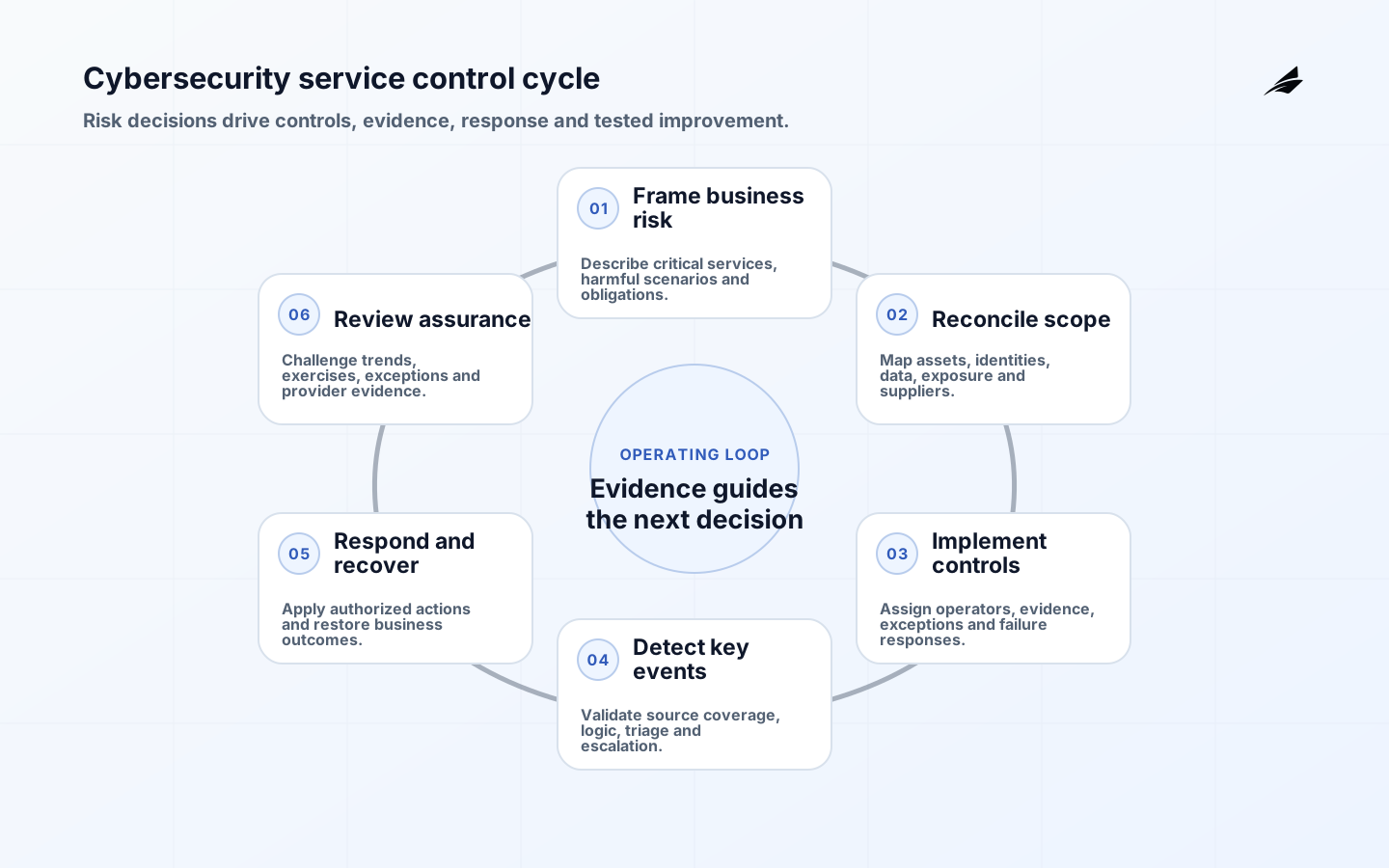
- Frame priority business services, harmful scenarios, obligations and accountable risk owners.
- Reconcile assets, identities, data, external exposure and suppliers for the selected scope.
- Define target outcomes and implementation evidence using an appropriate framework or profile.
- Implement controls in dependency-aware waves with change, rollback and exception handling.
- Validate telemetry, detections, containment authority and recovery through realistic exercises.
- Review trends, incidents, exceptions and threat changes, then fund the next risk-reduction decision.
How should identity and zero trust be handled?
Identity is a control plane for workforce, administrators, service accounts, workloads, customers and providers. Establish authoritative lifecycle sources, unique identities, strong authentication, least privilege, time-bound elevation, access reviews and prompt revocation. Separate daily and privileged activity. Protect recovery and break-glass paths and monitor their use. The provider should use customer-approved, attributable identities; shared accounts and permanent global administration make investigation and exit unnecessarily risky.
NIST’s Zero Trust Architecture removes implicit trust based solely on physical or network location and focuses on protecting resources. Zero trust is an architecture approach, not a single product purchase. Select use cases such as privileged administration or access to sensitive applications, define policy inputs and enforcement points, test fail-safe behavior, and measure unauthorized and unnecessary access reduction. Network segmentation remains useful but should not be mistaken for identity-aware authorization.
What should vulnerability and software security services deliver?
Vulnerability management needs authenticated coverage, asset ownership, validation, risk-based prioritization, remediation, exception expiry and verification. Severity scores are inputs, not complete business decisions. Account for exploitation, exposure, privilege, data and service consequence, available fixes and compensating controls. Track unsupported assets and remediation age. Scan results without owner and change capacity become an expanding queue, while an aggressive patch target without testing and rollback can create availability risk.
For software producers, NIST’s Secure Software Development Framework provides a common vocabulary for preparing the organization, protecting software, producing well-secured releases and responding to vulnerabilities. A service should integrate threat modeling, code and dependency review, build protection, testing, provenance, component inventory and disclosure into delivery. A penetration test is valuable evidence at a point in time, but it cannot replace secure lifecycle practices or production vulnerability response.
How should monitoring and incident response work?
Define the events that matter: privileged access changes, disabled controls, suspicious authentication, endpoint execution, data transfer, external exposure, backup interference and high-risk cloud changes. For each detection, record data dependencies, logic, severity, owner, expected response, test cases and tuning history. Measure source coverage and ingestion health alongside alert counts. A quiet console is not reassuring when agents are offline or required logs never arrived.
Incident authority must be explicit. Pre-authorize narrow containment for defined conditions, such as disabling a confirmed compromised provider account, and identify actions requiring a customer commander because they can stop production or affect evidence. NIST SP 800-61 Revision 3 integrates incident response into cybersecurity risk management across all CSF functions. Contracts should cover contacts, severity, notification, evidence preservation, legal and communications handoffs, recovery, lessons and corrective action.
| Measure | Useful definition | Why it matters |
|---|---|---|
| Control coverage | In-scope assets or identities with the required control operating | Shows whether safeguards reach the agreed estate |
| Telemetry coverage | Required sources sending timely, parseable events | Prevents blind spots from hiding behind alert totals |
| Triage time | Alert availability to documented severity decision | Measures provider-controlled understanding |
| Containment execution | Authorized decision to verified containment | Separates approval delay from operating ability |
| Remediation age | Open exposure by risk tier and deadline | Shows accumulation and exception behavior |
| Recovery proof | Critical scenarios restored within approved objectives | Tests resilience instead of assuming backups work |
Which provider model fits?
Consulting fits strategy, architecture, assessment and specialized change. A managed security service fits repeatable monitoring and control operation. An incident response retainer provides prepared specialist capacity. A virtual security leader can support governance where an accountable internal executive still owns risk. One supplier can combine roles, but independence and conflicts must be addressed. Ask which work is performed by named staff, automated systems, subcontractors and the customer.
Evaluate relevant competence, geographic and shift coverage, staff screening where lawful, access controls, tenant separation, secure development, continuity, incident history, assurance reports and subcontractors. Map evidence to the exact service, location and system. A corporate certification does not prove that a particular detection is tested or that recovery works. Run a sample alert investigation, access revocation and evidence export before accepting steady state.
What drives cybersecurity services cost?
Price drivers include asset and identity counts, cloud accounts, log volume and retention, endpoints, applications, sites, regulatory scope, operating hours, response authority, vulnerability frequency, integrations and reporting. Separate one-time discovery, implementation and transition from recurring operation, licenses, cloud consumption and optional incident hours. Require volume assumptions, included tiers, overage rates and a worked example. Cheapest per-device pricing may exclude the data and response work needed for critical systems.
Service levels should focus on work the provider controls: onboarding, source health, acknowledgement, triage, escalation, authorized action and evidence delivery. Define when clocks start, pause and stop; severity rules; customer dependencies; exclusions; and remedies. Pair speed with quality and coverage. Fixed scope needs a controlled process for new assets and threats. Budget explicit improvement capacity, because detections, baselines and response plans degrade when the environment changes.
What are the main service risks and exit controls?
Key risks include unclear responsibility, excessive provider privilege, missing telemetry, noisy detection, delayed customer decisions, untested recovery, unsupported assets, subcontractor dependency and evidence lock-in. Treat the provider itself as a supply-chain risk. Limit and monitor access, segregate duties, rehearse compromise of a provider identity, and maintain a direct route to critical technology vendors and authorities where needed. Customer leadership cannot outsource accountability for enterprise risk.
Exit terms should cover policies, inventories, architecture, configurations, rules, queries, cases, timelines, exceptions, evidence, runbooks and reports in usable formats. Transfer open incidents and vulnerabilities, revoke identities, rotate accessible secrets and keys, redirect data flows, and verify retention or deletion. Test a partial export during the contract. NIST’s CSF FAQ stresses communication of outcomes among executives, implementers, suppliers and customers; portable evidence sustains that communication through a provider change.
Key takeaways
- Scope cybersecurity services from business harm, critical services and risk decisions rather than a generic tool bundle.
- Assign every control an owner, operator, evidence source, cadence, exception path and failure response.
- Measure coverage and quality as well as response speed so missing data cannot look like improvement.
- Predefine incident authority and test containment, recovery and provider access before a real crisis.
- Keep configurations, evidence and operating knowledge portable, and treat the provider as part of supply-chain risk.
Frequently asked questions
Can a small organization use the same framework?
Yes. CSF 2.0 is designed for organizations of different sizes and maturity. Select a focused profile and prioritize high-impact basics instead of attempting every possible control. Leadership, inventory, secure identity, backups, updates, essential logging, response contacts and supplier controls usually provide a stronger start than a large collection of unowned tools.
Does a managed provider replace an internal security owner?
No. The customer needs authority for policy, risk acceptance, business impact, legal obligations, incidents, recovery priorities and supplier oversight. A managed provider can supply specialist people and continuous operations. Name an internal service owner who can resolve dependencies, approve consequential action and challenge the provider’s evidence.
Does framework alignment prove compliance?
Not by itself. Frameworks help organize outcomes, while compliance depends on the applicable law, regulation, contract and evidence. Map obligations explicitly, obtain qualified legal or assurance advice where needed, and verify control operation. Avoid public claims that exceed the assessed scope, period or assurance level.
Conclusion
Cybersecurity services are effective when they create demonstrable risk reduction and stronger recovery, not merely more findings. Frame harmful scenarios, establish an owned baseline, implement controls in sensible waves, connect detection to authority, and test the full response. Transparent scope, metrics and exit evidence make a provider an accountable extension of the organization while keeping enterprise risk decisions where they belong.