A cybersecurity services implementation checklist should produce verified risk reduction, not a pile of tools and policies. Begin with business services and credible harm, establish accountable governance, then connect assets, identities, protective controls, detection, response and recovery. Evidence must come from deployed configuration, telemetry and exercises. A provider can operate controls, but organizational leadership retains responsibility for risk decisions and affected customers.
Use the companion cybersecurity services plan to define scope and the cybersecurity services FAQ for buyer questions. This checklist is framework-informed rather than compliance-specific. Map applicable laws, contracts and sector standards separately, with qualified advice where needed.
1. Establish governance and risk decisions
Name an executive sponsor, security leader, business service owners, data owners, incident authority and control operators. Define risk appetite in operational terms such as maximum outage, data exposure, fraudulent payment or safety impact. Adopt a decision cadence, exception process and reporting route to leadership. NIST Cybersecurity Framework 2.0 adds Govern as a core function, reinforcing that strategy, roles, policy, oversight and supply-chain risk belong around the technical controls.
Create a current-state and target profile using outcomes that matter to the organization. NIST’s CSF quick-start guides support profiles, tiers and technology acquisition. Prioritize gaps by plausible scenario, business consequence, exposure and control dependency. Assign funding, owner, due date and acceptance evidence. Do not label an unresolved high risk “accepted” without an authorized decision and review date.
2. Reconcile services, assets, data and suppliers
Build service maps that connect applications, infrastructure, endpoints, identities, data, networks, code, cloud accounts, operational technology and suppliers. Reconcile discovery sources because no scanner sees business purpose or every environment. Record owner, criticality, exposure, supported version, data class, location and recovery dependency. Ownerless or unsupported assets need a disposition, not a permanent inventory exception.
Map sensitive and authoritative data from collection through use, sharing, backup, retention and deletion. Minimize unnecessary copies and stale access. Inventory supplier dependencies, subprocessors, remote administration and software components. Contract reviews should cover security duties, vulnerability handling, incident notice, evidence, recovery, data return and exit. Validate critical supplier claims through relevant assurance and exercises rather than relying on a questionnaire score alone.
| Checklist domain | Minimum evidence | Owner |
|---|---|---|
| Governance | Approved profile, risk register and exception dates | Executive and security leadership |
| Assets and data | Reconciled service map with owners and classifications | Service and data owners |
| Protection | Identity, hardening, patch and backup evidence | Platform and product teams |
| Detection and response | Telemetry coverage, playbooks and exercise findings | Security operations and incident lead |
| Recovery | Restored business transaction and reconciliation | Service owner and continuity lead |
3. Secure identity, privilege and access
Make identity the primary control plane across workforce, customers, machines and suppliers. Establish authoritative sources, joiner-mover-leaver automation, phishing-resistant multifactor authentication for high-risk access, conditional controls, separate administration, privileged elevation, service-account ownership and secret rotation. Remove shared and dormant accounts. Test revocation across sessions, tokens, VPNs, cloud consoles and downstream applications.
Move toward resource-level decisions based on verified subject, device, context and policy rather than trusted network location. NIST’s zero trust implementation guide provides concrete example architectures. Do not buy “zero trust” as a single product. Phase improvements around consequential access paths, measure coverage and preserve emergency access that is narrow, monitored and exercised.
4. Harden systems and the delivery path
Define secure baselines for endpoints, servers, cloud services, network devices, SaaS and development platforms. Remove default credentials and unnecessary services, encrypt sensitive paths, restrict administrative interfaces, manage configuration as code where possible, and detect drift. Prioritize vulnerabilities using exposure, exploitability, asset consequence and compensating controls, then verify remediation. A patch percentage can hide the few exposed systems that dominate risk.
Protect software delivery with reviewed source, branch and release controls, dependency management, isolated build identities, artifact signing or provenance where appropriate, secret scanning and deployment rollback. CISA’s Secure by Design places responsibility on technology providers to make products secure by default. Buyers should similarly prefer products that support strong authentication, logging and safe configuration without expensive add-ons.
5. Follow a six-stage cybersecurity implementation sequence
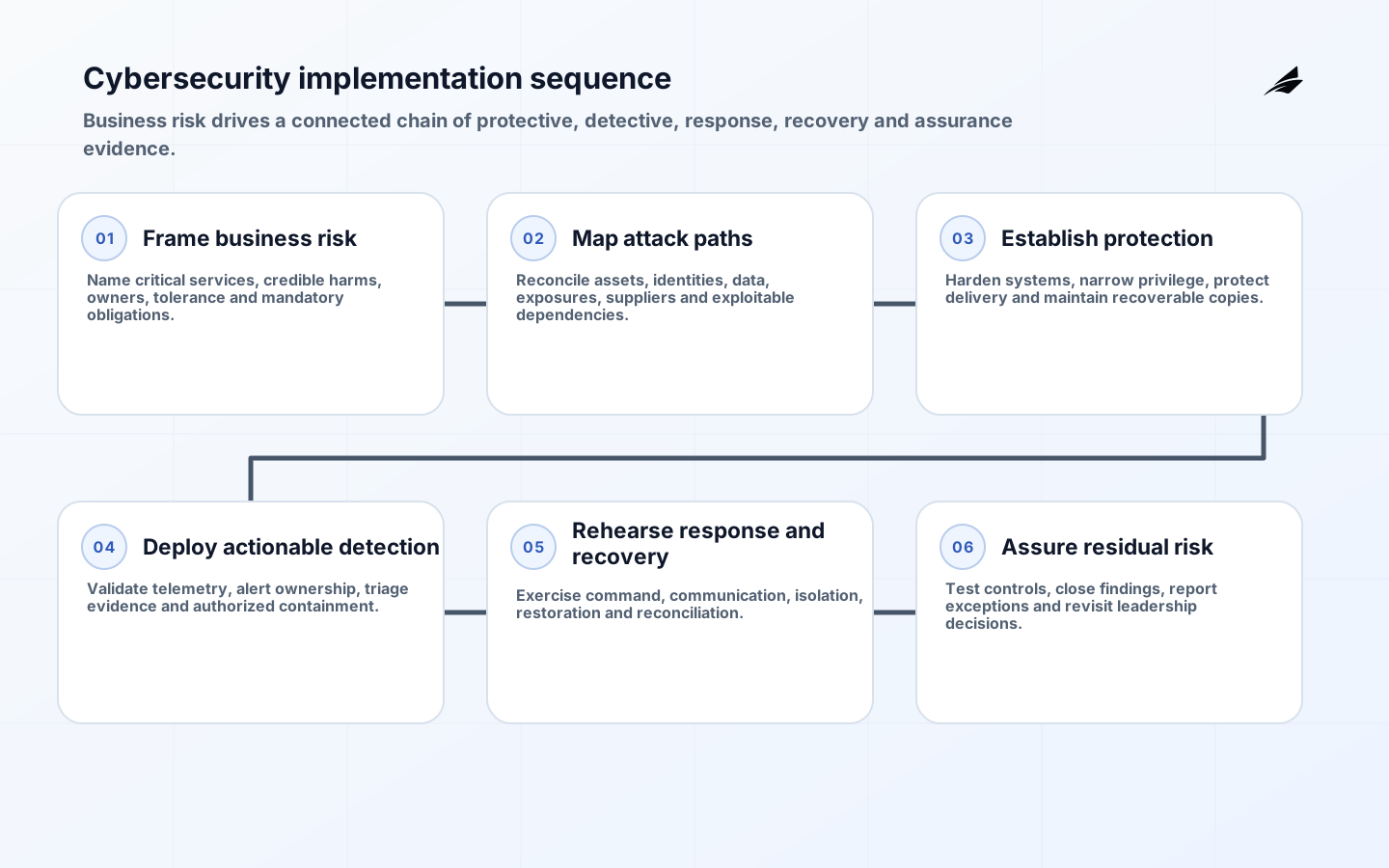
Sequence work as: frame business risk, map attack paths, establish identity and hardening, deploy actionable detection, rehearse response and recovery, then verify residual risk. This preserves dependencies. A response retainer cannot compensate for unknown assets; an alert cannot help without authority and a playbook; a restore cannot succeed when identities and keys are lost. Run a bounded scenario early to expose gaps before buying broad tooling.

Manage implementation through evidence gates. Require configuration samples, coverage metrics, test results and operator demonstrations. Roll out by service or attack scenario, not by raw endpoint count. Track temporary controls and migration risk. For every completed item, identify the recurring owner, health signal and maintenance event. A project that deploys controls without an operating budget creates rapid security decay.
6. Build detection that leads to decisions
Start from priority scenarios and identify the telemetry needed to distinguish normal from suspicious behavior: identity events, endpoint process activity, cloud control changes, network flows, application audit, data access and backup administration. Validate source health, timestamps, parsing, retention and access. Central collection without quality checks creates false confidence. Protect logs proportionately from alteration and document privacy and retention requirements.
For every alert, define severity, triage evidence, accountable queue, response time and authorized action. Test detections with safe simulations and known events. Measure coverage, precision, time to decision and repeated blind spots rather than celebrating event volume. Tune or retire alerts that cannot support action. Maintain an escalation path for supplier-managed telemetry and verify that the customer can obtain evidence during an incident.
7. Prepare incident response and communications
Adopt roles for incident command, technical leads, legal and privacy assessment, communications, business continuity, suppliers and executive decisions. NIST SP 800-61 Rev. 3 frames incident response as part of cybersecurity risk management. Build playbooks around scenarios such as ransomware, account takeover, data exposure, supplier compromise and destructive insider activity. Include evidence preservation, customer impact and regulatory or contractual decision points without hard-coding legal conclusions.
Exercise during normal operations. Tabletop exercises test authority and communication; technical exercises test access, telemetry, isolation and restoration. Include nights, weekends and unavailable leaders. Record assumptions and timed observations, assign findings and retest. Provide alternate communications when corporate identity or messaging is compromised. Pre-draft factual templates, but require human review before public or affected-party notification.
8. Prove recovery and service resilience
Define recovery objectives by business service and map every dependency. Use segregated, protected backup generations with monitored administration. Restore infrastructure, identity, configuration and data into an isolated environment, scan and validate, then reconcile business transactions. Measure from decision to usable service. High availability handles some faults; it does not replace recovery from malicious or administrative destruction.
Plan manual or degraded operations for critical services and set criteria for returning to normal. Verify contact lists, supplier escalation and customer support capacity. After incidents and exercises, examine system conditions, not only individual actions. Improve architecture, defaults, detection and decision rights. Track recovery findings at leadership level when they exceed risk tolerance or lack funding.
| Metric | Useful interpretation | Caution |
|---|---|---|
| MFA coverage | High-risk identities protected by approved methods | Account count alone ignores bypass and recovery |
| Vulnerability exposure | Time consequential exploitable paths remain open | CVSS alone ignores context |
| Detection coverage | Priority scenarios with tested signals and actions | Rule count rewards noise |
| Response time | Time from reliable signal to bounded decision | Average can hide severe outliers |
| Recovery performance | Actual transaction restored within objective | Backup completion is not restoration |
9. Establish continuous assurance
Collect control evidence automatically where reliable, then sample it independently. Review access, baselines, vulnerability exceptions, telemetry health, backup isolation, supplier changes and incident readiness. Penetration tests answer bounded questions and should follow threat modeling; they do not certify the entire program. Red-team exercises are valuable only when the organization can safely respond and close findings.
Report residual business risk and trends in plain language. Distinguish control deployment, control effectiveness and outcome. Include overdue decisions, unsupported assets, repeated incidents and untested recovery. Assurance should alter priorities and funding. If a dashboard stays green while serious exceptions age, its thresholds or governance are wrong.
Cybersecurity implementation takeaways
- Start with owned business services and credible attack scenarios.
- Reconcile assets, identities, data and suppliers before claiming coverage.
- Build controls with recurring owners, health signals and maintenance budgets.
- Test detections, response authority and restoration under realistic conditions.
- Report residual risk and overdue decisions, not only deployment activity.
Frequently asked questions
Does implementing NIST CSF make an organization compliant? CSF is a risk-management framework, not a universal certification. Which tool should be purchased first? Choose after priority scenarios, assets and current capabilities are known. Can an MSSP own incident response? It can operate detection and actions within authority, but the customer retains business, legal, communication and risk decisions.
How long does implementation take? Foundational improvements can start immediately, while durable maturity is continuous. Is annual penetration testing enough? No; combine secure delivery, control monitoring, scenario testing and periodic independent assessment. What proves success? Fewer and less consequential exposures, timely decisions, tested recovery and leadership visibility into residual risk.
Conclusion
Implement cybersecurity as an evidence-backed operating system. Govern risk, understand the service, secure identities and delivery, detect meaningful behavior, rehearse authority and restore the business. Tools support that chain; they do not create it. The checklist is complete only when accountable teams can show how controls reduce a priority scenario and what risk remains.